CPT code 48152: Whipple procedure without pancreatojejunostomy
CPT code 48152: Official description and procedure overview CPT code 48152 descr...

Last Updated: Nov 13, 2026
J0770 is the HCPCS Level II code for injection, colistimethate sodium, up to 150 mg. It covers Coly-Mycin M and its generic equivalents, given by IV or IM injection.
One billing unit equals one 150 mg vial, measured as colistin base activity, so a 300 mg dose bills as 2 units. Colistimethate is a polymyxin antibiotic. Cefazolin is a different drug and bills under J0690.
Let Pabau's smart automation suggest the right codes, reduce claim denials, and keep your practice compliant—effortlessly.
Automate repetitive tasks and focus on what matters most—your patients.
Reduce coding errors and ensure compliance with the latest regulations.
Clean claims, fewer denials, and faster reimbursements.
Powerful insights and reporting to help your practice thrive.
HIPAA compliant SOC 2 certified GDPR-compliant Trusted by 4,000+ clinics worldwide

HCPCS code J0770 is injection, colistimethate sodium, up to 150 mg. It covers Coly-Mycin M and generic colistimethate given by IV or IM injection.
One unit equals one 150 mg vial, measured as colistin base activity (CBA). Any dose up to 150 mg is 1 unit, and 151 to 300 mg is 2 units.
Cefazolin is not J0770. Cefazolin sodium 500 mg bills under J0690.
Colistimethate comes in single-dose vials, so Medicare Part B claims carry JW for whole discarded units or JZ when there are none.
The Medicare Part B payment limit for October to December 2026 is $18.051 per unit. Hospital outpatient claims package the drug under status indicator N.
HCPCS code J0770 is the Level II code for injection, colistimethate sodium, up to 150 mg. The Centers for Medicare & Medicaid Services (CMS) maintains it in the HCPCS code set. It reports the drug only. The IV push, infusion or IM injection is billed separately with a CPT administration code.
Some billing references list J0770 as cefazolin, which sends cefazolin claims to the wrong code. Cefazolin sodium 500 mg has its own code, HCPCS code J0690. J0770 belongs to colistimethate alone.
Colistimethate sodium is a form of colistin, an antibiotic also called polymyxin E. It belongs to the polymyxin class, not the cephalosporins. The Coly-Mycin M label describes it as a polypeptide antibiotic.
The label indicates it for acute or chronic infections caused by sensitive strains of certain gram-negative bacilli. It is particularly indicated for Pseudomonas aeruginosa. The label lists clinical effectiveness against four organisms:
The label also states that it is not indicated for Proteus or Neisseria infections. Prescribers usually reserve it for multidrug-resistant gram-negative infections, when other agents have failed or cannot be used. Use against an organism outside the label, such as Acinetobacter baumannii, is off-label. Payers may ask for culture and susceptibility results in that case.
The labeled dose is 2.5 to 5 mg/kg per day of colistin base, in 2 to 4 divided doses, for normal renal function. Obese patients are dosed on ideal body weight. Reduced kidney function lowers the dose and stretches the interval:
Check the unit count against these limits before the claim goes out. The label caps the daily dose at 5 mg/kg with normal renal function, and its warnings cover kidney injury and neurotoxicity. A count that implies a higher dose needs a documented reason in the chart.
One unit of J0770 covers up to 150 mg. The CMS NDC-HCPCS crosswalk maps each 150 mg colistimethate vial to exactly 1 billing unit, whichever company made it. So the unit count usually equals the number of vials the dose needs.
The 150 mg on a US vial is colistin base activity (CBA), and US orders are written in mg of CBA. Orders from European protocols may arrive in international units (IU) or in mg of colistimethate sodium. Convert them to CBA before you count units.
The conversions above come from the UK Colomycin summary of product characteristics, which treats them as approximate. The error they prevent runs one way. An order for 360 mg of colistimethate sodium is one vial and 1 unit. Read as 360 mg of CBA, it becomes 3 units and an overbilled claim.
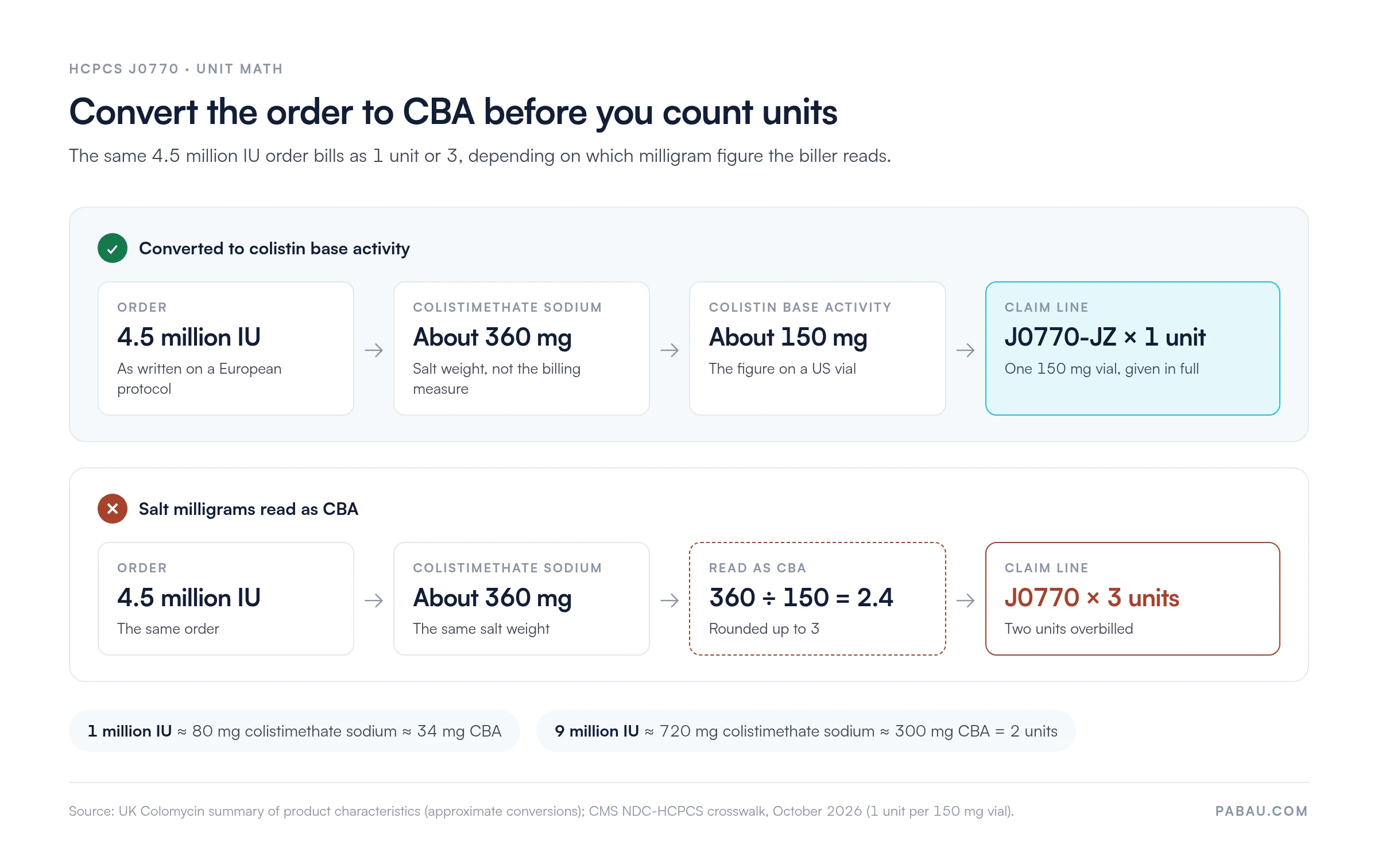
Units are reported per date of service. When a daily dose is split into several doses, add up what was given that day. Then apply the 150 mg rule to the total. A 70 kg patient on 5 mg/kg per day receives 350 mg, which is 3 units.
Colistimethate is packaged in single-dose vials, so Medicare Part B’s discarded drug policy applies. JW has been required for discarded amounts since January 1, 2017. JZ, which attests that no amount was discarded, has been required since July 1, 2023. Claims without the right modifier may be returned as unprocessable.
Being a generic drug does not exempt colistimethate. The CMS JW and JZ FAQ applies both modifiers to multiple source drugs from single-dose containers too.
On J0770, the vial and the billing unit are the same size, which makes JW lines rare. CMS does not pay fractional units. When the dose is below one billing unit, the FAQ says to bill the full unit with JZ and no JW line. A JW line appears only when a whole 150 mg unit goes unused.
Medicare pays both lines when they are correct, up to the amount on the vial labels. The 225 mg and split-dose rows apply the FAQ’s no-fractional-unit logic, so confirm them with your Medicare Administrative Contractor (MAC). Record the discarded amount in the chart either way. Commercial payers set their own JW and JZ rules.
Medicaid requires the National Drug Code (NDC) on claims for physician-administered drugs, so states can collect manufacturer rebates. That requirement comes from the Deficit Reduction Act of 2005. Many commercial payers require the NDC too. Medicare Part B prices J0770 from the HCPCS code, but the NDC still shows which product was given.
The CMS October 2026 ASP NDC-HCPCS crosswalk maps these packages to J0770:
Every package maps at 1 unit per vial, so the vial count on the administration record should match the units on the claim. Report the NDC in four steps:
The diagnosis must name the infection, and payers look for the organism behind it. Where the infection code does not name an organism, pair it with a B96 organism code. Add a Z16 resistance code when cultures show resistance, since that explains the choice of a polymyxin.
These are common pairings, not a coverage list. MACs and commercial plans set their own medical necessity rules, so check the policy before you submit.
Medicare Part B pays J0770 at its ASP-based payment limit, which is 106% of the average sales price. For October 1 to December 31, 2026, that limit is $18.051 per unit. CMS resets it every quarter, so check the current ASP pricing files before you set a fee.
At that rate, a 3-unit day comes to $54.15. The patient’s 20% coinsurance on that amount is $10.83. Payment then depends on where the drug was given:
A packaged J0770 line on a hospital claim still carries its charge. Report it even though the hospital receives no separate payment for it. Medicaid plans and commercial insurers may require prior authorization for colistimethate, so check before the first dose.
J0770 covers the drug, so each administration needs its own CPT code. The code depends on how the dose went in, and the label allows three methods:
CPT treats an infusion of 15 minutes or less as an IV push. Document start and stop times, because they decide between 96374 and 96365. Under OPPS, the administration code carries the payment for the packaged drug.
Two kinds of mix-up reach J0770 claims. One is a different drug billed under J0770. The other is colistimethate given by a route J0770 does not describe.
Nebulized colistimethate is the most common trap. The FDA label covers IV and IM use only, and J0770 describes an injection. When the injectable vial is nebulized, payers differ on S0142 versus J7699, so check the payer’s policy first.
The chart has to support the drug, the dose and the unit count. Payers reviewing J0770 look for these elements:
Missing elements are what post-payment audits find. Capture them at the infusion chair, not at the billing desk days later.
Add a CBA check to order review. When an order arrives in IU or mg of colistimethate sodium, record the CBA equivalent beside it before the dose is drawn. Billing then counts vials in one unit of measure, and the claim matches the chart.
J0770 denials follow a short list of patterns. Most trace back to the unit count, the modifier or the NDC.
Track denials by code over a rolling 90 days. A run of CARC 16 with M119 points to the NDC capture step, not the billing team. Our guide to denial codes in medical billing explains each code, and clean claim submission covers the checks that catch them first.
Most J0770 errors start between the infusion chair and the billing desk. The nurse records the dose, the vials and the waste in one place. Days later, a biller rebuilds the unit count from those notes in another.
Pabau, the practice management and EHR platform we build, keeps those steps in one patient record. Stock carries a lot number and expiry date, and IV sessions record the lot against the patient and the appointment. Prior authorization codes, dates and sessions sit on the case, with a warning when one is missing.
US practices send CMS-1500 and 837P claims through Claim.MD from that same record, with eligibility checks and ERA remittances coming back in. With Pabau’s claims management software, the biller checks the J0770 line against the documented dose in one place.

Pabau records the lot, the dose and the prior authorization on the patient record, then sends US claims through Claim.MD. Your J0770 line is checked against the chart the nurse completed.

Treat the CBA conversion as the step that decides a J0770 claim. Once the order reads in mg of CBA, the unit count is a vial count. The JW or JZ line then follows from what was discarded. Skip it, and a 360 mg salt-weight order turns one vial into three billed units.
The cost is a few seconds at order review, set against a recount after a payer audit. Record the conversion, the vial NDC and any waste at the bedside, and the claim can be built straight from the chart. To see how Pabau links the infusion record to the J0770 line, book a demo.

Need a framework for managing drug claim denials? Denial management in healthcare covers systematic approaches to tracking, appealing, and preventing claim rejections across your practice.
Want to understand how drug claims fit into the broader billing cycle? Revenue cycle management explains the end-to-end process from patient encounter to payment posting.
Looking for a checklist to verify claims before submission? Clean claim submission outlines the data elements every claim must carry to pass payer edits on the first pass.
Billing another injectable antibiotic? HCPCS code J0694 covers cefoxitin units, NDCs and the denials that follow a wrong unit count.
HCPCS code J0770 is injection, colistimethate sodium, up to 150 mg. It covers Coly-Mycin M and generic colistimethate given by IV or IM injection. Colistimethate is a polymyxin antibiotic, not a cephalosporin.
Bill 1 unit for each 150 mg of colistin base activity, rounded up. A 150 mg dose is 1 unit, a 300 mg dose is 2 units, and a 350 mg dose is 3 units. Convert orders written in IU or mg of colistimethate sodium to CBA first.
No. Cefazolin sodium bills under J0690, at 1 unit per 500 mg. J0770 is colistimethate sodium only, so billing cefazolin under it is a coding error.
Yes, on Medicare Part B claims, because colistimethate comes in single-dose vials. Use JW on a separate line for whole discarded units, and JZ when there are none. JZ has been required since July 1, 2023.
The Medicare Part B payment limit for October 1 to December 31, 2026 is $18.051 per unit. CMS resets it each quarter from average sales price data. Hospital outpatient claims package the drug under status indicator N, so it gets no separate payment there.
The CMS October 2026 crosswalk maps 150 mg vials from Endo (Par), Fresenius Kabi, Xellia, Hikma and Heritage to J0770. Each vial equals 1 billing unit. Report the NDC from the vial you used, in 11-digit 5-4-2 format with qualifier N4.
J0770 describes an injection, so it is a poor fit for nebulized use. Some commercial and Medicaid plans use S0142 for colistimethate inhalation solution. Others expect J7699, the code for inhalation drugs with no specific code, so check the payer policy first.