HCPCS Code E0272: Foam rubber mattress billing guide
HCPCS Code E0272: official descriptor and code overview HCPCS Code E0272 is the ...

Last Updated: Nov 6, 2026
H2027 is the HCPCS Level II code for psychoeducational service, per 15 minutes. It covers structured sessions that teach a patient, and often their family, about a diagnosed mental health or substance use disorder.
State Medicaid plans administer the code, and Medicare Part B does not pay it. It bills in 15-minute units, though some state plans pay a per diem rate instead. Prior authorization rules also vary by state. Don't confuse it with H2035 (which covers alcohol and/or other drug treatment programs, billed per hour). Missing modifiers and vague session notes are common reasons H2027 claims deny.
Let Pabau's smart automation suggest the right codes, reduce claim denials, and keep your practice compliant—effortlessly.
Automate repetitive tasks and focus on what matters most—your patients.
Reduce coding errors and ensure compliance with the latest regulations.
Clean claims, fewer denials, and faster reimbursements.
Powerful insights and reporting to help your practice thrive.
HIPAA compliant SOC 2 certified GDPR-compliant Trusted by 4,000+ clinics worldwide

HCPCS code H2027 covers structured psychoeducation for people with mental health or substance use disorder diagnoses, billed under state Medicaid plans.
The official billing unit is 15 minutes. Some state Medicaid plans pay H2027 per diem instead, so check your state provider manual before you submit.
Payers often require modifiers, such as HQ for group sessions, HE for mental health programs and HF for substance use programs. A missing modifier is a leading denial reason.
Pabau, the practice management platform we build, scrubs each claim for missing details and tracks approved sessions against every prior authorization.
HCPCS code H2027 carries the official descriptor “Psychoeducational service, per 15 minutes.” It pays for structured sessions that teach patients, and often their families, about a diagnosed mental health or substance use disorder.
It is a HCPCS Level II code maintained by the Centers for Medicare and Medicaid Services (CMS). It sits in the H-code series, which covers mental health and substance use disorder services that state Medicaid programs administer. To check a neighboring H-code before you bill, browse our HCPCS codes.
H2027 covers structured, facilitated educational sessions about a patient’s mental health condition or substance use disorder. A qualified provider delivers them to the patient and, where appropriate, to their family or support network. The session teaches. Therapy itself is billed under other codes.
Covered service activities include:
What H2027 does not cover:
Provider eligibility for HCPCS code H2027 is determined by each state Medicaid plan. No single universal provider type applies across all states. The following provider categories are commonly recognized, though you must confirm with your specific state Medicaid provider manual before billing.
Behavioral health practices billing H2027 should confirm their enrollment with the state Medicaid agency before submitting claims. An unenrolled or incorrectly credentialed provider is a leading reason H2027 claims deny on the first submission.
H2027 is a Medicaid-administered code. Medicare Part B does not pay it as a standard benefit, because CMS lists H-codes as not payable by Medicare. Some Medicare Advantage plans may cover psychoeducation services under their supplemental benefits, but coverage is plan-specific and not guaranteed.
State Medicaid coverage for H2027 varies significantly. California Medi-Cal, Minnesota Medical Assistance, and several other state plans have published billing memos and fee schedule entries that include H2027. Commercial insurers generally do not reimburse H2027 directly. For commercially insured patients, bill the closest applicable CPT code for psychotherapy or health behavior intervention instead.
Prior authorization requirements vary by state Medicaid plan and managed care organization. Some state fee-for-service Medicaid programs do not require prior authorization for H2027. Medicaid managed care organizations (MCOs) in the same state may still impose authorization limits. Always verify with your specific MCO before delivering services.
When prior authorization is required, the typical process involves:
Billing H2027 correctly requires completing each step in sequence. Skipping eligibility verification or deferring modifier selection until claim submission are the two workflow shortcuts that generate the most denials. Our guide to medical billing fundamentals covers the general claim cycle. H2027 adds HCPCS rules that CPT-based workflows don’t have.
Modifiers are the most commonly missed element when billing HCPCS code H2027. Many state Medicaid plans and MCOs require one or more modifiers to identify the program type, session format, or patient demographic. Omitting a required modifier typically results in automatic denial with a reason code indicating missing or invalid procedure information.
Modifier requirements for HCPCS code H2027 vary by payer and state plan. Verify the required modifier combination with your state Medicaid provider manual and with each MCO’s billing guide before submission.
Incomplete documentation is a frequent reason H2027 claims deny, and audits rarely go your way without complete records. Good medical billing compliance means the record is finished before the claim leaves your system. Patching it together after a denial arrives is slower and harder to defend.
Every H2027 claim must be supported by a medical record that includes all of the following:
Build a session note template specifically for H2027 that pre-populates the required fields above. Structured fields capture the content description and participant count before the clinician signs the note. That heads off the most common post-submission documentation request.
H2027 is frequently confused with adjacent HCPCS codes that cover overlapping behavioral health services. Choosing the wrong code results in a claim denial, and a compliance flag if the error recurs across claims. Coders most often mix it up with H2035 and H0036. The chart below maps each session purpose to its code and billing unit.
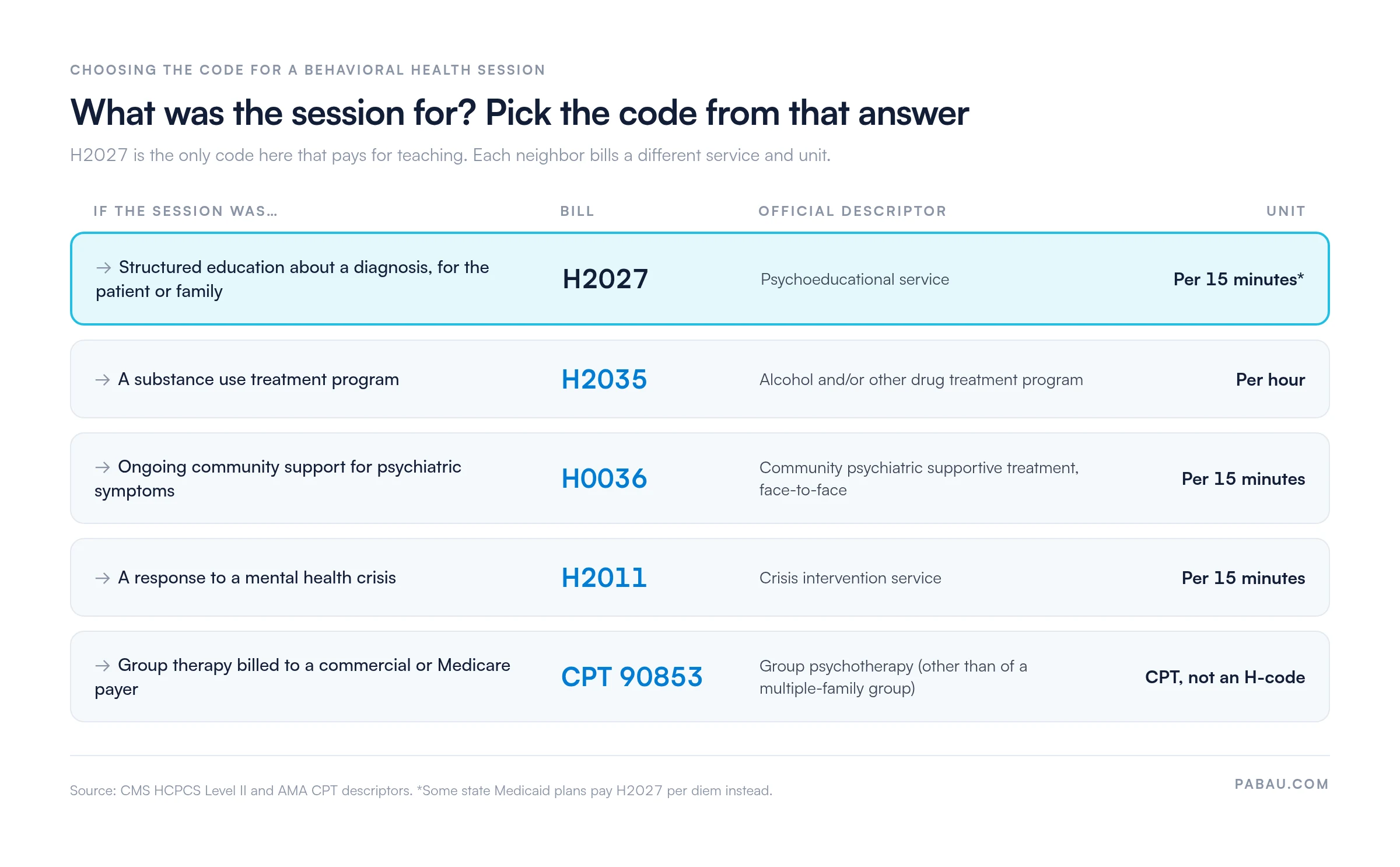
The table adds the cases where each code does not apply.
H2027 denials follow a recognizable pattern. Building denial management workflows around the triggers below catches these rejections before claims leave the billing queue.
H2027 reimbursement rates are set by each state Medicaid fee schedule and are not uniform nationally. There is no Medicare fee schedule entry for H2027. Sound revenue cycle management starts with verifying the current rate from your state’s Medicaid portal before projecting reimbursement for psychoeducation services.
California Medi-Cal and Minnesota Medical Assistance have both published fee schedule entries that include H2027. Their rates, unit definitions and modifier-adjusted rates still differ. The table below shows how state-level rates vary. Always retrieve current rates directly from your state Medicaid agency.
Request your state’s behavioral health fee schedule as a downloadable file from the Medicaid provider portal rather than looking codes up individually. The file lets you cross-reference H2027 alongside related codes like H2035 and H0036, so you can confirm rate differentials before choosing between closely related codes.
Most H2027 denials trace back to a manual step. A modifier gets missed, a session runs past its authorization, or a note goes out without its content description.
Pabau’s error-catching claims management moves those checks into the billing cycle itself, so they happen before the payer sees the claim.
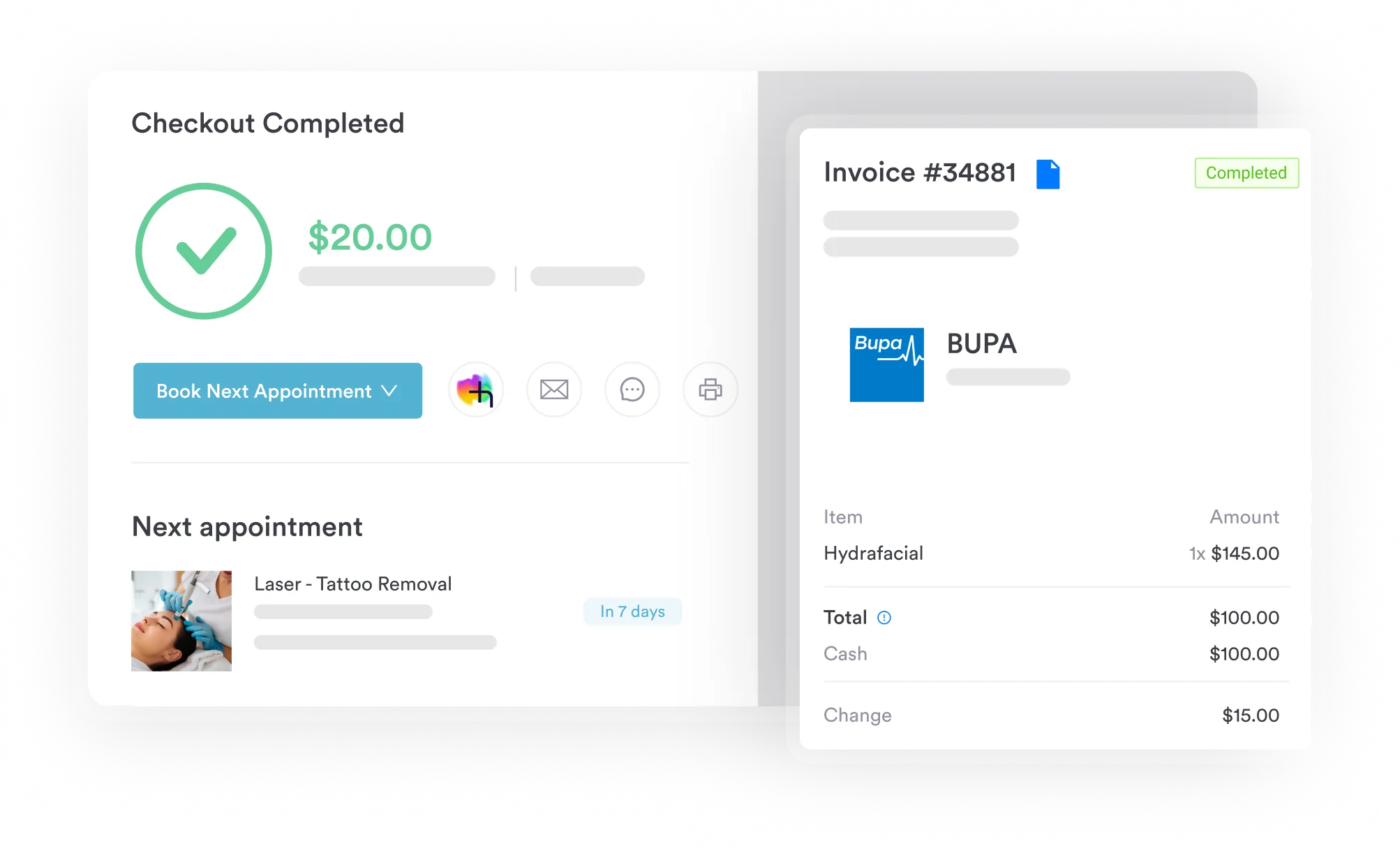
The outcome is a claim that leaves complete, stays inside its authorization, and shows the reason for any rejection in plain view. Your billing team spends its time on new claims instead of rework.

Pabau’s claim validation scrubs each claim for missing or invalid details, and authorization cases show how many approved sessions are used. See how it fits your behavioral health practice.

H2027 rewards the practice that settles the unit question before the first session. Confirm whether your state pays per 15 minutes or per diem, which modifiers each payer wants, and whether the MCO needs prior authorization.
Then let the session note do the billing work. A note that records content, times and participants survives an audit, and a generic one costs you the claim.
The trade-off is setup time. Building note templates and authorization tracking takes effort up front, but it saves rework on every claim that follows. Book a demo to see how Pabau keeps H2027 claims complete and inside their authorized sessions.

Need a framework for managing claim denials across behavioral health codes? Denial management in healthcare covers the end-to-end workflow for tracking, appealing, and preventing recurring denials.
New to the claim cycle behind H-code billing? Medical billing fundamentals explains how a claim moves from coding to payment.
Delivering crisis support rather than education? HCPCS code H2011 covers crisis intervention billed in 15-minute units.
Running group therapy for commercially insured patients? CPT code 90853 covers group psychotherapy billed to commercial and Medicare payers.
HCPCS code H2027 covers psychoeducational services, specifically structured educational sessions delivered to individuals with mental health or substance use disorder diagnoses. The service educates patients and their support networks about their diagnosed condition, medication adherence, coping strategies, and relapse prevention. It does not cover active psychotherapy or crisis intervention.
The official HCPCS descriptor bills H2027 per 15 minutes, so a 45-minute session is three units. Some state Medicaid plans pay it per diem instead, so check your state provider manual before you bill.
The most commonly required modifiers are HQ (group setting), HE (mental health program), HF (substance abuse program), and HA (child or adolescent services). Requirements vary by state Medicaid plan and MCO. Verify the required combination in your state’s behavioral health provider manual before submitting any H2027 claim.
Prior authorization requirements depend on your state Medicaid plan and the specific managed care organization managing the patient’s benefits. Some fee-for-service Medicaid programs do not require prior authorization. Most MCOs do. Always verify authorization requirements with the patient’s specific payer before delivering services to avoid authorization-related denials.
Yes. H2027 can be billed for group psychoeducation sessions when the HQ modifier is applied. Most state Medicaid plans that cover H2027 pay a lower rate for group sessions than for individual sessions. Document the number of participants in the session note, as auditors verify the HQ modifier against the clinical record.
H2027 reimbursement rates are set by each state Medicaid fee schedule and vary significantly by state. There is no Medicare Part B rate for H2027. Verify your current rate by accessing your state Medicaid provider portal or requesting the behavioral health fee schedule file from your state agency directly.
Common place of service codes for H2027 are 11 (office), 49 (independent clinic), 53 (community mental health center) and 57 (non-residential substance abuse treatment facility). School-based programs use 03 (school). The POS code must reflect the physical location where the service was delivered.
H2027 is a psychoeducational service billed per 15 minutes. H2035 is an alcohol and/or other drug treatment program billed per hour. Use H2027 when the session teaches the patient about a diagnosis, and H2035 when the patient attends a substance use treatment program.