CPT code 28200: Flexor tendon repair, foot (primary or secondary, no graft)
CPT code 28200 covers direct flexor tendon repair in the foot CPT code 28200 is ...

Last Updated: Oct 19, 2026

CPT code 90853 describes group psychotherapy other than a multiple-family group, as defined by the AMA CPT codebook.
Bill 90853 once per patient per session, not once per group. Billing per session is the leading cause of claim denials.
2026 Medicare non-facility rates run about $28 to $33 per patient. Rates vary by locality, and CMS updates them annually.
Practice management software like Pabau builds a claim for each patient from one group session, which removes the manual splitting behind modifier errors.
CPT code 90853 is the billable code for group psychotherapy other than a multiple-family group. It is a per-patient code, so a six-person group produces six claims rather than one.
The AMA description is “Group psychotherapy (other than a multiple-family group).” The CPT codebook specifies no session duration, though most payers expect 45 to 90 minutes. You can look up the official definition on the American Medical Association’s CPT code set overview, the authority on procedural coding in the US.
Eligibility to submit group psychotherapy claims depends on the payer. Medicare applies stricter licensure and supervision rules than most commercial insurers. Verify each provider’s credentials with every payer before you submit a claim.
Supervision note: Some payers require direct supervision for certain non-physician providers billing group therapy. Check the specific payer’s credentialing and supervision policies before billing, as blanket assumptions across payers lead to denials.
The CPT codebook does not define a minimum group size for 90853. Many payers, however, require at least two unrelated patients to be present. Clinicians should verify group size requirements directly with each payer and document attendance clearly in every session note.
The per-patient billing rule is where most practices lose revenue. A therapist running a six-person group who submits one claim for the session leaves five claims on the table. Each patient in the group is entitled to their own claim submission.
Medicare reimbursement for CPT 90853 is set through the CMS Physician Fee Schedule, updated annually. The 2026 rates below reflect national averages. Geographic practice cost indices (GPCIs) adjust rates by locality. Payment in a high-cost market such as San Francisco or Manhattan differs from a rural one. Verify your specific locality rate using the CMS Physician Fee Schedule lookup.
Medicare Part B coverage: Group psychotherapy is covered under Medicare Part B as an outpatient mental health service. Patients pay a 20% coinsurance after the Part B deductible is met, provided the provider accepts assignment. Use the FastRVU 2026 RVU lookup to calculate work, practice expense, and malpractice RVU components for 90853 in your locality.
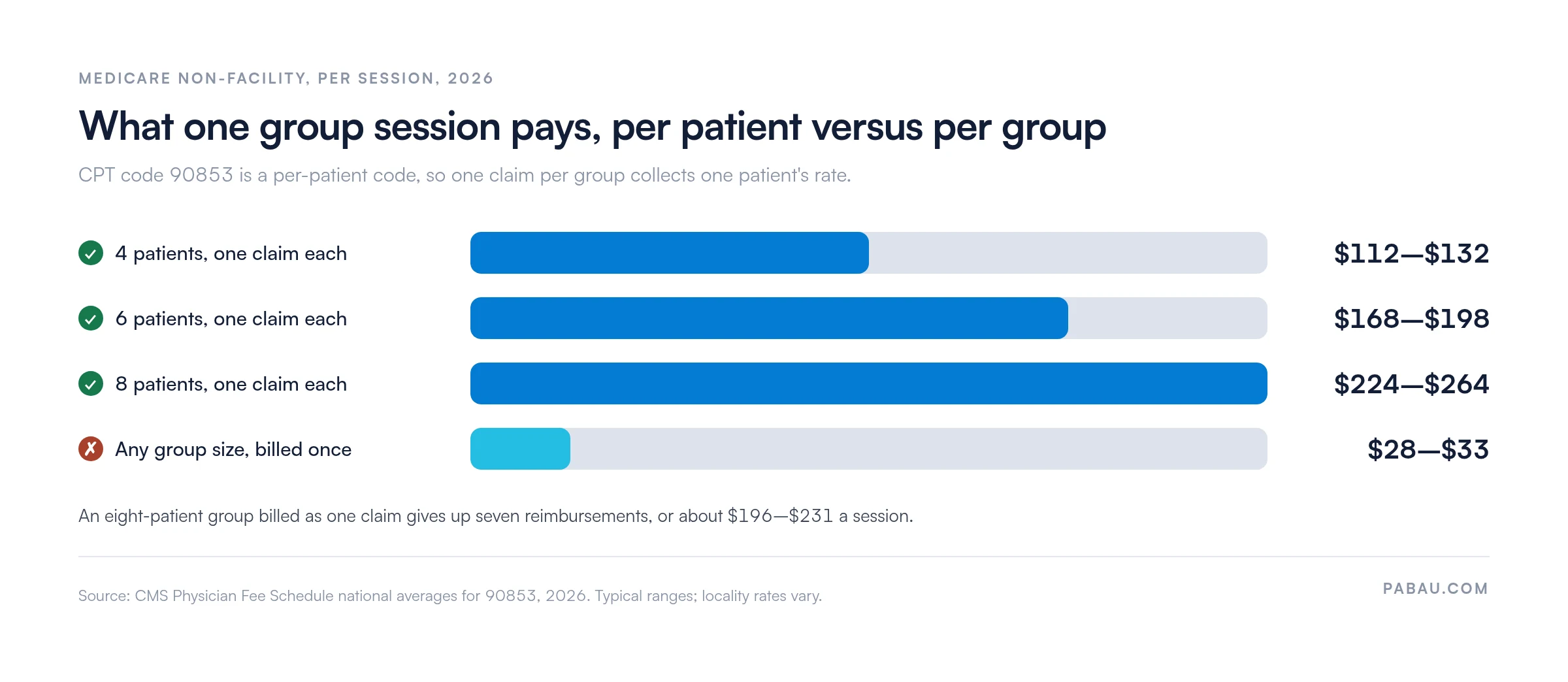
The per-patient rule is what decides a session’s value. The chart below applies the 2026 non-facility range to three common group sizes, next to the same session billed as one claim.
Medicaid variability: Coverage and rates for 90853 differ significantly by state. Some states cover group psychotherapy with rules similar to Medicare. Others impose prior authorization requirements or restrict eligible provider types. Always verify with your state Medicaid agency before enrolling patients in billed group sessions.
Run eligibility checks for every group member before the session, not just for new patients. Insurance changes mid-treatment are one of the most common reasons group therapy claims reject at the clearinghouse level.
The distinction between 90853 and 90849 comes down to who is in the room. CPT 90849 covers multiple-family group therapy: sessions where family members participate alongside patients as part of the treatment. CPT 90853 is for groups composed of unrelated patients only. Confusing these two codes is a common error that triggers payer audits.
Group therapy does not exist in isolation. Providers frequently bill 90853 alongside individual session codes, diagnostic evaluation codes, and add-on codes. Knowing the full 908xx family reduces coding errors and helps practices build accurate fee schedules. You can search the complete psychotherapy code range using the AAPC Codify CPT lookup.
Inadequate documentation is the second most common reason 90853 claims deny, after per-session billing errors. Each patient’s chart needs a session note that stands alone as evidence of that individual’s participation and clinical need. A group note that simply says “group therapy conducted” without individual documentation fails this standard.
A group therapy note template is the cheapest defense against a documentation denial. Build the required elements into the form once, and every clinician completes the same fields before signing off. That closes the omissions payers look for on audit.

Keep each patient’s note separate. Documentation shared across the group must never disclose another patient’s protected health information, which is a HIPAA exposure as well as a billing one. A per-patient statement drawn from the same session keeps that separation intact.
Each claim also carries the diagnosis that supports medical necessity for group treatment. A trauma-focused roster often runs on F43.1, and the note should show why the group setting suits that patient.
Group therapy delivered via video is billable under CPT 90853 for many payers. The rules differ by payer type, and by whether the pandemic-era flexibilities have been extended. Always check current CMS telehealth guidance and your state Medicaid policy before billing virtual group sessions.
Audio-only group therapy (telephone, no video) is generally not reimbursable under 90853 for Medicare. Commercial payer policies on audio-only vary. Document the technology platform used, confirm each participant’s location at the time of service, and retain that documentation in the patient’s record for audit purposes. Compliance also means confirming that every participant is in a state where the provider holds a license.
Group psychotherapy claims deny for predictable reasons. Most trace back to three root causes: misunderstanding the billing unit, missing documentation, or incorrect code selection. Reading the denial codes on the remittance tells you which of the three you are dealing with.
Group sessions delivered inside a substance use intensive outpatient program are typically bundled into the per diem code H0015. Billing 90853 separately on the same claim date triggers an NCCI bundling denial unless the payer explicitly allows it.
Denial prevention is upstream work. Building claim edits into the workflow before submission costs far less than correcting rejections afterwards. A claim that goes out right the first time also removes the administrative cost of rework and resubmission.
Audit your 90853 claims quarterly: pull a report of group sessions and count the number of claims submitted against the number of patients who attended. If the ratio is not 1:1, a per-session billing error is present somewhere in the workflow. Fix it before payers flag the pattern.
Manual 90853 billing breaks down as soon as the group calendar fills. A practice running 10 group sessions a week with eight patients in each generates 80 individual claims. Every one of them needs the right code, the right modifier, and a documentation link that survives an audit.
Practice management software like Pabau does that work from the appointment itself. Pabau’s claims software for therapists generates one claim per attending patient from a single group appointment. It applies CPT code 90853 and any required modifier, then routes each claim through the Claim.MD clearinghouse to over 4,000 US payers. The clearinghouse validates against payer rules before submission, so the errors above get caught while they are still cheap to fix.
For practices scaling group therapy programs, the arithmetic is simple. One uncaught per-session billing error a week costs more over a year than the software that would have prevented it. Every Pabau subscription includes the full claims workflow, so this is not an add-on decision.

Pabau builds an individual claim for every patient in a group session and flags missing modifiers before submission. Claims then route through the Claim.MD clearinghouse to over 4,000 US payers. See how it fits your mental health practice.

CPT code 90853 is technically straightforward but operationally easy to get wrong. The per-patient billing rule alone accounts for the majority of group therapy revenue leakage in practices that handle it manually.
Audit the ratio first. Pull one month of group sessions and count the claims submitted against the patients who attended. Fix the workflow if the two numbers do not match. That single check usually recovers more than any change to your fee schedule.
Automating the split is what keeps the ratio right once the group calendar grows. Book a demo to see Pabau bill a full group roster in one pass, modifiers and remittances included.

Need to code the assessment that places a patient in the group? CPT code 90791 covers billing for the psychiatric diagnostic evaluation.
Running crisis sessions alongside your groups? CPT code 90839 explains how crisis psychotherapy time is billed.
Want to see how clearinghouses handle mental health claims? Medical claims clearinghouse explains claim routing, validation, and payer connections.
Filing group therapy claims on paper? CMS-1500 form walks through each field and includes a free template.
CPT code 90853 is used to bill for group psychotherapy sessions composed of unrelated patients, excluding multiple-family group therapy. It is submitted once per patient per session, not once for the entire group. Medicare Part B and most commercial insurers cover it as an outpatient mental health service.
Submit a separate claim for each patient who attended the group session. Each claim uses CPT 90853, the patient’s individual insurance information, and the attending provider’s NPI. Include a session note that documents that patient’s individual participation, clinical rationale, and the group format. For telehealth sessions, add modifier 95 (Medicare) or GT (many Medicaid plans) and place of service code 02 or 10.
CPT 90853 covers group psychotherapy for unrelated patients only. CPT 90849 is for multiple-family group therapy, where family members participate alongside patients as part of structured treatment. If family members are in the room, use 90849. If the group is composed entirely of unrelated patients, use 90853.
Medicare non-facility rates for CPT 90853 in 2026 run about $28 to $33 per patient, depending on geographic locality. Facility rates sit modestly below that. Commercial payers negotiate individually, often 1.5 to 3 times the Medicare rate. Verify your exact locality rate using the CMS Physician Fee Schedule lookup, since CMS updates the schedule annually.
The CPT codebook does not define a minimum group size for 90853. Most payers require at least two unrelated patients to constitute a billable group. Verify the minimum size requirement with each specific payer, as some commercial insurers and Medicaid plans impose their own thresholds.
Yes, for most payers, provided the session uses synchronous audio-video technology and the applicable modifier is applied. Medicare requires modifier 95 and place of service code 02 or 10. Some Medicaid plans require modifier GT. Audio-only sessions are generally not reimbursable under 90853 for Medicare. Commercial payer policies vary, so verify with each insurer before billing virtual group sessions.