HCPCS Code E0272: Foam rubber mattress billing guide
HCPCS Code E0272: official descriptor and code overview HCPCS Code E0272 is the ...

Last Updated: Nov 6, 2026
H0027 is the HCPCS Level II code for alcohol and/or drug prevention environmental service. It covers a broad range of external activities that modify systems to mainstream prevention through policy and law.
It is a community-level prevention code with no per-diem unit, effective since January 1, 2001. Medicare does not pay it. State prevention contracts fund most H0027 work, and each funder sets the unit, rate and modifiers.
Let Pabau's smart automation suggest the right codes, reduce claim denials, and keep your practice compliant—effortlessly.
Automate repetitive tasks and focus on what matters most—your patients.
Reduce coding errors and ensure compliance with the latest regulations.
Clean claims, fewer denials, and faster reimbursements.
Powerful insights and reporting to help your practice thrive.
HIPAA compliant SOC 2 certified GDPR-compliant Trusted by 4,000+ clinics worldwide

HCPCS code H0027 covers alcohol and/or drug prevention environmental services that change community policies, laws and norms around substance use.
Medicare does not pay H0027, and its descriptor sets no per-diem or time unit.
Most H0027 work is funded through state prevention contracts backed by the federal SUPTRS Block Grant, so the state sets the unit, rate and modifiers.
State crosswalks can differ from CMS. Alabama’s FY26 sheet labels H0027 as education, so check each funder’s crosswalk before you code.
Pabau, the practice management platform we build, keeps prevention activity records, sign-in sheets and signatures in one file for state reporting.
HCPCS code H0027 is the Level II code for alcohol and/or drug prevention environmental service. Its official descriptor covers a “broad range of external activities geared toward modifying systems in order to mainstream prevention through policy and law.”
The Centers for Medicare and Medicaid Services (CMS) maintains it in the H-series of the HCPCS Level II code set. It shares the H0024 to H0029 prevention range with five other codes. H0027 works at community level. It serves a town, a school district or a county, and no individual receives treatment under it.
Federal block grant rules define the environmental strategy in 45 CFR 96.125(b)(6). It “establishes or changes written and unwritten community standards, codes and attitudes” that shape alcohol, tobacco and drug use in the general population.
The regulation names these activities as examples of the strategy.
In practice, an H0027 activity might be a coalition working with a city council on alcohol outlet rules. It might also be staff helping a school board review its drug use policy.
Not H0027: Any service delivered to an identified individual. Screening, assessment, counseling, treatment and crisis response each have their own codes, set out in the next section.
H0027 sits inside a six-code prevention family, and its neighbors split prevention work by strategy. Crisis codes such as H2011 sit in a different part of HCPCS and pay for care to one person. Two questions about the activity sort it into the right code.
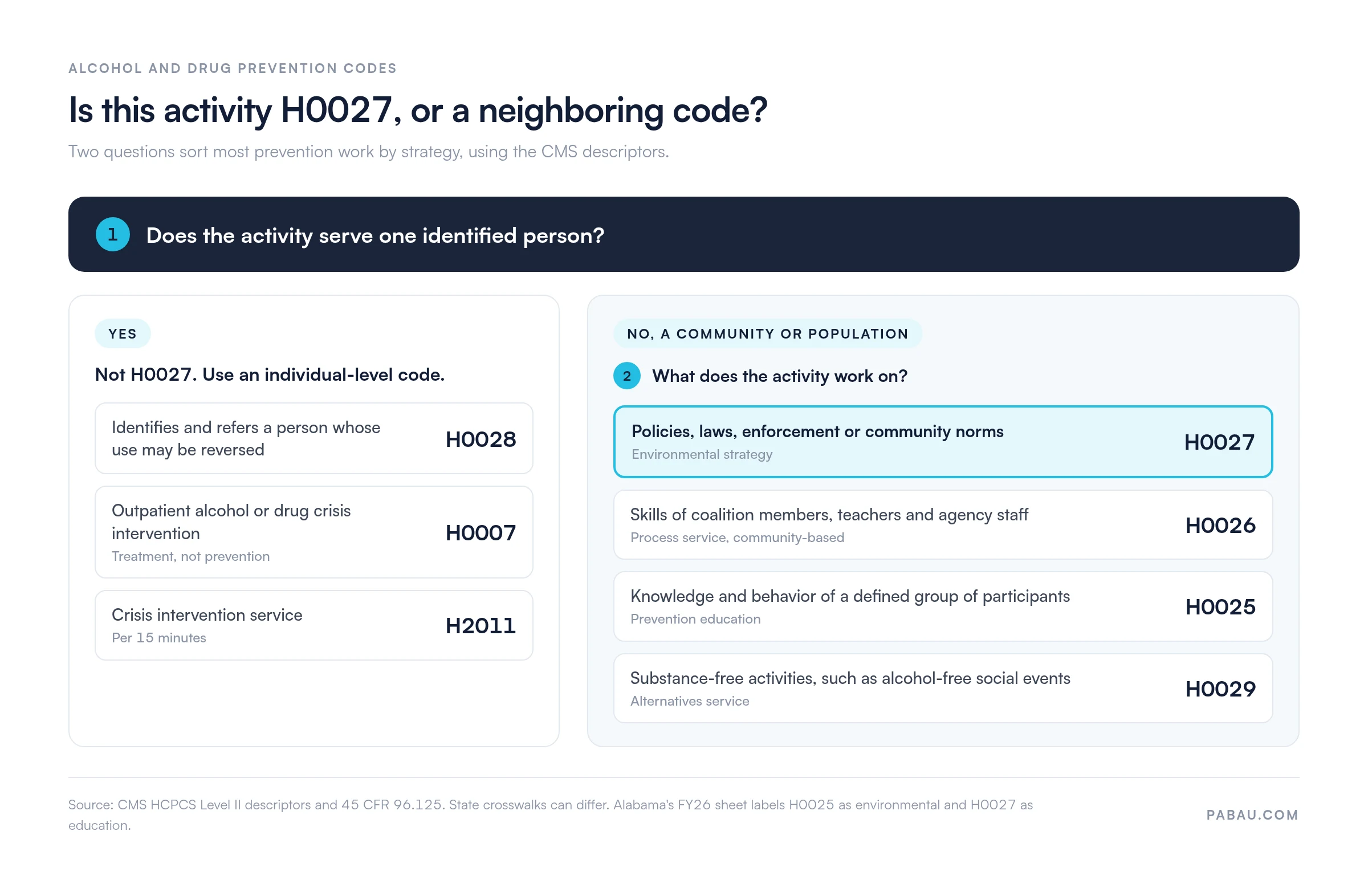
State crosswalks do not always follow the CMS wording. Alabama’s FY26 prevention activity sheet labels H0025 as environmental and H0027 as education, the reverse of the CMS descriptors. South Dakota pairs H0027 with the environmental strategy, as CMS does.
Report to each funder with that funder’s crosswalk. Never carry one state’s code mapping into another state’s claims or reports.
Medicare does not pay for H0027. The CMS HCPCS file gives it coverage indicator I, not payable by Medicare, and pricing indicator 00.
Most H0027 work is paid through state substance use agencies. Their main source is the federal Substance Use Prevention, Treatment, and Recovery Services (SUPTRS) Block Grant, administered by SAMHSA. Under 45 CFR 96.124, each state must spend at least 20% of that grant on primary prevention.
States then contract with prevention providers and track the work by strategy code. Medicaid coverage is a state and plan decision. UnitedHealthcare Community Plan of Colorado’s behavioral health fee schedule lists H0025 and H0029, for example, but not H0027.
Confirm the code appears in your prevention contract or on your payer’s schedule before you deliver billable work.
The H0027 descriptor carries no time increment and no per-diem unit. The state agency or payer defines the unit, and its definition is the one to follow.
Alabama’s FY26 instructions count one contact unit as 15 minutes, so a one-hour activity counts as four units. South Dakota also paid its prevention strategies in 15-minute units in 2022.
No national modifier applies to H0027. Alabama lists two modifier variants for it, one for multi-strategy programs during business hours and one for after-hours delivery. Other states assign their own, so check the current state manual.
Many states collect prevention activity through a data system rather than a claim form. Alabama’s providers, for example, enter activity details into WITS, the state’s data system. Where a funder does require a claim, follow its instructions for place of service.
A prevention activity serves people not identified as needing treatment, so an H0027 record carries no substance use disorder diagnosis. If a claim format still asks for one, follow your funder’s written instruction rather than adding a code.
The habits behind submitting a clean claim apply here too. Match each field to the funder’s manual before the claim leaves your agency.
There is no national rate for H0027, because Medicare does not price it. Each state agency or payer sets its own rate, often inside a prevention contract rather than a public fee schedule.
South Dakota published one example. Its January 2022 prevention rate review listed the environmental strategy at $12.00 per 15-minute unit under state prevention contracts. Administrative costs were paid separately, at 5% of direct services and resource development.
Treat that figure as a dated example from one state, not a benchmark. Your contract or the payer’s current schedule is the only rate that applies to your work.
Before you plan H0027 work, confirm three points in writing with the funder: The strategy the code maps to, the unit length and the rate. Alabama and CMS label H0027 differently, so an assumption carried over from another state can end in a charge back.
Prevention records describe an activity and the community it reached, not a patient encounter. Funders audit those details behind every unit they pay for. Digital forms built for prevention activity can hold them in one structured record.
Alabama’s FY26 instructions require these details for every billable prevention activity, whatever form the provider uses.
Environmental work benefits from one more habit. Keep the outputs that show the system change you worked toward, such as a draft policy, a council agenda or a retailer training roster. Those records tie each unit to the policy or norm the activity targeted.
Most H0027 denials trace back to three causes. The payer does not cover the code, the claim went to the wrong payer, or a state-required field or modifier is missing.
Read the reason code on the electronic remittance advice before you resubmit or appeal.
A structured denial management workflow tracks reason codes by payer, because the same code can need a different fix at each funder. Pabau’s claims management software submits and tracks claims, so your billing team can spot a repeat denial before it becomes a write-off.
State funders audit prevention work against the plan they approved. Alabama’s FY26 instructions say activity details must correlate with the approved prevention plan, and activity outside that plan “is subject to charge back.”
These are the compliance risks to check before you report H0027 units.
Keeping medical billing compliance current for prevention means reviewing each funder’s manual and crosswalk every year. Alabama issues its activity sheet instructions by fiscal year, so check for the current version before each contract year. An online HCPCS lookup confirms code details, but the state manual decides how you report the work.
Prevention teams often track policy meetings, retailer trainings and coalition work across spreadsheets, paper sign-in sheets and email. When a funder asks for contact units or attendance counts, someone rebuilds the record by hand.
Pabau keeps that work in one place. Custom forms capture the date, times, strategy code, description and signature for each activity. Attachments such as sign-in sheets, agendas and draft policies sit in the same file.
For funders and payers that accept prevention claims, Pabau’s claims tools submit and track claims built from the details your team entered. Pabau does not choose codes for you, so the state manual remains your coding authority.

Pabau stores prevention activity notes, sign-in sheets and signatures in one record, so your state reports start from complete data.

H0027 pays for prevention work aimed at systems, such as policies, laws, enforcement and community norms around alcohol and drugs. Code it by asking whether the activity changed a system or served a person. If it served a person, another code applies.
Then follow your funder’s crosswalk, unit and rate exactly, because a state can map H0027 differently from CMS. A behavioral health revenue cycle that checks those rules before submission catches crosswalk and unit errors early. Book a demo to see how Pabau keeps prevention activity records complete and ready for state reporting.

Need to understand how prevention claims are routed? Medical claims clearinghouse guide covers how claims are validated and routed before they reach state and Medicaid payers.
Want fewer claims sent to a payer that does not cover H0027? Insurance eligibility verification explains how checking coverage before the service date prevents wrong-payer denials.
Looking for the bigger billing picture? What is revenue cycle management breaks down the end-to-end billing process and where H-code claims fit within it.
H0027 covers alcohol and/or drug prevention environmental services. These are community-level activities that change policies, laws, enforcement and norms around substance use, such as school drug policies or alcohol advertising rules. It does not cover services to an individual.
No. H0027 is a prevention code with no crisis component. Outpatient alcohol and drug crisis intervention uses H0007, and behavioral health crisis intervention in 15-minute units uses H2011.
No. The CMS HCPCS file gives H0027 coverage indicator I, not payable by Medicare, and pricing indicator 00. State prevention contracts backed by the SUPTRS Block Grant fund most H0027 work, and Medicaid coverage varies by state and plan.
No diagnosis is expected, because H0027 serves a community rather than a patient identified as needing treatment. If a claim form still asks for one, follow the funder’s written instruction rather than adding a code.
H0026 covers community-based prevention process services that build the skills of impactors, such as coalition members and teachers. H0027 covers environmental work that changes policies, laws and norms. Check your state crosswalk, because states can map these codes differently.
There is no national rate, so each state agency or payer sets its own. South Dakota’s January 2022 prevention rate review listed the environmental strategy at $12.00 per 15-minute unit. Your contract or payer schedule is the only rate that applies to your work.