HCPCS code V2300: Sphere trifocal lens billing guide
HCPCS code V2300 covers one sphere trifocal lens up to 4.00D HCPCS code V2300 is...

Last Updated: Oct 19, 2026
G0124 is the HCPCS Level II code for a screening Pap test on a liquid-based, automated thin-layer slide that a physician interprets. The cervical or vaginal specimen arrives in preservative fluid. Medicare covers the screen once every 24 months, or every 12 months for high-risk patients.
The detail that decides the code is who reads the slide. When a cytotechnologist screens it under physician supervision instead, the code is G0123. Mix the two up and the lab either loses payment for the physician's work or gets a denial. Below, you'll see how G0124 compares with its sibling codes, what it pairs with, and how the claim moves.
Let Pabau's smart automation suggest the right codes, reduce claim denials, and keep your practice compliant—effortlessly.
Automate repetitive tasks and focus on what matters most—your patients.
Reduce coding errors and ensure compliance with the latest regulations.
Clean claims, fewer denials, and faster reimbursements.
Powerful insights and reporting to help your practice thrive.
HIPAA compliant SOC 2 certified GDPR-compliant Trusted by 4,000+ clinics worldwide

HCPCS code G0124 is a liquid-based screening Pap that requires physician interpretation of the slide.
G0123 covers the same slide when a cytotechnologist screens it under physician supervision, so who reads the slide decides the code.
Medicare covers the screen once every 24 months, or once every 12 months for patients who meet CMS high-risk criteria.
Specimen collection isn’t part of G0124. The practice that takes the sample bills it to Medicare with Q0091.
Medicare waives cost-sharing on screening Pap tests by statute, so modifier 33 only matters where a commercial or Medicaid payer asks for it.
HCPCS code G0124 is a Level II code for a screening Pap test on a liquid-based, automated thin-layer slide that a physician interprets. The cervical or vaginal specimen is collected in preservative fluid. CMS maintains the code in its annual HCPCS Level II file.
G0124 sits in the G range of the HCPCS code set, which holds temporary procedures and professional services. Medicare pays for it under the Part B preventive screening benefit.
In practice, a pathologist reports G0124 when a slide needs a physician’s reading. That usually happens after the cytotechnologist’s screen finds reactive or abnormal cells, which CLIA rules require a pathologist to review. Here is the code at a glance.
G0124 pays for the laboratory side of the screen. That means turning the specimen into a thin-layer slide and the physician’s interpretation of it. Collection happens in the exam room and goes on its own line, as does any HPV test.
Medicare Part B covers G0124 as a preventive screen, and the clock runs from the last screening Pap. Insurance eligibility verification before the visit tells you whether this one falls inside the window.
CMS sets out the high-risk factors in the Medicare Benefit Policy Manual, Chapter 15. A patient qualifies with at least one of these, documented in the medical record.
Claims at the 12-month frequency need that criterion in the chart. Without it, they’re exposed to audit and records requests.
What if the patient is due early? Medicare won’t pay for a screen inside the window. Give the patient an Advance Beneficiary Notice (ABN) before collection, or the denied screen usually can’t be billed to them.
The screening Pap family splits on two questions. What kind of specimen is it, and who screens and reads it? The table below maps each liquid-based and automated code to its method.
The pair that trips coders up most is G0124 and G0123. Both use the same liquid-based slide. For G0124, a physician interprets it. For G0123, a cytotechnologist screens it under physician supervision.
Codes like G0145 then split on how the slide was screened and rescreened. The matrix below puts the whole family side by side, conventional smears included.
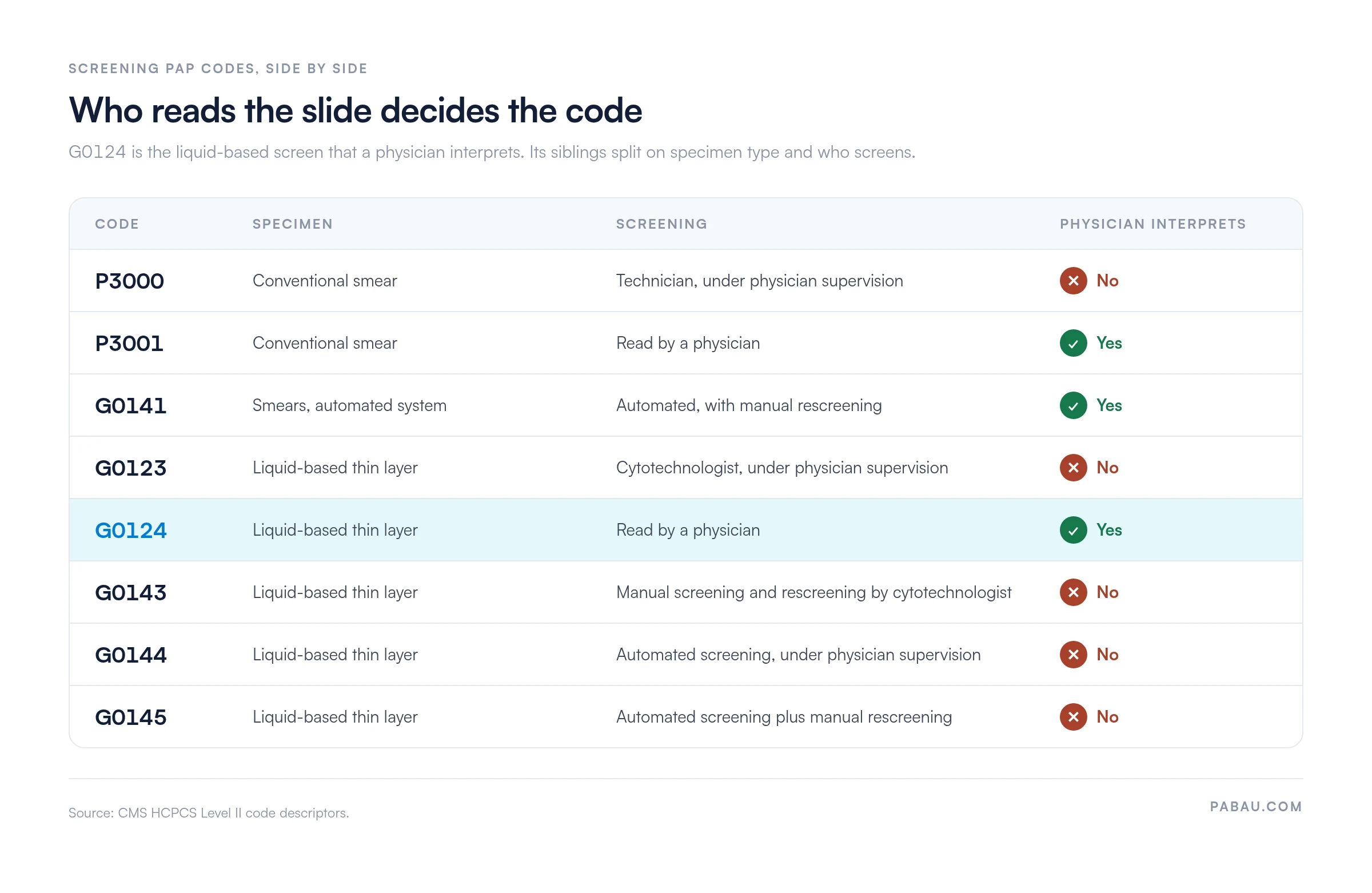
Here’s how that plays out. A cytotechnologist screens a liquid-based slide and finds atypical cells. CLIA sends the slide to a pathologist, whose reading is what G0124 reports. A slide that screens negative and never reaches a physician stays on a code like G0123.
So before you pick the code, ask the lab three things. Who screened the slide, who rescreened it, and who signed the interpretation?
Every G0124 claim needs an ICD-10-CM code that supports the screen. A diagnostic code on a preventive Pap claim draws a CO-11 denial, because the diagnosis doesn’t fit a screening service.
Most routine claims carry Z01.419 or Z12.4. For a high-risk patient billed at 12 months, add a code that names the risk factor, such as one from Z72.51 to Z72.53.
Medicare’s national coverage determination for screening Pap tests (NCD 210.2) sets the accepted codes. Commercial payers keep their own lists, so check before you submit.
One modifier comes up with G0124, and Medicare doesn’t need it. Medicare already waives cost-sharing on screening Pap tests by statute.
Check each commercial payer’s preventive-services policy before you add it. Where a payer requires 33 and it’s missing, the denial usually comes back as CO-4.
A G0124 claim usually leaves the lab or pathology group, not the practice that took the sample. The collecting practice bills Q0091. The lab bills G0124 on a CMS-1500 or its electronic 837P equivalent.
Claims management software that fills the claim from the patient record cuts keying errors. It also tracks each claim’s status through adjudication.
Hospital outpatient labs bill on the UB-04 instead. Use revenue code 0311 (cytology) or 0310 (pathology lab, general), and confirm the choice with your facility’s coding team.
Medicare pays screening Pap laboratory codes under the Clinical Laboratory Fee Schedule (CLFS). G0124 adds a physician’s reading, and CMS prices that interpretation with relative value units on the Medicare Physician Fee Schedule (MPFS).
To find the current amount, enter G0124 in the CMS fee schedule search tool and pick your MAC locality. Rates vary by locality and by who bills the code, so check the CLFS file for the laboratory side.
Recheck the G0124 rate after each January fee schedule update and any mid-year correction. A charge master that still carries last year’s figure invites underpayments nobody spots.
G0124 denials repeat the same patterns. Match the Claim Adjustment Reason Code (CARC) to its fix, and most of them clear on resubmission.
Meeting clean claim requirements before submission heads off most of these denials. The quickest win is a short check before each claim goes out.
Record each patient’s last screening date and risk status at every well-woman visit. A quick look before collection tells you whether the screen needs an ABN.
The medical record has to support G0124 if Medicare asks during an audit. For cytology claims, that takes more than the lab report alone.
Outside Medicare, G0124 coverage varies a lot. Billing the wrong code set for a payer can cause the same denial across your whole book of business.
Commercial payers: Many commercial plans accept G0124 under the same conditions as Medicare. Others want CPT codes, such as 88142 for a liquid-based slide with manual screening.
Some prefer 88175 for automated screening with manual rescreening, with 88141 for the physician’s interpretation. Check the payer’s provider manual or fee schedule first.
Medicaid: State Medicaid programs set their own cytology coding rules. Some accept HCPCS G-codes, while others mandate CPT or state-specific codes. Many follow US Preventive Services Task Force (USPSTF) screening intervals rather than Medicare’s.
HEDIS quality measure: G0124 counts toward the NCQA HEDIS Cervical Cancer Screening (CCS) measure. A G0124 claim for an eligible patient shows completed screening, provided it meets the measure’s age and frequency rules.
Confirm that with your quality reporting team to avoid missed credit during HEDIS data collection. For quick lookups, AAPC Codify offers a searchable HCPCS Level II directory.
Without claims software, someone keys each screening line by hand. Then they check a clearinghouse portal for status. A rejected Q0091 or G0124 line can sit for weeks before anyone notices.
Pabau fills the claim from the patient record, so the codes on the visit reach the claim without retyping. It checks that required fields are complete before the claim can go. In the US, it submits through Claim.MD and tracks each claim’s status.
Your billing team sees which screening claims are paid, pending or rejected in one place. That means they can fix a rejected line while the visit is still fresh.

Pabau fills claims from the patient record, submits them, and tracks each one’s status. Your team spots a rejected screening line early and fixes it fast.

G0124 is rarely denied because the code is obscure. It’s denied because the claim says one thing and the lab report says another.
Before your next batch of screening claims, ask your lab who signs the interpretation. Then build that answer into your order workflow, so the code is settled at collection rather than at appeal.
The trade-off is a little more setup now for far fewer rework hours later. Book a demo to see how Pabau tracks screening claims from submission to payment.

Need to understand how claims move from submission to payment? Our medical billing overview walks through the revenue cycle for physician practices.
Struggling to track and overturn denied claims? Denial codes in medical billing covers CARC and RARC codes with appeal guidance.
Want to confirm coverage before billing G0124? Insurance eligibility verification explains how checks at scheduling prevent frequency denials.
Billing an automated smear screen instead? HCPCS code G0141 covers automated screening with manual rescreening and physician interpretation.
Adding an HPV test to the screen? CPT code 87624 explains how to bill high-risk HPV testing on its own line.
No. The practice that takes the sample bills Q0091 to Medicare for obtaining and sending the specimen. The laboratory or pathology group bills G0124 for preparing and interpreting the slide.
Yes, on its own claim line. Commercial payers usually take CPT 87624 or 87625. Medicare uses G0476 for HPV co-testing with a Pap in patients aged 30 to 65, once every five years.
Medicare Advantage plans must cover every Part B preventive service, including the screening Pap. They can still apply their own network and billing rules, so check the plan’s policy before you submit.
The follow-up is diagnostic, not screening. Code repeat cytology with a diagnostic CPT code such as 88142 or 88175, and colposcopy with its own CPT code. Pair them with the abnormal finding, such as a code from R87.61-.
Yes. Medicare covers screening Pap tests ordered by a physician or a qualified non-physician practitioner, such as a nurse practitioner, physician assistant or certified nurse-midwife. The interpretation billed on G0124 still has to come from a physician.