



CCSD code G5100: Bypass of duodenum billing guide
CCSD code G5100 bills a bypass that leaves the duodenum in place CCSD code G5100...

Last Updated: Oct 16, 2026

CPT Code 88175 describes cervical or vaginal cytopathology using automated thin-layer preparation, with automated screening plus manual rescreening under physician supervision.
88175 is billed by the pathologist or laboratory, never the ordering clinician. Ordering providers bill G0101 for the encounter and Q0091 for specimen collection.
CPT 88141 is the physician interpretation code, and CMS confirms it may be reported alongside 88174 or 88175 whenever a physician interprets a diagnostic specimen.
The compliance risk sits with screening claims. 88141 must never be reported against Medicare screening codes G0143, G0144, G0145, G0147, and G0148.
Pabau’s claims management software supports accurate cytopathology claim submission, ICD-10 pairing, and eligibility verification, so gynecology and lab practices reduce denials on codes like 88175.
CPT Code 88175 covers cervical or vaginal cytopathology on an automated thin-layer preparation. The slide is screened by an automated system and then manually rescreened under physician supervision. That rescreening step is what separates 88175 from 88174, the code directly below it in the same series.
This guide covers the official descriptor, the 88174 versus 88175 split, and the screening G-codes that replace both on a Medicare screening Pap. It also sets out who bills what, the supported ICD-10-CM pairings, and 2026 Medicare payment. Documentation, modifiers, and the coding errors behind most denials follow after that.
CPT Code 88175 describes: Cytopathology, cervical or vaginal (any reporting system); automated thin-layer preparation with screening by automated system and manual rescreening under physician supervision.
In plain terms, a cervical or vaginal specimen is processed into a liquid-based thin-layer slide. That slide is then screened by an automated imaging system, such as a ThinPrep (Hologic) or SurePath (BD) workflow. A cytotechnologist working under physician supervision then manually rescreens the slide in addition to the automated read. That second, physician-supervised layer of review is the defining element of 88175. Without it, you are in 88174 territory.
The code is maintained by the American Medical Association (AMA) CPT code set and falls within the Cytopathology subsection, CPT 88104-88199. It is a US-specific procedure code with no direct equivalent in the UK SNOMED/OPCS system or the UAE DHA fee schedule.
The 88174 versus 88175 distinction is the most common source of coding errors in the automated thin-layer Pap series. Both codes use liquid-based cytology and automated screening. The separator is one step: manual rescreening performed under physician supervision.
Billing 88174 when manual rescreening actually occurred is underbilling. Billing 88175 when only the automated system screened the slide is upcoding. Auditors identify that pattern by comparing the lab’s rescreening records against the codes it submitted. The two codes are also mutually exclusive for the same specimen, so only one of them belongs on the claim.
Medicare splits cervical cytology into two tracks, and the track decides which code the lab reports. A diagnostic specimen is taken because of symptoms, a prior abnormal result, or ongoing surveillance, and it is reported from the 88142-88175 series. A screening specimen from an asymptomatic patient is reported with a HCPCS G-code instead.
G0145 is the direct screening counterpart of 88175. Its descriptor covers the same automated thin-layer preparation, automated screening, and manual rescreening under physician supervision. The only difference is why the specimen was collected. The G0145 guide sets out that screening pathway, including its coverage rules and frequency limits.
Two questions settle the code, and they run in a fixed order. The diagram below traces both branches from the specimen to the code the lab reports.
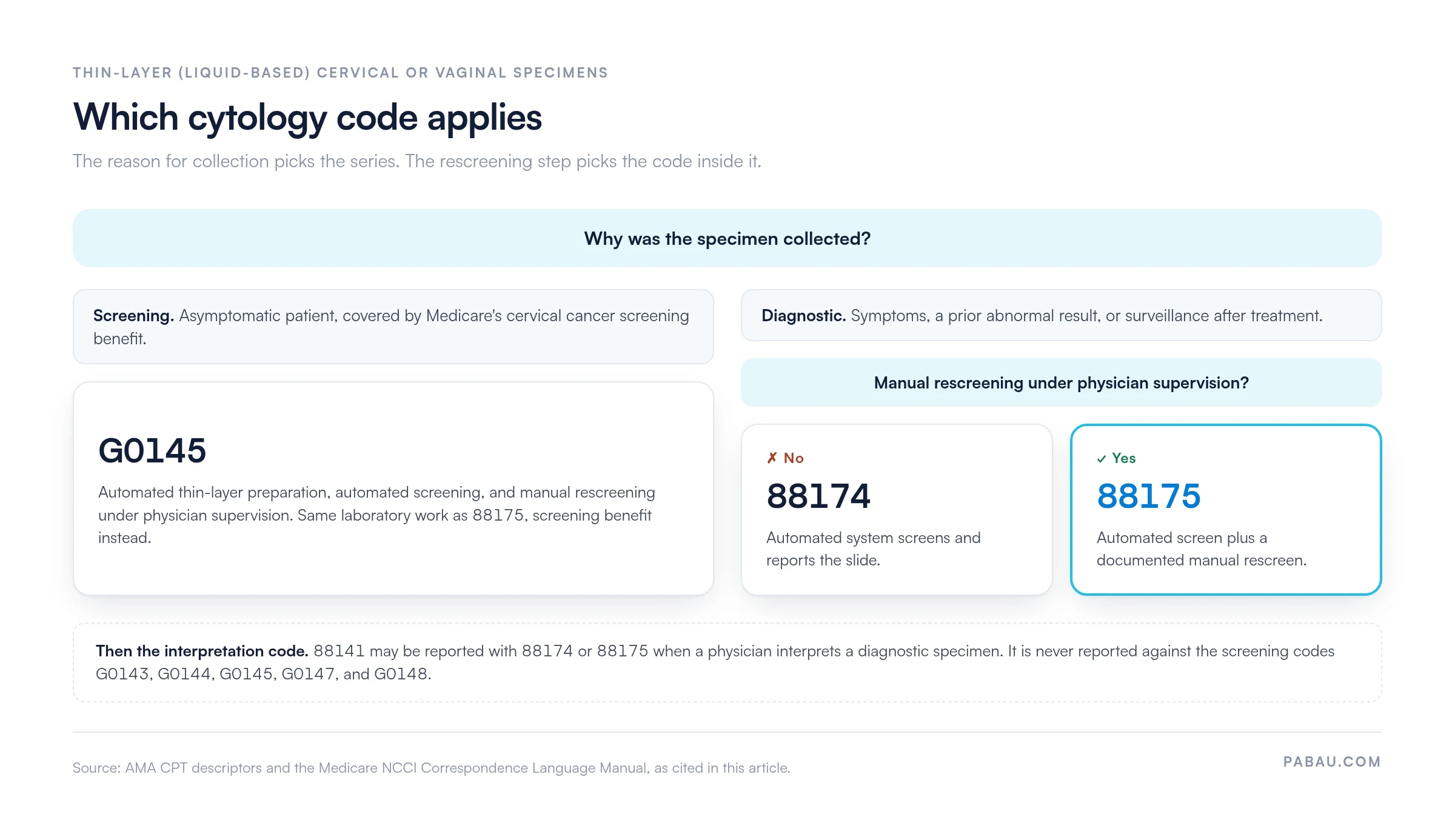
This split also drives the pairing rule for 88141. The billing section below sets out which combination is allowed and which one draws an edit.
CPT Code 88175 sits within a structured cytopathology series. Knowing where it lands in the 88141-88175 family prevents misassignment when a lab uses a different preparation method or screening approach. The table also separates conventional smear methods from liquid-based cytology.
88175 covers cervical and vaginal specimens only. A liquid-based slide from a non-gynecologic sample, such as urine or bronchial washings, is reported with 88112 instead. Fine needle aspirate material sits outside this preparation-based split. The pathologist’s interpretation of that specimen is reported under 88173, whichever preparation the laboratory used.
Gynecology practices that send specimens to a reference lab should note who selects the code. The lab, not the ordering practice, picks the code from this family and bills it. The requisition tells the lab what was collected and why, but it does not assign the CPT code.
Billing errors on 88175 usually start with ownership of the code. CPT Code 88175 is always billed by the pathologist or clinical laboratory that processes the specimen. The ordering provider, whether a family physician, OB/GYN, or nurse practitioner, does not bill 88175 under any circumstances. Doing so creates duplicate billing when the lab submits the same code.
Superbill and charge-capture templates need to reflect that split clearly, so 88175 never reaches the practice’s own fee sheet. The ordering provider bills a separate set of codes for the Pap encounter, explained below.
The ordering provider’s billing for a cervical cancer screening encounter follows a split-code model. That model is entirely separate from the cytopathology series, as the American Academy of Family Physicians (AAFP) Family Practice Management explains.
A practice that runs an in-house lab may bill both sides if it holds a separate laboratory NPI. Most community-based gynecology practices send specimens to a reference lab that bills 88175 independently. Confirming that arrangement when the lab contract is negotiated prevents inadvertent duplicate submissions.
Claim acceptance for CPT Code 88175 depends on pairing it with a covered ICD-10-CM diagnosis code. Medicare and most commercial payers reject claims where the diagnosis does not establish medical necessity for cervical cytopathology. The codes below are the most commonly accepted, and payer policies may be narrower.
The diagnosis code also signals which track the claim belongs to. A purely screening indication on a Medicare patient points to a G-code rather than 88175. A symptom, dysplasia, or surveillance code supports the diagnostic series instead.
Always verify current payer LCD and NCD requirements before submitting. Your MAC’s local coverage article lists the diagnosis codes it accepts for cervical cytopathology, and that list is revised with each fiscal year’s code update. An eligibility check at scheduling confirms coverage before the specimen is collected.
CPT 88175 is a clinical laboratory service, so Medicare pays it under the Clinical Laboratory Fee Schedule rather than the Physician Fee Schedule. There are no work, practice expense, or malpractice RVUs to look up, and no facility versus non-facility split. Payment is the lower of the local MAC fee or the national limitation amount, and it can never exceed the actual charge.
Pap smear tests also carry a statutory floor. Section 1833(h)(7) of the Social Security Act sets a national minimum payment amount, which CMS set at $18.54 for CY 2026. That is the 2025 figure of $18.19 with the 1.9% annual update applied.
Confirm the current amount against the annual CLFS data file, which CMS publishes in the CLFS files library after January 1 each year. The rules behind the update are set out in the CMS 2026 CLFS annual update (MM14312). Local fees vary by MAC, so treat the national minimum as a floor rather than the rate to expect.
Track expected payment against received payment for every cytopathology code. A consistent underpayment pattern on 88175 usually means the payer is applying a stale fee file, which is worth a formal reimbursement appeal.
Medicare’s frequency rules for cervical cancer screening set how often the benefit pays. Billing outside those parameters generates an automatic denial on medical necessity grounds.
Document the risk classification in the patient’s record before billing G0101 or Q0091. That documentation needs to be retrievable if Medicare requests records after a frequency edit rejection. An eligibility check at scheduling surfaces the last covered Pap date before the appointment, which avoids the denial entirely.
Run an eligibility check 48-72 hours before every cervical screening appointment. Most payers return the date of the last covered Pap in the response. Surfacing a frequency conflict before the patient arrives costs far less than appealing a denied claim after the specimen has been sent.
Cytopathology claims are audited against the laboratory’s records, not the ordering practice’s chart. Two elements carry the most weight on review. The first is proof that an automated system screened the slide. The second is proof that a manual rescreening happened under physician supervision. Keep the following available for every 88175 claim.
Where the manual rescreening step is not documented, the defensible code is 88174. Auditors treat a missing rescreening record as an upcoding pattern rather than a clerical omission, so the fix belongs in the lab’s reporting workflow.
88175 needs fewer modifiers than most procedure codes, because it has no professional and technical split to divide. The modifiers below are the ones that matter for cytopathology claims.
Modifier 59 draws the most audit attention of the group. Payers review it because it overrides an edit, so append it only when the record names the second specimen or service it represents.
The billing workflow for CPT Code 88175 involves more parties than most outpatient procedure codes. The ordering practice, the collecting staff, the reference lab, and the interpreting pathologist each own part of the claim.
The most persistent myth in this code family is that 88141 cannot be billed with 88175. It can. The Medicare NCCI Correspondence Language Manual describes 88141 as the professional component code for physician interpretation of a diagnostic cervical or vaginal specimen. It states that 88141 may be reported with technical component codes including 88142-88153, 88164-88167 and 88174-88175.
The current NCCI procedure-to-procedure edit tables agree. No edit pairs 88141 with 88175 in either direction, in either the practitioner or the hospital file. The condition on 88141 is clinical rather than clerical. Report it only when a physician actually interprets the specimen, not on every case the lab processes.
The real exposure sits one step to the side. 88141 must not be reported against Medicare’s screening codes, G0143, G0144, G0145, G0147 and G0148. CMS treats a physician interpretation billed on a screening specimen as a misuse of 88141, and those pairs are edited. 88175 carries its own edits too, against 88174, the screening G-codes, and other codes in the cytopathology series.
The practical control is simple. Decide screening or diagnostic first, then pick the technical code from the matching series. Add 88141 only where a physician interpretation exists on a diagnostic specimen. Build that order into charge capture rather than leaving it to the coder at the end.
CO-4 and CO-97 are the common denial codes this family produces most often. Both trace back to a modifier or diagnosis mismatch that charge capture could have caught before submission.
Gynecology and reproductive health practices that send Pap specimens to a reference lab still own the encounter side of the claim. Practice management software like Pabau handles that side cleanly, even when the pathology billing lives in the lab’s system.
Our claims software for practices integrates with Claim.MD, our US clearinghouse partner, for 837P electronic claim submission across thousands of US payers. Built-in CPT and ICD-10 catalogues help staff pair the right diagnosis to each procedure before the claim leaves the practice.
The same integration runs real-time eligibility verification, so practices catch Medicare frequency conflicts and inactive coverage before the appointment. ERA (835) remittances and CARC denial reason codes flow back into Pabau, so billing staff work denials without switching systems.
Pabau also exports CMS-1500 and superbill formats populated from the clinical record. That cuts manual entry on cervical screening encounters. The same patient and diagnosis data has to reach both the practice’s claim and the lab’s requisition.

Pabau’s claims management and eligibility tools help gynecology and reproductive health practices reduce denials on cervical screening codes. Book a demo to see the full billing workflow.

Get the two questions in the right order and 88175 stops being difficult. Ask why the specimen was collected, then ask whether a manual rescreen happened under physician supervision. Those answers decide the series and the code inside it.
The control belongs upstream of the claim. A lab that records the rescreening step inside its reporting workflow never has to reconstruct it for an auditor. An ordering practice that keeps 88175 off its own fee sheet never duplicates the lab’s charge.
Pabau’s eligibility verification and Claim.MD connection let gynecology and reproductive health practices catch these conflicts before submission. Book a demo to see the full claim lifecycle for a cervical screening encounter, from scheduling to remittance.

Need a clearinghouse that connects directly to your claims workflow? Pabau’s Claim.MD clearinghouse guide explains how the integration handles 837P submissions, real-time eligibility, and ERA remittances for US practices.
Wondering how denial codes map to specific CPT billing errors? Denial management in healthcare breaks down the most common CARC codes and the upstream documentation problems that trigger them.
Billing the screening side of the same service? HCPCS Code G0145 covers the screening counterpart of 88175, including coverage rules and frequency limits.
Need to catch a Medicare frequency conflict before the appointment? Insurance eligibility verification explains how a pre-visit check surfaces the last covered Pap date and the patient’s active coverage.
CPT Code 88175 covers automated thin-layer preparation of a cervical or vaginal specimen, screening by an automated system, and manual rescreening under physician supervision. It is the technical laboratory service, billed by the lab or pathologist. When a physician also interprets the specimen, that interpretation is reported separately with CPT 88141.
Yes, on diagnostic specimens. The Medicare NCCI Correspondence Language Manual states that 88141, the physician interpretation code, may be reported with technical component codes including 88174 and 88175. No NCCI edit pairs the two codes. Report 88141 only where a physician actually interprets the slide, and never against the screening codes G0143, G0144, G0145, G0147, and G0148.
The pathologist or clinical laboratory bills CPT 88175, never the ordering provider. The ordering provider bills G0101 for the cervical cancer screening encounter and Q0091 for specimen collection. Submitting 88175 from the ordering provider’s NPI is duplicate billing when the reference lab also submits the code.
Medicare pays 88175 under the Clinical Laboratory Fee Schedule, not the Physician Fee Schedule, so there are no RVUs and no facility split. The CY 2026 national minimum payment amount for pap smear tests is $18.54, and the Part B deductible and coinsurance do not apply. Local MAC fees vary, so check the current CLFS data file before setting expected payment.



