



HCPCS code E0198: Water pressure pad billing guide
HCPCS code E0198 is a water pad for a standard mattress HCPCS code E0198 is the ...

Last Updated: Oct 13, 2026

CPT 87624 reports high-risk HPV detection by nucleic acid (DNA or RNA), returned as one pooled result
It is a DNA-based test, so an order or report describing an HPV antigen or immunoassay does not support the code
Medicare requires G0476, not CPT 87624, for preventive HPV screening under its cervical cancer screening benefit
CPT 87621 was deleted on January 1, 2015; the current low-risk sibling code is CPT 87623
Pabau’s claims management software submits 87624 claims through Claim.MD and tracks the remittance that comes back
CPT code 87624 reports infectious agent detection by nucleic acid (DNA or RNA) for high-risk HPV types, returned as a single pooled result. It is a DNA-based test rather than an antigen or immunoassay test.
Filing it against the wrong payer costs the entire reimbursement. Send 87624 to Medicare for a preventive screening encounter and the claim denies. No modifier will correct it, because Medicare requires G0476 for that benefit.
OB/GYN and sexual health billing teams make the same routing decision on every cervical screening claim. This guide covers the official descriptor and the rest of the nucleic acid HPV code family. It also covers the ICD-10-CM codes that pair with 87624 and the fee schedule that prices it. Co-testing rules, documentation, and the 2025 changes follow.
CPT code 87624 describes infectious agent detection by nucleic acid (DNA or RNA); Human Papillomavirus (HPV), high-risk types, pooled result. The descriptor lists the genotypes as 16, 18, 31, 33, 35, 39, 45, 51, 52, 56, 58, 59, and 68.
The American Medical Association (AMA) owns and maintains the CPT code set. According to the AMA’s CPT code set overview, codes in the 87000 series cover microbiology and infectious disease laboratory tests. Within that series, 87623 through 87626 are the nucleic acid HPV codes.
The pooled result is what separates 87624 from the rest of its family. The assay looks for the whole high-risk panel and returns one answer. If the laboratory reports individual genotypes, a different code applies. Billing 87624 against a genotyping report creates a specificity mismatch that payers flag on audit.
Payer routing is the largest single source of 87624 denials. CPT code 87624 and HCPCS G0476 describe the same clinical test, and they are not interchangeable. G0476 sits among the HCPCS Level II codes that CMS maintains, while 87624 belongs to the AMA’s CPT set.
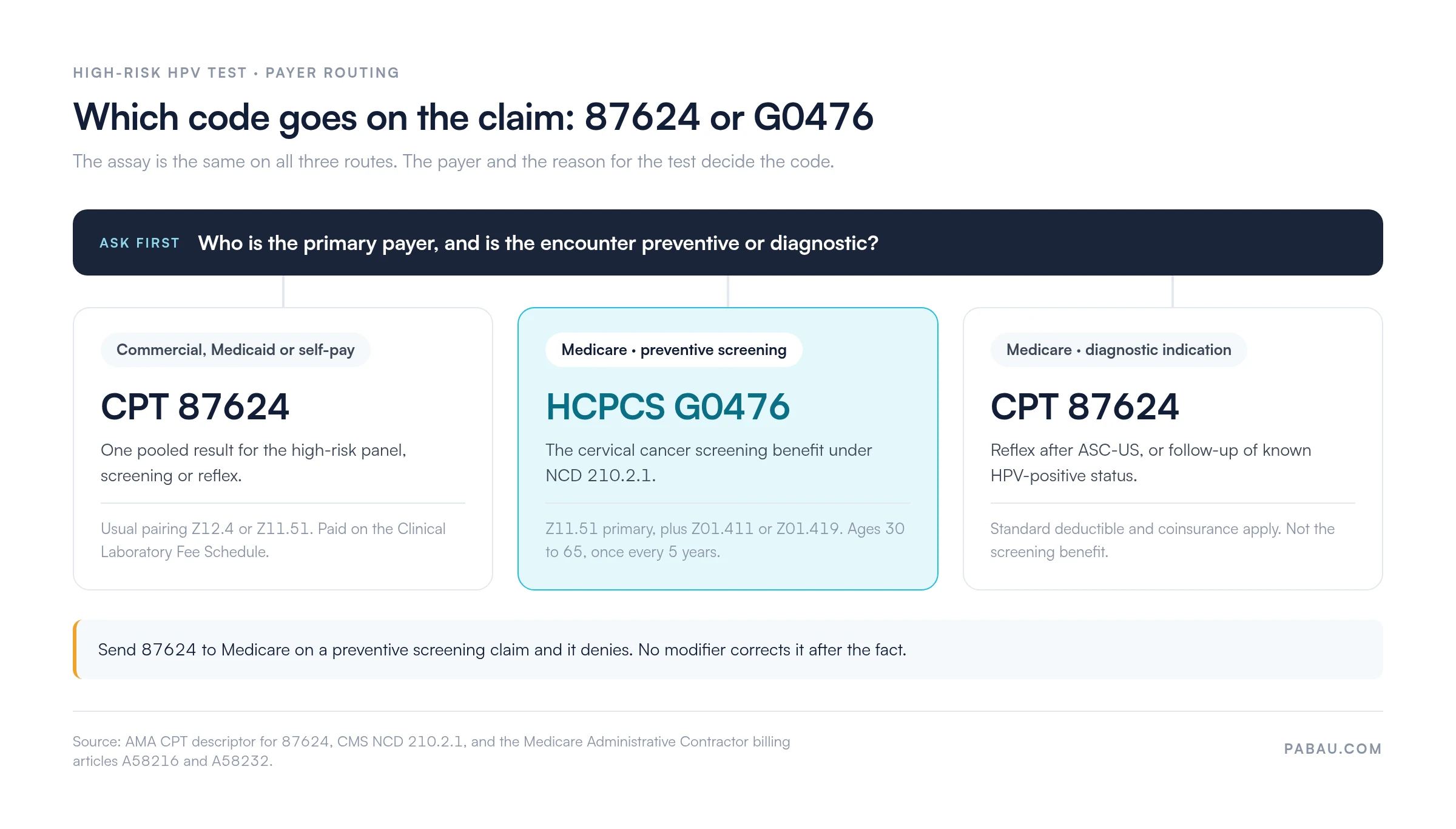
Medicare requires G0476 for preventive HPV screening under national coverage determination 210.2.1. Submitting CPT 87624 to Medicare for a preventive screening encounter produces a denial that no modifier will fix afterward.
Two things decide the code: the primary payer, and whether the encounter is preventive or diagnostic. Settle both before the claim is built. If Medicare is primary and the encounter is preventive, use G0476. If a commercial plan is primary, use CPT code 87624.
Where a patient carries Medicare plus a secondary commercial plan, G0476 goes on the Medicare claim and the secondary claim follows it. Running insurance eligibility verification at scheduling catches this routing question before anyone builds a claim. The routing tree below traces all three branches from payer to code.
Code choice follows what the laboratory reports, not what the ordering provider asked for. CPT 87623 covers low-risk HPV types. CPT 87624 covers the high-risk panel and returns a pooled result.
Both are nucleic acid tests in the same CPT family, which is why the pair gets mixed up. Miscoding the distinction creates a medical necessity mismatch that clears initial adjudication and then surfaces on retrospective audit.
If a laboratory panel runs low-risk and high-risk typing at the same time, 87623 and 87624 may both be reportable, subject to the payer’s policy. Most cervical cancer screening protocols only need the high-risk test.
Billing 87623 alone for a cervical cancer screening encounter draws a medical necessity denial, because low-risk types do not drive cervical cancer risk stratification. Read the genotype category off the laboratory report before you pick the code.
CPT 87621 is not a valid code, and has not been since January 1, 2015. It formerly read “Papillomavirus, human, amplified probe technique,” which named the assay method rather than a risk category.
The 2015 CPT set retired that technique-based family and replaced it with the risk-stratified codes 87623, 87624, and 87625. Any billing template, order set, or internal crosswalk still holding 87621 will reject, so the low-risk comparison to make is 87623 against 87624.
Every CPT 87624 claim needs a covered ICD-10-CM diagnosis code. Submitting the code with no valid linked diagnosis produces an automatic denial from any payer. The diagnosis has to reflect the clinical reason for the test rather than the result. According to the CDC/NCHS ICD-10-CM tool, codes are reported at their highest level of specificity for each encounter.
Z12.4 is the usual pairing for routine co-testing. When HPV testing follows an abnormal Pap, the cytology finding code drives the claim, and Z12.4 may follow as an additional code. Do not report Z11.51 and Z12.4 together on the same claim, since payers generally accept one screening indicator per visit.
Medicare screening claims carry their own pairing rule. The Medicare Administrative Contractor articles for cervical cancer screening with HPV set the pairing for G0476. Report Z11.51 as the primary diagnosis, plus Z01.411 or Z01.419 as a secondary code. State Medicaid programs publish their own accepted crosswalks, so check the current list in the provider manual before filing.
Medicare does not pay CPT code 87624 for preventive HPV screening. Those claims go out with G0476. CPT 87624 stays billable to Medicare only when the test is ordered for a diagnostic reason, such as follow-up after abnormal cytology. Coverage turns on whether the encounter is preventive or diagnostic, and the two paths have different cost-sharing rules.
Practices billing Medicare should confirm the coverage criteria before scheduling preventive HPV testing. Billing 87624 where G0476 is required is a recoverable audit finding. Build the check into the compliance routine rather than leaving it to individual billers.
CPT 87624 is paid under the Clinical Laboratory Fee Schedule (CLFS), not the Physician Fee Schedule. That one fact answers several questions at once. There are no relative value units for this code, and no facility versus non-facility split.
There is no geographic practice cost adjustment either. CMS publishes a single national payment amount per laboratory code, and updates it under the PAMA private payor rate methodology.
Rate aggregator sites and Physician Fee Schedule lookups are the wrong tools for this code. The MPFS search returns no usable rate for 87624, which is why some practices conclude the code is unpriced. Pull the figure from the current-year CLFS file instead, and compare it against each contracted commercial rate.
Download the CMS Clinical Laboratory Fee Schedule file each January and look 87624 up in it directly. Practices that check the Physician Fee Schedule instead find no rate and assume the code is unpriced. The CLFS carries one national amount, so there is no locality code to enter and no facility rate to choose between.
Co-testing means collecting a Pap smear and an HPV test at the same encounter. It is the most common clinical scenario for CPT code 87624. Billing both codes together is appropriate and expected when both tests are performed. NCCI bundling edits govern which code combinations are allowed without a modifier.
The National Correct Coding Initiative (NCCI) edits define which code pairs cannot be billed together without a modifier. Edits are updated quarterly, so check the current CMS table rather than a prior-year copy saved in a billing folder.
A submission checklist for 87624 co-testing confirms three things. Both the cytology and HPV codes are present, the modifier is justified in the chart note, and the ICD-10-CM code supports both tests. Record the indication for the Pap and the indication for the HPV test separately.
Documentation is the second most common denial driver after wrong payer code selection. The chart note has to support medical necessity for the HPV test on its own, independently of the other services billed at the same encounter.
The 2025 changes landed in the CPT code set rather than in the coverage rules. One new code arrived, and the descriptors around it were tightened so that pooled results and genotyping stopped competing for the same code.
An annual crosswalk validation step every January catches these changes before they turn into batch denials in the first quarter. Make it a scheduled task with a named owner, rather than leaving it to whoever notices the first rejection.
Most CPT 87624 denials fall into five categories, and each one has a specific root cause and a defined fix. Tracking denials by category rather than one claim at a time is the fastest way to bring the rate down across a full screening caseload.
A workable denial routine for HPV claims has three parts.
Grouping denials by claim adjustment reason code is the quickest way to tell a systemic workflow problem from a one-off error.
Prior authorization for CPT code 87624 varies by payer and plan year, and no universal rule applies. For routine preventive cervical cancer screening inside recommended intervals, most major commercial payers do not require it. The ACA generally covers preventive services without pre-approval. Testing outside standard intervals or age parameters is where authorization requirements start to appear.
Verify current requirements with the payer before performing the test for any non-routine indication. These policies change annually, and sometimes mid-year. State Medicaid programs, Medi-Cal included, publish their authorization rules in their provider manuals, and those should be reviewed separately from commercial policies.
On an HPV claim the coding decision takes seconds, and the consequence shows up weeks later. A biller checks the payer, picks 87624 or G0476, links the diagnosis, and sends the claim.
If the routing was wrong, the practice learns about it from a remittance advice a month afterward. By then the encounter is cold and the rework costs more than the claim.
Practice management software like Pabau keeps that chain in one place. Charges built at checkout carry through into the claim. Built-in CPT and ICD-10-CM catalogs give staff a maintained list to select codes from instead of typing them off a printout.
From there, Pabau’s claims management with tracking submits the claim electronically through Claim.MD and follows its status. Remittance advice comes back through the same integration, so payments and adjustments post against the claim they settle.
Denials collect in one queue rather than a shared inbox, which is what makes a monthly denial-by-category review practical. Pabau submits and tracks what your records hold, and the coding judgment stays with your billers. Keep the payer check and the crosswalk review in your own workflow.

Pabau’s claims management submits CPT 87624 and G0476 claims electronically through Claim.MD. Every remittance returns to the same queue, so denials surface where your billers already work.

The expensive 87624 errors are the ones that look like details. The descriptor names a nucleic acid test, so an order documenting an HPV immunoassay does not support the code. CPT 87621 has been dead since 2015, so a crosswalk still holding it will reject.
R87.82 is a low-risk parent code rather than a high-risk one. None of these are judgment calls, which is exactly why they are worth correcting once at the template level.
The routing decision deserves a control of its own. Verify the primary payer before the claim is built, use G0476 when Medicare is primary, and keep the diagnosis pointer linked at the service line. That combination clears most 87624 denials before a payer ever sees the claim.
Pabau’s claims management submits 87624 and G0476 claims through Claim.MD and tracks each remittance against the claim it settles. Book a demo to see how it handles cervical cancer screening billing end to end.

Need a framework for managing claim denials systematically? Denial management in healthcare walks through how to categorize, track, and resolve ERA adjustment reasons across high-volume billing workflows.
Want to understand how clearinghouse submissions work end to end? Medical claims clearinghouse workflow explains how electronic claims move from practice management system to payer and back.
Billing IVF or reproductive health lab panels alongside cervical screening? IVF CPT codes for reproductive health billing covers the lab code families that frequently co-occur with HPV testing in OB/GYN and fertility practice workflows.
CPT code 87624 reports infectious agent detection by nucleic acid (DNA or RNA) for high-risk Human Papillomavirus (HPV) types, returned as a single pooled result. It is a DNA-based test, not an antigen or immunoassay test. Practices use it for cervical cancer screening and reflex testing on commercial and most Medicaid claims. The high-risk panel covers genotypes 16, 18, 31, 33, 35, 39, 45, 51, 52, 56, 58, 59, and 68.
Yes. CPT 87624 can be billed with a Pap smear code such as 88175 or 88174 at the same encounter. That is the standard co-testing protocol, provided both tests are genuinely performed. NCCI bundling edits apply to certain code pairs. Where an edit exists, modifier 59 indicates a distinct procedural service and the chart note has to support it.
Prior authorization is generally not required for routine preventive HPV testing within recommended age and frequency guidelines. Most major commercial plans follow the ACA rule that preventive services are covered without cost-sharing. Non-routine testing, extended frequency, or testing outside standard age parameters may require authorization. Verify with the specific payer before performing the test.
No. CPT 87626 is not reported in conjunction with 87624 or 87625 for the same procedure. CPT 87626, new for 2025, already covers the separately identified high-risk genotypes plus the pooled result from a single analysis. Report the one code that matches what the laboratory reported.



