

CCSD code G5100: Bypass of duodenum billing guide
CCSD code G5100 bills a bypass that leaves the duodenum in place CCSD code G5100...

Last Updated: Oct 16, 2026
E2622 is the HCPCS Level II code for skin protection wheelchair seat cushion, adjustable, width less than 22 inches, any depth.
Let Pabau's smart automation suggest the right codes, reduce claim denials, and keep your practice compliant—effortlessly.
Automate repetitive tasks and focus on what matters most—your patients.
Reduce coding errors and ensure compliance with the latest regulations.
Clean claims, fewer denials, and faster reimbursements.
Powerful insights and reporting to help your practice thrive.
HIPAA compliant SOC 2 certified GDPR-compliant Trusted by 4,000+ clinics worldwide

HCPCS Code E2622 covers a skin protection wheelchair seat cushion, adjustable, width less than 22 inches, any depth, billed under Medicare Part B DME.
Medicare covers E2622 under LCD L33312 only when two criteria are met: the patient is at risk for pressure injury AND uses a wheelchair as their primary mobility device.
E2622 requires PDAC contractor verification before billing: the cushion must appear on the PDAC’s approved product list or risk denial.
Pabau’s claims management software helps DME suppliers attach HCPCS Level II codes like E2622 to encounters and insurance claims within a single billing workflow.
According to the Centers for Medicare and Medicaid Services (CMS) HCPCS system, E2622 describes: Skin protection wheelchair seat cushion, adjustable, width less than 22 inches, any depth. The code is active as of January 1, 2011, and remains valid for 2025 and 2026 billing. It falls under the Durable Medical Equipment, Prosthetics, Orthotics, and Supplies (DMEPOS) category and is governed by LCD L33312 (Wheelchair Seating).
The short descriptor used in claims processing is “Adj skin pro w/c cus wd<22in.” Understanding what “adjustable” means in CMS’s definition is critical before billing. According to CMS Policy Article A52505, an adjustable skin protection seat cushion (E2622, E2623) has all the characteristics of a standard skin protection cushion (E2603 or E2604) and is additionally determined to be adjustable by the PDAC (Pricing, Data Analysis and Coding) contractor.
Billing E2622 to Medicare without confirming both LCD L33312 criteria are documented is the single most avoidable denial source for DME suppliers. Both conditions must be satisfied simultaneously.
Under LCD L33312, a skin protection seat cushion (E2603, E2604, E2622, or E2623) is covered for a beneficiary who meets both of the following criteria:
One additional coverage exclusion matters for claims processing: if the patient has a power-operated vehicle (POV) or a power wheelchair with a captain’s chair seat, a separate seat or back cushion is denied as not reasonable and necessary. This exclusion catches many claims where the wheelchair type isn’t documented in the order.
The clinical conditions that justify E2622 are defined in the CMS LCD-related Policy Article A52505. Historically, suppliers had to report an ICD-10 diagnosis code from Group 1 (a current or prior pressure ulcer in the area of contact with the seating surface) or Group 2 (absent or impaired sensation in that area, or an inability to perform a functional weight shift).
Effective October 1, 2025, CMS removed the requirement to report a specific ICD-10 code for skin protection and positioning cushions. The underlying clinical conditions still apply and must be documented in the medical record, either by the ordering practitioner in the chart notes or by the LCMP in the wheelchair seating evaluation.
Documentation should clearly establish the pressure ulcer history, or the sensory or weight-shift deficit, that supports the cushion. Conditions commonly associated with this risk include spinal cord injury, multiple sclerosis, and advanced neuromuscular disease. For patients who also need pressure redistribution in bed.
Always verify current coverage and documentation requirements with your MAC jurisdiction. Noridian and CGS publish updated policies that may differ slightly from the national LCD. Robust client record documentation at the point of assessment reduces the risk of documentation mismatches during retrospective audits.
PDAC verification is a hard prerequisite for billing E2622, not a post-billing formality. If the specific cushion being dispensed is not on the PDAC’s approved product list at the time of dispensing, the claim will be denied regardless of how well the documentation supports medical necessity.
The PDAC contractor maintains a product classification list that assigns HCPCS codes to specific manufacturers’ products. Per CMS Policy Article A52505, the “adjustable” designation in E2622 is not self-reported by the manufacturer or supplier. The PDAC must confirm the product meets the adjustability criteria before it can be assigned the E2622 code.
According to CGS Medicare’s PDAC coding verification guidance, suppliers should check the PDAC product classification list before dispensing. Billing a non-verified product under E2622 creates audit exposure. Effective patient care management workflows should include a pre-dispensing PDAC check step to prevent this.
Run a PDAC product verification check before the wheelchair seating evaluation appointment. Confirm the specific cushion model your practice or supplier intends to dispense is listed on the PDAC product classification list under E2622. Document the verification date and the product’s PDAC listing in the patient record. This single step prevents the most common E2622 denial reason before a claim is ever submitted.
An inventory management tool ties each dispensed item to a patient and a billing code, ending stockroom guesswork.
Choosing the wrong code from the wheelchair cushion family is a common audit trigger. The differences between E2622 and its related codes are based on width, adjustability, and whether the cushion combines skin protection with positioning.
The key distinction between E2622 and E2603 is adjustability as confirmed by PDAC. Both cover cushions under 22 inches wide with a skin protection function, but E2622 carries a higher reimbursement rate because the product has been formally verified as adjustable. Never self-assign the adjustable code based on product marketing materials. The PDAC list is the authoritative source.
For patients who also require a positioning component to address postural alignment needs, E2624 (under 22 inches) or E2625 (22 inches or wider) are the appropriate codes. Billing E2622 when the dispensed product includes positioning features is an undercoding error that leaves reimbursement on the table and may misrepresent what was actually supplied. For more on how DME documentation fits within the broader medical billing process, see how integrated billing workflows reduce these manual crosswalk errors.
Modifier selection for E2622 is not discretionary. Using the wrong modifier, or omitting one when required, results in either a denial or an audit flag. These four modifiers govern the majority of E2622 claims under Medicare:
For standard Medicare-covered E2622 claims, KX is the required modifier. Suppliers should maintain a complete set of medical forms in the patient’s record, including the treating physician’s order, the seating evaluation, and the PDAC verification record, before appending KX. Box-by-box requirements on the professional claim form change by payer, so one filled sample is not a universal template.

Pabau’s claims management software helps DME suppliers and multi-specialty practices attach HCPCS Level II codes to encounters, track documentation requirements, and submit cleaner claims to Medicare and commercial payers. See how it works for your practice.

Documentation failures account for the majority of E2622 post-payment audit recoveries. The following records must be in the supplier file before the KX modifier is appended and the claim is submitted.
A written order from the treating physician, nurse practitioner, or physician assistant must be obtained before the item is dispensed. The order must include the HCPCS code (E2622), a description of the item, the patient’s diagnosis, and the practitioner’s signature and date. Verbal orders are not acceptable for DME without a written follow-up within a defined timeframe per your MAC’s policy.
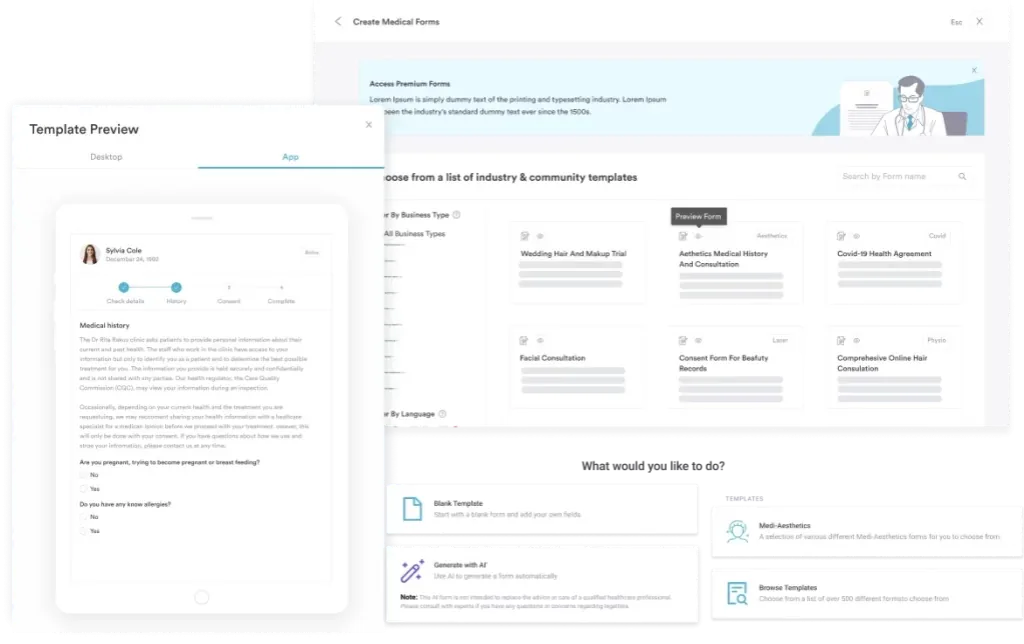
LCD L33312 requires a face-to-face evaluation by a licensed/certified medical professional (LCMP), typically an occupational therapist or physical therapist, to assess the patient’s seating needs. The evaluation report must document the medical condition creating pressure injury risk, the patient’s current wheelchair and mobility status, and the clinical justification for an adjustable (rather than non-adjustable) skin protection cushion. Practices using physical therapy EMR workflows benefit from structured evaluation templates that capture all required fields.
The supplier must retain a signed proof of delivery confirming the specific product was received by the beneficiary. The PDAC verification record (confirming the dispensed product model is listed under E2622) should be filed alongside the delivery documentation. Use digital forms to capture proof-of-delivery signatures and store them in the patient’s electronic record alongside the clinical documentation. This reduces the documentation retrieval burden during audits.
Good medical office compliance documentation practices apply directly here. Every E2622 file should include: the written order, the seating evaluation report, the PDAC verification printout, the delivery receipt, and the signed ABN if GA or GZ modifiers were applied. Missing any one of these during a targeted probe audit typically results in full repayment of the claim amount.
Audit your E2622 claim files quarterly before a MAC probe targets your practice. Pull five to ten random E2622 claims and verify each file contains the written order, seating evaluation, PDAC verification printout, proof of delivery, and modifier rationale. Document the audit findings. Practices that self-audit consistently demonstrate good faith compliance, which is a factor considered during corrective action plans.
Reimbursement rates for E2622 are not fixed nationally. They vary by MAC jurisdiction, geographic pricing locality, and calendar year. CMS publishes the DMEPOS fee schedule annually, and rates are adjusted based on the CPI-U index and any applicable policy changes.
Because E2622 is durable medical equipment, its rates are set by the CMS DMEPOS fee schedule, not the Medicare Physician Fee Schedule. To find the current fee for E2622 in your specific jurisdiction, consult the CMS DMEPOS fee schedule, which lists the fee schedule amounts, floors, and ceilings for each code. Your DME MAC (such as Noridian or CGS) also publishes a fee-schedule lookup where you can enter your state pricing locality and the E2622 code to see the applicable purchase and rental amounts.
Key billing workflow points that affect reimbursement:
Using claims management software that supports HCPCS Level II code entry helps DME billing teams track modifier requirements, link documentation to claims, and identify missing fields before submission. Fewer front-end errors mean fewer denials and less time spent on appeals. This is where practice management software features built for multi-specialty workflows make a measurable difference for practices handling DME alongside other service lines.
Most E2622 claim denials are preventable. The two most common causes, PDAC-unverified products and incomplete LCD L33312 documentation, are both controllable through pre-dispensing verification checks and standardized documentation workflows.
Pabau’s claims management software supports HCPCS Level II code attachment, documentation linking, and multi-payer claim workflows for DME and multi-specialty practices. If your practice handles wheelchair seating evaluations or DME supply alongside clinical services, see how Pabau handles the documentation and billing workflow end to end. Book a demo to explore how it fits your workflow.

Billing anesthesia for shoulder replacement? CPT code 01638 explains anesthesia billing for total shoulder replacement, including modifiers and payer rates.
Billing anesthesia for a biceps tenodesis? CPT code 01716 covers anesthesia for biceps tenodesis, billed at 5 base units.
Billing anesthesia for a vein procedure? CPT code 01932 covers anesthesia for procedures on the jugular and intrathoracic veins.
HCPCS Code E2622 is used to bill for a skin protection wheelchair seat cushion that is adjustable, with a width less than 22 inches and any depth, supplied to Medicare beneficiaries who are at risk for pressure injury and use a wheelchair as their primary mobility device. It falls under the DMEPOS category and is governed by LCD L33312.
E2622 covers an adjustable skin protection wheelchair seat cushion with a width less than 22 inches, while E2623 covers the same type of cushion with a width of 22 inches or greater. Both require PDAC contractor verification to confirm the product meets the adjustability criteria. Billing the wrong code based on cushion width is a common audit trigger.
E2603 covers a non-adjustable skin protection wheelchair seat cushion (width less than 22 inches), while E2622 covers the same size cushion with the adjustable designation confirmed by the PDAC contractor. E2622 carries a higher reimbursement rate. Never self-assign the adjustable code based on product marketing; only the PDAC listing determines which code applies.
E2622 covers an adjustable skin protection wheelchair seat cushion under 22 inches wide, while E2624 covers a cushion that combines both skin protection and positioning in the same size range. Choose E2624 when the patient also needs postural support; billing E2622 for a product with positioning features is an undercoding error. Both require PDAC verification.
The KX modifier is required for covered Medicare claims when the supplier attests that LCD L33312 criteria are met and supporting documentation is on file. The GA modifier is used when the beneficiary has signed an ABN. GY is used for statutory non-covered items, and GZ is used when a denial is expected and no ABN was obtained. Omitting KX on a covered claim typically results in denial.
No. Per LCD L33312, if the beneficiary has a power-operated vehicle or a power wheelchair with a captain’s chair seat, a separate seat cushion including E2622 is denied as not reasonable and necessary. The type of wheelchair must be documented in the order to avoid this denial.
PDAC (Pricing, Data Analysis and Coding) contractor verification confirms that a specific product meets CMS’s definition of an adjustable skin protection cushion before E2622 can be billed. Without PDAC verification, billing E2622 creates audit exposure. Suppliers must confirm the dispensed product model appears on the PDAC product classification list before submitting the claim.



