CPT Code 98981: RTM Treatment Management Billing Guide
CPT code 98981: Definition and official descriptor CPT code 98981 is an add-on c...

Last Updated: Nov 9, 2026
E0167 is the HCPCS Level II code for a pail or pan for use with a commode chair, replacement only. Suppliers bill it when a patient's existing pail is worn, broken or lost and the commode chair stays in use.
The pail that ships with a new commode chair is not billed separately. Medicare includes it in the allowance for the chair code, such as E0163, E0165 or E0168.
Let Pabau's smart automation suggest the right codes, reduce claim denials, and keep your practice compliant—effortlessly.
Automate repetitive tasks and focus on what matters most—your patients.
Reduce coding errors and ensure compliance with the latest regulations.
Clean claims, fewer denials, and faster reimbursements.
Powerful insights and reporting to help your practice thrive.
HIPAA compliant SOC 2 certified GDPR-compliant Trusted by 4,000+ clinics worldwide

HCPCS Code E0167 covers a replacement pail or pan for a commode chair the patient already owns, not the chair itself.
The pail supplied with a new commode chair is bundled into the chair code, such as E0163, E0165 or E0168. It is never billed as E0167.
Bill E0167 with the RA modifier when a worn, broken or lost pail is replaced and the commode chair remains in use.
Missing orders, undocumented medical necessity for the commode and early replacements with no recorded reason are the denials to prevent.
Pabau’s claims management software submits E0167 claims and tracks their status, so replacement claims stay visible until they are resolved.
HCPCS Code E0167 is a Level II code that the Centers for Medicare and Medicaid Services (CMS) maintains for durable medical equipment. The official descriptor reads Pail or pan for use with commode chair, replacement only.
The words “replacement only” set the billing rule. Suppliers bill E0167 when a patient’s existing pail or pan wears out, breaks or goes missing, and the commode chair stays in use.
E0167 covers the pail or pan that sits beneath a commode seat to collect waste, when it replaces one the patient already has. The first pail that ships with a chair falls outside the code.
Medicare’s commode policy article A52461 lists E0167 as a Column II code to the chair codes. A Column II item supplied at the same time as the chair is included in the chair’s allowance.
The decision below shows which of the three supply paths bills E0167.
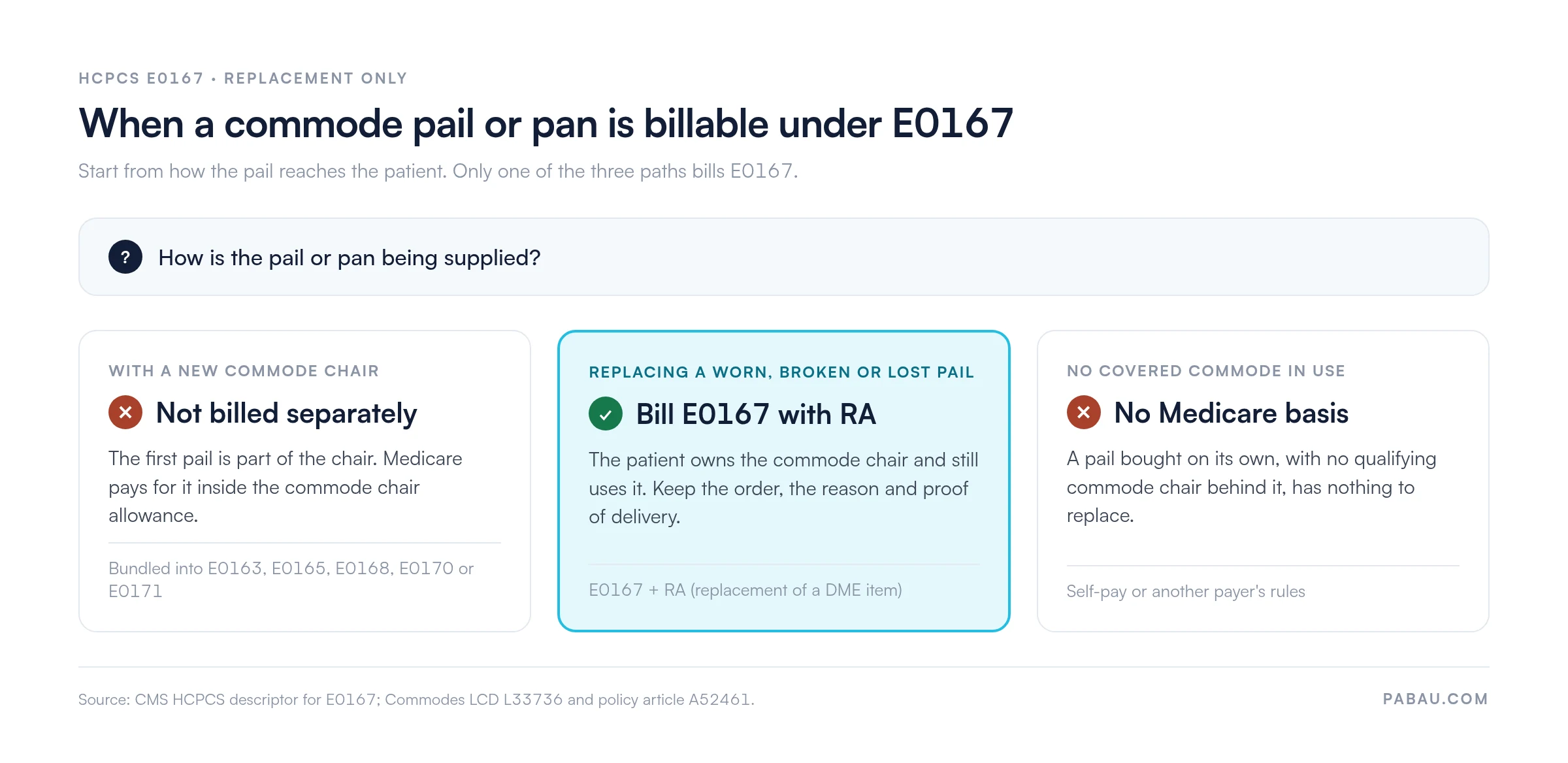
A pail or pan bought over the counter, with no order and no qualifying commode chair, is not payable by Medicare under E0167.
Medicare Part B covers commodes under the durable medical equipment benefit, and E0167 follows the chair. A replacement pail is payable when these conditions hold together.
Two contractors administer these rules across the four DME MAC jurisdictions. Noridian handles Jurisdictions A and D, and CGS Administrators handles Jurisdictions B and C. Confirm the current LCD for the patient’s state before billing.
E0167 is billed only against a commode chair the patient already has. The table maps it to the chair codes behind that replacement. Billing E0167 with a new chair, instead of as a later replacement, is the quickest route to a denial.
The E0163 and E0168 pages cover the chair-level coverage and documentation that a replacement pail relies on.
The documentation set for E0167 has to show two facts. The commode chair qualifies, and the pail or pan needed replacing.
The standard expectation for E0167 is one pail or pan per commode chair in use. A second claim inside a short window needs a documented reason, such as damage or loss.
Frequency allowances can differ by DME MAC. Check your contractor’s current guidance before billing a second replacement close to the first.
E0167 billing depends on the commode chair claim that came before it. If DME claims are new to your team, our guide to medical billing basics covers the full claim cycle.
Modifiers on E0167 tell the payer that the item replaces equipment and how it was supplied. Commode accessories are generally purchased, so rental modifiers rarely apply.
Validate modifier requirements against the applicable HCPCS Level II coding resources and your DME MAC’s current billing guidance. A missing RA on a replacement-only code invites an edit or a denial.
E0167 denials cluster around a few recurring errors, and most are preventable with a pre-submission check. The table maps each denial pattern to its root cause and fix.
Each denial arrives with a CARC and RARC pair. The guide to medical billing denial codes explains each pair, and a clear denial management process routes the rework to the right person.
Add a field to your E0167 workflow for the commode chair’s delivery date. A pail delivered on the same day as the chair belongs to the chair claim, so stop the E0167 line before it goes out.
Replacement pails are small claims that are easy to lose track of. When the order, delivery receipt and claim status sit in separate places, a denial can go unnoticed for weeks.
Pabau, the practice management platform we build, keeps those records on the patient’s file. Its end-to-end claims management submits the E0167 claim and tracks its status after submission.
Digital forms capture the written order and the signed delivery receipt against the same record. Your team can see what was sent, what came back and what still needs work.

Pabau’s claims management submits your DME claims and tracks their status after submission. Orders and delivery receipts sit on the same patient record, ready for an audit request.

E0167 has one rule worth building your process around. It pays for a replacement pail or pan, never for the one that ships with the chair.
Check the commode chair history before every E0167 claim, record why the pail needed replacing and add RA. That routine heads off the bundling, documentation and modifier denials this code attracts. Book a demo to see how Pabau submits and tracks DME replacement claims for your team.

Need a clearinghouse that handles HCPCS DME claims cleanly? Medical claims clearinghouse guide explains how clearinghouse routing works for DME suppliers and what to look for in a compliant setup.
Seeing denial codes you do not recognize on HCPCS claims? Denial codes in medical billing breaks down the most common CARC and RARC codes and what each one requires for a successful appeal.
Billing the chair with detachable arms? E0165 covers coverage criteria and documentation for the detachable-arm commode chair.
Working with a seat-lift commode? E0170 explains the electric seat-lift commode chair and how it is billed.
Want to understand the full revenue cycle behind DME billing? Revenue cycle management guide covers the end-to-end process from order through remittance posting.
HCPCS Code E0167 covers a pail or pan for use with a commode chair, replacement only. Suppliers bill it when a patient’s existing pail is worn, broken or lost. It does not cover the commode chair or the pail supplied with a new chair.
Yes, Medicare Part B can pay for E0167 as a replacement when the patient owns a commode chair that meets the Commodes LCD criteria. A written order per the applicable LCD and policy article is required. So are a documented reason for replacement and an accredited supplier.
Keep a written order that meets the applicable LCD and policy article, plus clinical notes supporting the commode chair. Record why the pail needed replacing. A signed delivery receipt and the supplier’s DMEPOS accreditation records complete the set.
E0163 is the code for a commode chair, mobile or stationary, with fixed arms. E0167 is the code for a replacement pail or pan used with a commode chair. The pail supplied with a new E0163 chair is included in the chair’s payment, so E0167 applies only to later replacements.
Replacement frequency for E0167 varies by DME MAC jurisdiction. The standard expectation is one pail or pan per commode chair in use, replaced when it is damaged, lost or worn out. An early replacement needs a documented reason. Check with Noridian or CGS Administrators for your jurisdiction’s limits.
Frequent causes include billing E0167 with a new commode chair, a missing or incomplete order, and medical necessity the notes do not support. Duplicate billing inside the frequency window, unmet LCD criteria and a missing RA modifier also lead to denials.