HCPCS Code Q4185: Cellesta flowable amnion billing guide
HCPCS Code Q4185: definition and official descriptor HCPCS Code Q4185 is the Lev...

Last Updated: Nov 20, 2026
E0276 is the HCPCS Level II code for bed pan, fracture, metal or plastic.
A fracture bed pan has a low, tapered front end. It slides under a patient who cannot lift the hips, such as after a hip fracture or spinal injury. Medicare covers it as durable medical equipment when the patient is bed-confined. It is paid from the DMEPOS fee schedule as an inexpensive or routinely purchased item.
Let Pabau's smart automation suggest the right codes, reduce claim denials, and keep your practice compliant—effortlessly.
Automate repetitive tasks and focus on what matters most—your patients.
Reduce coding errors and ensure compliance with the latest regulations.
Clean claims, fewer denials, and faster reimbursements.
Powerful insights and reporting to help your practice thrive.
HIPAA compliant SOC 2 certified GDPR-compliant Trusted by 4,000+ clinics worldwide

HCPCS code E0276 is the Level II code for a fracture bed pan, metal or plastic, while E0275 covers the standard bed pan.
Medicare covers E0276 as durable medical equipment only when the patient is bed-confined, under NCD 280.1 and LCD L36267.
Disposable bed pans do not meet the durability test, so they bill as A9270 rather than E0276.
The October 2026 DMEPOS fee schedule pays $14.21 to $15.78 for a new fracture bed pan in non-rural contiguous states.
E0276 needs no KX modifier or certificate of medical necessity, and GA applies only when a signed ABN covers doubtful coverage.
HCPCS code E0276 describes a bed pan, fracture, metal or plastic. Medicare covers it as durable medical equipment (DME) when the patient is bed-confined, under the Bowel Management Devices LCD. CMS maintains the code in its HCPCS Level II set, and claims go to the DME Medicare Administrative Contractor (DME MAC) for the patient’s state.
A fracture bed pan is built for patients who cannot raise their hips. Specifically, its front end is flat and tapered, so it slides under the buttocks with little lifting. As a result, that design suits patients recovering from a hip or pelvic fracture, spinal surgery, or a joint replacement.
The descriptor covers both reusable materials. Therefore, a metal pan and a plastic pan bill under the same code, as long as the pan is durable rather than disposable.
The two bed pan codes share the same coverage rule, pricing method, and modifiers. However, they split on the shape of the device, and the claim has to match the pan you delivered.
The standard pan has its own guide under E0275. In fact, the coverage logic is identical, so the code choice comes down to the device alone.
Neither bed pan code describes a bed rail. For example, a half-length bed side rail is HCPCS code E0305, and a full-length rail is E0310. Likewise, the nearby codes E0271, E0272, and E0273 are not rails either: they are an innerspring mattress, a foam rubber mattress, and a bed board.
A disposable bed pan is a third product on the shelf, but not a third bed pan code. Indeed, the DME MAC policy article A54516 requires bed pans to be durable. Consequently, disposable pans bill as A9270, noncovered item or service.
Medicare Part B covers a fracture bed pan under the DME benefit in section 1861(s)(6) of the Social Security Act. In short, the coverage condition is simple: the patient must be bed-confined.
Two CMS documents set that rule. NCD 280.1, the DME reference list, covers autoclavable hospital-type bed pans if the patient is bed confined. In addition, LCD L36267, Bowel Management Devices, repeats the condition for E0275 and E0276.
The same LCD reaches beyond bed pans. In contrast, it also denies pulsed irrigation and evacuation systems, such as E0350, as statutorily non-covered.
That condition shapes the claim in six ways.
Ask the ordering practitioner to state the reason for bed confinement in the visit note, not only on the order. A fracture, traction, or a weight-bearing restriction gives the DME MAC reviewer a clear basis for payment.
A fracture bed pan claim is small, so most suppliers never expect a review. However, the documentation still has to hold up when one arrives. Overall, solid medical billing compliance habits keep each of these items on file before the claim goes out.
The bed pan rule in LCD L36267 turns on bed confinement rather than a fixed diagnosis list. These codes are common examples that explain why a patient needs a fracture pan. Confirm current code status in the ICD-10-CM tabular list before you submit.
However, Z74.01 never travels alone on the claim. For example, for paraplegia after a spinal cord injury, list G82.20 with it, so the record shows both the cause and the confinement.
E0276 is an inexpensive or routinely purchased item. Therefore, the claim line tells Medicare whether the pan is new, used, or rented. Instead, liability modifiers come in only when coverage is in doubt.
NU covers nearly every E0276 claim. Renting rarely makes sense for an item this inexpensive, since the monthly rental fee is a tenth of the purchase fee.
Medicare pays E0276 from the DMEPOS fee schedule, not the physician fee schedule. In addition, fees are set by state, with separate amounts for rural and non-rural ZIP codes.
The October 2026 file sets these ranges across the contiguous states. However, Alaska, Hawaii, and Puerto Rico carry their own higher amounts.
Medicare pays 80% of the allowed amount once the Part B deductible is met. Then the patient or a secondary payer owes the remaining 20% coinsurance.
Suppliers in former competitive bidding areas price from a separate former CBA fee schedule file, which lists E0276 with its own amounts. Therefore, check the patient’s ZIP code against both files before you quote a price.
Bill your usual charge, not the fee schedule amount. Medicare pays the lower of the two, so a charge set below the fee schedule loses money on every claim.
The workflow below assumes original Medicare is the primary payer. In fact, most of the work happens before delivery, which is also where E0276 denials start.
First, three checks come first, because they decide the code and whether Medicare pays at all.
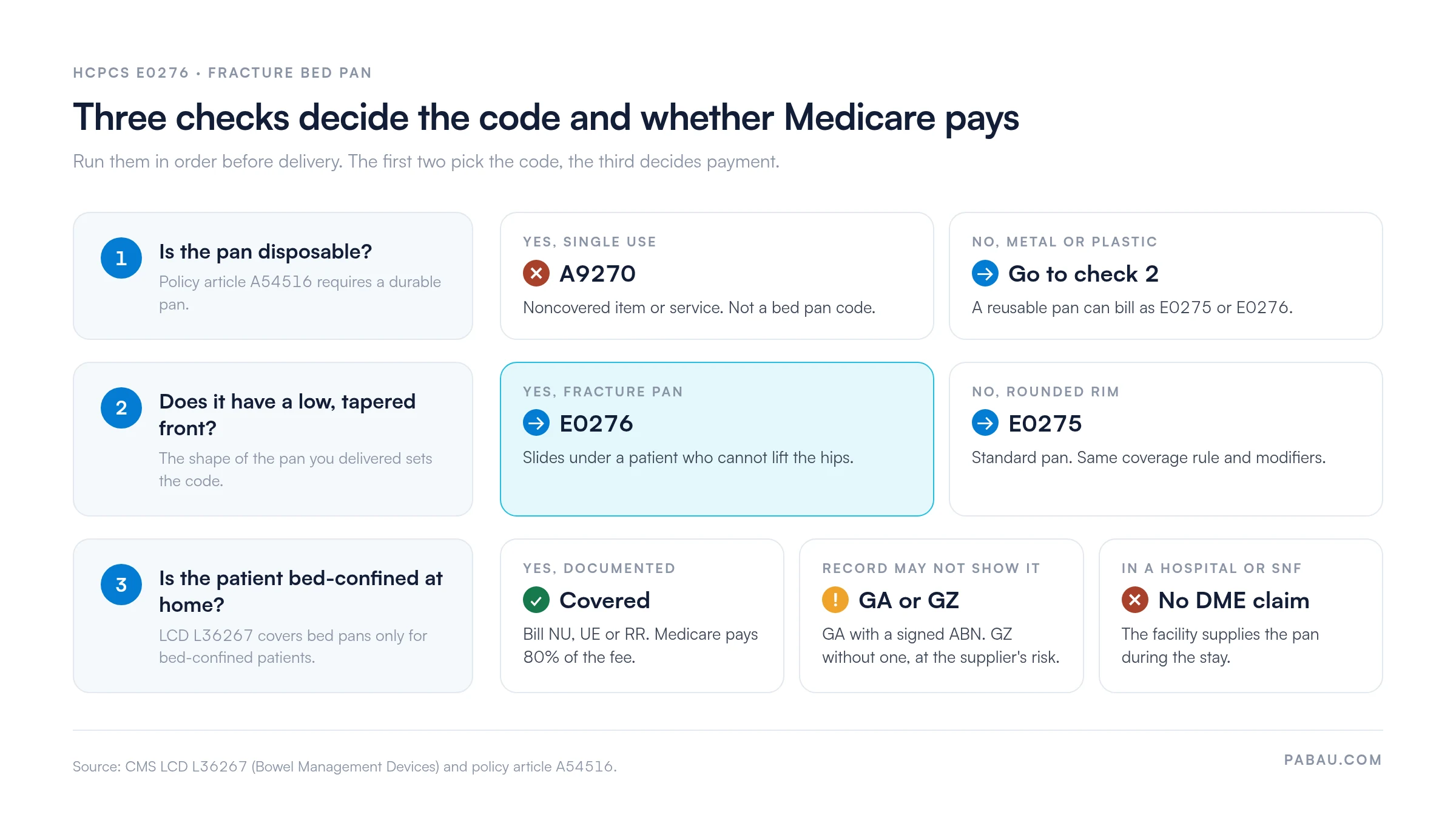
E0276 denials come from seven avoidable errors, and each one can be caught before the claim goes out. Indeed, tracking them through denial management workflows stops the same error repeating. The medical billing denial codes guide explains each remittance code.
Outside original Medicare, each payer sets its own rules for a fracture bed pan. Therefore, check the rules before delivery rather than after the denial.
A bed pan claim is small, but it fails for the same reasons as a costly one. Therefore, the order, the record of bed confinement, and the delivery signature have to sit together. Pabau’s billing and patient record software keeps all three on the same patient file.
Pabau’s digital forms capture the written order and the signed delivery receipt against the patient. In addition, Pabau’s claims management software submits the DME claim and tracks its status, so a denial surfaces while the paperwork is easy to find.
When the remittance comes back, the payment posts against the same record. As a result, your team sees which bed pan claims are paid and which still need a coinsurance bill.
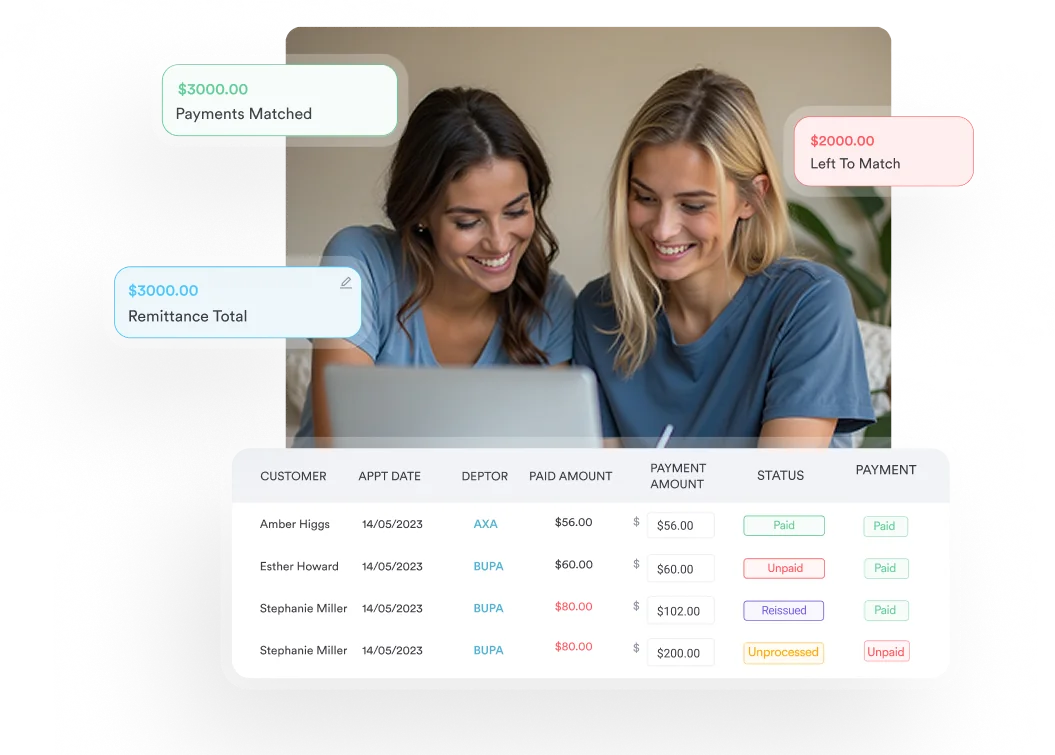

Pabau’s digital forms and claims management keep the written order, the proof of delivery, and the claim status on one patient record. Your team can spot a missing document before a bed pan claim goes out.

E0276 is one of the simpler DME codes to get paid, provided the record shows why the patient cannot leave the bed. In short, the fee is small, so one denial and a round of rework wipes out the margin on the item.
Build the check into intake rather than appeals. Specifically, confirm the pan is a durable fracture pan, the order is complete, and bed confinement is documented before delivery.
Book a demo to see how Pabau keeps the order, the delivery record, and the claim for every DME item in one place.

Billing a standard bed pan instead? HCPCS code E0275 covers the same coverage rule for the standard pan.
Looking for the half-length bed rail code? HCPCS code E0305 explains how half-length side rails are coded and covered.
Need a foundation for DME billing accuracy? What is revenue cycle management explains how coding, claims, and payment posting connect across the full billing workflow.
Building a denial prevention process? What makes a clean claim covers the pre-submission checks that prevent HCPCS code denials before they occur.
Looking for an overview of medical billing basics? The superbill in medical billing explains how claim documentation flows from encounter to payer submission.
HCPCS code E0276 is the Level II code for a bed pan, fracture, metal or plastic. A fracture bed pan has a low, tapered front end that slides under a patient who cannot lift the hips. Medicare covers it as durable medical equipment when the patient is bed-confined.
E0275 is a standard bed pan with a deeper, rounded rim. E0276 is a fracture bed pan with a flat, tapered front for patients with limited hip movement. Both codes share the same coverage rule and modifiers, and both are priced as inexpensive or routinely purchased DME.
No. E0276 is a fracture bed pan. A half-length bed side rail is E0305, and a full-length bed side rail is E0310. E0271, E0272, and E0273 are an innerspring mattress, a foam rubber mattress, and a bed board.
Yes, when the patient is bed-confined. NCD 280.1 and LCD L36267 set that condition, and the pan must be durable. Disposable bed pans bill as A9270, which Medicare does not cover.
Use NU for a new pan, UE for a used pan, or RR for a rental. Add GA when a signed ABN covers a patient who may not meet the bed-confinement rule, or GZ when no ABN is on file. KX is not called for on bed pans.
The October 2026 DMEPOS fee schedule sets a new purchase fee of $14.21 to $15.78 in non-rural contiguous states. Rural amounts run from $16.11 to $17.68. Medicare pays 80% of the allowed amount after the Part B deductible.