

HCPCS code E0198: Water pressure pad billing guide
HCPCS code E0198 is a water pad for a standard mattress HCPCS code E0198 is the ...

Last Updated: Oct 13, 2026
E0170 is the HCPCS Level II code for commode chair with integrated seat lift mechanism, electric, any type.
E0171 describes the same chair without electric power, and E0172 is a seat lift placed over a toilet rather than a chair. Medicare covers E0170 under CMS Policy Article A52461 when the treating physician documents why the patient needs a powered lift to transfer. The supplier must also hold current DMEPOS accreditation.
Let Pabau's smart automation suggest the right codes, reduce claim denials, and keep your practice compliant—effortlessly.
Automate repetitive tasks and focus on what matters most—your patients.
Reduce coding errors and ensure compliance with the latest regulations.
Clean claims, fewer denials, and faster reimbursements.
Powerful insights and reporting to help your practice thrive.
HIPAA compliant SOC 2 certified GDPR-compliant Trusted by 4,000+ clinics worldwide

HCPCS code E0170 describes a commode chair with an integrated electric seat lift mechanism.
E0171 is the same chair without electric power, and E0172 is a seat lift placed over a toilet rather than a chair.
Medicare Part B covers E0170 under CMS Policy Article A52461 when a documented functional limitation prevents safe toilet transfers.
A written physician order and supporting medical necessity notes must be on file before the item is dispensed.
Claims management software like Pabau helps DME billing teams track E0170 documentation and work denials in one place.
HCPCS code E0170 is a commode chair with an integrated seat lift mechanism, electric, any type.
It sits in the durable medical equipment family of HCPCS Level II codes, alongside the rest of the commode range at E0163 to E0175. The load-bearing word is “integrated”: the seat lift must be built into the commode unit itself, not added as a separate device. A standalone seat lift billed alongside a plain commode does not substitute for E0170.
According to the CMS HCPCS overview, Level II codes like E0170 are maintained by CMS and updated annually in the Alpha-Numeric HCPCS file. The device itself consists of a padded or contoured seat, a powered lift mechanism, a bucket or pan receptacle, and arms. The lift must function as part of the commode’s structure. If the chair the supplier is billing does not contain the lift as a built-in component, E0170 is the wrong code.
Medicare Part B covers E0170 as durable medical equipment when the claim satisfies the medical necessity criteria set out in CMS Policy Article A52461. That policy governs the whole commode family. E0170’s powered seat lift adds a layer of clinical justification beyond what a plain commode requires. The treating physician must document that the patient cannot safely transfer to or from a toilet without mechanical assistance.
The patient must have a documented functional limitation that prevents safe toilet transfers. Conditions that typically support medical necessity include severe lower-extremity weakness and hip or knee pathology limiting range of motion. Neuromuscular disorders affecting transfer ability and post-surgical status requiring protected weight bearing also qualify. The physician’s notes must connect that specific deficit to the need for a powered seat lift, not merely to the need for a commode.
The supporting ICD-10 codes listed above must be active, currently billable codes. Coders should verify currency each fiscal year, because CMS may retire or revise codes. A diagnosis on its own does not carry the claim. The documentation has to state why the seat lift is medically necessary for this patient’s limitation.
Insufficient documentation is the leading cause of E0170 claim denials. Every element below must be present in the claim file before the item is dispensed. Assembling the package after the fact rarely succeeds at redetermination, because backdated notes attract heightened scrutiny from DME MACs. The file is built at intake, not at billing.
A note on CMN applicability: CMS Policy Article A52461 sets CMN rules for the commode category as a whole. Some commode codes require a CMN, while others require only a written order. Suppliers billing E0170 should confirm which pathway applies with their DME MAC, whether that is Noridian, CGS, Palmetto GBA, or First Coast. Documentation checks are easier to enforce inside the billing system itself. Software that reviews claims before submission holds every E0170 file to the same list.
Billing E0170 to Medicare follows the standard DME MAC submission pathway. The six steps below reflect the usual sequence for a Medicare Part B durable medical equipment claim. They run from the signed order through to the records a prepayment reviewer may ask for.
Medicare does not currently list E0170 on the required items list for the DMEPOS Prior Authorization Program. That program targets high-expenditure equipment such as power wheelchairs and pressure-reducing mattresses. That list is revised annually, so suppliers should confirm the current version with their DME MAC before dispensing. Some Medicaid programs and commercial payers impose their own authorization rules for seat-lift commodes that differ from Medicare’s.
Run eligibility checks when the physician order arrives, not on the day of delivery. For E0170, confirm the patient’s DME benefit status and any secondary payer coordination rules. Check whether your DME MAC has placed commodes on a prepayment review list. A clean claim starts before the equipment leaves the warehouse.
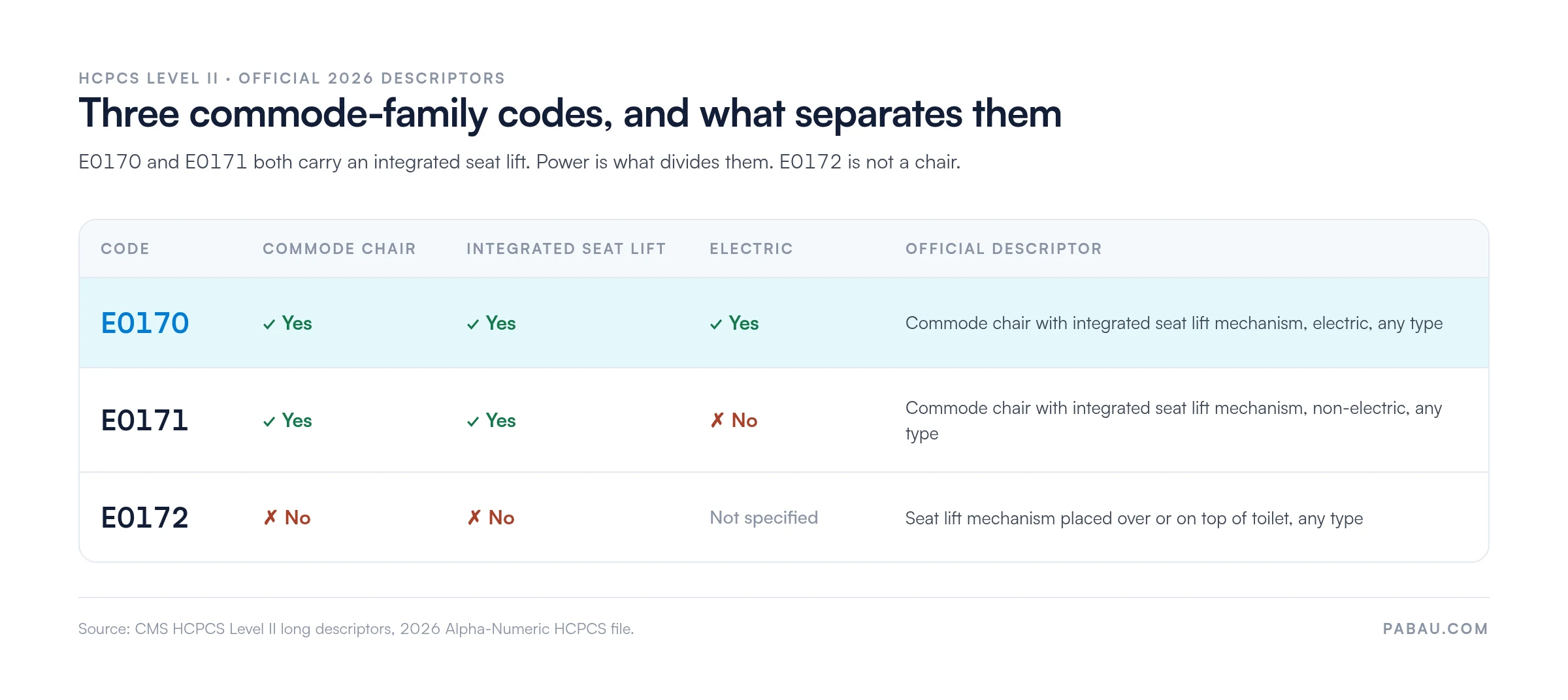
E0170 and E0171 describe the same device with one difference: E0170’s integrated seat lift is electric, and E0171’s is not. E0172 is not a chair at all. It is a seat lift mechanism placed over or on top of a toilet. Arm configuration separates E0163 from E0165, not these three codes. E1399 is the miscellaneous durable medical equipment fallback, used only when no specific HCPCS code describes the equipment.
The table below sets out the official descriptor for each code and the situation it fits.
Selecting the wrong code among these is a compliance problem in either direction. Billing E0170 for a chair with no powered lift is upcoding. Billing E0171 for a powered unit to dodge the documentation burden is downcoding. A common error is billing E0170 for a commode fitted with a separate raised toilet seat or an add-on lift cushion. That combination does not meet the built-in requirement. When a product’s classification is unclear, suppliers can request a coding verification from the Pricing, Data Analysis and Coding contractor. Stripped back to the features that decide the code, the three descriptors line up like this.
E0170 denials follow predictable patterns, and most are preventable before submission. Knowing the top reasons lets billing staff build a checklist that catches problems before the claim reaches the DME MAC. Effective denial management in healthcare starts with pattern recognition. When the same denial reason lands on more than three claims in a quarter, the process is at fault rather than the individual file.
Medicare claims appeals run through five levels. Most E0170 denials are resolved at level one or two, provided the missing documentation can still be produced. The pathway runs as follows:
At redetermination, the most effective addition to an appeal file is a letter of medical necessity. It should come from the ordering physician and answer the denial reason directly. Generic letters that repeat the diagnosis without tying the functional limitation to the seat lift rarely succeed. Remittance advice codes tell billing staff which denials are worth appealing first. Log them against each claim rather than working the queue in date order.
Medicare reimburses E0170 at the lesser of the supplier’s submitted charge or the fee schedule allowable for the claim’s service area. Allowable amounts for durable medical equipment are published in the CMS DMEPOS Fee Schedule, updated annually and varying by Medicare pricing region. Suppliers can look up the current allowable using the CMS fee schedule search tool.
Patient cost-sharing under Part B is 20% of the approved amount after the annual deductible, per Chapter 15 of the Medicare Benefit Policy Manual. The supplier receives 80% of the allowable from Medicare, and the patient or a secondary payer covers the rest. Specific dollar figures are left out here because they change with each annual fee schedule update. Verify the current allowable before quoting a patient or completing authorization paperwork.
Use the CMS DMEPOS Fee Schedule lookup at cms.gov rather than a third-party fee estimator for E0170 figures. Regional adjustments apply in competitive bidding areas, and a stale figure from a commercial tool creates a patient billing dispute when the actual reimbursement differs. Check the allowable at the start of each calendar year and after any mid-year CMS update.
CMS Policy Article A52461 governs Medicare only. Medicaid programs, Medicare Advantage plans, and commercial payers set their own coverage policies for E0170, and those policies can differ materially from Medicare’s. Treating Medicare’s criteria as universal is one of the more expensive habits in multi-payer DME billing.
Keep each payer’s rules recorded against the payer rather than in a shared procedure note. That is what stops a Medicare criterion being applied to a Medicaid claim. Those mix-ups are the most common source of avoidable rework in a multi-payer DME operation.
In most DME practices the E0170 file is scattered before it is ever assembled. The physician order arrives by fax and the progress notes sit in the clinical record. The delivery receipt is scanned into a shared drive, and the accreditation certificate lives with the compliance officer. Billing staff pull the pieces together one claim at a time, and they only find out what is missing once the DME MAC says so.
Pabau holds all of it against the patient record instead. The signed order and the progress note documenting the transfer limitation sit on one record. So do the delivery receipt and the CMN, where a payer asks for one. The claim is built from that record rather than from a separate spreadsheet. Payer rules and denial codes are tracked in the same place, so a pattern across several E0170 claims is visible while it is still fixable.
For a DME billing team the outcome is fewer claims held at prepayment review, and shorter appeal files. The medical necessity evidence was captured when the order was taken, rather than reconstructed after a denial.

Pabau keeps the physician order, medical necessity notes and delivery confirmation on one patient record. DME billing teams submit complete E-series claims and spend less time working denials.

E0170 is a narrow code, and the two things that decide it are settled before the equipment moves. The device has to carry a powered seat lift built into the chair. The physician’s notes have to explain why this patient cannot transfer without one. Get either wrong and the denial arrives whatever the patient’s clinical picture looks like.
The practical move is to treat the order date as the deadline for the whole file, not the submission date. Suppliers who work that way spend their time on delivery rather than on redetermination letters. Their appeal rate on commodes drops with no change to the clinical side of the business.
Book a demo to see how Pabau keeps E0170 orders, medical necessity notes and delivery receipts on one record, ready for the claim.

List Item #1
List Item #2
HCPCS code E0170 is the Level II code for a commode chair with an integrated electric seat lift mechanism. Suppliers use it to report that equipment to Medicare Part B and other payers when a documented functional limitation prevents safe toilet transfers.
Yes, Medicare Part B covers E0170 as durable medical equipment under CMS Policy Article A52461. The patient must have a documented functional limitation requiring mechanical seat lift assistance, and the supplier must be DMEPOS-accredited. The patient pays 20% coinsurance after the annual Part B deductible.
Both codes describe a commode chair with the same integrated seat lift mechanism. E0170 covers the electric version and E0171 covers the non-electric version. Power is the only distinction, so check whether the delivered unit’s lift is powered before you choose between them.
Medicare does not currently list E0170 on its DMEPOS Prior Authorization required items list, but that list changes annually. Medicaid programs and commercial payers may impose their own authorization requirements, so verify with each payer before dispensing.
A complete E0170 claim file holds four documents plus proof of accreditation. You need a physician order signed before dispensing, and progress notes documenting the functional limitation that requires a seat lift. You also need a Certificate of Medical Necessity where the payer asks for one, and a delivery receipt carrying the beneficiary’s signature. Current DMEPOS accreditation must be on file too.
The Medicare allowable for E0170 varies by pricing region and is updated annually in the CMS DMEPOS Fee Schedule. Use the CMS fee schedule search tool at cms.gov to look up the current allowable for your jurisdiction, because the figures change each year.



