CPT Code 62284: Injection procedure for myelography
CPT Code 62284: official descriptor and procedure overview The American Medical ...

Last Updated: Oct 19, 2026
B9004 is the HCPCS Level II code for a parenteral nutrition infusion pump, portable.
The code turns on portability. A portable pump is B9004 and a stationary one is B9006. Billing the stationary code for an ambulatory device is a frequent denial trigger. Medicare no longer requires a Certificate of Medical Necessity for parenteral nutrition. A standard written order and the supporting clinical records carry the claim instead.
Let Pabau's smart automation suggest the right codes, reduce claim denials, and keep your practice compliant—effortlessly.
Automate repetitive tasks and focus on what matters most—your patients.
Reduce coding errors and ensure compliance with the latest regulations.
Clean claims, fewer denials, and faster reimbursements.
Powerful insights and reporting to help your practice thrive.
HIPAA compliant SOC 2 certified GDPR-compliant Trusted by 4,000+ clinics worldwide

HCPCS code B9004 covers a portable parenteral nutrition infusion pump, not a stationary pump and not an enteral pump.
Medicare Part B pays for B9004 under the prosthetic device benefit, with claims processed by the DME MAC.
Billing B9006, the stationary pump code, for a portable device is a frequent cause of denials on these claims.
Medicare retired the CMN for parenteral nutrition in 2023, so a standard written order and clinical records now carry the claim.
Pabau’s medical claims management software supports DME billing workflows, modifier tracking, and clean-claim submission to MAC jurisdictions.
HCPCS code B9004 is the Level II code for a parenteral nutrition infusion pump that is portable. The official CMS descriptor places it in the B-range of HCPCS Level II, which covers enteral and parenteral nutrition equipment and supplies. CMS maintains the code and republishes the HCPCS Level II code set each year.
The B-range runs from B4034 through B9999 and covers enteral and parenteral nutrition equipment, solutions, and supplies. B9004 sits in the infusion pump sub-range alongside B9006, the stationary parenteral nutrition pump. B9999 is the not-otherwise-classified code for parenteral supplies, not a pump code.
The code applies to one device in one clinical scenario. Items outside that scope belong to a different B-range code, and that boundary is where most miscoding starts.
A portable pump billed as B9006, or an enteral pump billed as B9004, creates a medical-necessity mismatch that the MAC’s automated edits flag at adjudication.
B9004 and B9006 describe the same type of equipment, a parenteral nutrition infusion pump. They differ on one clinical variable, which is portability. Choosing the wrong one is a frequent cause of B9004 claim denials.
The order and the clinical notes must document the patient’s need for ambulatory infusion. Without that documentation, a MAC reviewer cannot tell a portable device claim from a stationary one. The claim then defaults to non-covered status, or it prompts a request for additional information.
Medicare Part B covers parenteral nutrition and its infusion pump under the prosthetic device benefit, with claims processed by the DME MAC. The coverage policy is the national DME MAC Local Coverage Determination for Parenteral Nutrition, L38953, together with Policy Article A58836.
Qualifying criteria that establish medical necessity for parenteral nutrition, and therefore for the associated pump, typically include:
Reimbursement rates for B9004 are published in the annual CMS DMEPOS fee schedule. Amounts change each January, so check the current-year rate with the CMS fee schedule lookup before quoting a figure. Rates are jurisdiction-adjusted, so never state a dollar amount without naming the year’s schedule.
Verify the applicable LCD revision on your DME MAC’s website before submitting any B9004 claim. Coverage criteria, documentation checklists, and diagnosis code lists can change between revisions. Submitting against a superseded LCD produces avoidable denials.
Documentation for a B9004 claim must satisfy both the LCD’s medical necessity criteria and the DMEPOS supplier’s record-keeping obligations. Missing one required element is enough for the MAC to deny or recoup the claim. Solid medical billing compliance practices start with a complete checklist before the claim is submitted.
Store all documentation for a minimum of seven years from the date of service, per standard Medicare record retention requirements. A superbill that captures the diagnosis codes, the device details, and the order date gives the billing team one reference document.
Billing B9004 correctly means confirming medical necessity, selecting the right modifier, attaching the correct ICD-10 codes, and routing the claim to the right MAC jurisdiction. Pabau, the practice management platform we build, runs that sequence through its medical claims management software. It tracks modifier assignments, flags missing documentation, and supports submitting a clean claim to the DMEPOS MAC.
Modifier reference for B9004 claims:
Parenteral and enteral nutrition pumps are priced under the DMEPOS parenteral and enteral nutrition fee schedule. Confirm the payer’s rental or purchase rules before applying a modifier, because the wrong modifier can trigger a payment adjustment or a denial.
Whether B9004 requires prior authorization depends on the payer and the MAC jurisdiction. Medicare does not require it for the pump itself, but several other scenarios still create a pre-authorization obligation.
A prior authorization request should carry the standard written order, the clinical notes establishing medical necessity, and the relevant ICD-10 diagnosis codes. Add the device specifications that confirm portability. Incomplete requests cause authorization denials that later cascade into claim denials.
Every B9004 claim must carry at least one ICD-10-CM diagnosis code from the LCD’s list of covered conditions. The diagnosis code must reflect the patient’s documented condition. Codes outside the covered list create a medical-necessity mismatch that the MAC’s automated edits catch at adjudication.
Always check the current LCD’s diagnosis code list before submitting. The covered list can change between LCD revisions, and a code valid under a prior revision may not appear in the current one. Our ICD-10-CM code library carries a reference page for each of these diagnoses, including the documentation a payer expects behind it.
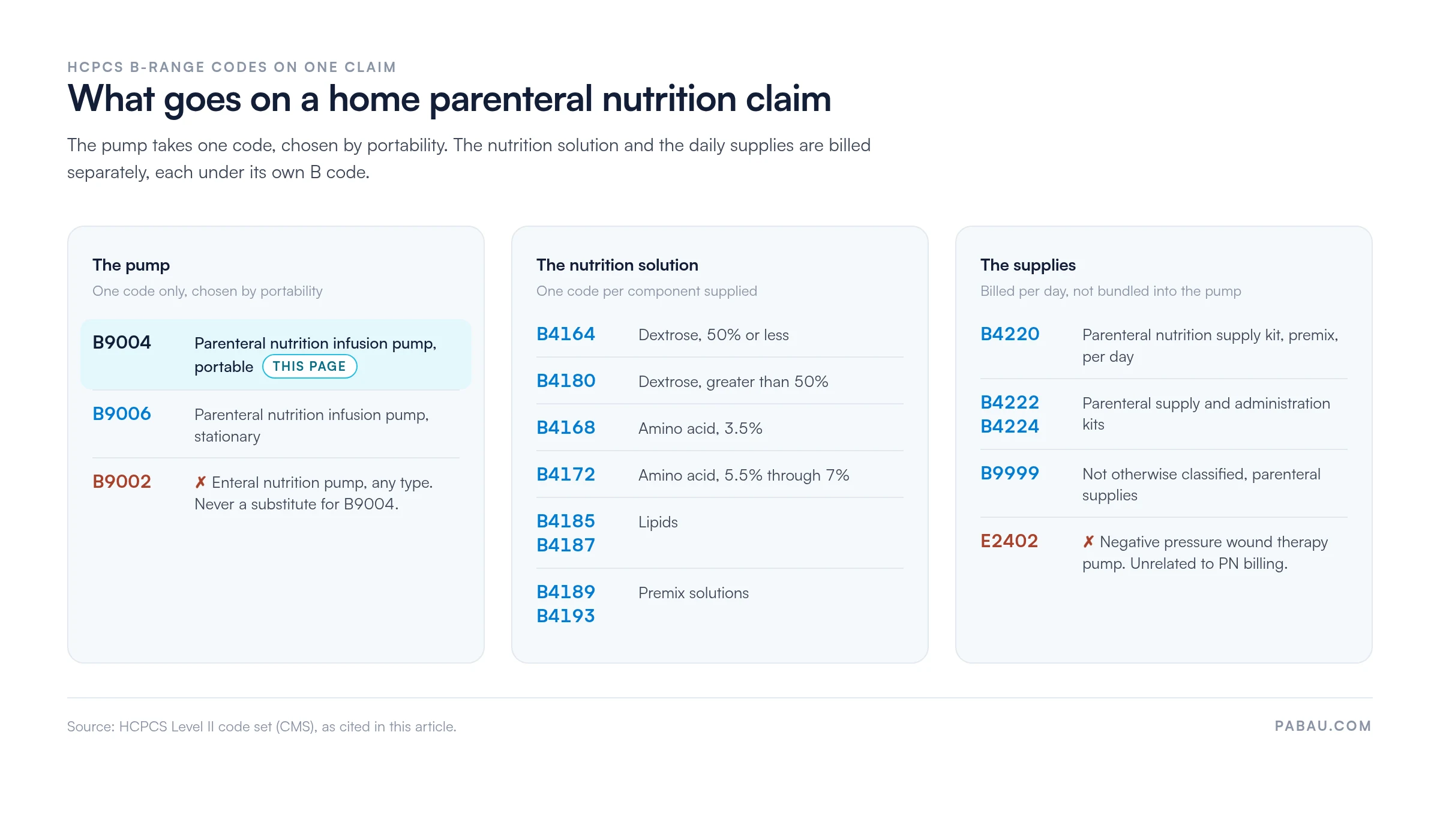
B9004 is rarely the only code on a parenteral nutrition claim. Billers co-bill nutrition solution codes, supply codes, and accessory codes alongside the pump code. Knowing which items are billed separately prevents unbundling errors and supports complete claim submission. The AAPC HCPCS code reference carries crosswalk information for the B-range.
When billing solution codes alongside B9004, each component is billed under its own code. Units correspond to the grams or milliliters supplied per day. Keep solution billing distinct from pump billing on the claim to avoid bundling edits. The map below shows where each code sits on a single home parenteral nutrition claim.
Each of the five scenarios below is preventable at the documentation review stage, which is where a B9004 claim is cheapest to fix. Solid denial management strategies address each root cause before submission rather than after. A well-structured medical billing workflow catches these errors before the claim goes out.
Run a pre-submission audit on every B9004 claim line. Confirm the device is documented as portable and the standard written order is signed and on file. Check that the ICD-10 code appears on the LCD’s covered list, and add the KX modifier once every criterion is met. Catching one missing element before submission costs minutes, while appealing a denied claim costs hours.
Most DMEPOS billing teams track B9004 documentation across a spreadsheet, a shared drive, and the supplier’s delivery system. The portability evidence sits in one place and the written order in another, so the missing piece only surfaces when the remittance arrives.
Pabau holds the order, the clinical notes, the device record, and the claim line on the same patient file. Modifier assignments are tracked against the code, so an RR or NU selection is visible to whoever reviews the claim. Documentation that is still outstanding gets flagged before submission rather than after a denial.
The outcome is a shorter pre-submission check. The billing team confirms portability, the written order, and the diagnosis in one view, then submits to the correct DME MAC jurisdiction.

Pabau helps DME suppliers and billing teams track modifier assignments, manage claim documentation, and submit clean claims to MAC jurisdictions, all from one platform.

B9004 has a narrow scope, and that is what makes it manageable. Bill it for a portable parenteral nutrition pump supplied by an enrolled DMEPOS supplier. The claim needs a qualifying ICD-10 diagnosis and a signed standard written order on file.
The judgment worth carrying into the next claim is that portability is a documentation question before it is a coding one. If the order and the device record do not say portable, a reviewer has no basis to pay B9004 rather than B9006.
Pabau’s claims tools track modifier assignments, flag outstanding documentation before submission, and manage denial workflows when claims come back. Book a demo to see how Pabau handles DME and outpatient billing end to end.

Billing the supplies that travel with the pump? HCPCS code B4220 covers the premix parenteral nutrition supply kit that is billed per day alongside B9004.
Want a reference for what clean claim standards look like? Denial codes in medical billing explains the CARC and RARC codes you will see on remittances when a B9004 claim is rejected.
Looking for the broader billing compliance framework? Revenue cycle management explains how DME billing fits into the full RCM cycle from prior auth through remittance posting.
Submitting claims electronically? Electronic remittance advice explains how 835 ERA files map back to individual claim lines so you can reconcile B9004 payments against submitted amounts.
HCPCS code B9004 is the Level II code for a portable parenteral nutrition infusion pump. Enrolled DMEPOS suppliers bill it when they furnish an ambulatory pump to a patient on home parenteral nutrition. It covers the pump only, and nutrition solutions and accessories are billed under separate codes.
B9006 is the code for a stationary parenteral nutrition infusion pump, and B9004 is for a portable one. Use B9004 when the patient needs an ambulatory pump during infusion. Billing B9006 for a portable device is a frequent denial trigger on these claims.
Yes. Medicare Part B covers B9004 under the prosthetic device benefit, with claims processed by the DME MAC. The patient needs a qualifying diagnosis, such as short bowel syndrome or severe malabsorption, and the claim must meet LCD L38953. Reimbursement rates are set in the annual DMEPOS fee schedule and vary by jurisdiction.
A B9004 claim needs a signed standard written order that names the portable pump, plus clinical notes establishing the qualifying diagnosis. It also needs device specifications confirming portability, a signed delivery receipt, and evidence of DMEPOS supplier enrollment. Medicare eliminated the CMN for dates of service on or after 1 January 2023. Missing one element is grounds for denial or recoupment.
Common denial reasons include an incomplete standard written order and billing B9006 instead of B9004 for a portable device. A missing prior authorization also causes denials when the payer requires one. Claims fail too when the ICD-10 diagnosis is off the LCD’s covered list, or the supplier was not DMEPOS-enrolled at the time of service.
B9004 is not on CMS’s Required Prior Authorization List of DMEPOS items, so Medicare does not require prior authorization for the pump itself. Individual MACs may impose jurisdiction-specific requirements, and most commercial payers require authorization for home parenteral nutrition equipment. Confirm with the specific MAC and any commercial payer before delivering the pump.
Commonly paired ICD-10-CM codes include K91.2 (short bowel syndrome), K90.0 (celiac disease), and K90.3 (pancreatic steatorrhea). K50.00 (Crohn’s disease of small intestine), K56.60 (intestinal obstruction), and E46 (protein-calorie malnutrition) also appear. Every code used must appear on the current LCD’s covered diagnosis list for the applicable MAC jurisdiction.