HCPCS code C1731: Catheter billing, OPPS reimbursement, and denial guide
HCPCS code C1731: Official descriptor and code series context HCPCS code C1731 i...

Last Updated: Oct 8, 2026
B9006 is the HCPCS Level II code for parenteral nutrition infusion pump, stationary.
The code covers the pump only. Nutrient solutions, supply kits and administration kits are billed under their own codes. Medicare covers B9006 only when the patient qualifies for parenteral nutrition under the DME MAC Parenteral Nutrition LCD (L38953). Only one pump, stationary or portable, is paid at a time.
Let Pabau's smart automation suggest the right codes, reduce claim denials, and keep your practice compliant—effortlessly.
Automate repetitive tasks and focus on what matters most—your patients.
Reduce coding errors and ensure compliance with the latest regulations.
Clean claims, fewer denials, and faster reimbursements.
Powerful insights and reporting to help your practice thrive.
HIPAA compliant SOC 2 certified GDPR-compliant Trusted by 4,000+ clinics worldwide

HCPCS code B9006 describes a stationary parenteral nutrition infusion pump. B9004 is the portable version, and B9002 is the enteral pump.
Medicare covers B9006 only when parenteral nutrition itself is covered under the DME MAC Parenteral Nutrition LCD (L38953).
Only one pump, stationary or portable, is paid at a time, so B9004 and B9006 never belong on claims for the same period.
Insufficient documentation caused 69.4% of parenteral nutrition improper payments in 2024, so the medical record has to be complete before the first claim.
Pabau’s claims management software keeps orders, records and claim status in one place, so missing documents are caught before submission.
HCPCS code B9006 sits in the B-series, the section of HCPCS Level II codes that CMS maintains for enteral and parenteral therapy. The official descriptor reads: Parenteral nutrition infusion pump, stationary.
The B-series runs from B4000 to B9999. It covers enteral formulas, parenteral solutions, supply kits and the pumps that deliver them. B9006 occupies a narrow slot. It is the stationary pump used for parenteral nutrition, which is delivered intravenously rather than through the gut. Its portable counterpart is B9004, and enteral pumps bill under B9002.
B9006 covers the stationary infusion pump that delivers parenteral nutrition at home. The nutrient solutions and kits used with it have their own HCPCS codes, so they never fold into the pump line.
The most common coding error is reaching for an enteral code. B9002 and the deleted B9000 describe enteral feeding pumps, so neither one fits an intravenous nutrition pump. The second error is billing B9006 for a pump the patient carries, which is B9004.
Medicare covers B9006 only when the beneficiary qualifies for parenteral nutrition. The criteria come from the DME MAC Parenteral Nutrition LCD (L38953) and its Policy Article A58836, which suppliers must review before billing. Enteral and tube-feeding criteria do not apply to this code.
Under the LCD, the beneficiary needs one of two conditions. The first is a condition of the small intestine or its exocrine glands that significantly impairs nutrient absorption. The second is a motility disorder of the stomach or intestine that prevents nutrients from being moved and absorbed.
B9006 sits next to several B-series codes for nutrition pumps and kits. Choosing the wrong one leads to a denial or a recoupment after review. The table below shows the alternatives coders mix up most often.
When in doubt between B9006 and B9004, ask how the patient uses the pump. A pump that stays at the bedside is stationary, while one worn in a backpack or bag is portable. If the patient receives enteral feeds, neither code applies. The decision guide below puts those checks in order, together with the setting rules.
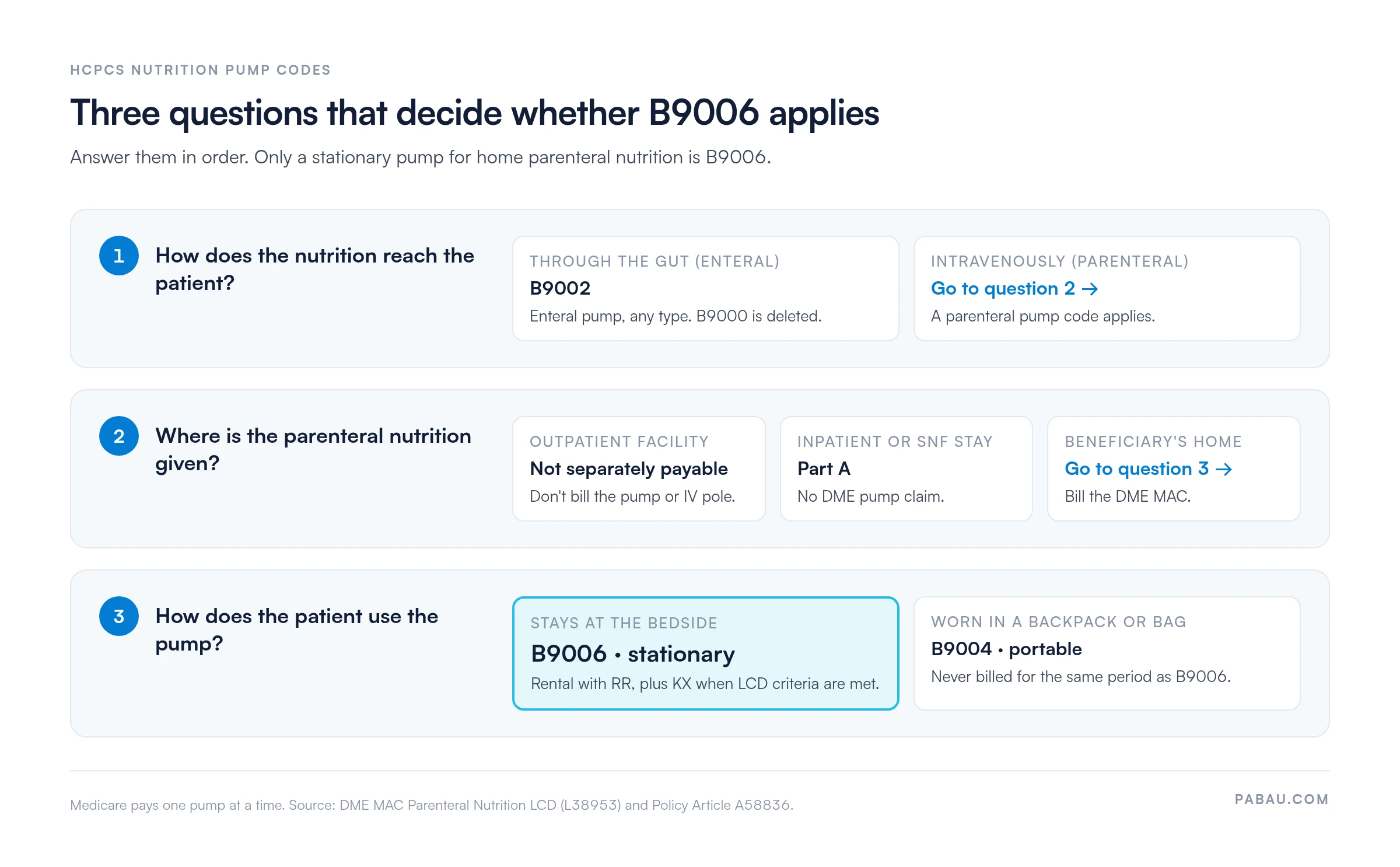
An enrolled DMEPOS supplier bills B9006, not the ordering practitioner. The workflow follows the standard DME rental process, with the parenteral nutrition LCD layered on top. Tracking orders, modifiers and claim status in one claims workspace cuts down the manual checking.
A clean claim on first pass needs every field to match the documentation. Beneficiary name, Medicare ID, date of service, supplier NPI and HCPCS code all have to agree. A single mismatch triggers a rejection before anyone reviews the clinical record.
Check for an overlapping pump before every first claim. If another supplier is already billing B9004 or B9006 for the beneficiary, your claim will deny because Medicare pays one pump at a time. Ask at intake whether the patient already has a portable or stationary pump at home.
Insufficient documentation is the leading problem on parenteral nutrition claims. CMS compliance data for parenteral nutrition show a 33% improper payment rate in 2024, with insufficient documentation behind 69.4% of those errors. Documentation follows the LCD and Policy Article, and every item below belongs in the supplier’s file before the claim goes out.
Understanding medical billing workflows end to end helps suppliers see when each document must arrive relative to delivery and submission. Noridian has retired the old nutrition and infusion pump DME information forms, so no separate certificate replaces the medical record. A reviewer can deny the claim over one missing element in the record.
Most B9006 denials share one root: Documentation that does not meet the Parenteral Nutrition LCD. The denial management process starts with the CARC (Claim Adjustment Reason Code) on the ERA. From there, trace the code back to the missing document or modifier behind it.
Medicare does not universally require prior authorization for B9006. Coverage instead rests on the Parenteral Nutrition LCD, the KX modifier, and a record that survives review. Some state Medicaid plans do require prior authorization.
Review the active LCD on the CMS Medicare Coverage Database rather than relying on archived copies. Confirm current descriptors against the latest CMS HCPCS quarterly update.
Turn the LCD into a one-page intake checklist for B9006. List the qualifying conditions, the test of permanence, and the enteral rule-out. Staff can work through it with each new referral before the order is signed. Missing criteria then come to light before the pump leaves the warehouse.
Medicare sets B9006 allowed amounts through the DMEPOS fee schedule, not the Physician Fee Schedule. CMS publishes updated fee schedule files throughout the year.
Because rates change, no fixed dollar figure is stated here. Look up the current B9006 amount in the latest DMEPOS file on the CMS website. Medicare pays 80% of the allowed amount once the beneficiary’s Part B deductible is met.
Strong revenue cycle management for a DMEPOS supplier means tracking rental months per beneficiary and catching duplicate-pump conflicts. It also means reconciling ERA payments against expected allowed amounts each cycle.
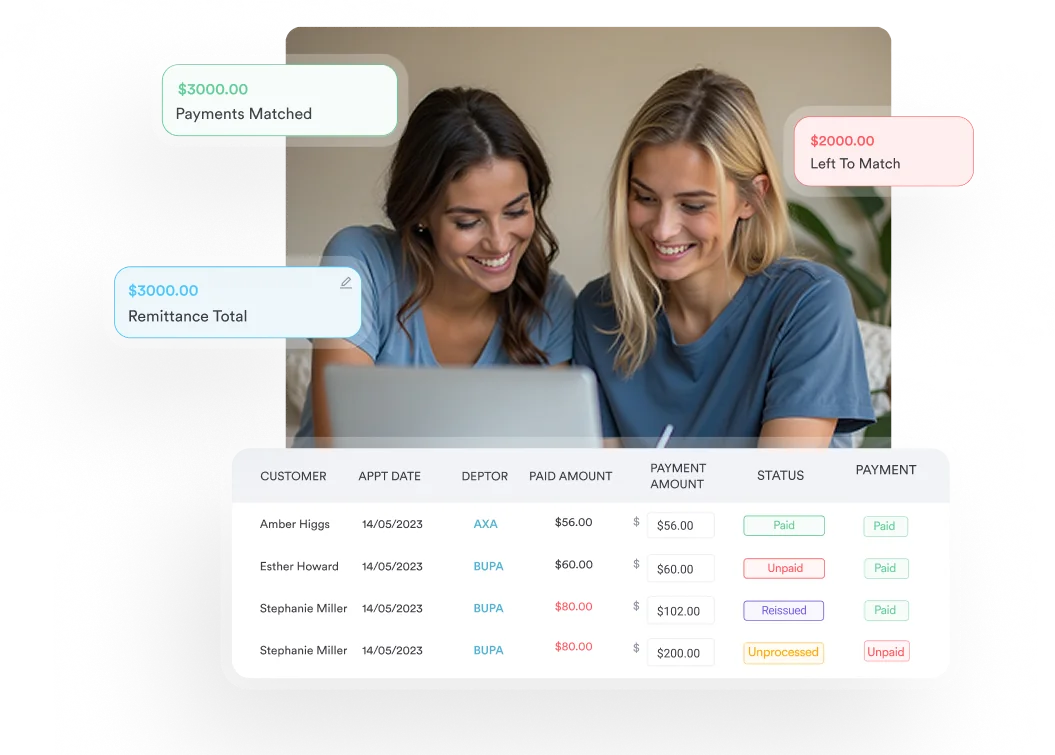
Most B9006 errors start with a scattered record. The order sits in one inbox, the practitioner’s notes in another system, and the claim status in a spreadsheet. Nobody sees the missing permanence statement until the denial arrives.
Pabau, our all-in-one practice management system, keeps patient records, documents and claims in the same place. Billing teams can track each claim, read denial reason codes and manage resubmissions without losing work in spreadsheets.
The result is a claim that leaves with its documentation already attached. A missing permanence statement gets spotted at intake, when it takes minutes to fix, instead of months later in an appeal.

Pabau’s claims management tools help billing teams keep orders, records and claim status together, so missing documents are caught before claims go out the door.

B9006 has a narrow scope: One stationary pump for home parenteral nutrition. The risk lies in the coverage behind it. Every claim depends on the patient meeting the Parenteral Nutrition LCD, a record that proves the test of permanence, and no overlapping portable pump.
Suppliers who check the LCD at intake keep B9006 denials rare, because the record is complete before the first rental month is billed. Pabau helps billing teams build that habit into every claim.
Book a demo to see how it works for DME and home infusion billing workflows.

Need a cleaner claim submission process? Submitting clean claims covers the field-by-field requirements that prevent rejections before claims reach a human reviewer.
Struggling with denied claims across multiple codes? Denial management in healthcare walks through a systematic approach to CARC analysis and appeal workflows.
Want to understand the broader billing cycle? What is revenue cycle management explains how claim submission, payment posting, and AR management fit together.
Billing the supply kit alongside the pump? HCPCS code B4220 covers the premix parenteral nutrition kit billed per day of infusion.
Working with a parenteral supply that has no specific code? HCPCS code B9999 explains when the not-otherwise-classified parenteral code is allowed.
HCPCS code B9006 covers a stationary parenteral nutrition infusion pump used at home. It covers the pump only. Parenteral solutions, supply kits, the administration kit and the IV pole are billed under their own codes.
An enrolled DMEPOS supplier bills B9006 to the beneficiary’s DME MAC on the CMS-1500 or its electronic equivalent, with Place of Service 12 (Home). The pump is billed as a rental with the RR modifier, plus KX when the Parenteral Nutrition LCD criteria are met.
The most common cause is a record that does not meet the Parenteral Nutrition LCD. A missing KX modifier and a duplicate pump billed for the same period are close behind. Coding an enteral pump code instead of B9006 also triggers denials. Check the CARC on the remittance, then fix the specific problem it names before resubmitting.
Documentation follows the LCD and Policy Article. The supplier needs a standard written order and medical records showing a qualifying condition, the test of permanence, and why enteral nutrition was ruled out. A signed proof of delivery is also required.
Medicare sets the B9006 allowed amount through the DMEPOS fee schedule, which CMS updates during the year. Look up the current amount in the latest DMEPOS file on the CMS website. Medicare pays 80% of the allowed amount after the Part B deductible is met.
Both are parenteral nutrition infusion pumps. B9006 is the stationary pump, and B9004 is the portable one. Medicare pays only one pump at a time, so the two are never billed for the same period.