

CPT Code 52352: Ureteroscopic stone removal billing guide
CPT Code 52352: Official descriptor and procedure overview CPT Code 52352 descri...

Last Updated: Oct 30, 2026
99464 is the CPT code for attendance at delivery and initial stabilization of newborn. The attendance must be requested by the delivering physician or other qualified health care professional.
Pediatricians, neonatologists, and family physicians report it when they attend a birth at the delivering clinician's request because the newborn is at risk. It covers delivery room assessment and stabilization only. If the newborn needs active resuscitation, 99465 is reported instead, never alongside 99464.
Let Pabau's smart automation suggest the right codes, reduce claim denials, and keep your practice compliant—effortlessly.
Automate repetitive tasks and focus on what matters most—your patients.
Reduce coding errors and ensure compliance with the latest regulations.
Clean claims, fewer denials, and faster reimbursements.
Powerful insights and reporting to help your practice thrive.
HIPAA compliant SOC 2 certified GDPR-compliant Trusted by 4,000+ clinics worldwide

CPT code 99464 applies when a separate clinician attends a birth, at the delivering clinician’s request, to assess and stabilize the newborn.
The request must come from the delivering physician or other qualified health care professional, and the record must show who made it.
CPT bars reporting 99464 with 99465, so bill 99465 alone when the newborn needs active resuscitation.
Pabau’s claims management software validates each claim before submission and flags rejected claims with the field that needs fixing.
This is the American Medical Association’s official descriptor for CPT code 99464. Attendance at delivery (when requested by the delivering physician or other qualified health care professional) and initial stabilization of newborn.
Two elements must both be present for the code to apply. The first is a request from the delivering physician or other qualified health care professional. The second is the physical presence of a separate clinician who assesses and stabilizes the infant.
99464 is an evaluation and management (E/M) code. It sits in CPT’s newborn care services (99460-99465), next to the neonatal intensive care codes (99477-99480). It covers the delivery room moment only, before the newborn moves to nursery or NICU care. Routine nursery visits bill under other codes.
Billing clinicians are typically pediatricians, neonatologists, or family medicine physicians. An obstetrician can’t bill 99464 for their own delivery, because the code requires someone other than the delivering provider. The American Academy of Pediatrics (AAP) coding guidance treats this “other clinician” requirement as the code’s defining criterion.
Use 99464 when a second clinician attends the birth to assess and stabilize the newborn. The request must come from the delivering physician or other qualified health care professional. The most common clinical triggers include:
Attendance begins when the clinician enters the delivery room and ends when the newborn moves to nursery or NICU care. If the infant needs no intervention and goes straight to the mother, 99464 still applies. The code pays for attendance and readiness to stabilize, whether or not stabilization turns out to be needed.
Place of service must reflect an inpatient hospital setting (POS 21) or an equivalent birthing center where labor and delivery occurs. The code doesn’t apply to outpatient or office encounters.
The three most frequently confused codes in newborn billing are 99464, 99460, and 99465. Each describes a distinct clinical scenario and a different level of service.
99464 vs. 99460: CPT 99460 covers initial hospital or birthing center care for a normal, healthy newborn on the first day of life. It’s a post-delivery nursery code, while 99464 covers the delivery itself. The same physician may bill 99464 for the attendance and 99460 for the later normal newborn care visit. Each needs its own documentation entry.
99464 vs. 99465: CPT 99465 covers delivery room resuscitation. That means positive pressure ventilation and/or chest compressions when the newborn’s breathing or cardiac output is inadequate.
CPT instructs coders not to report 99464 in conjunction with 99465, so the two codes are mutually exclusive. When the attending clinician resuscitates the newborn, bill 99465 alone and document the specific interventions.
The decision below follows a requested attendance through to the one delivery room code it supports, plus the care code added after transfer.
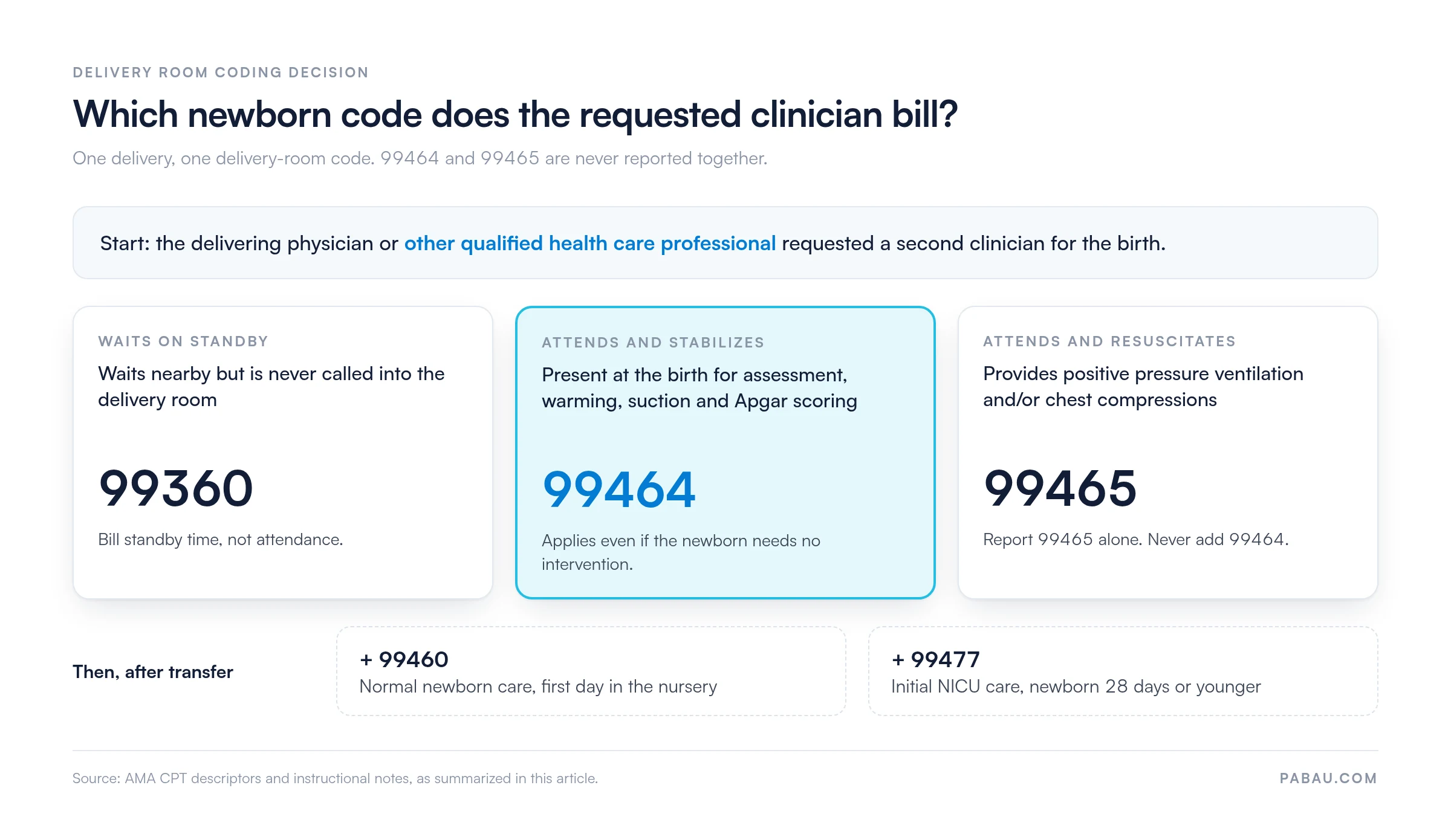
CPT code 99464 belongs to a family of codes covering newborn services from the delivery room through intensive neonatal care. Knowing the full range helps coders pick the right code when a newborn’s condition changes during an admission.
A newborn attended at delivery and then admitted straight to the NICU carries both 99464 and 99477 for the same date. They’re separately payable because they cover distinct services, each with the clinician present.
Some commercial carriers apply column 1/column 2 edits to this pair, so check payer-specific NCCI edits before billing both.
Documentation is where most 99464 claims fail. A name on the delivery note isn’t enough. The medical record has to show the clinician’s separate presence and role through each of the elements below.
Required documentation elements, per AAP coding guidance:
The shortest compliant note is a brief, separately signed entry that answers three questions. Who requested the attendance, why was it requested, and what did the attending physician find and do? For submitting a clean claim, that note must be in the chart before the claim is generated. Retroactive addenda are a red flag in audits.
CPT code 99464 sits outside the delivering physician’s global obstetric package. That package covers the delivering physician’s prenatal visits, the delivery, and postpartum care. Because 99464 requires a different clinician, it’s separately payable and not included in the global OB fee.
Payers sometimes bundle 99464 into the OB global in error when both physicians share the same Tax ID, as in a group practice. A modifier won’t reliably fix that. The dependable fix is to bill under the attending physician’s individual NPI rather than the group NPI. Add a note in the record establishing that they are a separate provider.
Modifiers commonly associated with 99464:
Modifier 59 doesn’t belong on 99464. NCCI policy reserves 59 for services other than E/M, and 99464 is itself an E/M code. It sits in CPT’s Delivery/Birthing Room Attendance and Resuscitation Services, within the E/M section (99202-99499). A routine 99464 claim with no same-day procedure needs no modifier 25 either.
Payer policies vary, so check each payer’s billing manual before submission.
A 99464 claim requires at least one ICD-10 diagnosis code supporting medical necessity. The primary diagnosis is typically a Z38 liveborn infant code identifying the newborn’s status.
Secondary codes capture the condition that prompted the attendance request. The CMS ICD-10 coding resources confirm the current tabular hierarchy for these pairings.
Always check that the secondary diagnosis codes reflect documented findings. Adding a high-risk code without documentation support creates upcoding exposure. Pick the most specific code available. Replace P07.30 (preterm newborn, unspecified weeks) with the matching P07.3x subcode when gestational age is documented.
Medicare covers CPT code 99464 as a separately payable service when a clinician other than the delivering obstetrician submits the claim with documented medical necessity. Under CMS policy, the code isn’t bundled into the global OB package when a different provider bills it under a separate NPI.
Key payer considerations:
For practices billing 99464 under Medicare, RVU values and payment amounts change annually with the Medicare Physician Fee Schedule update. Use the CMS Physician Fee Schedule lookup tool to verify current payment rates for your practice locality before projecting revenue.
Medicare reimbursement for CPT code 99464 is calculated from the AMA’s RVU data and applied through the Medicare Physician Fee Schedule. Rates update each January 1 and vary by geographic practice cost index (GPCI). So no static figure here should be used for contracting or revenue cycle planning.
The FastRVU 2026 RVU lookup pulls CMS data and applies GPCI adjustments by state and locality. Enter code 99464 and choose your state and payment locality. The tool returns the work, practice expense, and malpractice RVUs, plus the Medicare rate for that locality.
General benchmarks (verify against current MPFS for your locality):
For Medicaid rates, check your state’s fee schedule directly. Medicaid payment for newborn attendance varies widely by state and often changes mid-year.
Most 99464 denials trace to one of six root causes. Each has a specific fix to apply before resubmission.
A denial management workflow that reviews 99464 claims before submission catches most of these errors before they become denials. Check specifically for NPI/TIN conflicts, a missing secondary ICD-10 code, and a 99465 on the same claim.
Reactive rework costs three to five times more staff time than a structured pre-claim audit. Each 99464 denial that ages past 90 days also carries write-off risk. The list of medical billing denial codes shows the CARC/RARC codes typically attached to bundling and medical necessity denials.
Run a monthly audit of your 99464 claims filtered by rendering NPI. Flag any claim where the rendering NPI matches the billing NPI on an obstetric global service billed the same date. These are the claims most likely to trigger a bundling denial. They are also the easiest to prevent, with NPI separation at charge entry.
Beyond the denial triggers above, coders make a few consistent errors with this code. They rarely cause an immediate denial, but they build audit exposure over time.
Neonatology and pediatric billing teams usually catch 99464 errors by hand, reviewing each delivery room claim before it goes out. That works, but it’s slow, and an NPI or diagnosis slip can still get through on a busy week.
Pabau, the practice management platform we build, includes claims management software that validates each claim before submission. A missing field or invalid code is caught before the payer can bounce the claim back. Rejected claims are flagged “Needs action”, with a direct link to the field to correct.
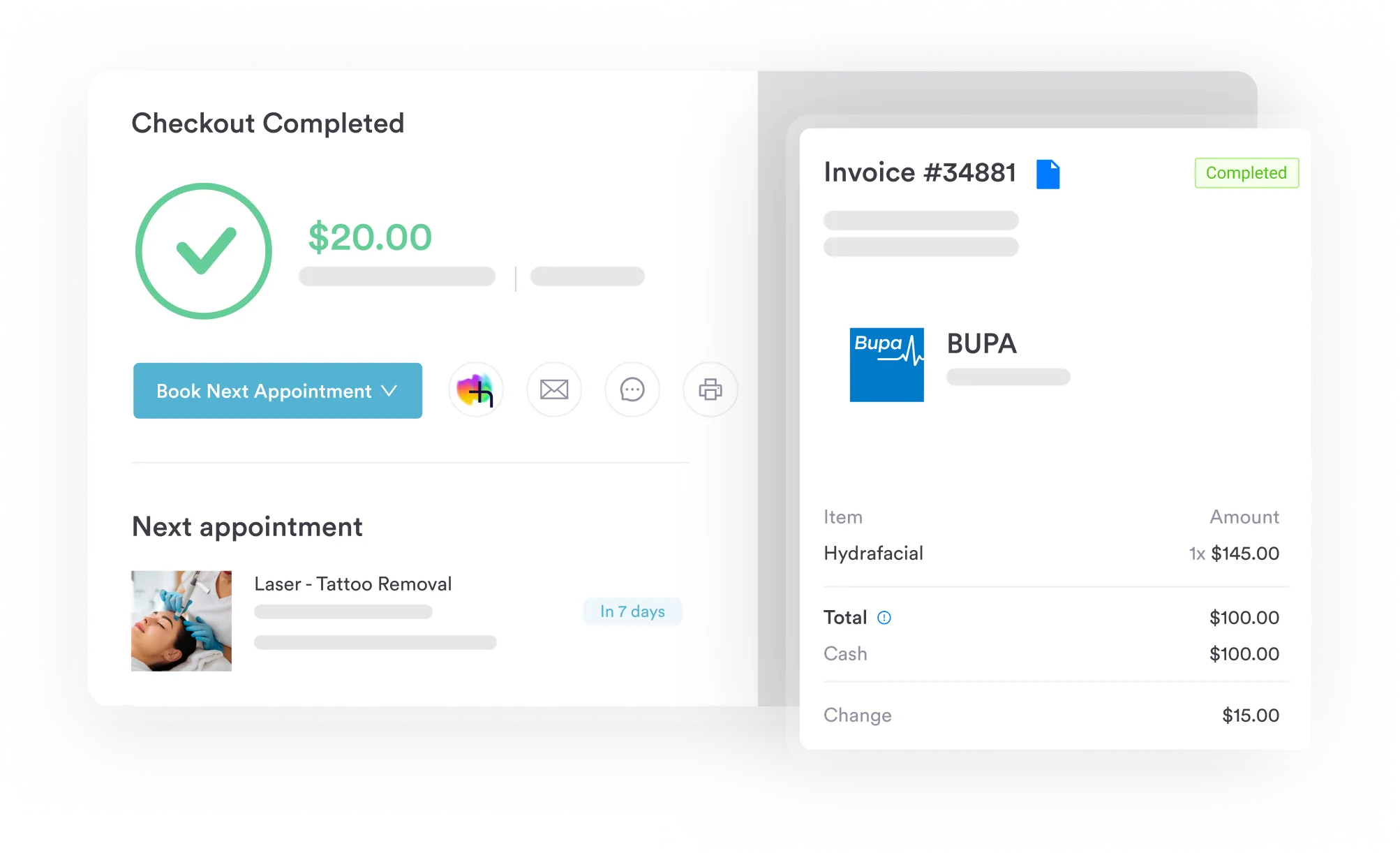
For US practices, claims go to payers through Claim.MD, which also runs insurance eligibility checks. That helps confirm the newborn’s own coverage once it’s on file. The medical billing workflow closes when electronic remittance advice files come back and payments are reconciled against invoices.
A claims dashboard tracks each 99464 claim from Pending to Paid, with days overdue in view. Your team spends its time on the claims that need work instead of checking the ones that don’t.

Pabau validates newborn attendance claims before submission and flags rejected ones with the exact field to fix, so reimbursement arrives on time.

CPT code 99464 rewards precision. Bill it under the attending clinician’s own NPI, document who requested the attendance and why, and pair it with a supported secondary ICD-10 code. Get those three right and most delivery room denials never happen.
The trade-off to remember is 99465. When the newborn needs resuscitation, the higher code replaces 99464 instead of joining it, so the note has to show exactly what was done.
Pabau’s claims tools check each claim before it leaves the practice, so pediatric and neonatal billing teams spend their time on exceptions. Book a demo to see how claim validation and Claim.MD submission work together for newborn attendance codes.

Need a broader overview of clearinghouse claim submission? How medical claims clearinghouses work explains the 837P transmission process and how clearinghouse validation catches errors before payer adjudication.
Want to understand the full revenue cycle behind newborn billing? Revenue cycle management in healthcare covers the end-to-end process from charge entry to payment posting.
Billing the hospital days after delivery? CPT code 99462 covers subsequent hospital care for a normal newborn, billed per day.
CPT code 99464 covers attendance at delivery by a clinician other than the delivering obstetrician, plus initial stabilization of the newborn. The delivering physician or other qualified health care professional must request that attendance. It doesn’t cover routine nursery visits, standby services, or later inpatient newborn care.
Use 99464 for delivery room attendance by a requested separate clinician. Use 99460 for the first day of normal newborn care once the infant moves to the nursery. Both can be billed on the same date when the same physician also does the first nursery assessment. Each service needs its own documentation.
No. CPT instructs coders not to report 99464 in conjunction with 99465, so only one of the two is reported per delivery. When the newborn needs positive pressure ventilation or chest compressions, bill 99465 alone. Document the specific resuscitative interventions to support it.
Yes. Medicare covers CPT 99464 as a separately payable service when it’s billed under an NPI different from the delivering obstetrician’s, with documented medical necessity. The claim goes to the newborn’s own coverage, not the mother’s. The place of service must be inpatient hospital (POS 21).
No modifier is needed when the attending physician bills under their own individual NPI, separate from the delivering OB. 99464 is an E/M code, so modifier 59 doesn’t apply to it. Modifier 25 is used only when 99464 is billed on the same date as a separately reported procedure.
The most common reason is bundling into the OB global package, usually from a group NPI conflict. Missing documentation of the separate attendance or the request comes next. A missing secondary ICD-10 code, a wrong place of service, or a 99465 on the same claim also trigger denials. Check the CARC code on the ERA before resubmitting.
No. The AMA CPT descriptor requires a request from the delivering physician or other qualified health care professional, so a different clinician must attend. An obstetrician billing 99464 for their own delivery is incorrect, because that service sits inside the obstetric global package. Only a separate pediatrician, neonatologist, or family medicine physician attending at that request can bill it.
The primary diagnosis is usually a Z38 liveborn infant code, such as Z38.00 for vaginal delivery or Z38.01 for cesarean. Secondary codes capture the condition behind the attendance request. Common examples are P07.3x for prematurity, P24.01 for meconium aspiration with symptoms, and P03.810 for fetal heart rate or rhythm abnormalities. Always pick the most specific subcode the documentation supports.



