CCSD Code H2220: Endoscopic ultrasound for tumour staging
What is CCSD Code H2220? CCSD Code H2220 is the UK private healthcare procedure ...

Last Updated: Oct 16, 2026
99462 is the CPT code for subsequent hospital care, per day, for evaluation and management of normal newborn. The attending bills it once for each calendar day between the admission day and the discharge day.
The most important rule is the day type. Day one takes 99460, a later discharge day takes 99238 or 99239, and a same-day birth and discharge takes 99463 alone. Bill the wrong day and the claim denies. This guide covers the code family, the daily note, the 2026 Medicare rate, and the denials to catch before you submit.
Let Pabau's smart automation suggest the right codes, reduce claim denials, and keep your practice compliant—effortlessly.
Automate repetitive tasks and focus on what matters most—your patients.
Reduce coding errors and ensure compliance with the latest regulations.
Clean claims, fewer denials, and faster reimbursements.
Powerful insights and reporting to help your practice thrive.
HIPAA compliant SOC 2 certified GDPR-compliant Trusted by 4,000+ clinics worldwide

CPT code 99462 reports one day of subsequent hospital care for a normal newborn, on each calendar day after the admission day.
Day one takes 99460, and a discharge after the admission date takes 99238 or 99239, so 99462 only fills the days in between.
Only the responsible attending bills 99462 for a baby on a given date, so a second physician’s claim for that day will deny.
The daily note must show the physician’s own assessment of weight, feeding, voiding, stooling, and jaundice, beyond copied vitals.
In 2026, Medicare’s national unadjusted rate is about $35.40 per day, based on 1.06 total RVUs.
CPT code 99462 reports subsequent hospital care for a normal newborn, once per calendar day. It covers each day after the admission day and before the discharge day. The American Medical Association (AMA), which maintains CPT, publishes the official descriptor as “Subsequent hospital care, per day, for evaluation and management of normal newborn.”
The code sits in the Newborn Care Services range (99460-99463) of the evaluation and management (E/M) section. It’s reported for the inpatient hospital setting, place of service 21, and standard claims carry no modifier.
The key qualifier is “normal newborn.” If the infant needs neonatal intensive care, the codes shift to neonatal critical care (99468/99469). Billing 99462 after that change misstates the service, which makes it a compliance problem as well as a denial.
The code covers the physician’s daily evaluation and management of a healthy newborn in the hospital. Knowing where it stops prevents both undercoding and compliance errors.
The newborn care codes work as a sequence, one code per calendar day, starting with 99460 on the admission date. Picking the code for the wrong day type is one of the most frequent newborn billing errors.
The timeline below shows how a three-night stay breaks down.
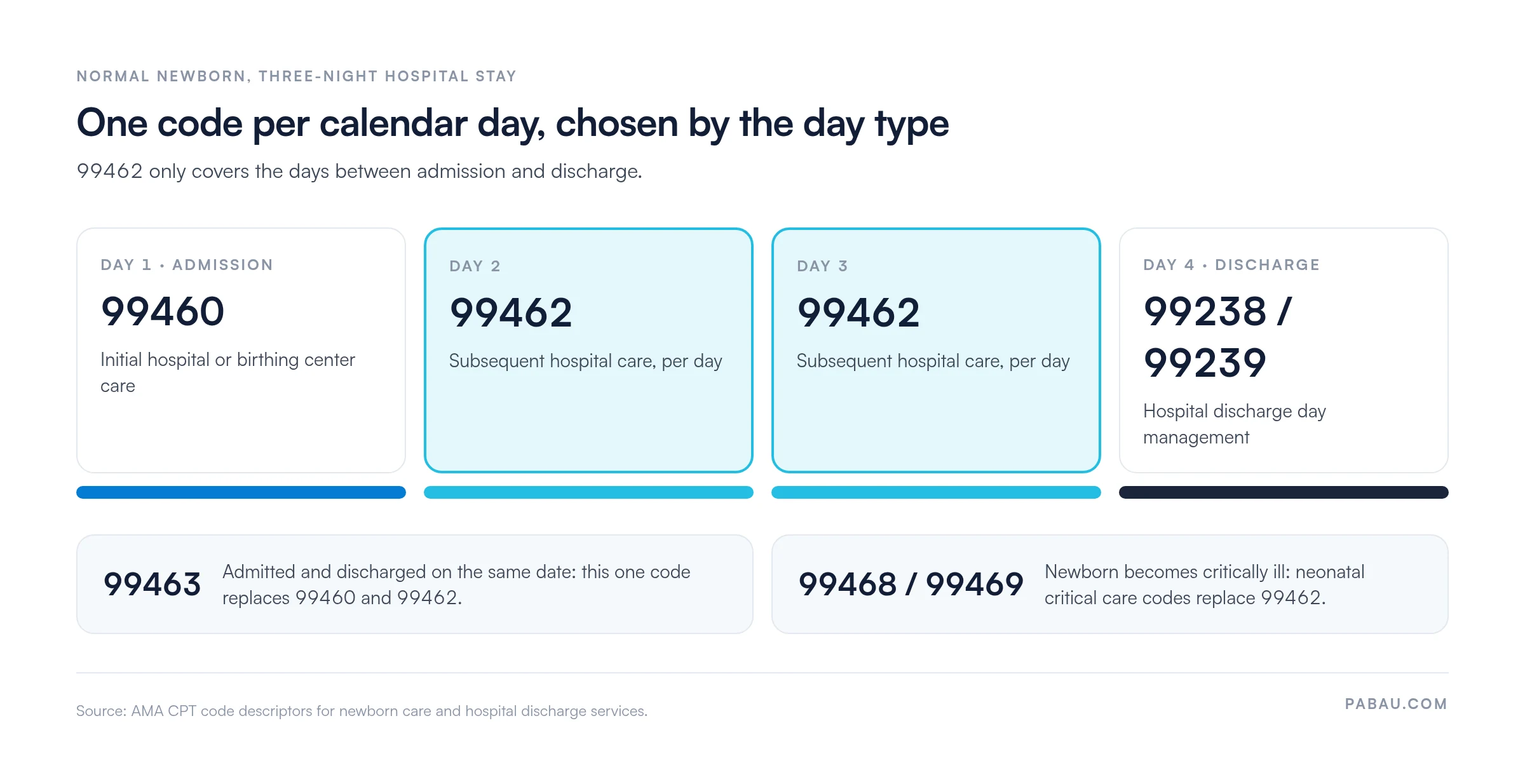
A practical rule follows from the table. If the baby is still in the hospital and it’s neither the admission day nor the discharge day, 99462 is the code. On a later discharge date, bill 99239 when discharge work runs over 30 minutes, or 99238 when it takes 30 minutes or less. If the baby goes home on the admission date, 99463 is the only code for that encounter.
99232 is the subsequent inpatient E/M code for patients who aren’t normal newborns. It trips up coders who switch between adult and pediatric inpatient billing. The two codes don’t overlap, because 99462 applies only to normal newborns and 99232 never does.
The practical test is simple. Was the newborn admitted as a healthy infant with no acute illness? If yes, use the 99460/99462 series. If a condition such as respiratory distress, fever, or hypoglycemia drove the admission, standard inpatient E/M codes may apply from day one.
A progress note that only lists vitals won’t support CPT 99462. Auditors look for the attending’s active clinical assessment, beyond a review of the nursing flowsheets. Here’s what each daily note needs.
A templated daily note that fills itself in without the physician’s interpretation doesn’t meet the standard. The note has to show an individual assessment of that baby on that day.
Run a quarterly audit of 10-15 randomly selected 99462 notes. The feeding assessment is where notes most often fall short. Nurses chart feeding in the intake and output record, but the physician note never references it. Auditors flag that disconnect as insufficient documentation.
With the note in place, the claim itself follows a short, repeatable path. Most problems show up at one of these five steps.
Pairing that check with the habits behind submitting a clean claim cuts avoidable rejections on a code you bill every day.
Medicare calculates payment for CPT 99462 from the CMS Physician Fee Schedule using relative value units (RVUs).
The figures below are 2026 national unadjusted values. Geographic practice cost indices (GPCIs) then adjust payment by locality, so check current rates with CMS before billing.
At the 2026 non-APM conversion factor of $33.4009, 1.06 total RVUs pay about $35.40 per day before GPCI adjustment. That’s down from 1.19 RVUs and about $38.49 in 2025. Use the FastRVU 2026 RVU lookup to estimate payment for your location.
Most newborn claims go to Medicaid or commercial plans, so treat the Medicare figure as a benchmark. Medicaid rates vary widely, because each state plan sets its own. Commercial rates are negotiated separately and vary by contract.
Common 99462 denials fall into six patterns. Catching the root cause before submission is the cheapest step in any denial management workflow.
For documentation appeals, attach the full progress note and the claim adjustment reason codes (CARCs) from the ERA. Matching those against common denial codes shows which pattern caused each rejection.
Set a weekly review of every 99462 claim rejected in the prior seven days. Patterns repeat. If duplicate billing causes denials three weeks running, fix the rounding assignments as well as the claims.
A pediatric group billing 99462 for several babies a day often juggles a hospital note, a billing spreadsheet, and a clearinghouse portal. Each handoff is another chance to retype a date or a code wrong.
Pabau, the practice management platform we build, keeps that chain in one place. Its claims management software pre-fills the CMS-1500 from the patient record and includes CPT and ICD-10 lookup libraries. It also checks that every required claim field is complete before the claim can be sent.
For US practices, the Claim.MD integration adds real-time eligibility checks, claim-status tracking, and ERA posting. Your team spends less time chasing remittances and more time on the few claims that need a fix.
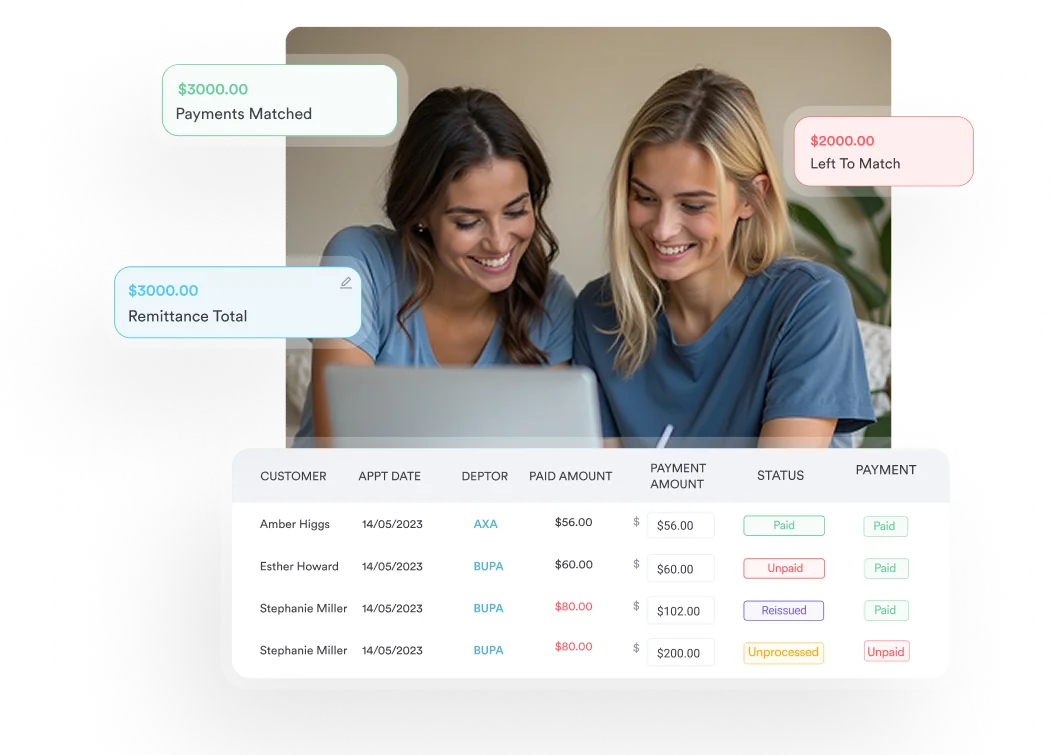

Pabau’s claims management software pre-fills 99462 claims from the patient record and checks required fields before submission. US practices also get eligibility checks and ERA posting through Claim.MD.

CPT 99462 is a simple code, and one rule does most of the work. Match the code to the day type: 99460 on admission, 99462 for the days between, and 99238 or 99239 at discharge.
The trade-off is volume. A small error repeated on every daily claim adds up fast, so a short pre-submission check pays for itself. Spend your audit time on attending assignments and the feeding note, where these denials cluster.
Still rekeying newborn claims by hand? Book a demo to see how Pabau pre-fills them from the patient record and tracks each one to payment.

Billing the admission day? CPT code 99460 covers initial hospital or birthing center care for a normal newborn.
Closing out the stay? CPT code 99239 explains discharge day management when it runs over 30 minutes.
Need a reference for handling claim rejections at scale? Denial management in healthcare covers the end-to-end workflow for resolving and appealing payer rejections.
Want to understand the clearinghouse layer in the claims process? Medical claims clearinghouse guide explains how EDI claims move from practice to payer and where scrubbing happens.
Looking for a primer on the billing side of clinical practice? What is revenue cycle management covers the full lifecycle from patient encounter to payment posting.
For the birth admission, the first-listed diagnosis is usually a Z38 code, which records a liveborn infant by place of birth and type of delivery. Z38.00 covers a single baby born vaginally in hospital, and Z38.01 a cesarean birth. Add codes for any findings the note documents.
The newborn is the patient, so the claim goes under the baby’s name and coverage. Many plans let you bill with the mother’s member ID until the baby has one, but enrollment windows vary. Check the payer’s newborn rules before submitting.
Often, yes. Nurse practitioners and physician assistants can bill newborn care where state scope of practice and the payer’s credentialing allow it. The one-provider-per-day rule still applies, so coordinate with the attending.
Two. Day one is 99460, days two and three are 99462, and day four is the discharge date, billed with 99238 or 99239. A two-night stay produces one 99462 day.
In 2026, the national unadjusted Medicare rate is about $35.40 per day, based on 1.06 total RVUs and a $33.4009 conversion factor. Local GPCIs adjust the final amount, so check the CMS Physician Fee Schedule lookup.