


CPT code 48152: Whipple procedure without pancreatojejunostomy
CPT code 48152: Official description and procedure overview CPT code 48152 descr...

Last Updated: Nov 13, 2026
CPT Code 99360 is the evaluation and management code for physician standby services, billed per full 30 minutes of waiting. It applies when a physician waits at another physician’s request and performs no procedure during that time.
Medicare does not pay it separately, and UnitedHealthcare’s Medicare Advantage policy confirms that CMS folds standby into the facility’s Part A payment.
Private payer policies vary, so check coverage before you submit. Most denials trace back to one of three documentation failures. The chart lacks the attending’s request, the standby ran under 30 minutes, or the physician was busy with another patient.

CPT Code 99360 covers standby at another physician’s request, billed per complete 30-minute block of uninterrupted waiting time.
The standby physician must be immediately available, not otherwise occupied, and must not perform any procedure during the reported period.
If standby ends with a surgical-package procedure performed by the standby physician, none of the standby time is reported.
Medicare does not pay separately for CPT Code 99360, so check MAC and private payer policy before you submit.
Pabau’s claims management software keeps the standby record and the claim together, from submission to remittance.
The American Medical Association publishes the official descriptor for CPT Code 99360.
Standby service, requiring prolonged attendance, each 30 minutes (eg, operative standby, standby for frozen section, for cesarean/high risk delivery, for monitoring EEG).
Three elements make a 99360 claim valid:
CPT 99360 sits in the evaluation and management (E/M) section of the CPT code set, in its Standby Services subsection. That placement does not make it payable wherever E/M visits are. Many payers that cover E/M services still exclude standby under a separate policy.
CPT Code 99360 covers a defined set of clinical situations. In each one, a physician’s immediate presence is needed, but whether they will act stays uncertain until the case unfolds.
In every scenario, another physician asks for the standby physician’s presence, and the record shows why it was clinically justified.
CPT Code 99360 is reported once for each complete 30-minute block of standby time. Partial periods do not count. A physician who stands by for 45 minutes reports one unit, and one who stands by for 90 minutes reports three. The chart below shows how the leftover minutes fall away.
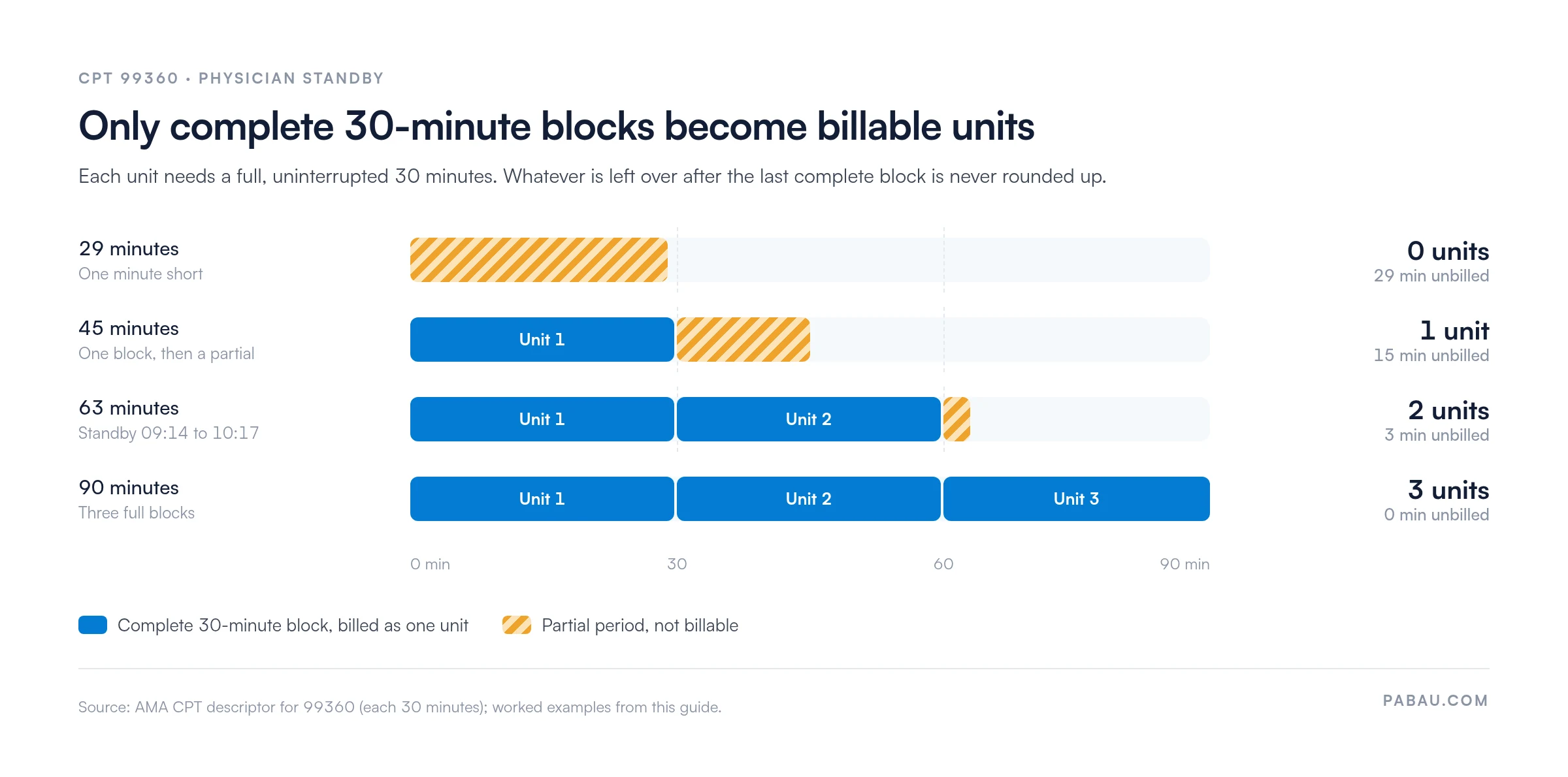
Time counting starts when the physician is physically present and available where the attending asked them to be. It stops when the clinical situation resolves, when the physician is called to perform a service, or when the physician leaves the standby location.
One of the most consequential errors in 99360 coding happens mid-standby. If the standby physician is called to perform a procedure, these rules apply.
The documentation must record when standby began, when the physician was called to perform a service, and what that service was. Without this timeline, payers cannot verify that each reported unit was pure waiting time.
Record the start time, any interruptions, the end time, and the reason standby ended at the point of service. A note entered hours later is easy for an auditor to challenge. Some practices use a printed standby attestation card that the physician completes and signs in real time, then scans into the patient chart.
CPT Code 99360 has explicit exclusions that trip up coders who apply it too broadly.
Several adjacent codes are often confused with 99360. The table below shows when each one applies.
The 99417/99418 confusion is common because these codes and 99360 all cover extended physician time. The older prolonged service codes, 99354 to 99357, were deleted on January 1, 2023.
The decisive test is whether the physician is working on the patient’s care or simply available. Active care is reported with a prolonged service code such as 99417, and pure availability with CPT Code 99360.
Medicare does not accept 99417 or 99418. Under the Medicare Claims Processing Manual, prolonged office visits are reported with G2212 and prolonged inpatient or observation visits with G0316.
Most 99360 denials trace back to documentation. Capture the required elements at the point of service, then have the coder confirm each one before the claim goes out. The medical record must contain these five elements:

Confirming all five elements before submission is the most reliable way to achieve a clean claim submission on the first pass.
Neonatologist standby at cesarean sections and high-risk vaginal deliveries is a common audit target. The move from standby to active newborn care can happen in seconds, so payers check these timelines closely.
When the neonatologist begins attending to the newborn, billing moves to the newborn care codes. Attendance at delivery is reported with 99464, initial hospital care with 99460, and delivery room resuscitation with 99465. CPT Code 99360 covers only the waiting period before that point.
Medicare does not pay separately for CPT Code 99360, so check coverage before you submit a claim. The CMS Physician Fee Schedule gives 99360 a Part B payment status indicator that excludes it from separate payment. Verify the current status in the CMS Physician Fee Schedule lookup tool before submitting.
Coverage can vary by Medicare Administrative Contractor (MAC). Some MACs address standby services in specific clinical contexts. Before concluding that 99360 is non-billable for a Medicare patient, check the applicable MAC’s policies for the state where the service was rendered.
Private payer coverage varies significantly. Common private payer policy patterns include:
CPT Code 99360 claims are often denied because the requirements are precise and easy to miss in the chart. Structured denial management workflows catch these patterns before they become write-offs.
When a 99360 claim comes back, use the remittance to decode denial codes and see which of these failures the payer found.
Because Medicare does not separately reimburse CPT Code 99360, there is no national Medicare payment rate to cite for this code. Practices that bill Medicare for this service should expect non-coverage denials unless an applicable MAC policy says otherwise.
Private payer rates vary by contract and geography. Request 99360 reimbursement data from each contracted payer during contract negotiations. Use the FastRVU 2026 RVU lookup tool to check any RVU values for this code against your payer contracts.
When private payers do cover 99360, they often pay a flat fee per 30-minute unit. There is no Medicare fee schedule rate for them to take a percentage of. If standby is a regular part of your practice, negotiate a per-unit dollar amount explicitly.
Run a quarterly claims audit on all submitted 99360 units. Compare units billed to units paid, segment by payer, and flag any payer with a denial rate above 20%. That pattern usually points to a payer policy your pre-submission check missed, or to a weak standby attestation template.
Accurate entry of CPT Code 99360 depends on three things: unit count, supporting documentation, and payer coverage. Check all three before the claim leaves the billing queue.
A complete superbill documentation record for each standby encounter makes downstream billing more reliable. It holds the attending’s request, the time log, and the physician attestation, and it supports audit defense if the claim is selected for review.
Without one system, a standby claim gets pieced together by hand. The attending’s request sits in one note and the clock times in another, so the coder rebuilds the timeline from both.
Pabau, the practice management platform we build, keeps the clinical record and the claim in one place. Its claims management software submits claims through the Claim.MD clearinghouse, checks eligibility, tracks claim status, and posts remittances against the patient record.
The coder works from the standby log itself, not from a re-keyed summary. A denied 99360 unit surfaces on the day it happens, not at month-end reconciliation.

Pabau’s claims management software keeps the standby log, the attending’s request and the claim in one record. Each 99360 claim goes out with its evidence attached.

CPT Code 99360 pays only when the chart proves the waiting. That takes a documented request and clock times that add up to full 30-minute blocks. It also takes an attestation that the physician was free and did nothing billable. A coder cannot reconstruct any of it after the fact.
Check coverage before the standby, not after the denial. Medicare will not pay it separately, so the value sits with the private payers that do. Book a demo to see how Pabau links standby documentation to the claim before it goes out.

Seeing recurring denials on physician services? Medical billing compliance fundamentals covers the documentation standards and payer policy checks that prevent systematic denial patterns.
Billing a neonatologist who attended the delivery? CPT code 99464 covers attendance at delivery and initial stabilization of the newborn.
CPT Code 99360 reports physician standby services in 30-minute units. It covers time a physician spends waiting at another physician’s request without performing a procedure. Common uses include operative standby, frozen section standby, high-risk delivery standby, and EEG monitoring standby.
There is no fixed cap on the number of units, but each unit requires a complete, uninterrupted 30-minute block of standby time. A four-hour standby could support eight units. The documentation must show continuous availability across the whole period, with no other patient care and no procedure performed.
Medicare does not cover CPT Code 99360 as a separately payable Part B service. CMS treats standby as part of the facility’s Part A payment. Check the applicable MAC policy for the state where the service was rendered before you conclude that no coverage exists.
CPT 99417 is a prolonged service add-on code for office or outpatient E/M visits, reported per 15 minutes beyond the visit’s required time. That time is spent working on the patient’s care. CPT Code 99360 applies when a physician waits and stays available without providing a service. Medicare uses G2212 in place of 99417.
Sometimes. If the standby physician ends the standby by performing a procedure that carries a surgical package, 99360 is not reported at all. Otherwise, complete standby periods before the procedure may still be reported, but not the 30-minute block in which it occurred. Document the transition time and bill the procedure under its own code.
Yes. High-risk delivery standby is named as an example in the AMA CPT descriptor. The standby period runs from the neonatologist’s arrival at the delivery suite until active newborn care begins. From then on, billing moves to 99464, 99460 or 99465 as appropriate, and 99360 is not reported with 99464.



