Pabau Engage inbox

Pabau Engage is here: every patient conversation in one inbox.

Learn more
Book a demo Book a demo
☰
CPT Code

CPT code 99251 – Inpatient consultation, Level 1


Code Definition

99251 is the CPT code for inpatient or observation consultation for a new or established patient, which requires a medically appropriate history and/or examination and straightforward medical decision making.

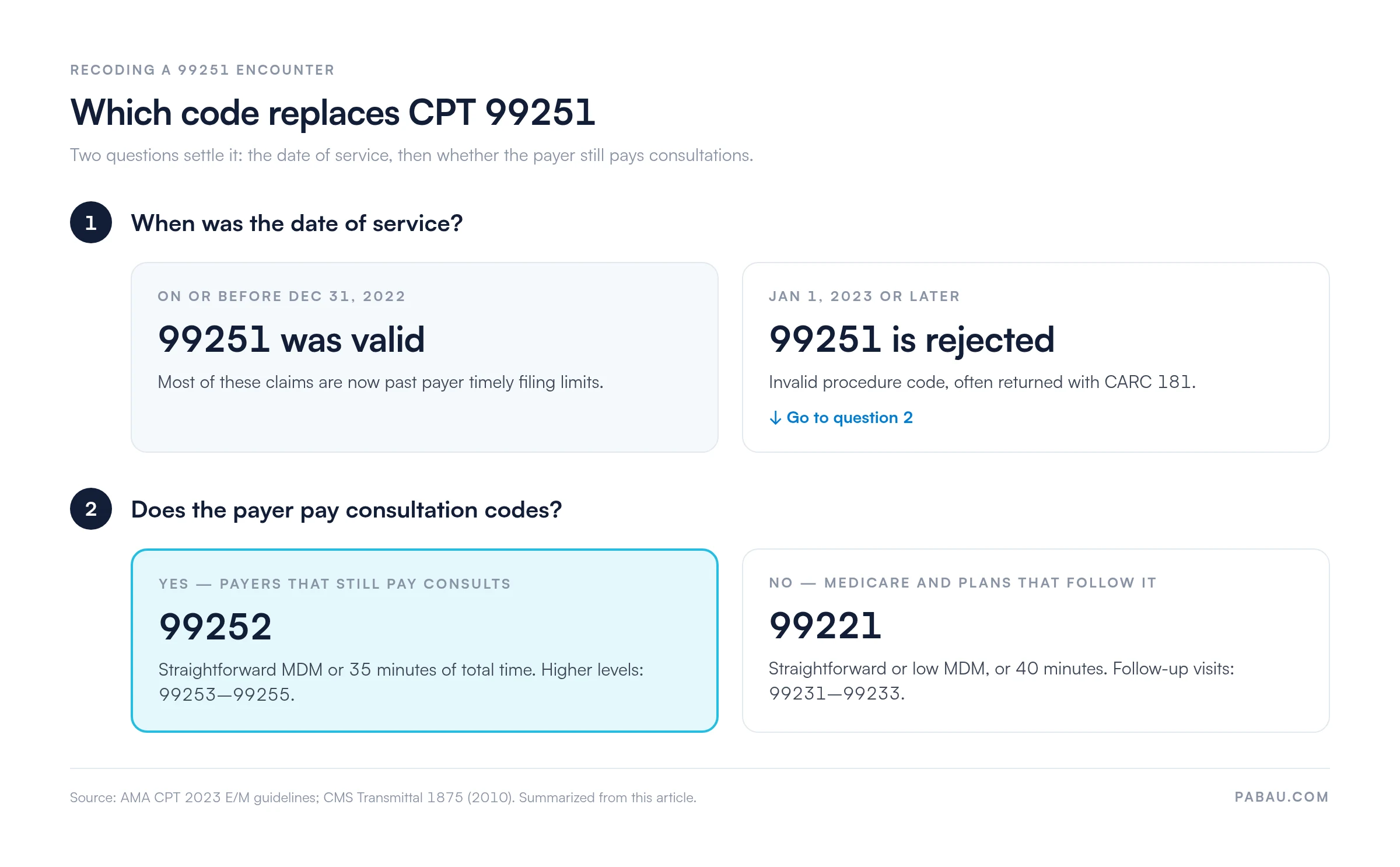
CPT code 99251 is the Level 1 inpatient consultation code, used to report a straightforward hospital consult requiring a problem-focused history, problem-focused examination, and straightforward medical decision making. Traditional Medicare has not reimbursed this code since January 1, 2010, when the Centers for Medicare and Medicaid Services (CMS) eliminated payment for the entire 99251-99255 series under Transmittal 1875. Most commercial payers still accept 99251, but billing it without understanding payer-by-payer policy is one of the most reliable ways to generate a denial. This reference covers the documentation checklist, level-selection criteria, payer acceptance rules, and the denial patterns that keep 99251 claims off the payment rail.

Section
99202-99499 Evaluation and management
Billable
No
Code also known as
hospital consultation, inpatient consult, specialist consultation code, Level 1 inpatient consult
Save time. Improve accuracy. Get paid faster.
Automate coding with Pabau

Let Pabau's smart automation suggest the right codes, reduce claim denials, and keep your practice compliant—effortlessly.

  • AI-powered code suggestions
  • Real-time compliance checks
  • Faster claims, fewer denials
Why practices choose Pabau
Save hours every week

Automate repetitive tasks and focus on what matters most—your patients.

Improve accuracy

Reduce coding errors and ensure compliance with the latest regulations.

Get paid faster

Clean claims, fewer denials, and faster reimbursements.

Grow with confidence

Powerful insights and reporting to help your practice thrive.

HIPAA compliant SOC 2 certified GDPR-compliant Trusted by 4,000+ clinics worldwide

Key Takeaways

Key Takeaways

CPT code 99251 reports a Level 1 inpatient consultation: problem-focused history and exam, straightforward MDM, in a hospital or observation setting.

Three elements are required for any consultation code: a documented request from the requesting provider, performance and documentation of the consult, and a written report sent back.

Traditional Medicare and most state Medicaid programs do not reimburse 99251; commercial payers and many Medicare Advantage plans still accept the code, but always verify per payer.

The 2026 Medicare facility rate for 99251 is approximately $27-$30; the work RVU is .64. Verify current figures via the CMS Physician Fee Schedule lookup tool.

CPT code 99251: official descriptor and key facts

CPT code 99251 is defined by the American Medical Association (AMA) as an inpatient or observation consultation with a problem-focused history, problem-focused examination, and straightforward medical decision making. It is the lowest-complexity level in the 99251-99255 inpatient consult series and is appropriate only for narrow, single-system clinical questions where no significant data review or management risk is involved.

Field Value
Code 99251
Official descriptor Inpatient or observation consultation for a new or established patient, which requires a medically appropriate history and/or examination and straightforward medical decision making
Code family 99251-99255 (inpatient/observation consultations)
Place of service Inpatient hospital (21), observation (22), nursing facility (31/32)
Work RVU (wRVU) 0.64
2026 Medicare facility rate Approximately $27-$30 (verify via CMS MPFS lookup)
Global period XXX (no global period applies)
Medicare coverage Not payable by traditional Medicare (eliminated January 1, 2010)

Verify all reimbursement figures against the CMS Physician Fee Schedule lookup tool before billing. Rates adjust each January 1 with the annual MPFS update.

What CPT 99251 covers and what it does not

CPT 99251 covers a formal inpatient consultation at the lowest complexity tier. Three elements must be present for any consultation code in the 99251-99255 series to be billable, and all three must be documented in the medical record. Missing even one is a denial waiting to happen.

  • Written or verbal request: The requesting provider’s name and the reason for consultation must be documented in the chart before the consult is performed.
  • Performance and documentation: The consulting physician must personally perform and document a problem-focused history and examination with straightforward medical decision making for Level 1.
  • Written report: The consulting provider must document a written opinion or report and communicate it back to the requesting provider. A notation in the chart that the report was sent is not sufficient on its own; the report itself must be present.

What 99251 does NOT cover is equally important. Follow-up visits to the same inpatient by the consulting specialist are not reported with 99251 or any other consult code; since the 2010 CMS elimination, subsequent encounters by the consulting physician are reported using subsequent hospital care codes 99231-99233. A consultation performed solely to confirm another physician’s diagnosis, without a written report back, also does not meet the definition.

Documentation requirements for CPT 99251

The documentation for a Level 1 inpatient consultation must satisfy the AMA’s 1997 Evaluation and Management Documentation Guidelines at the problem-focused threshold. Read the clean claim requirements before submitting, because a technically complete encounter note can still generate a denial if the administrative data fields are wrong.

  1. Documented request: Record the requesting provider’s name and the specific clinical question in the chart. A verbal request is permitted but must be followed by written confirmation in the medical record.
  2. Problem-focused history: Document a brief chief complaint and a history of the present illness focused on the reason for the consultation. A comprehensive review of systems is not required at Level 1.
  3. Problem-focused examination: Perform and document an examination limited to the affected body area or organ system. For the 1997 guidelines, this means one to five elements in one or more organ systems.
  4. Straightforward MDM: Document minimal diagnosis options, minimal data review (typically no independent interpretation of diagnostic studies), and minimal management risk. Over-documenting and then billing Level 1 creates an under-billing scenario; under-documenting and billing higher creates an audit risk.
  5. Written report back: The consulting physician’s opinion, findings, and recommendations must be clearly documented and communicated to the requesting provider. Date and method of communication should be noted.

Maintaining consistent medical billing compliance practices means auditing consultation records regularly, not just when a denial arrives. A single missing request element is the most common trigger for 99251 denials across all payer types.

How to select the right level: CPT 99251 vs 99252 vs 99253 vs 99254 vs 99255

Level selection is the most consequential coding decision in the 99251-99255 series. Overcoding by one level on a consultation that should be 99251 exposes the practice to recoupment; undercoding a complex 99255 consult leaves revenue on the table. The decision rule: 99251 is appropriate only when all three key components (history, exam, MDM) support the lowest-complexity tier.

Code History Examination MDM Typical clinical scenario
99251 Problem-focused Problem-focused Straightforward Single minor question, no data review needed
99252 Expanded problem-focused Expanded problem-focused Straightforward Simple question with limited data review
99253 Detailed Detailed Low complexity Moderate question with some lab or imaging review
99254 Comprehensive Comprehensive Moderate complexity Complex question with prescription management decisions
99255 Comprehensive Comprehensive High complexity Critically ill or complex multi-system problem

When the documentation supports Level 1 on all three key components, 99251 is the correct code regardless of how brief the encounter felt clinically. Complex cases that involve reviewing independent test data, ordering additional studies, or making high-risk management decisions belong at 99254 or 99255. When in doubt, consult a certified professional coder (CPC) or compliance officer before submission.

Pro Tip

Review the actual chart note against each key component, not against the diagnosis. A patient with a complicated medical history who presents with a simple, narrow consultation question may still support only 99251 if the documented history, exam, and MDM are problem-focused.

Medicare billing rules for CPT 99251

Traditional Medicare does not reimburse CPT code 99251. CMS eliminated payment for the full 99241-99245 outpatient and 99251-99255 inpatient consultation series effective January 1, 2010, via Transmittal 1875. Submitting 99251 to traditional Medicare will produce a denial on the basis that the code is not payable under the Medicare Physician Fee Schedule.

Understanding the underlying medical billing fundamentals here matters because the replacement codes are not interchangeable. When a consulting specialist sees a Medicare patient for the first time in an inpatient setting, the correct code depends on the provider’s role. The admitting physician uses initial hospital care codes 99221-99223. A specialist called in to consult, who is not the admitting physician, bills with subsequent hospital care codes 99231-99233 for follow-up visits, and for the initial specialist encounter, bills 99221-99223 (selecting the level based on the documented complexity).

  • Traditional Medicare: Does not accept 99251 or any code in the 99251-99255 series. Bill initial hospital care or subsequent care codes instead.
  • Medicaid: Policy varies by state. Some state Medicaid programs still recognize consultation codes; verify with the specific state Medicaid program before billing.
  • Medicare Advantage plans: Many have restored consultation codes to their covered service lists. Check the specific plan’s provider policy document for the current plan year.
  • Commercial payers: Most private insurers continue to accept 99251-99255. Obtain and retain written documentation of payer policy.
  • TRICARE: Continues to recognize consultation codes 99251-99255 as payable services.

Which payers still accept CPT 99251?

Payer acceptance for CPT 99251 varies by category and, within Medicare Advantage, by individual plan. Confirm insurance eligibility verification and payer policy before every consult billing cycle, not just at onboarding.

Payer type Accepts 99251? Action required
Traditional Medicare No Bill 99221-99223 or 99231-99233 instead
Medicaid Varies by state Check state Medicaid program policy
Medicare Advantage Many accept; varies by plan Verify per plan’s annual coverage document
Commercial / private Generally yes Obtain written policy confirmation
TRICARE Yes Bill per standard TRICARE submission rules
Workers’ compensation Generally yes Verify per state workers’ comp fee schedule

Practices billing a high volume of inpatient consultations should maintain a payer-policy matrix updated at each contract renewal period. A consult to a Medicare Advantage patient billed as 99251 may pay, while the same code for a traditional Medicare patient will deny every time.

CPT 99251 reimbursement rate and RVU values

The 2026 reimbursement rate for CPT code 99251 is set via the Medicare Physician Fee Schedule where the code is payable. Traditional Medicare does not pay 99251, so the MPFS rate is relevant only to payers who use it as a reference for their own fee schedules. Many commercial payers base their contracted rates on a percentage of Medicare’s fee schedule, even for codes Medicare itself does not pay.

Submit claims and track reimbursement efficiently with electronic claims via Claim.MD, Pabau’s US clearinghouse partner that connects to 4,000+ payers including commercial and Medicare Advantage plans. Managing revenue cycle management for inpatient consults requires tracking which codes each payer accepts before claims are submitted, not after denials arrive.

RVU component Value Notes
Work RVU (wRVU) 0.64 Reflects physician time and intensity
Practice expense RVU (PE) Facility: 0.13 / Non-facility: 0.72 Differs by place of service
Malpractice RVU (MP) 0.03 Malpractice insurance cost component
2026 facility rate Approx. $27-$30 Verify via CMS MPFS tool; changes annually

Use the FastRVU 2026 lookup tool to access current work, practice expense, and malpractice RVU values with geographic adjustment factors applied. Commercial payers typically set rates at 110-150% of Medicare for consultation codes, but this varies widely by contract.

Pabau’s claims management software tracks submitted claims against expected reimbursement rates per payer, flagging variances that may indicate contract underpayment rather than coding errors.

Automate claims through Healthcode

Track inpatient consultation claims across every payer

Pabau’s claims management tools connect to 4,000+ US payers via Claim.MD, track reimbursement rates per code per payer, and flag denial patterns before they compound.

Pabau claims management dashboard

Common reasons CPT 99251 claims are denied

Denials on CPT code 99251 cluster around a short list of avoidable errors. Each denial reason below maps to a specific corrective action that can be built into a pre-submission workflow. Systematic denial management workflows start at the documentation stage, not the rework queue.

  • Submitted to Medicare or non-accepting Medicaid: The claim will deny as a non-covered service. Corrective action: identify the payer type at registration and route Medicare patients to the appropriate E/M code before billing.
  • Missing documented request: No record of the requesting provider’s name or the reason for consultation. Corrective action: create a documentation prompt in the chart note template that requires the requesting provider field to be completed before the note can be finalized.
  • No written report in the record: The consulting physician documented the encounter but did not document a written communication back to the requesting provider. Corrective action: make the consultation report a required element of the note structure rather than an optional add-on.
  • Documentation supports a different level: The chart note reflects a more complex encounter (detailed history, comprehensive exam, low-complexity MDM) that would support 99252 or 99253, but 99251 was billed. Corrective action: recode to the supported level; do not retroactively rewrite the note.
  • Incorrect place-of-service (POS) code: A consultation performed in an inpatient setting submitted with an outpatient POS code. Corrective action: verify that POS 21 (inpatient), 22 (observation), or 31/32 (nursing facility) is used per the actual service location.
  • Missing or unsupported ICD-10 diagnosis code: The diagnosis code submitted does not support medical necessity for a consultation. Corrective action: ensure the ICD-10 code reflects the specific reason for the consult request, not just the patient’s primary admission diagnosis.
  • Modifier errors: Modifier 32 (mandated services) applied incorrectly, or Modifier AI (principal physician of record) misused. Corrective action: review modifier definitions before applying; AI distinguishes the consulting physician from the admitting physician in inpatient settings.

Reference the full list of denial codes in medical billing to identify the specific CARC (Claim Adjustment Reason Code) or RARC (Remittance Advice Remark Code) attached to denied 99251 claims. Each code maps to one of the failure modes above. Tracking these through the electronic remittance advice (ERA/835) feed is the fastest way to find systemic billing problems before they accumulate.

CPT 99251 vs outpatient consultation codes 99241-99245

The 99251-99255 inpatient series and the 99241-99245 outpatient series are parallel families with different place-of-service requirements. The clinical complexity thresholds are similar across levels, but using the wrong series for the service setting is a billing error. Both series were eliminated for traditional Medicare in 2010, but commercial payers that accept consultation codes generally accept both.

Feature 99251-99255 (inpatient) 99241-99245 (outpatient)
Applicable setting Hospital inpatient, observation, nursing facility Office, outpatient clinic, ER (non-admitted)
Place of service 21, 22, 31, 32 11, 22 (outpatient observation), 23
Medicare coverage Not covered (eliminated 2010) Not covered (eliminated 2010)
Commercial payer coverage Generally accepted Generally accepted
Level 1 code 99251 99241

The most common cross-series error is billing 99251 for a consultation that occurred in an outpatient clinic or emergency department for a patient who was not admitted. Review the coding principles for other outpatient CPT procedure codes to confirm how POS codes interact with E/M level selection across the AMA’s code families.

Modifiers and special billing scenarios for CPT 99251

Several modifier scenarios come up regularly with inpatient consultation billing. Getting modifiers wrong adds an avoidable layer of denial risk on an already policy-sensitive code series. Reviewing the superbill documentation process at your practice will help standardize modifier assignment before claims are submitted.

  • Modifier 32 (mandated services): Appended when the consultation was required by a third party, such as a workers’ compensation carrier or court order. Does not change the reimbursement amount for most payers but is required for proper documentation of the reason the consult was performed.
  • Modifier AI (principal physician of record): Used by the admitting physician to distinguish themselves from the consulting specialist. If you are the consulting specialist and not the admitting physician, do NOT append Modifier AI. Applying it incorrectly signals to the payer that you are the principal physician of record, which contradicts a consultation billing.
  • Modifier GT / 95 (telehealth): Virtual inpatient consultations require a telehealth modifier when the service is delivered via interactive audio-video technology. Apply only to payers that both accept 99251 and cover telehealth consultations. Verify the specific modifier requirement per payer; CMS telehealth policy has evolved since the public health emergency.
  • Same-day billing: A consulting specialist who sees a patient on the same day the admitting physician performs an initial hospital care service can bill both codes, provided each service is medically necessary, separately documented, and performed by different providers. Append Modifier 25 to the E/M service if another procedure is performed on the same date.

Pro Tip

Flag Modifier AI in your billing software as a default block for consulting specialists. A specialist who is not the admitting physician should never have AI on a claim without a manual override. Build that guard into the claim workflow, not into post-submission audits.

Conclusion

CPT code 99251 is a straightforward code with a complicated payer landscape. The documentation requirements are clear, the denial triggers are predictable, and the level-selection criteria are well defined. The most consequential variable is payer acceptance, which requires ongoing verification rather than a one-time check at credentialing.

Pabau’s Claim.MD clearinghouse integration routes inpatient consultation claims to the correct payer pathway, tracks ERA responses by CARC code, and surfaces denial patterns before they compound across billing cycles. To see how Pabau handles consultation billing workflows end to end, book a demo.

Continue your research

Continue your research

Need to understand how clean claims prevent consultation denials? Clean claim requirements explains every field a payer checks before processing a hospital billing submission.

Want a broader view of the billing cycle behind consultation codes? Revenue cycle management covers the end-to-end process from patient registration through payment posting.

Seeing recurring CARC codes on 99251 denials? Denial codes in medical billing maps every common CARC and RARC to its root cause and corrective action.

Frequently Asked Questions

What is CPT code 99251?

CPT code 99251 is the Level 1 inpatient consultation code, reporting a hospital or observation consultation that requires a problem-focused history, problem-focused examination, and straightforward medical decision making. It is the lowest-complexity level in the 99251-99255 inpatient consult series maintained by the American Medical Association.

Is CPT code 99251 still valid for Medicare billing?

No. Traditional Medicare has not reimbursed CPT code 99251 since January 1, 2010, when CMS eliminated payment for all consultation codes under Transmittal 1875. Medicare Advantage plans vary; many have restored consultation codes. Always verify the specific plan’s coverage before billing.

What is the difference between 99251 and 99252?

CPT 99251 requires a problem-focused history, problem-focused examination, and straightforward MDM; CPT 99252 requires an expanded problem-focused history and examination, also with straightforward MDM. The key difference is the depth of history and examination documented, not the MDM complexity level. Both are Level 1 and Level 2 of the same inpatient consultation series.

What is the RVU value for CPT 99251?

The work RVU (wRVU) for CPT code 99251 is 0.64. Total RVUs including practice expense and malpractice components vary by place of service (facility vs. non-facility). Use the AAPC CPT lookup or the CMS Physician Fee Schedule tool to verify the current total RVU and geographic adjustment for your location.

Which payers accept consultation codes 99251-99255?

Commercial and private payers generally accept 99251-99255. TRICARE accepts them. Traditional Medicare and most state Medicaid programs do not. Medicare Advantage plans vary by plan and year. Always obtain written payer policy confirmation before billing a consultation series to any payer.

What are the most common reasons 99251 claims are denied?

The top denial reasons are: submitting to Medicare or non-accepting Medicaid, missing the documented request from the requesting provider, no written report back to the requesting provider in the chart, incorrect place-of-service code, and documentation that supports a different level than billed. Each maps to a preventable workflow gap.

Can 99251 be billed on the same day as a new patient E/M code?

Yes, when different providers perform separately documented, medically necessary services on the same date. The admitting physician and the consulting specialist can each bill their respective service codes on the same day, provided the documentation supports each service independently. Append Modifier 25 when an E/M and a procedure are billed on the same date by the same provider.

×