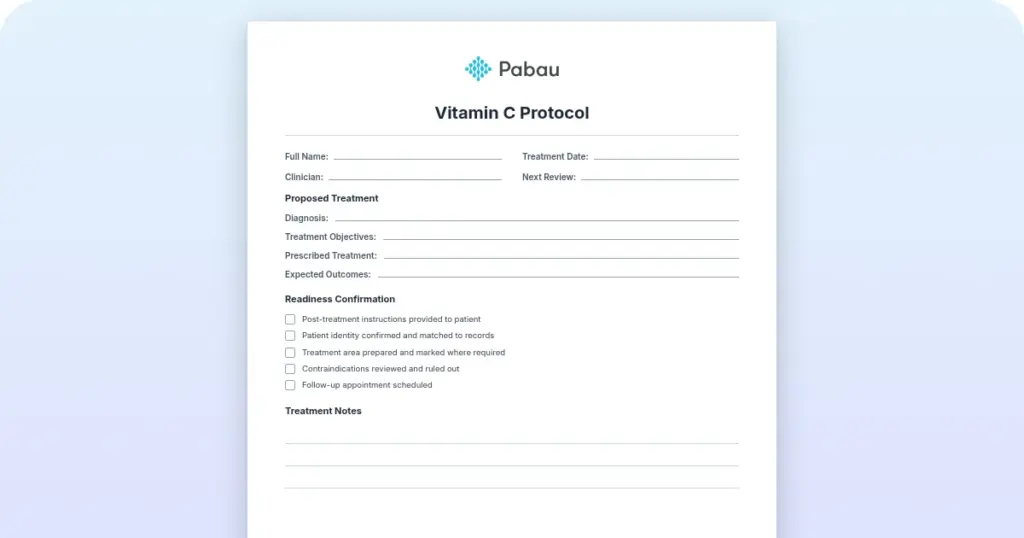
Vitamin C protocol: Free template for oral and IV treatment
A vitamin C protocol is a written clinical framework for giving vitamin C to pat...

16
Last Updated: Oct 16, 2026
Working out how to start an IV hydration business takes five decisions: ownership, medical oversight, clinicians, your launch model and the budget behind it. Settle them in that order, because your state’s ownership rules decide the structure every other choice sits inside.
California, Texas and New York keep the clinical entity in physician hands. Florida, Ohio and Arizona let a nurse or a non-clinician own the whole company. In each of those states, a physician, nurse practitioner or physician assistant still examines each patient and writes the order a registered nurse follows.
From there, the money depends on the model. A lean mobile launch runs $11,000 to $50,000, and a fitted medical van pushes it past $125,000. A storefront swaps the vehicle for a lease and build-out.
The same steps answer how to start an IV therapy business and how to start an IV vitamin therapy business. A saline bag and a vitamin blend are both prescription products given by infusion. Below are the launch-model decision table, the state ownership matrix, the eight launch steps and an itemized startup budget.

Ownership rules come first: California, Texas and New York keep the clinical entity with physicians, while Florida and Ohio let a nurse own it.
A registered nurse can run the drip and own the business side, but a physician, nurse practitioner or physician assistant must write every order.
The launch-model decision table matches storefront, mobile, hybrid and franchise models to your capital, licensing and staffing.
A lean mobile launch runs $11,000 to $50,000, while a fitted medical van pushes the total past $125,000.
A drip costing $35 to $60 to deliver sells for $99 to $225, so fixed monthly costs decide profitability.
Start an IV hydration business by settling ownership first and working forward, because each decision limits the options open to the next. Ownership rules differ enough by state that a structure lifted from another state’s guide may be illegal where you open. Fixing it later means restructuring, with legal fees on top. The order holds whether you’re a nurse, a physician or an owner with no clinical license.
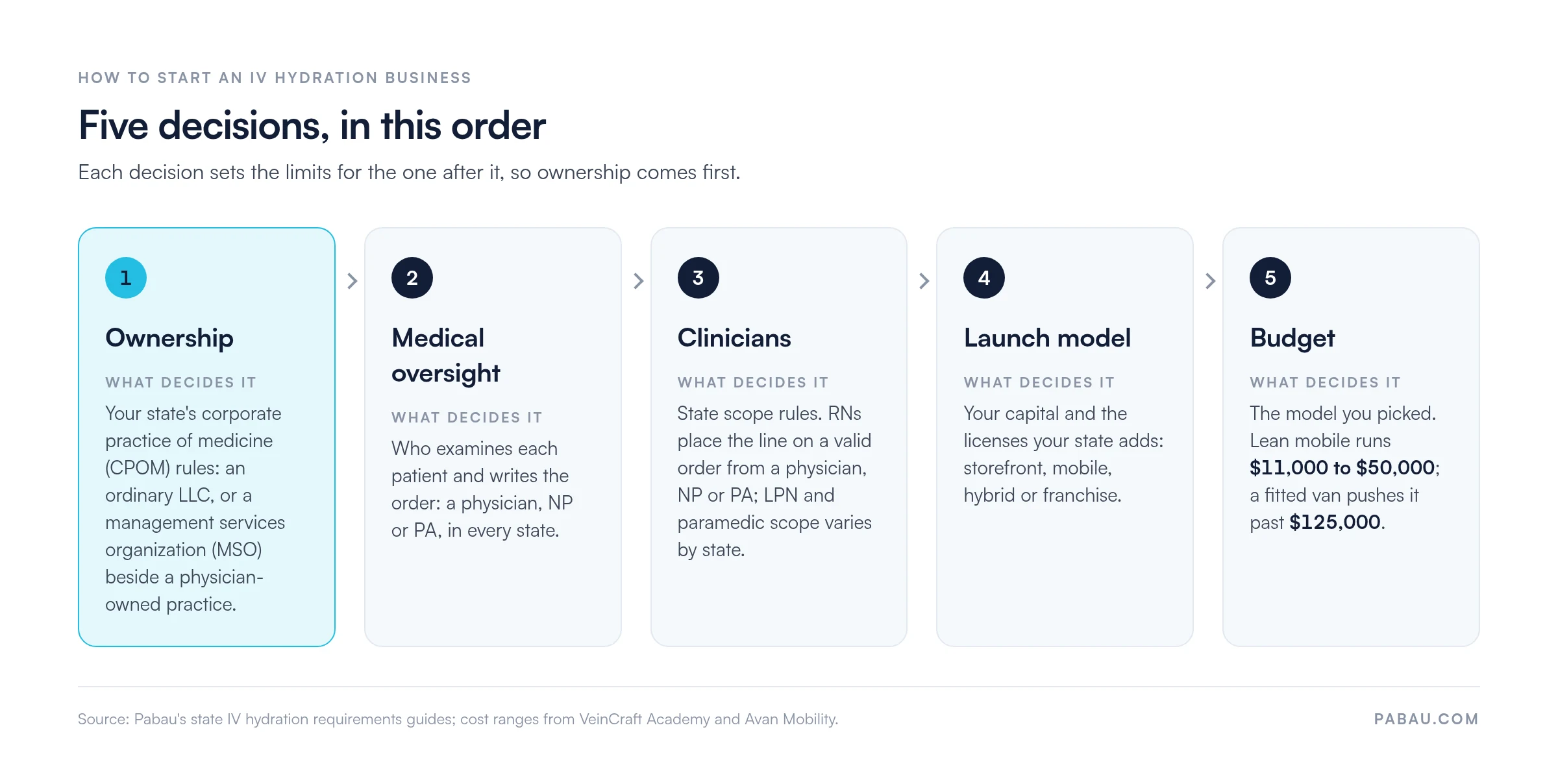
Each decision in brief:
If you’re a registered nurse, the RN section covers what your license lets you do and what you may own.
An IV hydration business runs as one of four models: a storefront clinic, a mobile IV service, a hybrid of the two, or a franchise.
The launch-model decision table matches each model to the owner it suits, the money and licenses it needs, and how its calendar fills. Read across the row that matches your capital and your state.
| Model | Who it suits | Startup cost | Extra licensing | Staffing minimum | How bookings work |
|---|---|---|---|---|---|
| Storefront clinic | A physician owner in a CPOM state, or any owner with walk-in traffic and a lease budget. | The mobile line items minus the vehicle, plus a lease and build-out quoted locally. | A facility license where the state imposes one, such as Florida’s $2,000 AHCA clinic license. | One prescriber on protocols and one RN on site for every open shift. | Rooms and chairs, sold by the chair-hour, with memberships filling off-peak slots. |
| Mobile IV | An RN or NP owner with under $50,000, in a state that allows non-physician ownership. | $11,000 to $50,000 lean, or past $125,000 with a fitted medical van. | A home care license for in-home infusion where required, such as Virginia’s $1,500 HCO license. | One prescriber on protocols and one clinician who travels and works alone. | Travel zones and route buffers, with a deposit on every visit. |
| Hybrid | A storefront owner with event, office or hotel demand within a short drive. | Storefront costs plus a vehicle, from a car you own to a fitted van. | Both the facility license and, for home visits, the home care license. | Two clinicians, so the chair stays open while one travels. | Chairs by the hour and outside visits in blocks, on one calendar. |
| Franchise | A first-time owner who wants a brand and protocols, and accepts royalties and territory limits. | Listed in Item 7 of the franchisor’s Franchise Disclosure Document. | The same state licenses, held by your local entity rather than the franchisor. | Set by the franchise model, within your state’s ownership rules. | Usually the franchisor’s booking system and assigned territory. |
Start with ownership. If your state requires a physician-owned entity, every model still works, but the clinical partner comes first and bills monthly. Then look at capital: under $50,000 points to mobile, because the lease and build-out are the largest costs you can skip.
Add a storefront chair once repeat bookings fill a mobile calendar, not before. Mobile and storefront costs come from the startup budget further down, and the franchise disclosure rule comes from the FTC Franchise Rule.
Two shortcuts sit outside the table. An IV therapy franchise sells you a brand, protocols and supplier terms in exchange for fees and territory rules. Buying an existing IV drip business gets you patients and staff on day one, so confirm its licenses and ownership structure transfer legally to you.
The comparison below sets the two core models, mobile and storefront, side by side before each gets its own section.
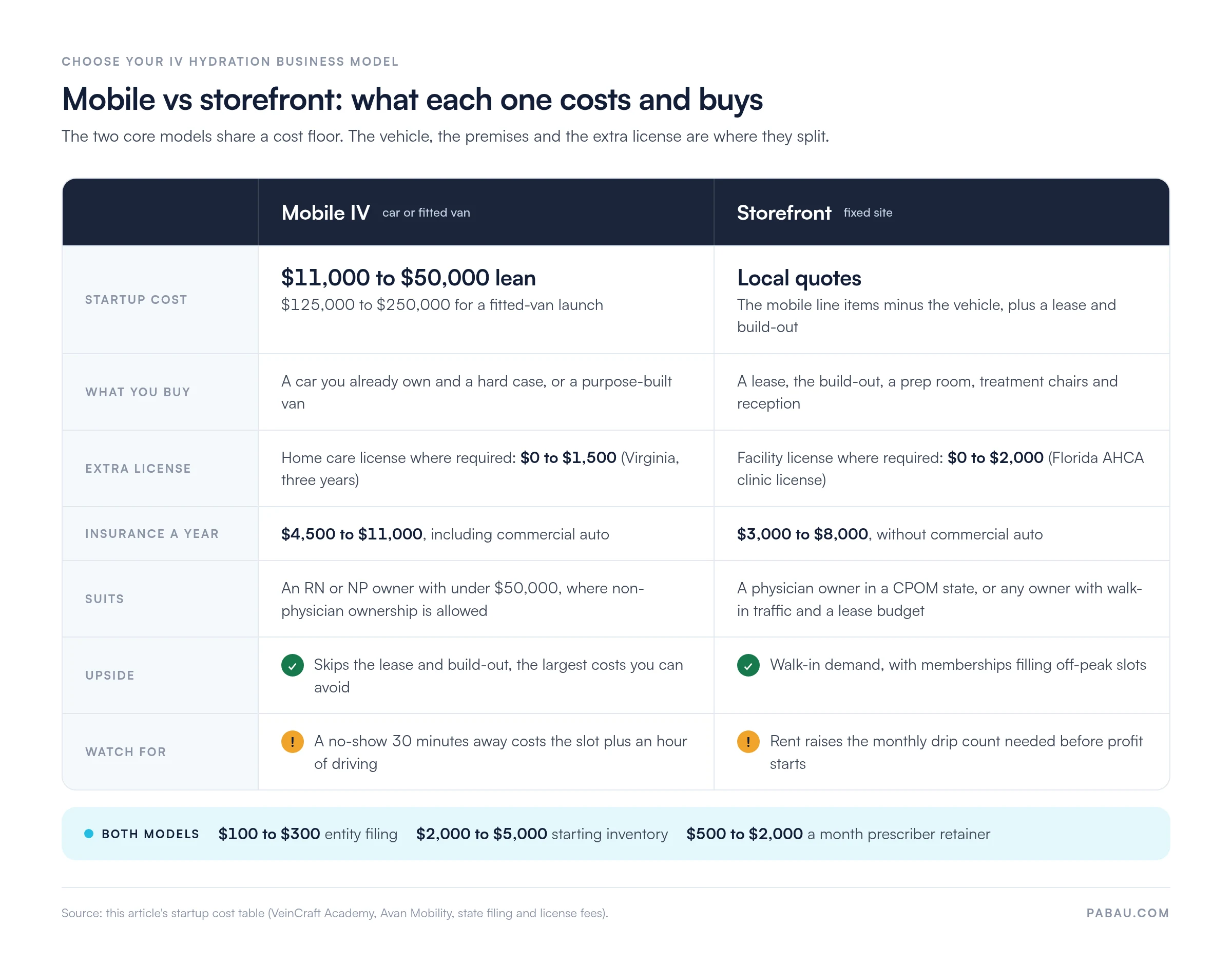
Starting a mobile IV therapy business adds four jobs: a vehicle, travel-based booking, inventory you carry, and safety procedures for working alone.
Ownership and oversight work exactly as in the state ownership matrix below, so the new work is running a practice from the road. According to Grand View Research, the global mobile IV hydration services market was worth $2.0 billion in 2024, growing 9.8% a year through 2030.
Mobile IV business requirements add one license in some states. Virginia requires a home care organization license from the Virginia Department of Health for any infusion in a patient’s residence. Running a home care organization without one is a Class 6 felony there.
A niche keeps the drive time sensible, so choosing one is the first commercial decision for a mobile IV hydration business. Three work well:
Corporate and concierge work earn more per mile driven, which is the number that decides whether a route is worth running. Athletic recovery brings repeat bookings but spreads them across town.
A mobile IV vehicle needs secure storage, temperature control for fluids and medications, and room to work beside a seated patient. Most operators of a mobile IV business start in a car they already own and carry a hard case.
A purpose-built IV van only pays for itself once the schedule can carry the payment. Avan Mobility, which builds mobile medical vehicles, puts a fully fitted launch at $125,000 to $250,000, including the van, supplies and licensing.
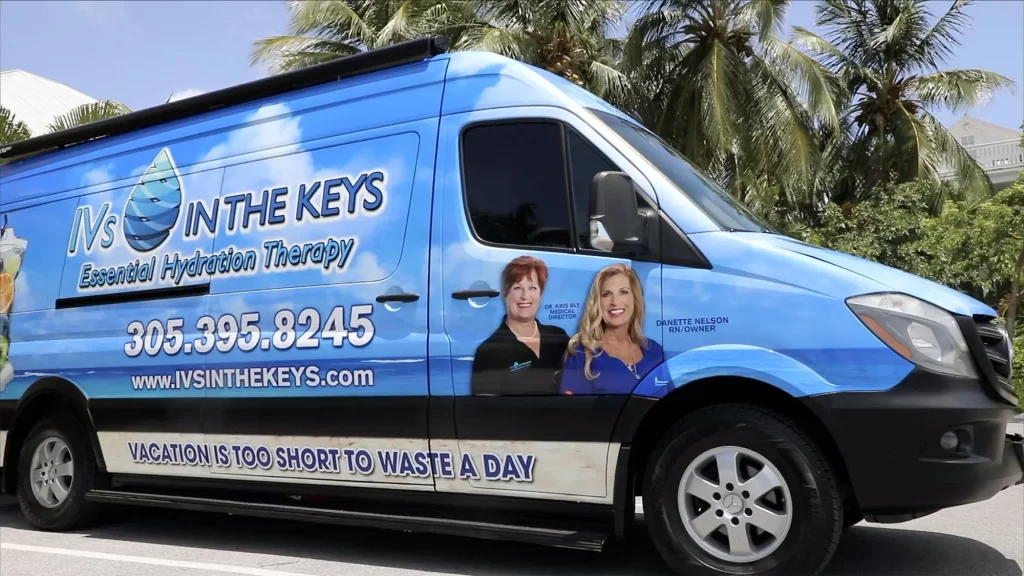
Whichever vehicle you use, add commercial auto insurance with medical cargo cover. A personal auto policy will not respond to a claim involving supplies carried for the business.
Travel time is the constraint a fixed practice never has. Split your area into travel zones, and build a route buffer into the booking rules between visits.
Without that buffer, the calendar will sell a 2 PM across town against a 1:30 that runs long. Online booking lets patients pick a slot without a phone call, and the team sees who is where.
Deposits do the other half of the work. A no-show at a fixed practice costs a slot, while a no-show 30 minutes away costs the slot plus an hour of driving.
Restocking mid-route is rarely possible, so your stock records have to show what is in the vehicle before the day starts. Track IV fluids, vitamins, consumables and equipment against expiry dates.
Good stock records also cut selection errors. Look-alike bags side by side in a case are a known hazard. ISMP Canada recommends clear labeling and a checked pick list to prevent mix-ups.
Write standing procedures for sanitizing equipment, handling supplies and disposing of sharps and medical waste. A mobile clinician carries the waste back rather than leaving it in a patient’s trash.
A reaction in a patient’s kitchen is handled by one person, with no colleague in the next room. Train every clinician on the common IV therapy complications and log every visit, so a reaction reported days later can be traced.
The requirements, steps and budget that follow apply to a mobile IV therapy business and a storefront alike.
A storefront IV clinic trades the vehicle for a lease, a build-out and walk-in demand. Starting an IV infusion clinic at a fixed site means a prep room, treatment chairs and a reception area.
Fixed-site licensing is where the states differ most. Florida requires an AHCA health care clinic license unless practitioners wholly own the clinic. Arizona requires a health care institution license and a state inspection unless an exemption applies. Virginia does not license practitioner offices at all.
Storefronts that add NAD+ and wellness consults often grow into a broader practice. If yours heads that way, our guide to building a longevity clinic sets out what to finish first, from medical oversight to software. Longevity clinic software keeps those service lines in one patient record as the menu widens. If peptide injections join the menu, compare software for peptide clinics on per-peptide consent and dosing logs before you commit. Once the practice runs annual longevity programs, see how eight longevity clinic platforms compare on lab trends, memberships and booking.
A registered nurse can start an IV hydration business in states without corporate-practice-of-medicine limits, but a licensed prescriber must order every drip.
That answer splits in two. Your license decides what you may do with a patient. Your state’s ownership rules decide what you may own.
On the clinical side, an RN can place the line, monitor the patient and run the visit. An RN cannot perform the good-faith exam, write the order or set the treatment protocol.
California’s Business and Professions Code §2725.1 is a typical example. It lets an RN dispense drugs or devices on an order from a physician, NP or PA.
On the ownership side, the corporate practice of medicine doctrine, known as CPOM, bars non-physicians from owning a medical practice where states enforce it.
California, Texas, New York, Georgia, Michigan, North Carolina and Illinois all keep the clinical entity with physicians or named licensees.
So can a nurse start an IV therapy business in a CPOM state? Yes, as the owner of a management services organization, or MSO.
The RN’s MSO runs booking, marketing, staffing and premises. A physician-owned professional corporation or PLLC holds every clinical decision, as the structure below shows.
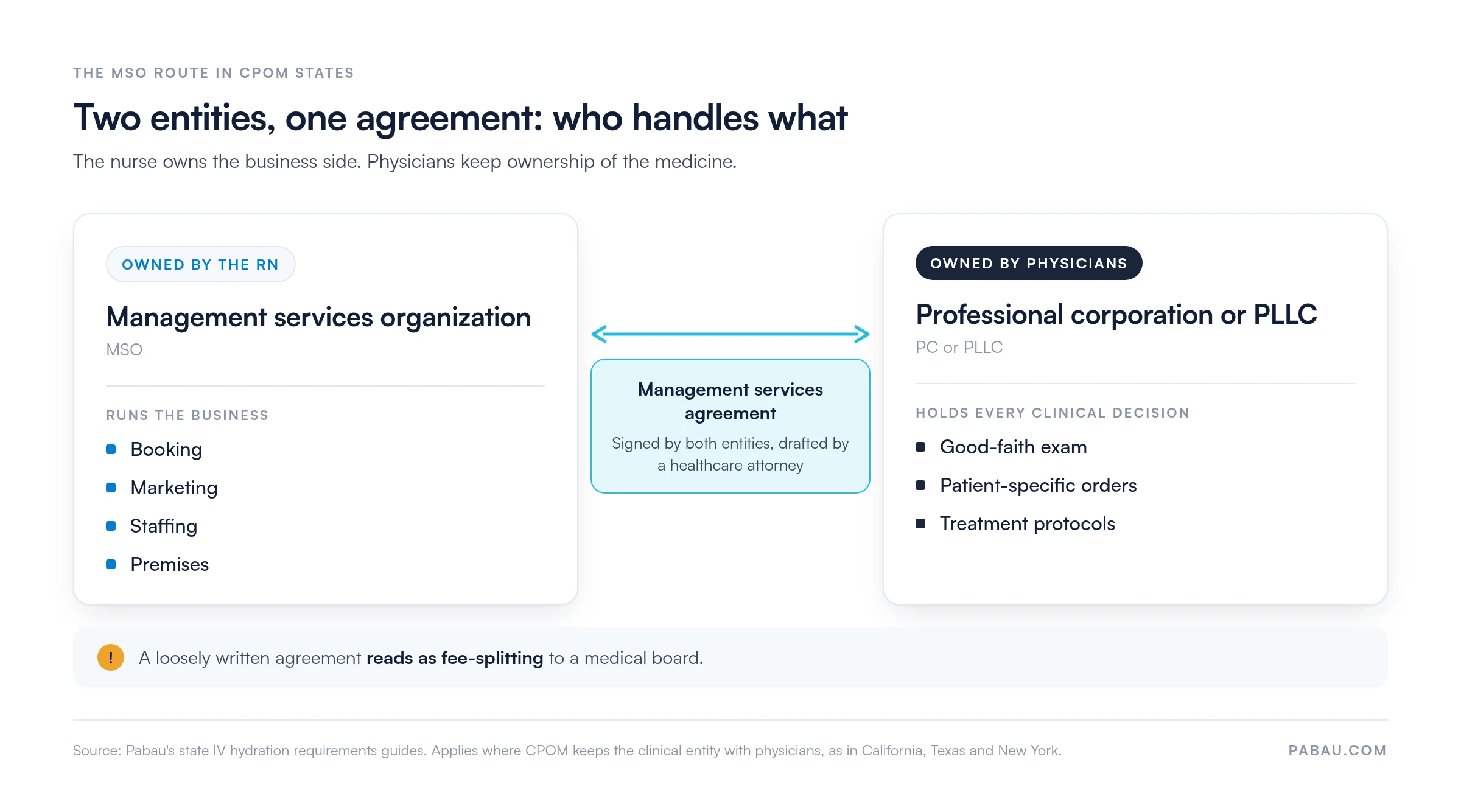
The two entities sign a management services agreement. Have a healthcare attorney draft it, because a loosely written agreement reads as fee-splitting to a medical board.
Nurse practitioners sit in between. Arizona grants NPs full practice authority, so an NP there can order drips without a supervising physician.
New York lets an NP with over 3,600 hours practice without a written agreement, yet still bars NPs from owning a medical PLLC.
A nurse starting an IV hydration business needs five pieces in place before any state filing:
When you start an IV hydration business as an RN, your license already covers the clinical work. The entity you may own is what changes by state, and the map and matrix below show how far it moves.
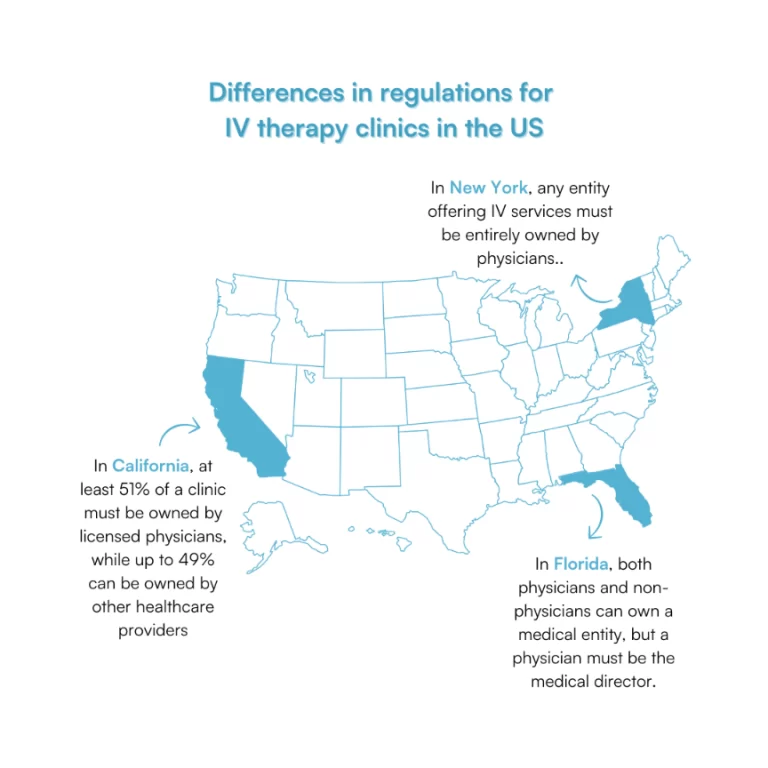
Each row in the matrix comes from our state requirements guide, which cites the statute or board behind it. Florida and Texas rows cite the regulator directly.
| State | Who can own the clinical entity | Can an RN own the business? | Nurse practitioner authority | Source |
|---|---|---|---|---|
| Arizona | Anyone, including a non-clinician. Arizona has no statutory CPOM ban. | Yes. Orders still come from an NP, PA or physician. | Full practice authority, so an NP can order without a supervising physician. | Arizona IV hydration requirements |
| California | A medical corporation at least 51% owned by California physicians. | Minority shareholder only, or a professional nursing corporation. | Works under standardized procedures. AB 890’s “104 NP” pathway opened in 2026, but NP ownership of a medical corporation remains unsettled. | California IV hydration requirements |
| Colorado | A physician-owned PC or PLLC holds the medical side. | Yes, the business side. The clinical entity stays physician-owned. | An APRN with full prescriptive authority can be the prescriber. | Colorado IV hydration requirements |
| Florida | Anyone, with a physician medical director who accepts legal responsibility in writing. | Yes, outright. | Autonomous practice is limited to primary care. Otherwise an APRN works under a physician protocol. | Fla. Stat. §400.9935 and §464.0123 |
| Georgia | Only Georgia-licensed physicians may hold shares in the professional corporation. | No, not in the professional corporation. | Orders under a filed nurse protocol agreement, with up to four APRNs per physician. | Georgia IV hydration requirements |
| Illinois | Physicians form medical corporations. Physicians and APRNs may own a professional service corporation or PLLC. | No. The RN owns an MSO instead. | An APRN may own a professional service corporation or PLLC. | Illinois IV hydration requirements |
| Michigan | A physician-owned PLLC or PC, with PAs alongside an MD or DO. | The business side only, through an MSO. | Prescribes non-controlled drugs independently, but cannot own the clinical PLLC. | Michigan IV hydration requirements |
| New York | Physicians only, or a PLLC or PC owned entirely by physicians. | No. An RN can own a company supplying premises, software and administration. | Practices without a written agreement after 3,600 hours, but cannot own a medical PLLC. | New York IV hydration requirements |
| North Carolina | Physicians and PAs may own outright. An NP may co-own only alongside a physician. | No. RNs are not a listed owner category. | Works under a collaborative practice agreement with a supervising physician. | North Carolina IV hydration requirements |
| Ohio | Anyone. No Ohio statute reserves ownership to a licensed profession. | Yes. | Needs a standard care arrangement with a collaborating physician that names the business. | Ohio IV hydration requirements |
| South Carolina | Anyone may hold equity, while a physician, PA or APRN holds clinical control. | Yes, as equity, with an authorized provider in clinical control. | May prescribe an infusion. RNs administer on a patient-specific order. | South Carolina IV hydration requirements |
| Texas | Physicians, under the state’s CPOM rules. Non-clinicians own an MSO alongside. | Not the medical practice. The MSO route applies. | Orders elective IV therapy only under physician delegation. | Texas HB 3749 (2025) |
| Virginia | Anyone. Virginia has no standalone CPOM statute. | Yes, through an ordinary LLC that contracts the clinical work. | Needs a practice agreement with a patient care team physician until roughly three years of full-time experience. | Virginia IV hydration requirements |
Before you lock in an ownership structure, confirm your state’s corporate practice of medicine and supervision rules with a healthcare attorney. It is far cheaper to structure it correctly now than to unwind it after you open.
Texas added a specific rule in 2025. HB 3749, known as Jenifer’s Law, created Occupations Code Chapter 172 for elective IV therapy.
A physician may delegate ordering to a PA or NP, and administration to a PA, APRN or RN under physician supervision.
IV hydration business requirements fall into six groups: licensing and medical oversight, facility and equipment, staffing, compliance, insurance, and business and financial management.
Every US state limits IV administration to licensed clinicians, and a physician, NP or PA must write the protocols and orders they follow. How that prescriber is appointed and supervised varies by state. Adding peptides to the menu brings its own license check, set out in our guide to peptide prescribing rules.
If peptides grow into a service line of their own, see how to open a peptide clinic, from compounding routes to consent and records.
Florida writes the role into statute. Under section 400.9935, the clinic’s medical director agrees in writing to accept legal responsibility for the clinic.
The protocols have to cover contraindication screening in writing. Heart failure, kidney disease and pregnancy all change what a drip can safely contain.
A fixed site needs a prep room, a treatment room and a reception area. Stock IV catheters and bags, emergency supplies, a medical refrigerator, carts and oxygen, and expect your licensing body to issue its own equipment list.
Pharmacy sourcing matters as much as the equipment. Compounded bags kept as office stock come from an FDA-registered 503B outsourcing facility. A 503A pharmacy compounds only against a patient-specific prescription.
An IV hydration team needs three roles: a prescriber who writes protocols, a clinician who can place a line, and a named compliance owner.
Beyond the clinical team, plan for front-desk cover and a practice manager once volume grows.
Physicians, nurse practitioners, physician assistants and registered nurses can insert an IV in every state on a valid order. LPN and paramedic scope depends on the state. Our guide to who can administer IV vitamin therapy covers each license in detail.
Appoint someone on your team as compliance officer. Give them ownership of tracking licensing renewals, monitoring clinical protocols, and flagging issues before they turn into bigger problems.
Three compliance regimes apply to every US IV visit: HIPAA for patient data, OSHA for staff safety, and local health department sanitation rules.
Mobile work makes HIPAA harder than it looks. Patient records travel on a phone or tablet. Device encryption and a remote-wipe policy do the job a locked filing cabinet does at a fixed site.
Build a compliance checklist as soon as you start planning. Track every license, permit and certification you need, along with renewal dates, so none of them lapses as the business grows.
Budget $4,500 to $11,000 a year for insurance on a mobile IV business, or less at a fixed site without commercial auto.
Those figures come from VeinCraft Academy, which trains clinicians launching IV services. Its typical annual ranges by policy are:
Ongoing monthly costs for supplies, insurance, the prescriber’s retainer and marketing typically run $2,000 to $5,000 before clinician pay, according to VeinCraft Academy. Plan cash for several months of that floor before bookings cover it.
Track overheads monthly: consumables, staff pay, insurance and rent or fuel. Keep bookings, intake forms, consent and pre- and aftercare in one system, so the admin does not pile up after hours.
Starting an IV hydration business takes eight steps in this order: plan, menu, location, licenses, setup, hiring, policies and marketing. The order protects your cash, because each step depends on the one before it.
Any IV hydration business start up follows the same sequence, whether you open a chair or a van. The licenses step takes longest, so file early.
An IV hydration business plan names your model, menu, prices, startup budget and the sessions per day you need to break even.
Keep it to a few pages. An IV therapy business plan earns its keep when it forces the decisions the rest of the setup depends on:
Start the IV hydration therapy business plan with a competitor review: what nearby services charge, how far they travel and which drips they list. An IV hydration clinic business plan adds the lease terms and the chair count.
Your menu is a business decision as much as a clinical one. Map each drip to local demand, then price and package around it:
Turn drips with steady repeat demand into memberships or packages, so revenue arrives monthly rather than walk-in by walk-in.
Launch with three or four core drips you can staff and stock reliably, then add higher-ticket options like NAD+ once you have proven local demand. A shorter menu is easier to price, train on, and keep in inventory.
A storefront needs visibility, parking and a space that meets health and safety standards. A mobile service needs a defined service area, drawn tight enough that drive time does not eat the margin.
Form the entity first, then apply for any facility or home care license, then confirm every clinician’s license is active in your state.
Lead times vary. Florida asks you to file with AHCA 60 to 120 days ahead of opening, while California and Texas need an entity filing only. California also charges an $800 minimum franchise tax every year after the first.
If you plan to bill insurance for medically necessary hydration, set up coding from day one. CPT code 96360 covers IV hydration, and ICD-10 code E86.0 covers dehydration.
Fit out the treatment space or vehicle to the equipment list your license requires. Then make the space calm, because many patients arrive tired, hungover or nervous about needles.
Train every clinician on infection control, emergency response and patient assessment, not only on IV competency. Set the hiring order by cost: the prescriber’s retainer bills from signing, so sign once the launch date is firm.
Write down how your team handles cancellations, no-shows, complaints and adverse reactions. Then build a consent and safety checklist every clinician runs before each infusion:
An IV therapy intake form gives you a starting point for the screening questions.
Keep an emergency kit and your written adverse-reaction protocol at every treatment station, and rehearse it with new hires during onboarding, not after an incident.
Line up partners before opening day: gyms, spas, wedding planners and event organizers send block bookings an IV business cannot win alone. Add a review strategy, gift vouchers and a referral offer once the first patients are through.
Our IV therapy marketing guide covers the channels in detail. Bookings dry up fast without steady outreach, so budget for marketing every month, not only at launch.
A lean mobile IV hydration business launches for $11,000 to $50,000, and a fitted medical van pushes the total past $125,000.
A storefront skips the vehicle but adds a lease, a build-out and treatment chairs. Those vary too much by market for a published benchmark to be useful, so get local quotes. The table itemizes the rest.
| Cost line | Storefront | Mobile | Source |
|---|---|---|---|
| Entity formation, one-time | $100 to $300 | $100 to $300 | State filing fees: $100 in California, $125 in Florida, $300 in Texas. |
| Facility or home care license, one-time | $0 to $2,000. Florida’s AHCA clinic license is $2,000. | $0 to $1,500. Virginia’s home care license is $1,500 for three years. | Fla. Admin. Code 59A-33.002 and our Virginia guide. |
| Starting inventory, one-time | $2,000 to $5,000 | $2,000 to $5,000 | VeinCraft Academy, then $500 to $1,500 a month to replenish. |
| Insurance, annual | $3,000 to $8,000 | $4,500 to $11,000 | VeinCraft Academy. The storefront range is our arithmetic, without commercial auto. |
| Prescriber retainer, monthly | $500 to $2,000 | $500 to $2,000 | VeinCraft Academy. The retainer scales with state duties and menu size. |
| Lease and build-out | Local quotes | None | Varies too widely by market to benchmark. |
| Vehicle | None | $0 for a car you own, or a $125,000 to $250,000 fitted launch | Avan Mobility, for the fitted-van launch including supplies and licensing. |
In the mobile IV practices we onboard at Pabau, the practice management platform we build, owners underestimate the retainer and the insurance most. Both bill every month, whether or not anyone books.
An IV hydration business is profitable per session, because a drip costing $35 to $60 to deliver typically sells for $99 to $225 or more.
The American IV Association puts anchor hydration drips at $99 to $149 and signature drips at $150 to $220. Premium formulas such as NAD+ start at $225. The same benchmarks put the break-even cost of one drip at $35 to $60.
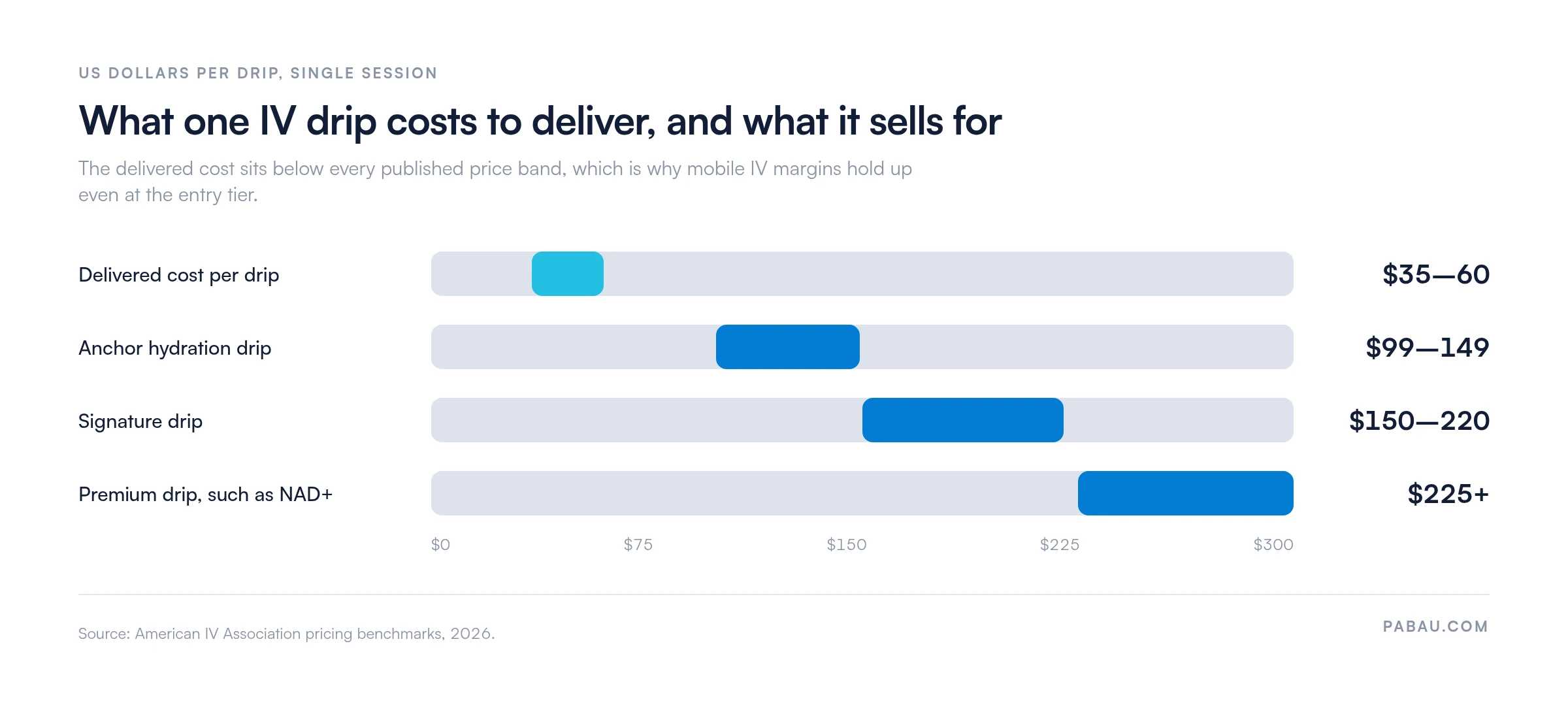
The fixed costs decide the month. A prescriber’s retainer and insurance bill whether the calendar is full or empty.
Take the midpoints from the cost table: a $1,250 retainer and roughly $645 a month in mobile insurance. At a $150 drip costing $48 to deliver, the business covers those fixed costs at about 19 drips a month.
That arithmetic is our own. Clinician pay sits on top, so an owner who runs the drips personally breaks even far sooner than one paying a per-visit rate. A storefront adds rent to the fixed side, which raises the monthly drip count before profit starts.
Memberships smooth out a slow month. The American IV Association puts basic membership tiers at $89 to $129 a month and premium tiers at $199 to $299. Our guide to membership tier pricing shows how to work out each tier’s margin from your own costs.
Track four numbers every month: bookings, repeat visit rate, revenue per patient and, for mobile work, drive time per visit. Two patients in the same building earn far more per hour than two on opposite sides of a city.
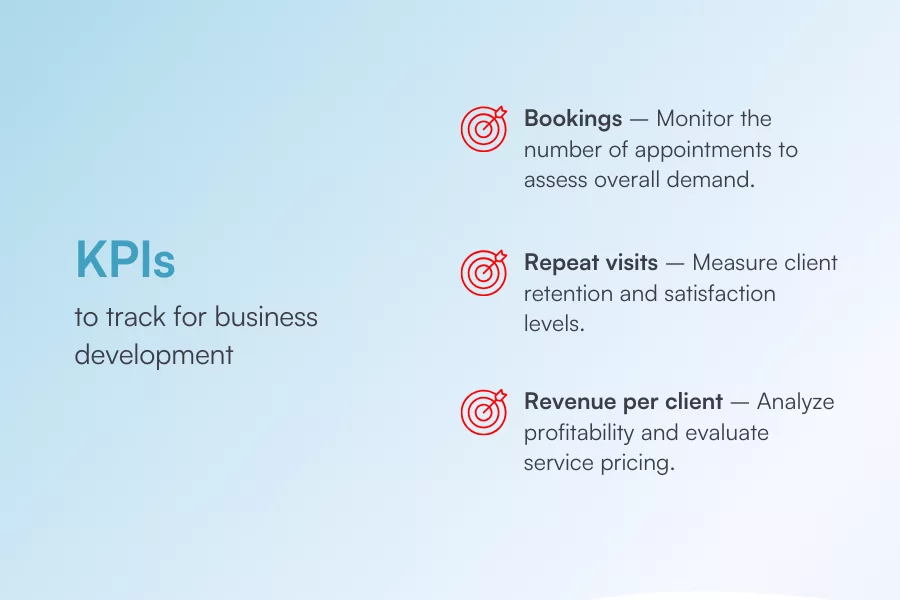
Growth then comes from referrals, loyalty programs and partnerships, which create demand instead of waiting for it.
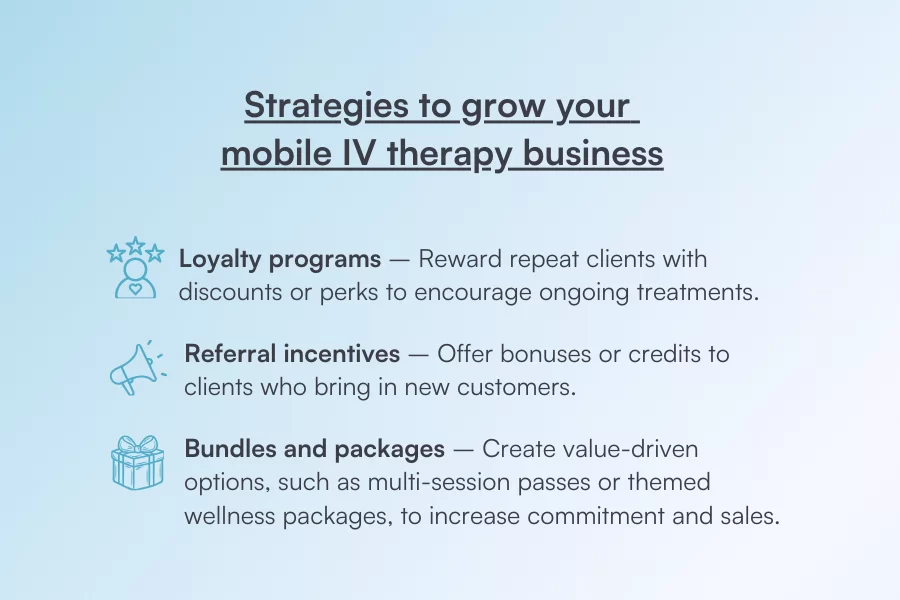
As the patient base grows, add clinicians before adding drips. A second nurse doubles the slots you can sell, while a longer menu mostly adds inventory to carry.
Five mistakes do the most damage in the first two years of an IV hydration business:
Most new IV owners start with a booking app, PDF consent forms and a stock spreadsheet that never agree with each other. Pabau puts the booking, the medical intake, the consent and the invoice on one patient record, for a storefront chair or a van.
With Pabau’s capture forms, patients complete the medical history and sign consent online before the visit. Your nurse arrives with the screening done, so the appointment starts with the drip rather than the paperwork.
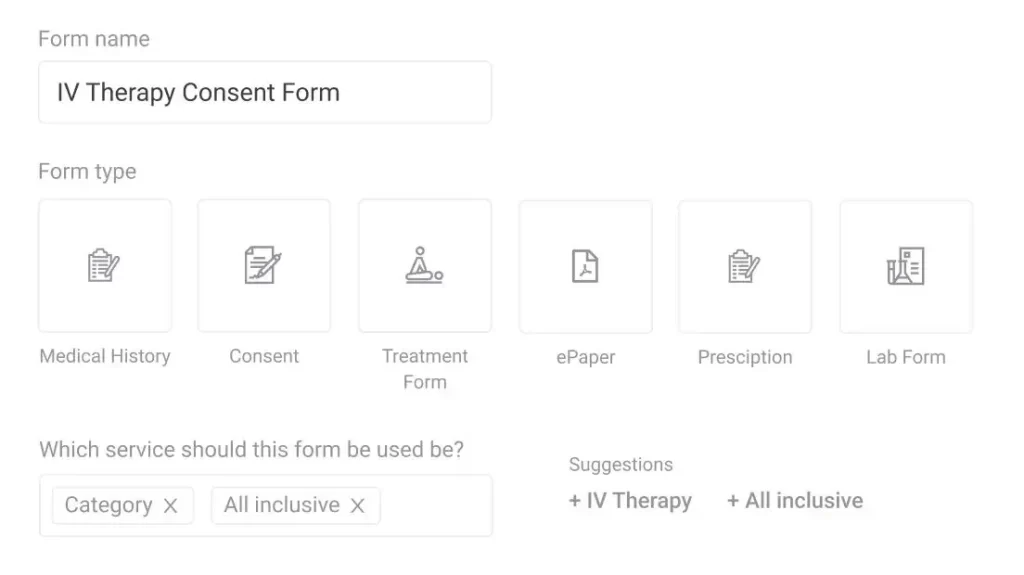
The same IV therapy EMR software handles the parts of an IV day that usually get done twice:
Pabau GO, our iOS app for practitioners, puts the schedule, Client records and notes on the phone in the van. DRIPwoRX, an IV therapy practice in South Carolina, built its booking, intake and consent workflows in Pabau as it opened in 2025.
Learn how Bank MediSpa optimized operations with Pabau’s secure digital patient record system.


Pabau brings online booking, intake and consent forms, patient records, stock and payments into one place, for a storefront, a mobile service or both. Patients complete medical questionnaires before they arrive, so every drip starts from a complete record.

Pick the model your state’s ownership rules and your capital allow, then build in that order. A structure copied from the wrong state is the one mistake a regulator can close you over. It is also the costliest to unwind once patients are booking.
For most first-time owners with under $50,000, that means a lean mobile launch and a storefront later. The trade-off is speed against stability. Opening before the prescriber agreement and licenses are in place reaches a first patient sooner, and puts the business at risk.
Once the structure holds, profit comes down to repeat visits and the fixed monthly floor, not menu size. Book a demo to see how Pabau runs booking, intake, consent and stock for an IV hydration business from the first appointment.

Choosing your software? The best EMR for IV therapy compares what to look for in a clinical system.
Building your drip menu? Our Myers’ cocktail protocol breaks down one of the most requested IV blends.
Planning for safety? IV therapy complications covers the reactions to screen for and how to respond.
Adding vitamin B6 shots to your services? The vitamin B6 injection guide gives you the dosing table for deficiency and isoniazid depletion, plus a consent template.
Offering vitamin D3 shots too? The vitamin D3 injection consent form comes with dosage, protocol and aftercare guidance.
For an IV hydration business start up, you need a legal structure your state allows, a prescriber writing orders, and licensed clinicians running each drip. Add malpractice and liability insurance, supplies, HIPAA-compliant records and, for mobile work, a vehicle.
An LPN can own the business entity where lay ownership is legal, such as Ohio or Florida, but cannot write orders. The same split applies whenever a nurse starts an IV therapy business. Clinical scope is narrower for LPNs: Ohio bars them from starting an IV, and South Carolina excludes them from retail IV hydration.
A paramedic can own an IV business wherever lay ownership is legal, such as Ohio, Florida or Arizona. A physician, NP or PA still examines each patient and writes the order. Whether a paramedic may run the drip varies by state, and South Carolina’s boards exclude EMTs and paramedics from retail IV therapy.
Not in every state. Florida, Ohio and Arizona let non-physicians own the business, while New York reserves ownership to physicians and California requires a 51% physician majority. Every owner still needs a licensed prescriber who examines patients and writes the orders.
Expect three layers of IV hydration business requirements: an entity filing, an active license for every clinician, and any facility license your state imposes. Florida’s AHCA clinic license costs $2,000, and Virginia requires a $1,500 home care license for in-home infusion.
A lean mobile launch costs $11,000 to $50,000, according to VeinCraft Academy, and a fitted medical van pushes it past $125,000. A storefront skips the vehicle but adds a lease and build-out. An IV therapy franchise lists its full initial investment in Item 7 of its disclosure document.
A mobile IV hydration business earns a wide margin per session, because a drip costing $35 to $60 to deliver sells for $99 to $225. Fixed costs decide the month, since the prescriber’s retainer and insurance bill whether or not anyone books.
An IV drip business suits an owner who already holds a clinical license or has a physician partner lined up. Margin per drip is wide and demand is steady around events and travel. The prescriber’s retainer is a fixed monthly cost from day one.