Vitamin C protocol: Free template for oral and IV treatment
A vitamin C protocol is a written clinical framework for giving vitamin C to pat...

7
Last Updated: Oct 16, 2026
Who can administer IV vitamin therapy comes down to license: physicians, nurse practitioners and physician assistants order the drip, and registered nurses usually give it.
All three prescribing roles can also run the infusion themselves. By contrast, LPN and LVN authority depends on your state, and unlicensed staff such as medical assistants usually cannot start a line.
That answer matters the moment you staff a drip day. Hire the wrong license and the exposure lands on your supervising practitioner, not on the person holding the cannula.
This guide gives owners and managers one way to hold those rules together: the order-administer-supervise-record chain. In practice, every drip needs a named person on each of its four links. Still, treat the guide as general information rather than legal advice.

Physicians, nurse practitioners, physician assistants and registered nurses are the roles most widely authorized to administer IV vitamin therapy.
LPN and LVN authority depends on the state, and many states require a separate IV certification first.
Medical assistants, estheticians and other unlicensed staff cannot start an IV in California or New York, whatever training they hold.
A licensed prescriber has to assess the patient and order the drip, even when a nurse administers it.
Map the order-administer-supervise-record chain before you open, so one patient record names who ordered, administered and supervised every infusion.
Physicians, nurse practitioners, physician assistants and registered nurses can administer IV vitamin therapy in most states. However, LPN and LVN staff may in some, usually only after a separate IV certification. Medical assistants, phlebotomists and estheticians generally cannot.
Two separate permissions sit behind that answer. First, there is the authority to insert the cannula. Second, there is the authority to order what goes into it.
Hospitals split the work the same way. In fact, their IV infusion nurse, sometimes titled an IV specialist, is a registered nurse with dedicated infusion experience.
The table below sorts the nine roles you are most likely to interview.
Use it to build a shortlist, then verify every role against your own state before you post the job. In turn, your state medical board sets physician and delegation rules, and your board of nursing sets RN and LPN scope.
Where the table says varies by state, a phone call to the board beats an assumption.
Physicians, nurse practitioners and physician assistants are the roles authorized to both order and administer IV therapy in the widest range of states.
Their training already covers the parts of an infusion that go wrong.
Nurse practitioners can often go furthest, assessing, prescribing and running the IV program themselves. Independent practice authority varies by state, so confirm yours before you design the role.
Physician assistants carry similar clinical range, though their prescribing usually runs through a supervising or collaborating physician.
Overall, registered nurses administer most drips in this industry, and LPN/LVNs, paramedics and phlebotomists sit on edges that shift from state to state.
An RN who places lines daily on a ward arrives in a wellness setting with no skills problem to solve. In fact, they have already handled fainting and vein inflammation under pressure. Still, what an RN cannot do is order the drip.
LPN and LVN staff are the classic conditional case. For example, Florida lets an IV-certified LPN administer therapy after a post-licensure course of at least 30 hours. By contrast, California requires LVNs to hold a separate board certification before they touch a line.
Paramedics and EMTs are trained to cannulate, but that authority normally belongs to an emergency medical services system and its medical direction. So it does not follow them into a wellness practice by default.
Phlebotomists are the role owners most often misread. Drawing blood and running an infusion are different skills and, in most states, different scopes. In fact, Florida does not license phlebotomists as clinical laboratory personnel at all.
So do you need to be a nurse to give IV drips? Not necessarily, because physicians, NPs and PAs all qualify. Still, you do need a license that your state ties to intravenous administration.
The order-administer-supervise-record chain is how boards test every drip: who ordered it, who administered it, who supervised, and whether the record proves it.
An investigator never accepts a job title as the answer. Instead, the question of who can administer IV therapy of any kind, from saline hydration to vitamin blends, runs through the same four links.
Oregon puts the point bluntly. Its Board of Nursing says a patient has no legal authority to self-prescribe by choosing a cocktail from a menu. Moreover, prescribing cannot be delegated to an RN or LPN either.
Write the four-link chain out as a staffing plan before you hire. If any link has no named person attached, the service is not ready to open. The diagram below shows who can hold each link.
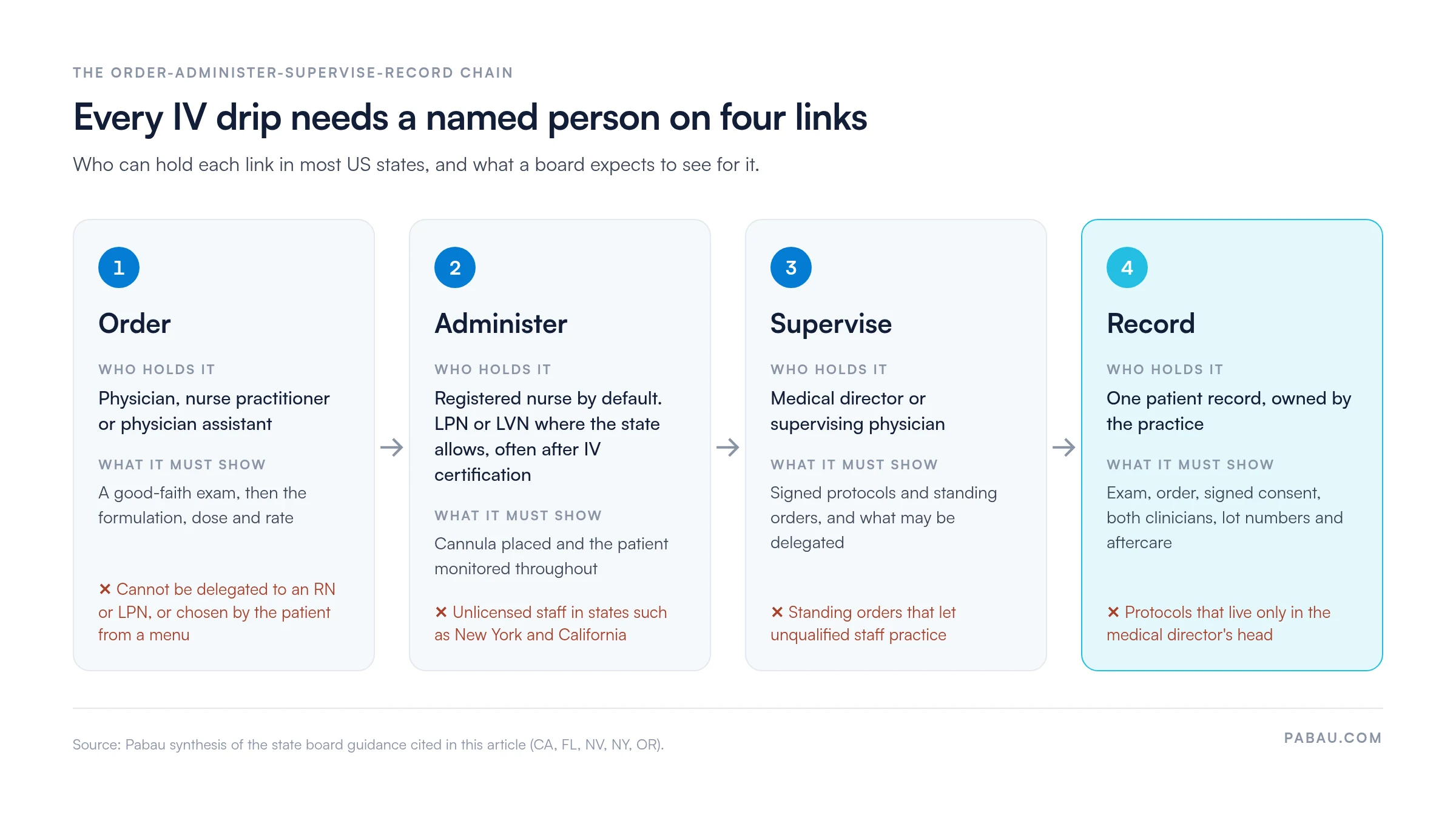
IV vitamin therapy delivers vitamins, minerals or fluids straight into a vein, and it is regulated because it is a medical procedure. A drip enters the bloodstream directly, so it skips the body’s usual filters.
That is also the appeal. Oral supplements pass through the digestive system, which breaks them down and absorbs only a fraction. By contrast, an infusion reaches circulation immediately. In addition, a vitamin deficiency test shows which nutrients a patient needs.
Regulation follows the risk. A badly placed cannula or a lapse in aseptic technique can cause infection, phlebitis or extravasation. States therefore restrict administration to licensed roles, rather than to anyone who has sat a course.
Most practices add drips for a familiar set of reasons.

State law decides which of those licensed roles may start your drips, and the answers conflict. For example, New York bars unlicensed staff from touching an IV at all. By contrast, Florida lets a certified LPN run one with no RN on the premises.
The table below sets out five states that have published their rules directly. Each row links to the regulator that wrote it.
Those five states give five different answers. An industry rule of thumb carries little weight when a board asks you to justify a staffing decision.
Ask who can administer IV therapy in Florida and the answer includes an IV-certified LPN. The directing RN or practitioner need not be on site. By contrast, the same question in a neighboring state can produce a stricter answer.
California stacks the layers higher. There, RNs work from a prescriber’s order, and LVNs need a separate board IV certification first.
California’s Board of Pharmacy also warns that IV hydration clinics are largely unregulated. In addition, the board notes that mixing these drips counts as sterile compounding under national standards.
Texas is the state to watch next. House Bill 3749, known as Jenifer’s Law, followed a patient’s death at a med spa. As a result, it created new rules for elective IV therapy given outside a physician’s office or licensed facility.
Legal analysts disagree on how far Jenifer’s Law restricts delegation, so read the current statute rather than a summary.
Two calls settle most of this. Your board of nursing owns RN and LPN scope. Meanwhile, your medical board owns physician delegation and supervision.
Good IV vitamin therapy guidelines cover five areas. They name the exam before the first drip, the order behind every formula, and the source that compounds it. They also set the sterile routine and the response when a patient reacts badly.
An inspection asks to see all five in writing, including the three that are easiest to leave to habit.
Write these guidelines down once and hand them to every new hire on day one. Protocols that live in the medical director’s head cannot be produced when a board asks for them.
Your guidelines should also name the boundary for each role, so an unlicensed team member knows exactly which step is not theirs.
An IV certification shows a clinician is trained to place and run a line, while only a state license grants the authority to do it. The certificate never creates scope of practice on its own.
That distinction catches people out. For instance, a search for a local IV course turns up plenty of providers selling the skill. In the end, only your state grants the permission, and it does so through a license.
In the US, the Infusion Nurses Society is the best-known source, alongside the American Red Cross and accredited infusion training centers. A typical IV therapy training course covers:
For LPN and LVN staff, the certificate does more work. Several states treat that separate credential as the condition for letting them near an IV line, so check your rule before you assign infusions.
So how do you become an IV therapist? You qualify into a license your state ties to intravenous administration, then add infusion training on top. No course lets you skip the license.
CPR and basic first aid are non-negotiable for anyone in the treatment room. After all, an allergic reaction nobody recognizes in the first minute becomes an emergency in the second.

Running the service needs two different permissions: a medical spa license for the company and clinical authority for the treatments. However, an IV hydration business license alone does not let anyone put a needle in a vein.
Owners tend to discover the second half late. These are the pieces most states expect you to have in place.
An IV hydration business license question almost always turns into an ownership question. So, ask your state medical board who is allowed to own the clinical entity before you file any paperwork.
Our guide to opening an IV clinic walks through the setup in order. Once the doors are open, IV therapy EMR software keeps each license, protocol and patient record in one place.
Mobile services add a layer, because the rules can follow the address where the drip is given. Our guide to running a mobile IV therapy business covers what changes when the treatment room is a patient’s living room.
A training certificate never grants scope of practice. Indeed, an unlicensed team member with an IV course behind them still cannot start a line where the state reserves that act.
New York states it in one line. Unlicensed persons may not insert or remove IVs of any kind. In other words, being competent at a task does not confer legal authorization to perform it.
California draws the line in a different place. The Medical Board of California allows medical assistants to draw blood, but not to start an IV or inject into an IV line.
Unlicensed assistive personnel, known as UAPs, work under a range of job titles.
Phlebotomists show the rule most clearly. An IV course adds infusion skills to a phlebotomist’s training, yet the phlebotomy role still carries no authority to start a line in most states.
Liability does not sit with the person holding the cannula. If a UAP acts, or fails to act, the supervising practitioner answers for it.
A non-medical team member can still legally own plenty of work, and it is usually the work that eats a nurse’s day.
Give that list to your unlicensed staff in writing. That way, a clear boundary protects them as much as it protects your supervising clinician.
The disadvantages of IV therapy begin at the insertion site, where infection, phlebitis, vein irritation and bruising are the common complications. Infiltration and extravasation follow when fluid leaks out of the vein into surrounding tissue.
Two more sit further from the needle. First, an allergic reaction to an additive can escalate fast. Second, high-dose formulations carry a fluid and electrolyte overload risk, which matters most for patients with cardiac or kidney conditions.
Patients with cardiac or kidney conditions, and anyone allergic to an additive in the formula, are poor candidates for an elective IV drip. That’s why the prescriber’s good-faith exam is where they get screened out.
Then there are the two nobody enjoys putting on a form. Evidence for many wellness claims is limited. Insurance generally does not cover elective drips, so the patient pays out of pocket.
The table below turns the clinical risks into a staffing question, which is the version your team needs in the room.
Treat the table as a quick reference alongside the protocol your medical director signs off. Say all of it before treatment, and record that you said it.
Your consent form should name the complications, the evidence position and the cost, along the lines of our IV consent form template. So, the patient’s signature belongs against that version of the form.
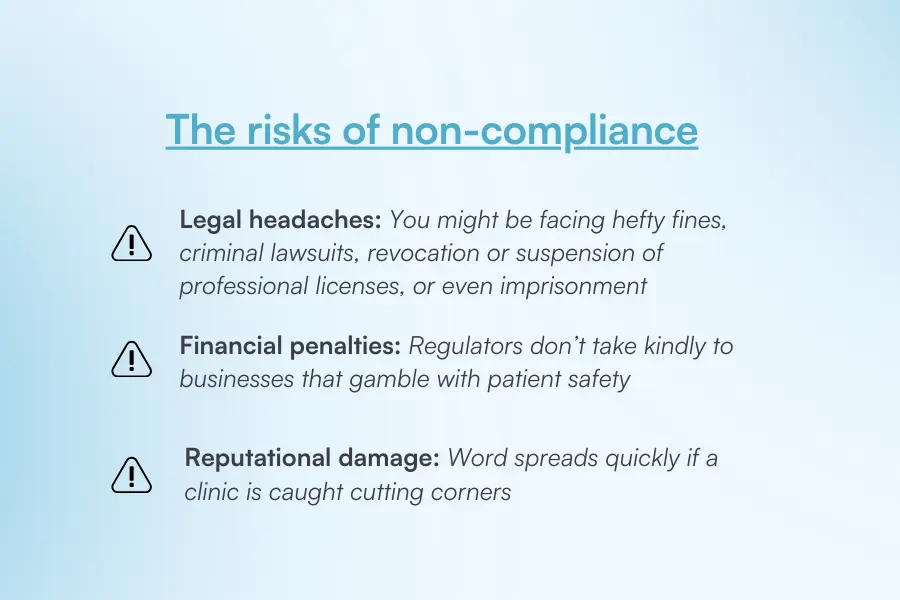
Non-compliance costs money, licenses and patients, and the license at risk is often not the one you would expect. In fact, the supervising practitioner is usually the first person a board investigates.
In 2023, Jenifer Cleveland of Fairfield, Texas died after receiving an IV drip infusion at Luxe Med Spa, Fox 4 News reported. As a result, the Texas Medical Board suspended the acting medical director’s license, over an allegation that he failed to supervise IV administration properly.
Texas House Bill 3749, known as Jenifer’s Law, was introduced in response to that case. In turn, it pushed state regulators to tighten oversight of the elective IV therapy industry.
Oregon reached the same conclusion from the other direction. There, its Medical Board treats IV hydration therapy as the practice of medicine. So, it warns medical directors against standing orders that let unqualified personnel practice it.
Owning an IV therapy business and administering the treatment are two different permissions. Many states also expect a named medical director on file, and that person carries the supervision duty for every infusion.
The fallout from getting it wrong tends to land in three places.
This audit checks that every link of the order-administer-supervise-record chain has a named person and a record behind it. Run it before every drip day and it takes about ten minutes.
Skip it, and the missing pieces only surface when someone asks for records months later.
Treat any item you cannot answer today as a scheduling decision. Either way, fix it before the first patient arrives, or move the appointment.
The four-link chain only holds if it lives somewhere your team opens every day. Practice management software like Pabau keeps all four links on one patient record. Pabau is built as software for longevity practices, so drip services, consultations and aftercare share one system.
That turns the audit above from a hunt through folders into a glance at a screen.
Every Pabau subscription includes every feature, so none of this sits behind a higher tier. Pricing scales with your number of locations and users instead.
Setup is guided rather than self-serve. A dedicated Client Coordinator and structured onboarding configure your forms, protocols and booking rules around how your practice runs.
When we set up an IV therapy practice, we build the four links into the treatment form itself. The chain is then enforced from the first drip, before anyone has to remember it.

See how Pabau holds the good-faith exam, the order, the consent form and the supervising clinician against a single patient record. Bring your current protocol and we will map it.

Staff for the license first. A weekend course shows someone has been taught cannulation, and only your state decides whether they may perform it.
The harder discipline is the paperwork around the hire. So, a defensible IV service can show its order-administer-supervise-record chain for any drip, on demand, months later.
Call the two boards that own the answer, write the chain into your staffing plan, and re-run the audit before each drip day. Book a demo to see how Pabau keeps every IV order, consent and signature against one patient record.

Operating in Arizona? Check the Arizona IV hydration requirements before you sign a lease or hire an injector.
Opening a drip service in New York? The New York IV hydration requirements set out who may own the practice and who may run the drips.
Preparing your team for a bad reaction? Our guide to IV therapy complications covers infiltration, phlebitis and extravasation, and how to prevent them.
Need the exam on paper before the first drip? The IV therapy patient intake template captures the medical history your prescriber reviews.
Yes, IV vitamin therapy is legal in the US when a licensed prescriber examines the patient and orders the drip. A licensed clinician then gives it. Legality turns on who can administer IV therapy in your state and under whose order. Unlicensed staff starting lines, drips chosen from a menu, or no supervising medical director can each make a service unlawful.
No, a registered nurse is the most common administering role, but physicians, nurse practitioners and physician assistants can also administer IV therapy. LPNs and LVNs may in some states, usually after a separate IV certification. Unlicensed staff are barred outright in states such as New York and California.
In many states an RN can own the business, but owning it is not the same as running the clinical side. You will usually need a business license for the company and a medical director who orders the drips. Some states restrict medical practice ownership to physicians, which pushes RN owners toward a management services arrangement. Check your state’s corporate practice rules before you register anything.
Insurance generally does not cover elective IV vitamin drips, so the patient pays out of pocket. Tell patients before treatment, and name the cost on your consent form alongside the complications and the evidence position.