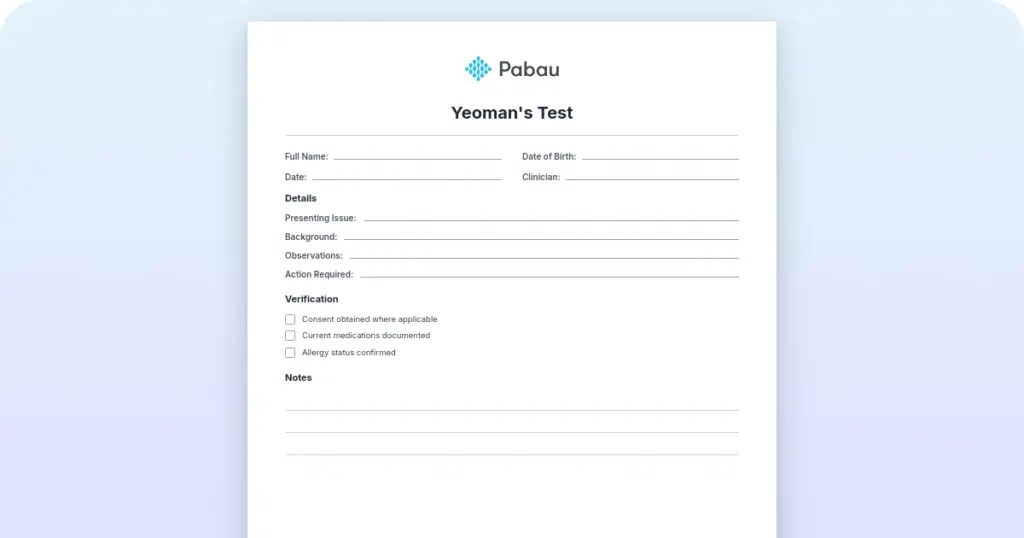
Yeoman’s Test Template
Yeoman’s test is a prone provocation test for sacroiliac joint (SIJ) pain....

3
Last Updated: Sep 28, 2026
Starting a mobile IV therapy business takes four steps: settle ownership and licensing, appoint a medical director, hire licensed clinicians, and set up mobile operations.
Which of those comes first depends on your state. California and Texas require a physician to own the practice, while Florida lets a nurse own it outright.
The demand side is the easy part. Clients want treatment at home, at the office, or at an event, without losing an afternoon to a waiting room.
The setup is where new owners get stuck. Mobile IV therapy is regulated healthcare, so oversight, licensing, and insurance all have to be settled before the first appointment.
This guide covers the ownership rules in Florida, California and Texas, plus what the launch costs at each end of the range. The rest walks through building the clinical team, running mobile operations, and the software that holds them together.

Ownership rules decide your structure: California and Texas require physician ownership, while Florida lets a non-physician own the business with a medical director appointed.
Only a licensed clinician may place the line, and a physician has to write and sign off the treatment protocols.
A lean mobile launch runs $11,000 to $50,000, while a purpose-built medical van pushes the total past $125,000.
A drip costing $35 to $60 to deliver commonly sells for $99 to $225, so margin per session is wide.
Scheduling, inventory, and compliant client records have to run from a phone, because a mobile business has no front desk behind it.
Demand clusters around a few predictable moments: recovery after a race, jet lag after a long flight, and the morning before a wedding. Each one is a booking a fixed practice rarely captures, because the client will not travel for it.
Mobile IV therapy services, including popular formulas like the Myers cocktail, sell on convenience as much as on the drip itself. Weight-loss injections now sit beside drips on many mobile menus.
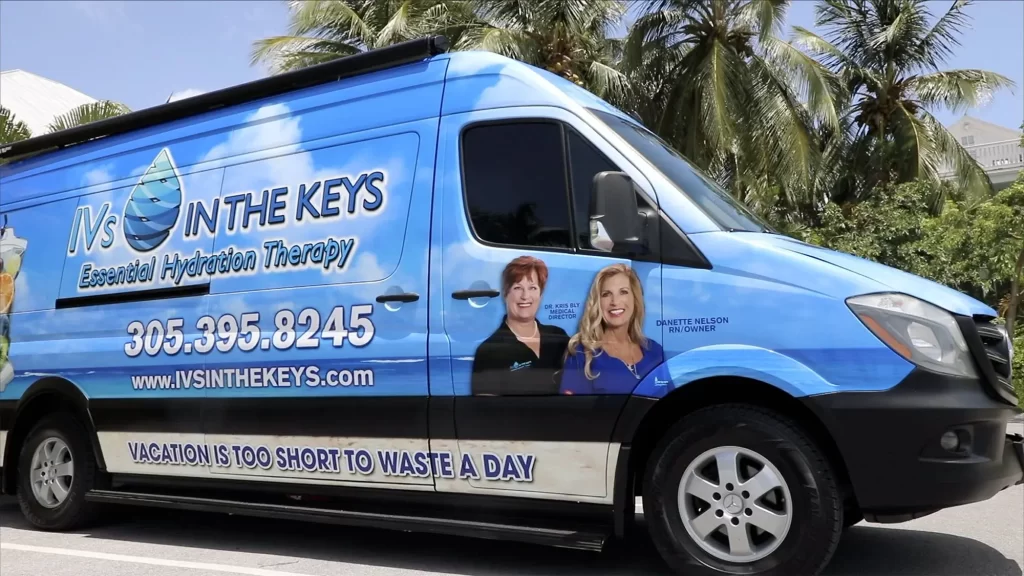
According to Grand View Research, the global mobile IV hydration services market was valued at $1.3 billion in 2024. Grand View projects a compound annual growth rate of 9.8% between 2025 and 2030.
Home-visit care is growing well beyond hydration, too. Providers in occupational therapy and speech therapy increasingly deliver sessions in clients’ homes for the same convenience reasons.
A niche is what keeps the drive time sensible. Three models work well for a mobile service:
The corporate and concierge models earn more per mile driven, which is the number that decides whether a mobile route is worth running. Athletic recovery brings repeat bookings but spreads them across town.
Mobile drips also pair well with adjacent services. Many practices running functional medicine software add IV therapy as a complementary offering for existing patients.
What to do: Start with a competitor review. Look at what other mobile IV services in your area charge, how far they travel, and which drips they list.
Write the findings into a one-page plan before you commit. Pricing, target neighborhoods, and the drips you stock are the three decisions the rest of the setup depends on.
Yes, IV therapy requires a license everywhere in the US, because only a physician, nurse practitioner, physician assistant, or nurse may place the line.
Each state sets its own scope of practice rules. Those rules decide who can own a mobile IV hydration business, who may administer treatments, and which licenses each of them must hold.
Two terms decide the structure. The corporate practice of medicine doctrine, known as CPOM, bars non-physicians from owning a medical practice in the states that enforce it.
The management services organization, or MSO, is the route around CPOM. A non-clinical owner runs an MSO that handles booking, marketing, staffing, and billing, while a physician-owned entity holds every clinical decision.
The two entities sign a management services agreement. Have a healthcare attorney draft it, because a loosely written agreement reads as fee-splitting to a medical board.
In the UK, the business owner does not need to be a medical practitioner. The business itself must be registered with the CQC before it can provide IV drip services.
In 2023, the UK confirmed that administering vitamins or any prescription-only product intravenously counts as a regulated activity. That includes 0.9% saline, and it requires Care Quality Commission registration.
The table below summarizes how the two markets differ.
A physician can own a mobile IV therapy business in any state, while nurses and non-clinicians can only where state law allows non-physician ownership.
Ownership and administration are separate questions, and conflating them is what catches new founders out. Your credentials decide the first one, and your state’s CPOM position decides the second.
In the UK, the owner does not need to be a clinician at all. The business still needs CQC registration, and a qualified prescriber must administer or supervise every treatment.
Whichever route applies, confirm the structure with a healthcare attorney before you spend on a vehicle or supplies. A signed client agreement is worth having in place before the first visit, so cancellation and payment terms are clear on both sides.
A licensed physician must write the treatment protocols, review client health histories, and take responsibility for the clinical side of every mobile visit.
Contraindication screening is where that oversight earns its retainer. Heart failure, kidney disease, and pregnancy all change what a drip can safely contain, and the protocol has to say so in writing.
State boards have also sharpened their view of the passive medical director. A physician who signs the agreement, collects the retainer, and never reviews a chart leaves the practice exposed.
Agree the review cadence in writing at the start. A monthly chart review and a named route for clinical questions during a visit are the two things a mobile team uses most.
Florida lets a nurse own a mobile IV therapy business outright, while California and Texas require a physician to hold the practice.
Those three states sit at opposite ends of the ownership question, and most guides stop at “check your state”. The state licensing snapshot below sets the three side by side.
Starting a mobile IV therapy business in Florida is the simplest structurally, because an RN can own the company outright. The AHCA health care clinic license is the cost to plan for, at $2,000, unless the business qualifies for a practitioner-owner exemption.
Florida also names the medical director’s duties in statute. Under section 400.9935, the director agrees in writing to accept legal responsibility and serves as the clinic’s records owner.
In California and Texas, the money goes the other way. Neither state charges a facility fee, but both require a physician-owned entity, so the recurring cost is the clinical partner rather than the license.
Setting up in California means a professional medical corporation, filed with the Secretary of State for $100. Budget for the $800 minimum franchise tax from the second year onward.
Texas adds one detail worth checking early. Under Occupations Code Chapter 172, elective IV therapy must be delegated by a physician and administered by a registered nurse or a higher-level licensee.
Treat the snapshot as a starting point rather than legal advice. Fees and board interpretations change, so confirm each line with the relevant state agency before you file.
Three compliance regimes apply to every US mobile IV visit: HIPAA for client data, OSHA for staff safety, and local health department rules for sanitation.
Mobile work makes the HIPAA piece harder than it looks. Client records travel on a phone or tablet. Device encryption and a remote wipe policy carry the weight a locked filing cabinet would in a fixed practice.
Build a compliance checklist as soon as you start planning your mobile IV therapy business. Track every license, permit, and certification you need, along with renewal dates, so nothing slips through as the business grows. Our compliance checklist is a good starting framework.
A mobile IV team needs three roles: a physician medical director, at least one clinician who can place a line, and a named compliance owner.
Train every clinician on infection control, emergency response, and client care, not only on IV competency. A reaction in a client’s kitchen is handled by one person with no colleague in the next room.
Set the hiring order by cost. The medical director retainer starts billing before you take a booking, so sign that agreement once the launch date is firm rather than months ahead.
Appoint someone on your team as compliance officer. Give them ownership of tracking licensing renewals, monitoring clinical protocols, and flagging issues before they turn into bigger problems.
With licensing settled, the build-out decides how many visits a day the business can handle.
A mobile IV vehicle needs secure storage, temperature control for fluids and medications, and enough room to work beside a seated client.
Most operators start in a car they already own and carry a hard case. A purpose-built van only pays for itself once the schedule is full enough to justify the payment.
Either way, commercial auto insurance with medical cargo cover is the policy that gets forgotten. A personal auto policy will not respond to a claim involving supplies carried for the business.
Online booking does two jobs for a mobile service. Clients pick a slot without a phone call, and the team sees who is where, in real time.
Travel time is the constraint a fixed practice never has. Build drive time into the booking rules, or the calendar will sell a 2pm across town against a 1:30 that runs long.
Deposits do the other half of the work. A no-show at a fixed practice costs a slot, while a no-show 30 minutes away costs the slot plus an hour of driving.
Restocking mid-route is not an option, so inventory software has to show what is in the vehicle before the day starts. Track IV fluids, vitamins, consumables, and equipment against expiry dates.
Good stock records also cut selection errors. Look-alike bags sitting side by side in a case are a known hazard, and clear labeling plus a checked pick list reduces selection errors.
Write standing procedures for sanitizing equipment, handling supplies, and disposing of sharps and medical waste. A mobile clinician carries the waste back rather than dropping it in a client’s bin.
Understanding common IV therapy complications ahead of time helps the team recognize and respond to issues quickly. Logging every visit gives you a record to trace back if a reaction is reported days later.
A lean mobile IV therapy business launches for $11,000 to $50,000, while a purpose-built medical van pushes the total past $125,000.
The spread comes almost entirely from the vehicle. Avan Mobility, which builds mobile medical vehicles, puts a fully fitted launch at $125,000 to $250,000 including the van, supplies, and licensing.
Entity and licensing figures come from the state agencies themselves. The insurance, inventory, and retainer ranges follow VeinCraft Academy, which trains clinicians launching IV services.
In the mobile practices we onboard, the retainer and the insurance are the costs owners underestimate. Both bill every month, whether or not anyone books.
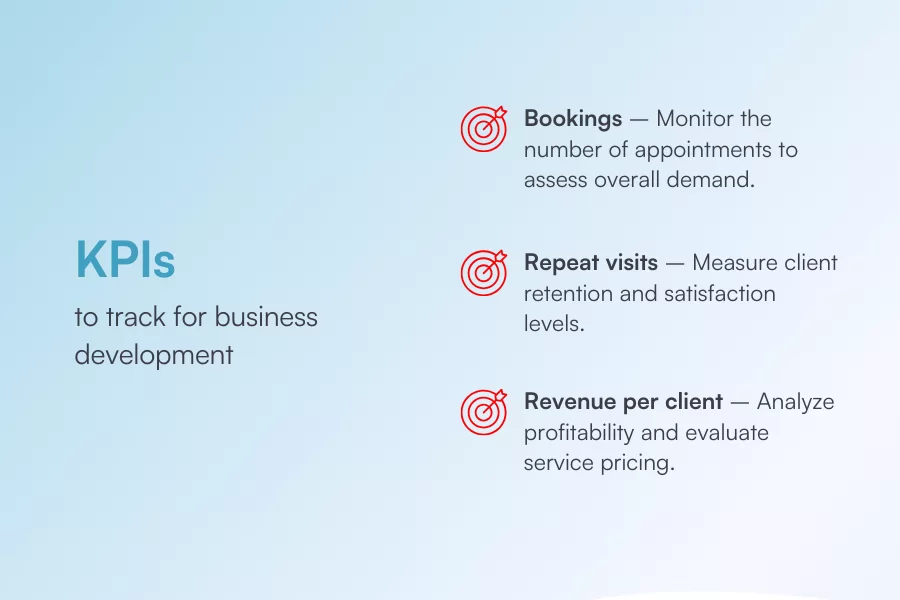
Track four numbers every month: bookings, repeat visit rate, revenue per client, and drive time per visit.
Drive time is the one a fixed practice never has to watch. Two clients in the same building earn far more per hour than two on opposite sides of a city, at the same price.
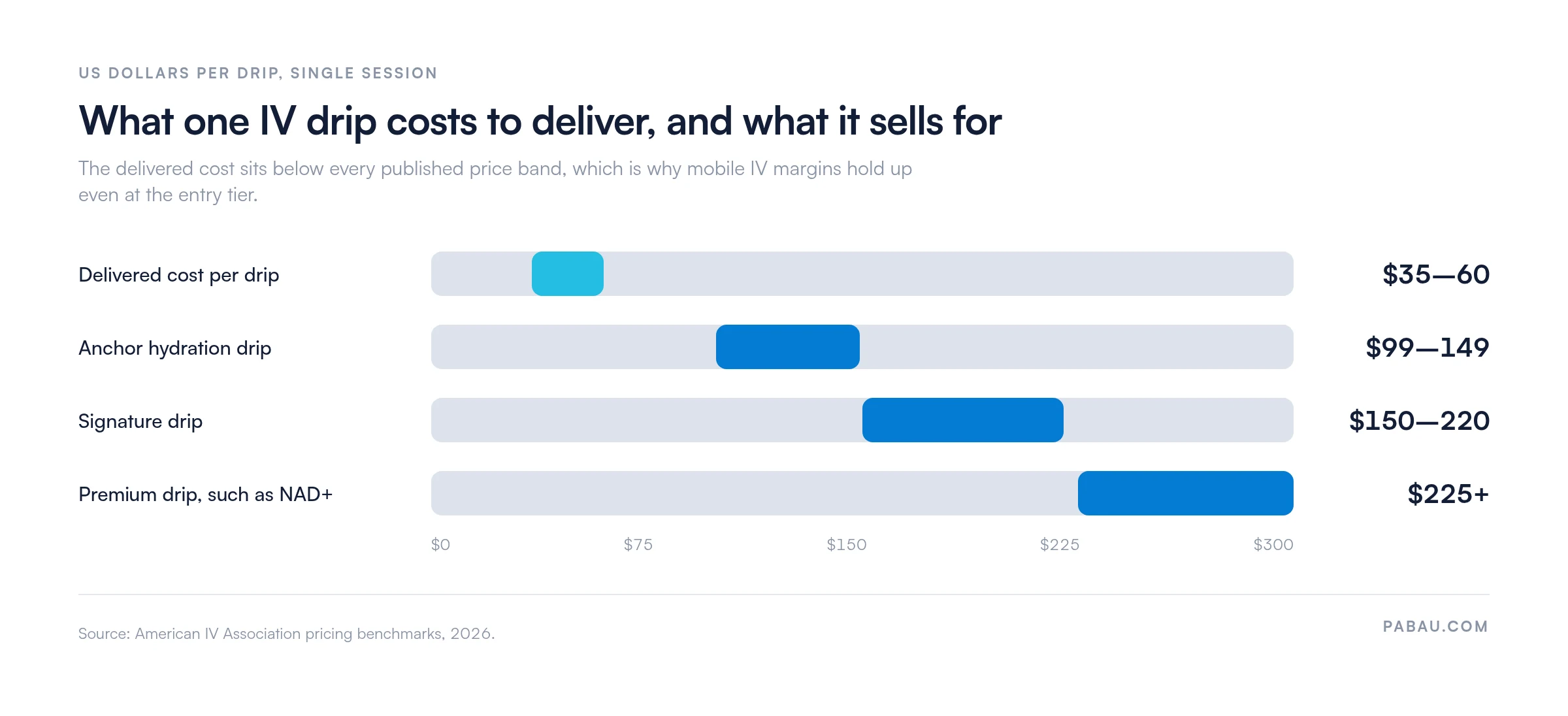
Yes, mobile IV services are profitable per session, because a drip costing $35 to $60 to deliver typically sells for $99 to $225.
The American IV Association puts anchor hydration drips at $99 to $149 and signature drips at $150 to $220. Premium formulas such as NAD+ start above $225. The same benchmarks put the delivered cost of a drip at $35 to $60.
The fixed costs are what decide the month. A medical director retainer and insurance bill whether the calendar is full or empty.
Take the midpoints from the cost table above: a $1,250 retainer and roughly $645 a month in insurance. At a $150 drip costing $48 to deliver, the business covers those fixed costs at about 19 drips a month.
That arithmetic is our own, built from the midpoints of the ranges above. Clinician pay sits on top of it, so an owner who runs the drips personally reaches break-even far sooner than one paying a per-visit rate.
Memberships are how mobile operators smooth out a seasonal month. The American IV Association puts basic tiers at $89 to $129 a month and premium tiers at $199 to $299.
Beyond the numbers, growth comes from demand you create rather than wait for.
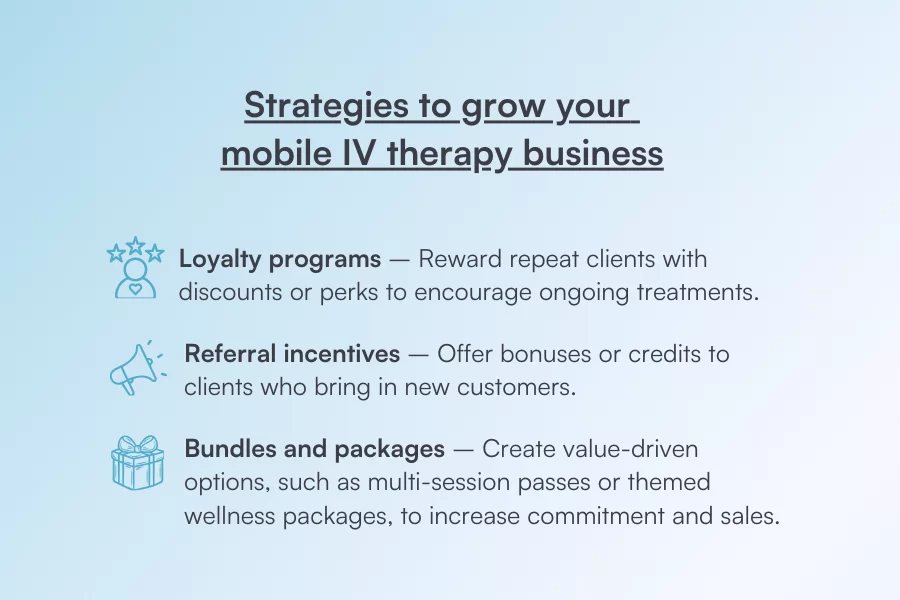
As the client base expands, scale by adding clinicians before adding drips. A second nurse doubles the slots you can sell, while a longer menu mostly adds inventory to carry.
Five mistakes account for most of the mobile IV businesses that close in the first two years:
A mobile business has no front desk, so the software has to do that job from a phone. Bookings, client records, payments, staff schedules, and stock all need to be reachable between visits.
Splitting those across separate tools is what creates the admin evening. A booking app that does not hold client records means the consent form lives somewhere else, and the invoice somewhere else again.
Practice management software like Pabau brings those pieces into one system built for IV drip providers. Pabau holds intake forms, consent documents, and treatment notes against the same client record as the appointment.
With Pabau’s capture forms, clients complete and sign those documents online before the visit. Your nurse arrives with the paperwork already done, which is the difference between a 45-minute visit and an hour.
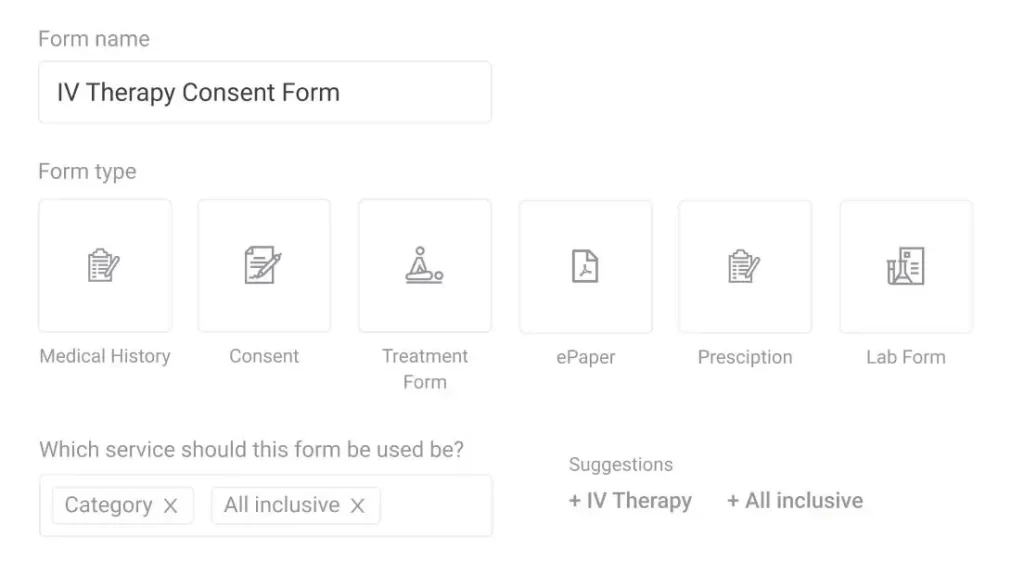
Pabau also handles the parts of a mobile day that usually get done twice:
Every Pabau subscription includes every one of those features, so nothing above sits behind a higher tier. Pricing scales with locations and users instead.
Pabau GO, our iOS app for practitioners, puts the same schedule, client records, and notes on the phone in the van. For a fully mobile practice, that removes the trip back to a desk to write the visit up.

See how Pabau helps mobile IV therapy businesses manage bookings, staff schedules, stock, and HIPAA-compliant records from one system, on the road or off.

Getting mobile IV therapy right is mostly a question of sequencing. Settle the ownership structure and licensing before you spend on a vehicle or build a service menu.
That order matters because the structure is the one thing a regulator can close the business over. Restructuring later is also the most expensive fix on this list, once clients are booking.
The trade-off worth remembering is speed against stability. Rushing training or launching before licensing is confirmed gets you to the first client sooner. That shortcut is also the quickest route to losing the business entirely.
After that, operations decide whether the business scales or turns into constant admin. Scheduling, stock, and compliant client records have to work together without you holding the picture in your head. Book a demo to see how Pabau runs that side of a mobile IV therapy business from one system.

Adding vitamin B6 shots to your services? Vitamin B6 injection guide gives you the dosing table for deficiency and isoniazid depletion, plus a consent template.
Offering vitamin D3 shots too? Vitamin D3 injection guide gives you dosage bands, target ranges, and a free consent template.
Weighing a mobile model against a fixed location? Starting an IV clinic compares the requirements and costs of each setup.
Yes, the per-session economics work well. A drip costs $35 to $60 to deliver and commonly sells for $99 to $225. Fixed costs decide the rest, because a medical director retainer and insurance bill every month regardless of bookings.
Settle the ownership structure for your state first, then appoint a physician medical director. Register the entity, secure liability and commercial auto insurance, and hire licensed clinicians. Set up booking, stock, and client records last, before the first visit.
Yes. Every US state restricts IV administration to licensed clinicians, usually a registered nurse, nurse practitioner, physician assistant, or physician. A physician also has to write the treatment protocols. Some states add a facility license on top, such as Florida’s health care clinic license.
IV hydration suits an owner who already holds a clinical license or has a physician partner lined up. Margin per drip is wide and demand is steady around events and travel. The medical director retainer is a fixed monthly cost from day one.
Yes, in states that allow non-physician ownership, such as Florida. An RN can own the company and administer drips under a physician’s protocols, but cannot diagnose or prescribe. In California and Texas, an RN owns a management services organization instead.
An LPN can own the business side wherever non-physician ownership is permitted. Whether an LPN may place the IV line is a separate question, set by the state nursing board, and several states restrict it to RNs.