CPT Code 31653: EBUS With 3+ Mediastinal Stations
CPT code 31653: Official descriptor and clinical scope CPT code 31653 is the pro...

Last Updated: Oct 20, 2026
92552 is the CPT code for pure tone audiometry (threshold), air conduction only. It reports diagnostic hearing thresholds measured with air-conducted tones at each test frequency, for one or both ears in a single encounter. Bone conduction and speech audiometry are not included.
Denials usually come from one of three problems: Confusing 92552 with screening code 92551, same-day billing with 92557, or a missing Medicare physician order.
Let Pabau's smart automation suggest the right codes, reduce claim denials, and keep your practice compliant—effortlessly.
Automate repetitive tasks and focus on what matters most—your patients.
Reduce coding errors and ensure compliance with the latest regulations.
Clean claims, fewer denials, and faster reimbursements.
Powerful insights and reporting to help your practice thrive.
HIPAA compliant SOC 2 certified GDPR-compliant Trusted by 4,000+ clinics worldwide

CPT code 92552 covers diagnostic pure tone air conduction audiometry only. Bone conduction and speech testing are excluded and need separate codes.
92552 cannot be billed on the same date as 92557: The comprehensive battery includes 92552, so billing both is an unbundling violation under NCCI edits.
Medicare covers 92552 only when a physician orders it for diagnostic purposes, and a signed order must be in the chart before billing.
Pabau’s claims management software flags bundling conflicts and missing physician orders before submission, so fewer 92552 claims come back denied.
CPT code 92552 describes pure tone audiometry (threshold), air conduction only. The American Medical Association defines the service as measuring hearing thresholds across a range of test frequencies. The tones are air-conducted and delivered through supra-aural or insert earphones. The code does not include bone conduction, speech audiometry, or masking beyond what reliable air conduction thresholds require.
The code is appropriate for both unilateral and bilateral testing within a single encounter. Audiologists, otolaryngologists, and other qualified providers can bill 92552. Medicare and many commercial payers add supervision and physician-order requirements, which are covered later in this guide.
The scope of 92552 is narrower than many coders assume. Knowing exactly what the code covers prevents both under-coding (missing billable services) and over-coding (bundling violations).
The most common coder error in audiology billing is selecting the screening code 92551 when diagnostic 92552 is clinically appropriate. The distinction matters for both reimbursement and audit risk.
Use 92551 only when the clinical intent is a pass/fail screen with no threshold measurement. Any encounter that produces a complete audiogram documenting decibel thresholds at discrete frequencies is 92552, regardless of whether the patient “passes.”
The comprehensive audiometry battery, 92557, is an all-inclusive code: It bundles pure tone air conduction, bone conduction, and speech audiometry into one reportable service. Billing CPT code 92552 on the same date as 92557 is an NCCI unbundling violation.
The CMS National Correct Coding Initiative (NCCI) edits flag 92552 and 92557 as a column 1/column 2 pair. Modifier -59 cannot override this edit, because 92557 contains 92552 by definition. Submitting both on the same claim will result in 92552 being denied or bundled into 92557.
The decision flow below puts 92551, 92552 and 92557 side by side, then lists the same-day checks that apply to a 92552 claim.
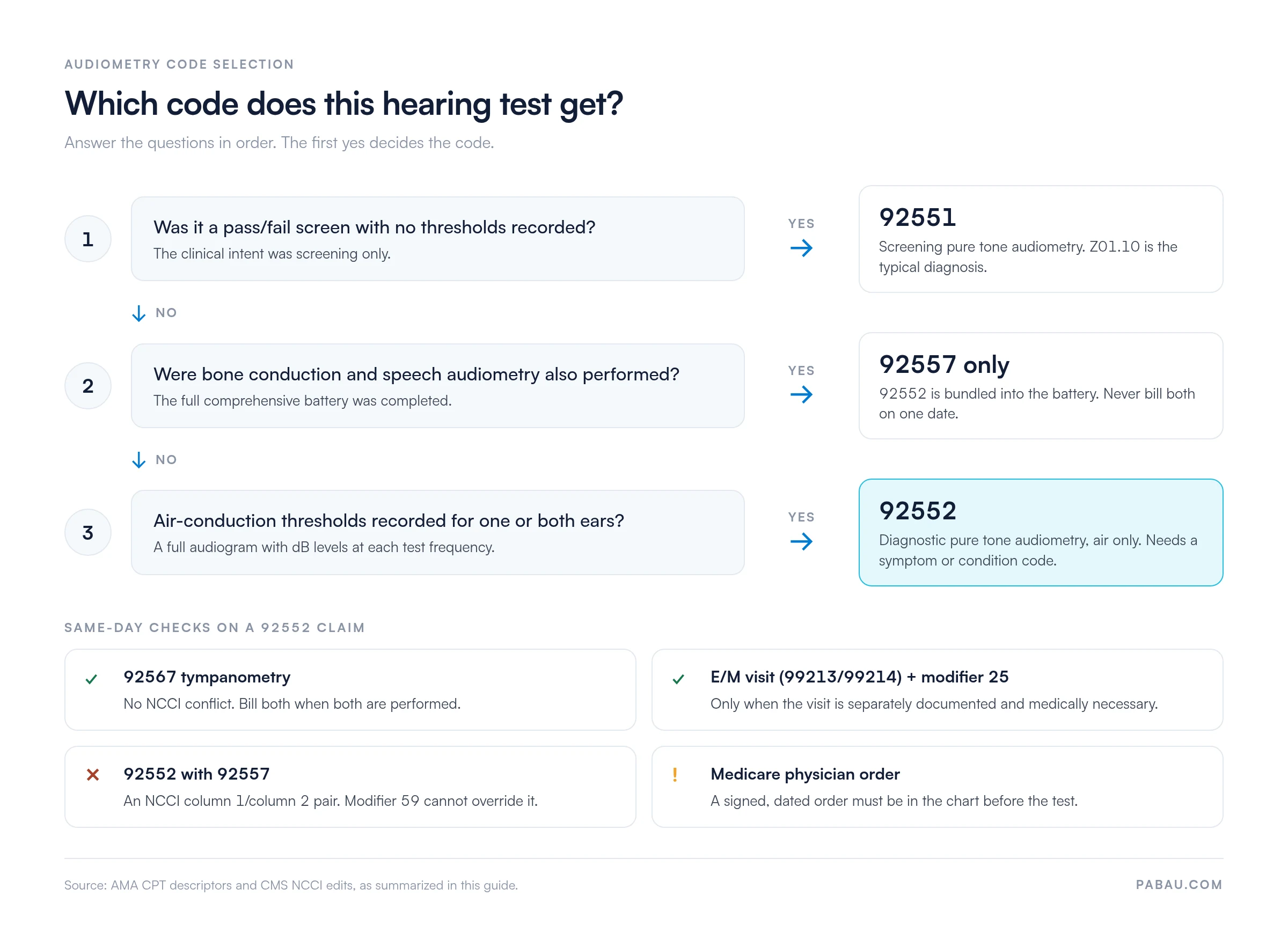
Several audiology codes can legitimately appear on the same date of service as CPT code 92552. The table below shows the most common pairings, whether an NCCI conflict exists, and when a modifier is needed.
Payers require a medically necessary diagnosis to support every billable claim. Selecting the wrong ICD-10 code is one of the top denial triggers for 92552. It happens most often when the screening code Z01.10 is submitted in place of a symptom or condition code for a diagnostic encounter.
When 92552 monitors a known sensorineural loss, such as after ototoxic medication, H90.5 is the usual supporting code. Pick the laterality-specific code instead once the chart confirms which ear is affected.
Avoid submitting Z01.10 (encounter for examination of ears and hearing) as the primary diagnosis on a 92552 claim for Medicare or most commercial payers. That code signals a screening encounter and will trigger a medical necessity denial on a diagnostic claim.
Check your payer’s local coverage determination (LCD) before finalizing the ICD-10 pairing. Medicare Administrative Contractors publish LCD policies for audiology services that list the specific diagnosis codes they accept to support 92552. Using a code not on the LCD’s covered diagnoses list is a predictable denial, even when the clinical documentation is solid.
Medicare covers CPT code 92552 when a physician or other treating practitioner orders the service for diagnostic purposes. The order is a hard coverage condition under the Medicare Benefit Policy Manual, Chapter 15. Audiologists billing Medicare must have a physician order in the chart before the service is performed.
Commercial payers largely mirror Medicare’s physician-order requirement, though some add prior authorization for audiology services above a certain frequency. Check individual payer policies before scheduling diagnostic audiometry.
Modifier misuse is a consistent audit trigger on audiology claims. The table below covers the modifiers most relevant to 92552 billing, when each applies, and where coders most commonly go wrong.
Audiology denials cluster around a predictable set of errors. Fixing each one below before submission prevents most of the rejections billing teams see on CPT code 92552 claims.
Pabau, the practice management platform we build, integrates with the Claim.MD clearinghouse to catch several of these flags before claims reach the payer. When one does slip through, our guide to medical billing denial codes explains the CARC and RARC codes that come back.
Post-payment reviewers pull the chart behind each 92552 claim and check it against a fixed standard. The checklist below reflects what they verify, drawn from CMS LCD criteria and ASHA’s audiology reimbursement guidance.
Building these checks into charge capture stops most documentation denials before the claim leaves the practice. Error-catching claims management software can hold a 92552 claim until the order and audiogram are attached.
For practices generating superbills, the superbill must include the physician order date, the ICD-10 code, and the rendering provider’s NPI to support clean claim submission.
Run a quarterly audit of your 92552 claims: Pull every encounter where 92552 was billed. Verify each one has a signed physician order on file, an audiogram in the chart, and a supporting ICD-10 code from your payer’s LCD. Audiology practices that audit quarterly catch documentation drift before a payer does.
Without a pre-submission check, 92552 errors surface as denials. Someone then pulls the chart, finds the missing order or the 92557 conflict, and resubmits weeks later.
Pabau’s claims management software moves those checks to charge entry. It flags the 92552/92557 bundling conflict, checks for a physician order, and validates the ICD-10 pairing before the claim goes out. Clean claims then travel to the payer through the Claim.MD clearinghouse integration.
Your billing team spends less time reworking returned audiology claims, so payment for each hearing test arrives on the first submission.

Pabau’s claims management software validates CPT code 92552 claims against bundling rules, physician-order flags, and ICD-10 pairings before submission. It catches the errors that generate denials.

CPT code 92552 has a narrow scope. Its bundling risk with 92557 and Medicare’s physician-order rule still make it one of the more denial-prone audiology codes. Getting it right starts at the point of care: The audiogram, the clinical indication, the signed order, and the correct ICD-10 pairing.
If your team bills 92552 regularly, run the quarterly audit above and fix whichever check fails most often. A few extra minutes at charge entry cost far less than weeks of rework on a denied claim.
Book a demo to see how Pabau flags the 92552/92557 conflict and missing physician orders before your audiology claims go out.

Need to understand how claims are submitted electronically? 837 file format explains how electronic claim files are structured and what payers receive.
Want to reduce rework on returned claims? Electronic remittance advice covers how ERAs work and how to read denial reason codes efficiently.
Looking for a breakdown of denial reason codes? Denial codes in medical billing covers CARC and RARC codes and how to respond to each.
Building a compliance routine for your billing team? Medical billing compliance sets out the standards payers audit against.
CPT code 92552 is the diagnostic code for pure tone audiometry, air conduction only. It documents hearing thresholds measured at discrete frequencies using air-conducted tones, for one or both ears in a single encounter. It does not include bone conduction or speech audiometry, which require separate codes or the comprehensive battery code 92557.
92551 is a screening code that produces a pass/fail result. 92552 is a diagnostic code that produces a full audiogram with decibel thresholds at each test frequency. Diagnostic encounters that generate a complete audiogram are 92552 regardless of the patient’s result. They also need a supporting symptom or condition ICD-10 code rather than the screening encounter code Z01.10.
No. 92557 (comprehensive audiometry battery) includes 92552 as a component, so billing both on the same date is an NCCI unbundling violation. The NCCI edit for this pair does not have a modifier indicator of “1,” meaning modifier -59 cannot override it. When the full battery is performed, bill only 92557.
Yes, when a physician or other treating practitioner orders it for diagnostic purposes and the medical record holds the signed order. Medicare does not cover audiology services performed for screening purposes alone. The ordering physician’s written order must be in the chart before the claim is submitted.
Reimbursement rates are RVU-based and are updated annually by CMS. Check the current non-facility and facility payment amounts in the CMS Physician Fee Schedule lookup tool. Figures published in secondary sources are often from prior years. Medicaid rates are set by individual states and vary significantly.
Tympanometry is billed under CPT code 92567. It can be billed on the same date as 92552, with no NCCI conflict between the two codes. Both services are routinely performed together in audiology and ENT evaluations. Document each one separately and make sure both are clinically indicated.