HCPCS Code G0163: Skilled nursing observation and assessment
What is HCPCS Code G0163? HCPCS Code G0163 is a deleted Level II code for skille...

Last Updated: Oct 15, 2026

CPT code 92557 describes comprehensive audiometry threshold evaluation and speech recognition, binaural, bundling three test components into a single billable code.
All three components must be performed and documented to support a valid 92557 claim. Those are pure tone air conduction, pure tone bone conduction, and speech recognition testing.
The 2026 Medicare non-facility rate runs about $37 to $45, depending on geographic location. Verify the exact figure in the CMS Physician Fee Schedule lookup for your MAC jurisdiction.
Pabau’s claims management tools help practices submit clean 92557 claims, with documentation prompts and electronic claim routing through Claim.MD.
CPT code 92557 covers comprehensive audiometry threshold evaluation and speech recognition, binaural.
The American Medical Association’s CPT code set bundles three tests into it, all performed on the same date of service. Those are pure tone air conduction, pure tone bone conduction, and speech recognition (word recognition) testing.
Because all three components sit inside the one code, 92557 is what audiology and otolaryngology practices bill for a full baseline hearing evaluation. It only fits when all three were performed and written up.
This guide covers the 2026 Medicare rate, the RVU breakdown, modifiers, and documentation requirements. It then works through provider eligibility, common denial reasons, and how 92557 compares to adjacent audiology codes.
92557 is a bundled code. Billing it requires performing and documenting all three components during the same encounter. Knowing what each component covers prevents the under-documentation that drives most denials on this code.
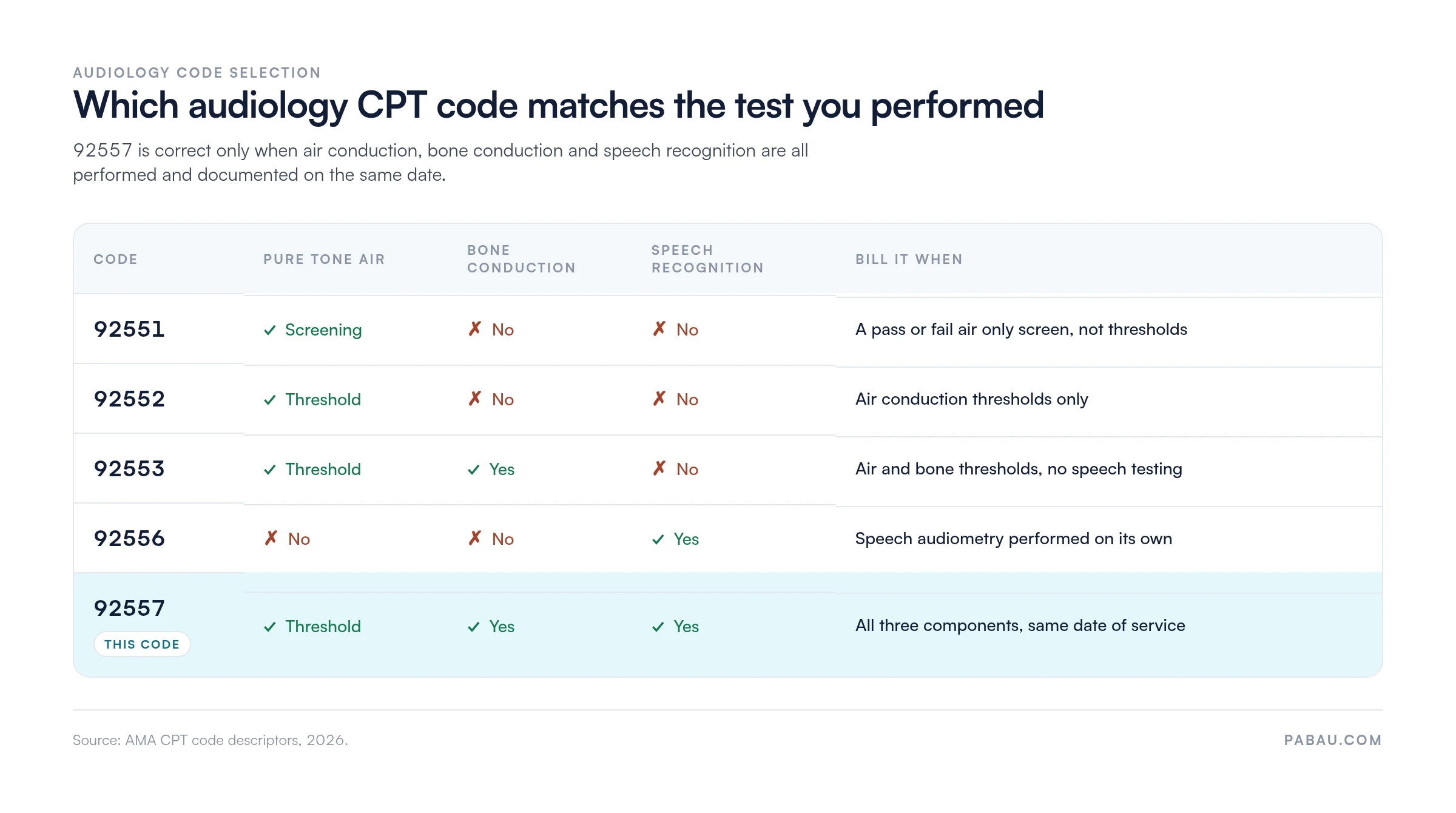
If only air and bone conduction are completed without speech recognition, use CPT 92553 instead. When air conduction thresholds alone are measured, CPT 92552 is the code to bill. If only speech testing is performed, CPT 92556 applies. Submitting 92557 when a component is missing counts as upcoding and creates audit risk. The matrix below maps each set of components to the code that fits it.
Medicare reimburses CPT code 92557 under the Medicare Physician Fee Schedule (MPFS). Rates vary by geographic location (MAC jurisdiction) and by place of service. The figures below reflect 2026 national averages. Use the CMS Physician Fee Schedule lookup tool to verify the exact rate for your locality.
Private payer rates for CPT code 92557 often exceed Medicare rates. Rates are negotiated through provider contracts and can sit well above the Medicare floor. Confirm contracted rates with each payer before assuming Medicare-level reimbursement applies.
RVU values drive the Medicare payment calculation. The 2026 figures below are approximate national values. Confirm them against the CMS Physician Fee Schedule final rule before you build them into a fee analysis.
Modifier use on CPT code 92557 claims affects payment and coverage determination. Applying the wrong modifier, or leaving out a required one, is among the top reasons audiology claims come back. Below are the modifiers most relevant to 92557 billing.
Modifier 52 and modifier GY are not interchangeable. Modifier 52 says the service was partially completed. Modifier GY says Medicare does not cover the service at all. Using GY on a medically necessary evaluation that was fully performed will produce a denial and no payment.
Incomplete documentation drives a large share of CPT code 92557 denials. A clean claim submission for this code rests on three parallel documentation elements. Each one has to be in the patient record before the claim goes out.
Treat it as a documentation triple-check: order, necessity, results. A claim missing any one of the three triggers manual review or auto-denial at most MACs.
Provider eligibility for CPT code 92557 differs slightly between Medicare and private payers. Knowing who can bill, and under what enrollment conditions, prevents rejections at the front end of the claims process.
State scope-of-practice law governs which professionals may legally perform audiologic testing, separately from Medicare billing rules. Confirm both licensure and enrollment status before submitting claims.
Medicare Part B covers CPT code 92557 when a physician order is present and medical necessity is documented. Routine hearing evaluations without a clinical indication do not qualify. Practices that bill 92557 for screening purposes risk recoupment, so checking the patient’s benefits before the appointment is worth the minute it takes.
Check your MAC’s LCD for CPT 92557 at least quarterly. CMS LCD databases are updated throughout the year. A coverage criterion that did not exist six months ago can silently trigger denials on claims you are submitting now.
92557 denials fall into a small number of repeatable patterns. Sorting your denials by root cause, rather than working them one by one, shows you which pattern your practice is actually hitting.
Choosing the right code from the audiology CPT family is rarely obvious, particularly when only part of the battery is completed. The table below maps the most common adjacent codes to 92557 and the clinical scenario behind each one.
Some patients cannot respond reliably to pure tones, which rules out the behavioral battery 92557 describes. A limited otoacoustic emissions evaluation reports as 92587, which screens cochlear function in pediatric and difficult-to-test patients. A comprehensive distortion product study that maps at least 12 frequencies in each ear reports as 92588 instead.
Yes, in most cases. Tympanometry (CPT 92567) tests middle ear function and is clinically distinct from the threshold evaluation 92557 describes. Because the two measure different physiologic parameters, they can generally be billed on the same date when both are medically necessary and documented.
CCI edit data does not currently create a hard bundle between 92557 and 92567. Payer-specific policies and MAC LCDs may still add restrictions, so verify both before you pair these codes routinely. When you bill both on the same date, document the clinical rationale for each test in the encounter notes.
Dizziness workups raise the same question, because the basic vestibular evaluation, CPT 92540, is often performed on the same date as 92557. Each test needs its own indication and its own interpretation in the record.
Audiology billing has a specific operational problem. The documentation behind a 92557 claim has to be assembled from three places: the physician order, the audiogram report, and the medical necessity note. When those live in separate systems, billers spend their day chasing records instead of submitting claims. Practice management software like Pabau keeps them in one patient record.
Pabau integrates with Claim.MD, our clearinghouse partner, which routes 92557 and other audiology claims electronically to thousands of US payers. The integration handles CMS-1500 and 837P claim formats, real-time eligibility verification, and ERA (835 remittance advice) processing. Billing teams can confirm claim status without leaving the platform, which removes the manual re-keying behind most place-of-service and modifier errors.
Pabau’s claims management software also supports structured documentation. Intake forms capture the referring physician details the order requirement depends on. Clinical note templates then prompt practitioners to record all three test components before the encounter closes. When the audiogram and the note line up at the point of care, the claim builds itself instead of being reconstructed hours later.
Practices submitting CPT code 92557 electronically can also use the built-in denial workflow. When a claim comes back denied, the system flags it for review and ties it to the original encounter. The billing team’s worklist stays organized without a separate spreadsheet.

Pabau connects your clinical documentation, claim submission, and denial management in one platform. See how practices cut CPT 92557 claim errors with structured intake, automated eligibility checks, and the Claim.MD integration.

The decision on 92557 is made in the treatment room, not in the billing office. If air conduction, bone conduction and speech recognition were all performed and written up, the code is correct. If one is missing, a narrower code applies, and no modifier can fix a component that was never done.
So the work that protects this code happens upstream. It is a signed order in the chart, a clinical indication that is not a routine screen, and an audiogram showing all three results. Practices that get those three right stop arguing with MACs about medical necessity months after the appointment.
Want your 92557 claims to leave the practice complete the first time? Book a demo and we will show you how Pabau prompts for the order, the indication and the audiogram before the encounter closes.

Want to understand the broader billing landscape? Revenue cycle management fundamentals covers how claims flow from documentation through payment in outpatient clinical settings.
Concerned about electronic claim submission? Electronic 837 claim file guide explains the EDI transaction format used to submit audiology and other outpatient claims to payers.
Need a denial prevention framework? Building a clean claim walks through the pre-submission checklist that catches the most common 92557 billing errors before they reach the payer.
Not sure what belongs on the patient-facing bill? What a superbill includes shows how to tie audiogram findings and codes to a document the patient can submit.
Denials already piling up? Denial management in healthcare sets out how to categorize denials by root cause and rework them in priority order.
CPT code 92557 is a bundled comprehensive audiometric evaluation with three components. Those are pure tone air conduction threshold testing, pure tone bone conduction threshold testing, and speech recognition testing. All three must be performed on the same date of service. All three must also appear in the audiometric report to support billing this code.
The 2026 Medicare non-facility rate for CPT 92557 is approximately $37 to $45, depending on geographic location and MAC jurisdiction. The facility rate is lower, because overhead costs are reimbursed separately to the facility. Use the CMS Physician Fee Schedule lookup tool to find the exact rate for your locality code.
Yes, in most cases CPT 92557 and CPT 92567 (tympanometry) can be billed on the same date, because they measure different physiologic parameters. Both must be medically necessary and documented. CCI edits do not currently create a hard bundle between the two codes. Verify your MAC’s current LCD and payer policies before pairing them routinely.
Four modifiers come up most often. Modifier 52 covers reduced services, when one component could not be completed. Modifier GY marks an item Medicare does not cover, for routine evaluations billed to obtain a denial. Modifier KX affirms that LCD medical necessity criteria are met, and some MACs require it. Modifier 59 marks a distinct procedural service when another code is subject to CCI bundling edits.
CPT 92553 covers pure tone audiometry for both air and bone conduction thresholds, but it does not include speech recognition testing. CPT 92557 adds the speech recognition component, which makes it the comprehensive code. When all three elements of the battery are performed, 92557 is correct. Billing 92553 and 92556 separately on that date creates a CCI bundling violation.
Three documentation elements are required. First, a signed physician order stating the clinical reason for the evaluation. Second, documentation of medical necessity in the clinical record, such as a complaint of hearing loss, tinnitus, or vertigo. Third, a complete audiometric report showing results for all three test components. Missing any one of them is the most common trigger for 92557 denials under Medicare.
Yes. Medicare Part B covers CPT 92557 when a physician or qualified non-physician practitioner has ordered the evaluation and medical necessity is documented. Routine hearing examinations, with no clinical complaint or underlying pathology, are explicitly excluded from coverage. Your documentation has to make the difference between a medically indicated evaluation and a routine screen obvious.