CPT Code 98981: RTM Treatment Management Billing Guide
CPT code 98981: Definition and official descriptor CPT code 98981 is an add-on c...

Last Updated: Nov 9, 2026
92541 is the CPT code for spontaneous nystagmus test, including gaze and fixation nystagmus, with recording. It reports nystagmus recorded with the patient at rest, across several gaze positions, with and without visual fixation.
Most denials on this code trace back to documentation. The usual causes are missing the fixation notation, omitting the recording equipment, or billing 92541 alongside 92540, which already bundles the spontaneous nystagmus component.
Let Pabau's smart automation suggest the right codes, reduce claim denials, and keep your practice compliant—effortlessly.
Automate repetitive tasks and focus on what matters most—your patients.
Reduce coding errors and ensure compliance with the latest regulations.
Clean claims, fewer denials, and faster reimbursements.
Powerful insights and reporting to help your practice thrive.
HIPAA compliant SOC 2 certified GDPR-compliant Trusted by 4,000+ clinics worldwide

CPT code 92541 covers spontaneous nystagmus testing, including gaze and fixation nystagmus, with recording, as a standalone vestibular component.
92541 cannot be billed alongside CPT 92540, because 92540 is a basic vestibular panel that bundles 92541, 92542, 92544 and 92545.
Medical necessity must be documented with a qualifying ICD-10 diagnosis code, and common pairings include H81.1-, H81.3-, R42 and H55.00.
Pabau’s claims management software submits claims through Claim.MD and runs real-time eligibility checks, so coverage is confirmed before the test.
The American Medical Association (AMA) defines CPT code 92541 as Spontaneous nystagmus test, including gaze and fixation nystagmus, with recording. Report it on its own only when you did not perform the full 92540 basic vestibular evaluation at the same encounter. The AMA CPT coding resources list it among the vestibular function tests with recording, codes 92537 through 92549.
Breaking that descriptor down matters for documentation. “With recording” means electronystagmography (ENG) or videonystagmography (VNG) equipment must capture the findings. Hand notes alone do not count. “Including gaze and fixation nystagmus” means the test checks eye movement across several gaze positions, with and without a visual fixation target.
Three documentation points carry most 92541 claims. The report names the recording equipment, records the gaze and fixation findings, and ends with a signed interpretation from a qualified provider. A note that reads only “nystagmus present” shows none of the three.
CPT code 92541 covers gaze testing and fixation assessment as part of the spontaneous nystagmus evaluation.
Recording equipment is not optional. ENG uses electrodes around the eyes to detect electrical signals from eye movement. VNG uses infrared video cameras inside goggles. Both satisfy the “with recording” requirement in the 92541 descriptor. A clinician who observes nystagmus by eye and writes it into a chart note, with no objective recording, has not met the descriptor.
CPT code 92541 covers only the spontaneous nystagmus component. Practices that add other vestibular tests to the same encounter must bill those with separate codes, unless the panel code 92540 applies instead.
Procedures not included in 92541:
The critical unbundling risk: CPT 92540 is a basic vestibular evaluation that bundles 92541, 92542, 92544 and 92545 into a single panel. If you performed all four components on the same date, 92540 is the correct code. Billing 92541 separately on a date when you billed 92540 creates an unbundling error. Payers run automated edits that catch this pairing, so the denial is hard to appeal because the coding itself is wrong.
CPT 92540 is the basic vestibular evaluation panel, and CPT 92541 is a single component within it. The choice depends on how many of the four panel components the clinician performed at the encounter, as the breakdown below shows.
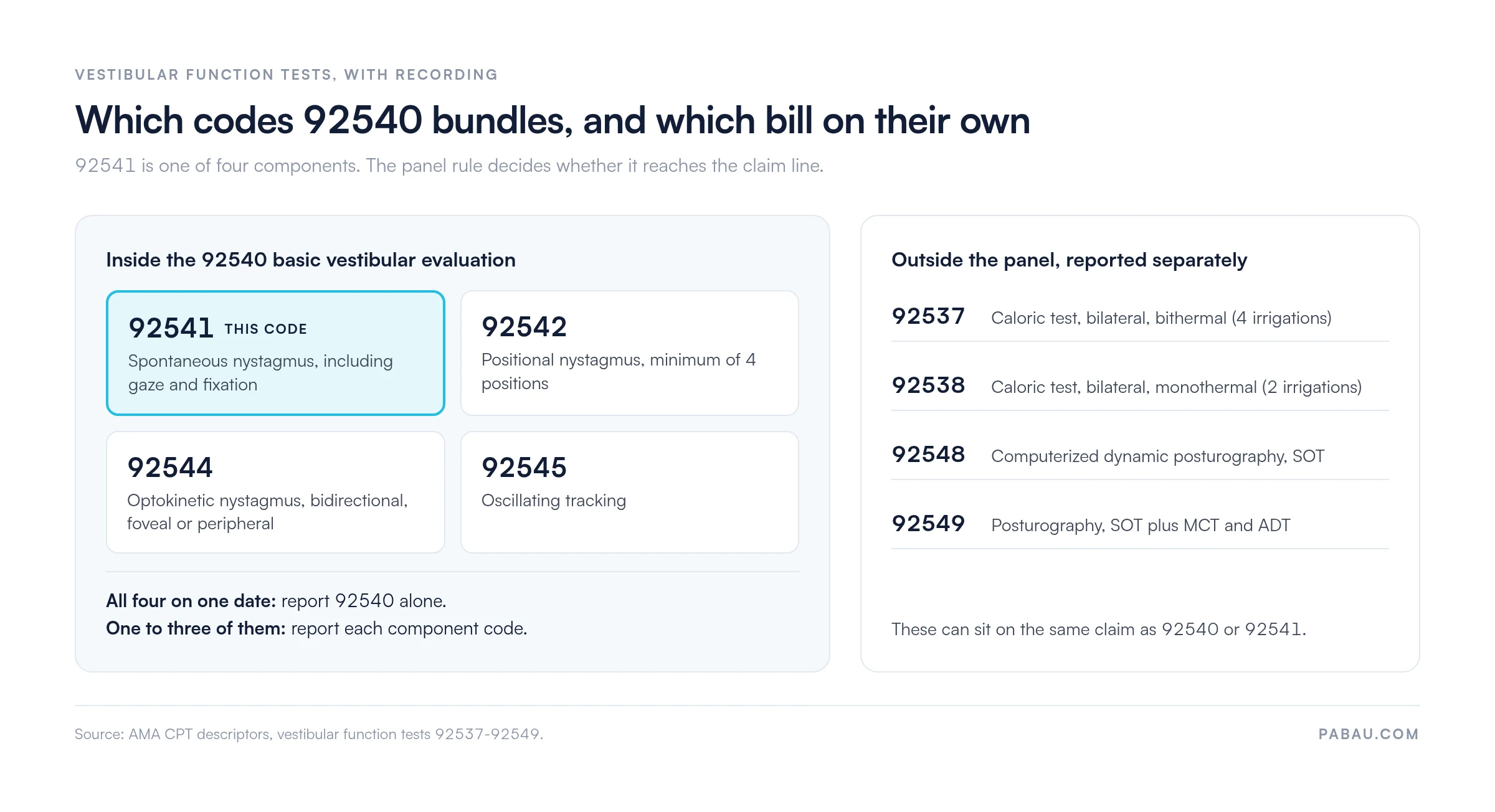
The decision rule is straightforward. If the patient needed only the spontaneous nystagmus evaluation, bill 92541. If the clinician ran 92541, 92542, 92544 and 92545 together, bill 92540 instead, and never bill both on the same date.
The vestibular function tests with recording span CPT 92537 through 92549. Each code represents a distinct test or panel. Knowing the full set helps practices choose the right code when they run several tests, so they avoid both undercoding and overbilling.
When CPT code 92541 is performed alongside 92542, 92544 or 92545 without the full panel, you can report each one separately. In either case, report the caloric codes 92537 and 92538 separately. However, payers may still apply multiple procedure payment reductions, so verify the current fee schedule for each combination.
Documentation failures cause more 92541 denials than coding errors. The clinical report must show that the clinician performed and recorded every element of the descriptor.
Run a documentation checklist before submitting any 92541 claim. Confirm three items. The ENG or VNG equipment type is named. Results are documented for each gaze position and for both fixation conditions. A qualified provider has signed the interpretation in the chart. Missing any one of these can trigger the same denial as missing medical necessity.
A compliant 92541 claim requires documentation of the following elements:
Submitting a clean 92541 claim starts long before you generate the claim, as clean claim submission standards make clear. The medical record must exist and be complete on the date of service. Do not rebuild it after a denial.
Payers require a supported ICD-10 diagnosis code on every 92541 claim. The diagnosis must establish medical necessity for spontaneous nystagmus testing. Pairings that payers commonly accept include vestibular disorders, dizziness, and nystagmus itself.
Where the chart supports only a symptom, R42 is the usual code, though several LCDs treat dizziness alone as insufficient for vestibular testing. Because payer diagnosis lists change, check your MAC’s LCD and your payer contract before you submit. Confirm current code status in the CDC/NCHS ICD-10-CM web tool, and never treat any list as exhaustive or permanently current.
Local Coverage Determinations (LCDs) from Medicare Administrative Contractors (MACs) govern Medicare coverage for CPT code 92541. Each MAC publishes its own vestibular function testing LCD (for example First Coast L33966, Palmetto L34537, Novitas L35007). Check yours in the CMS Medicare Coverage Database.
Under LCD guidelines, vestibular testing is covered when there is a clinical indication of a vestibular disorder. The symptoms must not be explained by non-vestibular causes, and the results must be expected to change clinical management. To meet these conditions, the clinician must document more than the patient’s complaint of dizziness. The chart must show why vestibular testing was clinically indicated at this encounter.
Standard medical necessity documentation for a 92541 claim should include:
Proper billing compliance documentation means the medical record tells the clinical story that justifies the test, beyond the test name and result. Payers reviewing 92541 claims during audit look for that story.
Medicare pays CPT code 92541 under the CMS Physician Fee Schedule (PFS). The amount varies by provider type, place of service, and geographic adjustment. For CY2026 the non-QP conversion factor is $33.4009, and your MAC’s geographic practice cost indices then adjust the national rate for your locality.
Rates change with each annual PFS update. Therefore, for current figures, use the CMS Physician Fee Schedule lookup tool and select the current year. Enter code 92541 and your locality to get the adjusted facility and non-facility rates.
In contrast, commercial payers typically reimburse at a percentage of the Medicare fee schedule or at a contracted rate. Some commercial plans require prior authorization for vestibular testing even when Medicare does not. Reimbursement for audiologists billing under incident-to rules versus direct billing also differs by payer. Confirm your enrollment status and billing pathway before submitting.
Traditional Medicare (Parts A and B) does not require prior authorization for CPT code 92541 as of the current policy cycle. The service still has to meet the coverage criteria in the applicable LCD. The situation differs for Medicare Advantage and commercial plans.
Running insurance eligibility verification before the encounter catches prior authorization requirements before the practice performs the test. Payers deny a 92541 claim on procedural grounds when the service needed PA and the practice did not obtain it. As a result, you cannot appeal that denial on clinical grounds.
Audiologists and otolaryngologists are the primary provider types billing CPT code 92541. Neurologists who perform vestibular evaluations in a neurology practice setting may also bill this code, depending on payer policy and state scope of practice rules.
Provider-specific considerations:
Place of service (POS) codes affect reimbursement. POS 11 (office) triggers the non-facility rate, and POS 22 (hospital outpatient) triggers the facility rate. A wrong POS can trigger underpayment at the facility rate. It can also cause a denial when the POS does not match where the service occurred.
Fortunately, most 92541 denials are preventable. The leading causes follow predictable patterns that good front-end processes can interrupt before the claim is submitted.
Effective denial management workflows treat these patterns as a system problem. Tracking the reason code on each 92541 denial across a quarter shows whether the cause is documentation, coding, or payer-side. Each of those root causes needs its own intervention. Reviewing common billing denial codes alongside your remittance data speeds up that diagnosis.
Check your 92541 denial rate separately from the broader vestibular code family. A practice with low overall vestibular denials but high 92541 denials usually has a documentation problem specific to the spontaneous nystagmus component. Isolating by code shows where to focus training.
Coverage checks, claim entry and remittance tracking often sit in separate tools at audiology and ENT practices. Each handoff gives you a chance to miss a prior authorization requirement, or to send 92541 on the same date as 92540.
Pabau brings those steps together with denial-flagging claims management. Claims go out through Claim.MD, which connects to thousands of US payers.
Real-time eligibility checks run before the encounter, so a plan’s authorization requirement shows up before you run the test. When a remittance comes back denied, Pabau flags the claim so your billing team can correct and resubmit it.

Pabau’s claims management software submits claims through Claim.MD and runs real-time eligibility checks, so coverage is confirmed before the vestibular test.

Coding 92541 correctly comes down to one question at every encounter. Were all four panel components run? If they were, 92540 replaces 92541 on the claim. If they were not, 92541 stands alone, and the report has to show the recording equipment, both fixation conditions and a signed interpretation.
However, the trade-off is front-end time. A short check of the chart and the patient’s plan before submission costs less than reworking a denial that was never appealable.
Pabau’s claims management software submits claims through Claim.MD to thousands of US payers and runs real-time eligibility checks before the test. Book a demo to see how it keeps vestibular testing claims moving in an audiology or ENT practice.

Need a broader view of medical billing compliance? Understanding revenue cycle management covers the end-to-end process from eligibility check through final payment posting.
Confused about how clearinghouses process vestibular claims? The Claim.MD clearinghouse guide explains how electronic claim routing, payer enrollment, and ERA processing work for specialty practices.
Want to reduce claim errors before submission? Medical billing fundamentals explains the full billing cycle and where vestibular coding fits within it.
Ran the full vestibular battery? CPT code 92540 covers the basic vestibular evaluation panel that absorbs 92541.
Suspect a central cause? ICD-10 code H81.4 explains coding vertigo of central origin.
CPT code 92541 covers a spontaneous nystagmus test, including gaze and fixation nystagmus, with recording. It includes gaze nystagmus assessment and spontaneous nystagmus evaluation with and without fixation, captured on ENG or VNG recording equipment. It does not include positional, caloric, or optokinetic testing.
CPT 92540 is a basic vestibular evaluation that bundles four component codes: 92541, 92542, 92544 and 92545. Use 92540 when all four components are performed at the same encounter. Use 92541 alone when the full panel was not performed. Billing 92541 alongside 92540 is an unbundling error that payers catch with automated edits.
Yes, Medicare covers CPT code 92541 under the Physician Fee Schedule when medical necessity is documented. The service must also meet the applicable Local Coverage Determination criteria. Traditional Medicare generally does not require prior authorization, though Medicare Advantage plans may impose their own requirements. Check your MAC’s LCD for current coverage criteria.
Traditional Medicare does not require prior authorization for CPT 92541, but many Medicare Advantage and commercial plans do. Requirements vary by plan and geographic region. Check the payer’s PA requirements at scheduling rather than at billing, since a service performed without required PA typically cannot be appealed on clinical grounds.