CCSD code A7310: Biopsy of peripheral nerve
CCSD code A7310: definition and procedure scope CCSD code A7310 is the South Afr...

Last Updated: Oct 7, 2026
92540 is the CPT code for a basic vestibular evaluation, a battery of four eye-movement tests, each performed with recording. It covers a spontaneous nystagmus test with eccentric gaze fixation nystagmus and a positional nystagmus test in a minimum of 4 positions. It also covers an optokinetic nystagmus test with bidirectional foveal and peripheral stimulation, plus an oscillating tracking test.
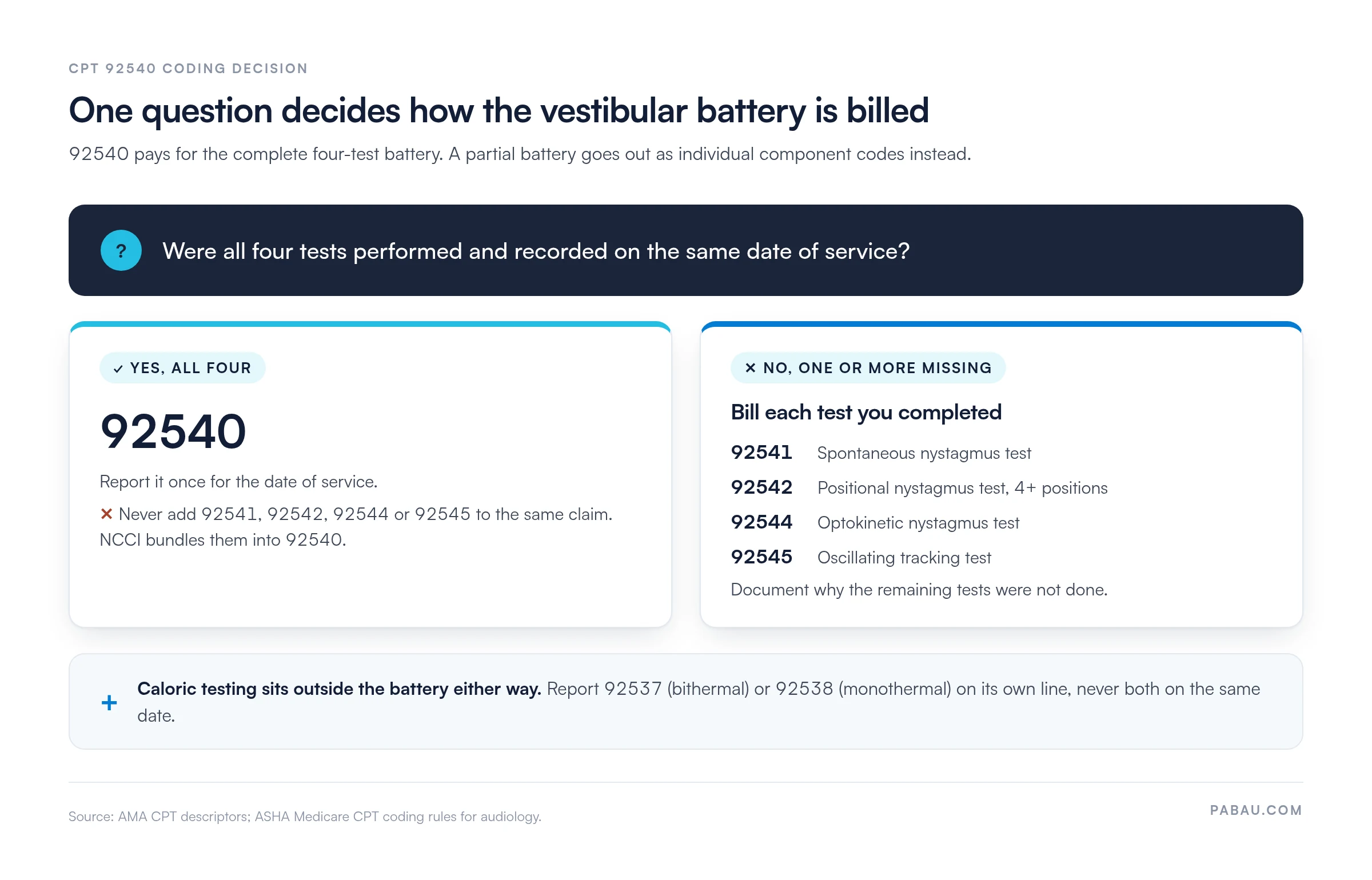
Report 92540 once, when all four tests are completed and recorded on the same date. If any test is missing, bill the individual component codes for the tests you performed instead. Never add those component codes to a 92540 claim, because NCCI edits bundle them into the battery.
Let Pabau's smart automation suggest the right codes, reduce claim denials, and keep your practice compliant—effortlessly.
Automate repetitive tasks and focus on what matters most—your patients.
Reduce coding errors and ensure compliance with the latest regulations.
Clean claims, fewer denials, and faster reimbursements.
Powerful insights and reporting to help your practice thrive.
HIPAA compliant SOC 2 certified GDPR-compliant Trusted by 4,000+ clinics worldwide

CPT code 92540 bundles four recorded tests: spontaneous nystagmus, positional nystagmus, optokinetic nystagmus and oscillating tracking.
Bill 92540 only when all four tests are completed and recorded on the same date of service.
When a test is missed, bill the component codes you performed (92541, 92542, 92544 or 92545) instead of 92540.
Never report a component code on the same claim as 92540, because NCCI edits bundle it into the battery.
Pair the claim with the most specific ICD-10 code the record supports, such as H81.1- for benign paroxysmal vertigo.
CPT code 92540 is the basic vestibular evaluation. It’s a battery of four eye-movement tests that shows how the inner ear and brain control balance. The American Medical Association (AMA) descriptor lists four parts, each performed with recording:
That repeated “with recording” matters. Each test must be captured on videonystagmography (VNG) or electronystagmography (ENG) equipment. A qualified provider then interprets the tracings. A note that only describes the eye movements won’t support the claim with Medicare or most commercial payers.
Audiologists and physicians, including otolaryngologists (ENT) and neurologists, bill the code. Audiologist scope of practice varies by state, so confirm your state’s rules first. Testing happens in offices and hospital outpatient departments, and the place of service changes the Medicare rate.
Every test in the battery targets a distinct piece of vestibular function, and each has its own component code. All four must be completed on the same date for 92540 to apply. If one can’t be done, you bill the individual codes for the tests you did perform.
Say a patient with acute vertigo can’t tolerate positional testing. You’d bill 92541, 92544 and 92545 for the three completed tests, not 92540. Then document the clinical reason the positional test was skipped. That note protects the claim if an auditor later asks why the battery stopped short.
CPT 92540 is the comprehensive package code, and each of its four component codes covers one test. National Correct Coding Initiative (NCCI) edits treat the components as column 2 codes when 92540 is on the claim. In practice, they’re never separately payable alongside it on the same date.
The decision below sums up the whole rule. It starts with one question: were all four tests done and recorded that day?
NCCI tables change every quarter, so check the current procedure-to-procedure edits on the CMS NCCI page before you submit. The CrossCoder procedure-to-diagnosis crosswalk does a different job. Use it to match procedures with the diagnoses that support them.
Payers check the diagnosis on a 92540 claim against their coverage list. For Medicare, that’s the applicable Local Coverage Determination (LCD) for your Medicare Administrative Contractor (MAC) jurisdiction. A vague or mismatched diagnosis is one of the common causes of denial.
Treat the table below as guidance, since accepted codes vary by MAC.
Always code to the highest specificity the documentation supports. Submitting R42 when the record establishes H81.1- (benign paroxysmal vertigo) undersells the finding. It can also invite a medical necessity review on later claims for the same patient.
Run an eligibility check before the appointment to confirm vestibular testing benefits. Some Medicare Advantage and commercial plans cap how often they cover the battery. Catching a limit before the visit prevents a denial and an awkward conversation about out-of-pocket costs.
Medicare covers CPT code 92540 when medical necessity is documented and the claim meets the applicable LCD. Rates vary by locality and place of service, according to the CMS Physician Fee Schedule lookup tool. Office (non-facility) rates run higher than hospital outpatient (facility) rates. The difference reflects the practice expense of owning VNG or ENG equipment.
Medicare pays 80% of the approved amount after the annual Part B deductible. The patient owes the remaining 20% coinsurance unless a Medigap policy picks it up. Check your locality’s rate in the fee schedule tool each year, because published rates change with every update.
Pabau, the practice management platform we build, connects to the Claim.MD clearinghouse. It runs real-time eligibility verification and payer enrollment checks before a 92540 claim goes out.
Use POS code 11 (office) when testing happens in the practice. Use POS 22 (on-campus outpatient hospital) or POS 19 (off-campus outpatient hospital) for a hospital-affiliated audiology department. A wrong POS code delays payment without a formal denial reason. That makes it harder to spot in a standard denial report.
Traditional Medicare (fee-for-service) doesn’t require prior authorization for CPT 92540. Medicare Advantage plans, Medicaid managed care organizations and many commercial insurers do.
Check requirements plan by plan before scheduling the test. Thorough insurance eligibility verification at intake is the most reliable way to catch these requirements before they turn into denials.
When prior authorization is required, payers typically ask for:
Missing any one element below can justify recoupment under Medicare’s post-payment review. Strong medical billing compliance in audiology and ENT starts with a standard vestibular note template. Build it so the note can’t be signed until every required field is complete.
A complete 92540 record includes:
Most 92540 problems start well before the claim is built. Here’s the path a clean claim follows, step by step.
Three modifiers come up regularly on 92540: TC, 26 and GY. Modifier 52 needs a warning, because it’s the wrong fix for a partial battery. A wrong modifier usually causes incorrect payment rather than an outright denial.
Vestibular claims tend to fail for the same seven reasons. Good denial management in audiology and ENT starts with knowing which ones show up most in your aging report.
A guide to medical billing denial codes helps you map claim adjustment reason codes (CARCs) back to the failures above. CARC 97 means the benefit is included in payment for another service, which usually signals unbundling. CARC 4 means the procedure code is inconsistent with the modifier, such as a 26 or TC that doesn’t fit the claim.
CPT 92540 bundles only its four named tests. Other vestibular and audiology codes can be reported on the same date when they’re medically distinct and documented separately. ASHA’s Medicare coding rules list the pairs that can’t be reported together.
Comprehensive audiometry, 92557, is the most frequent same-day companion to the vestibular battery.
When billing 92557 on the same date as 92540, give the audiometric test its own documented indication and interpretation paragraph. A combined note that blurs the findings for each test is a common reason payers recoup separately billed audiology codes.
A clean 92540 claim passes three checkpoints. Eligibility and authorization come before the visit, coding comes at claim creation, and denial follow-up comes after submission. Purpose-built claims management software takes the retyping and chasing out of all three.
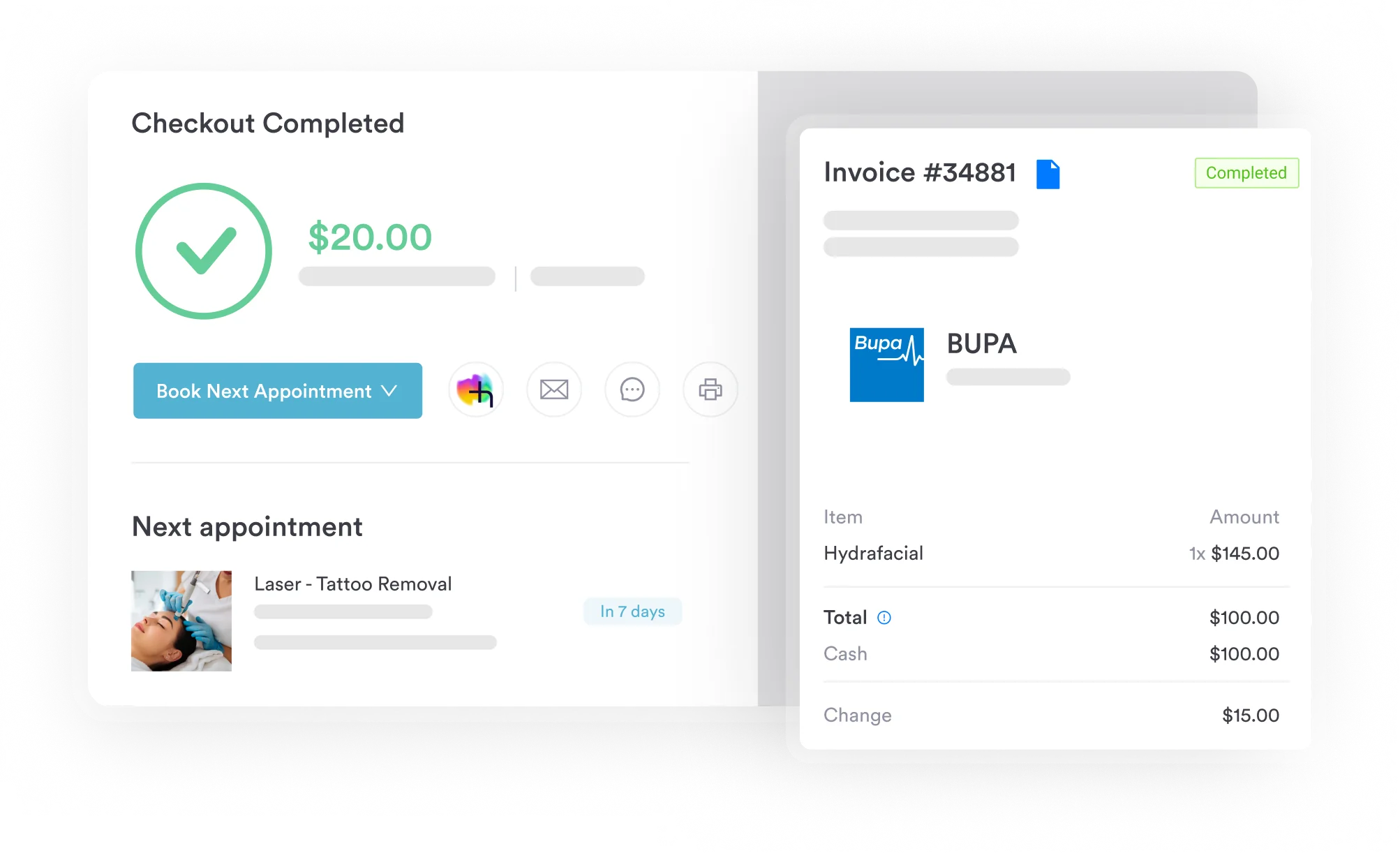
Pabau pre-fills the claim from the patient record, so the CPT code attached to the service and the recorded diagnoses land on the form automatically. Built-in CPT and ICD-10 lookup libraries help coders find the right code fast. Required-field checks stop a claim going out without details like an authorization number.
For US practices, Pabau submits claims through Claim.MD and runs eligibility checks first. Electronic remittance advice (ERA) posting brings each payment response back into the record, so staff see denial reasons without reading paper statements.
Coding decisions, like choosing 92540 or the component codes, stay with your team. Pabau can walk you through a clean claim from eligibility check to ERA posting.

Pabau pre-fills claims from the patient record, checks required fields before submission and posts remittances back automatically. Book a demo to see the workflow for ENT and audiology practices.

The 92540 rule is simple once it’s built into your workflow. All four tests recorded on one date means 92540, and anything less means component codes. Get that call right, pair it with a specific diagnosis and keep the tracings, and you remove the most common reasons these claims bounce.
The trade-off is discipline at the front end. Orders, eligibility and authorizations need checking before the patient sits down, not after the denial lands. Book a demo to see how Pabau keeps vestibular testing claims moving from order to payment.

Need to understand how clearinghouse submissions work for CPT codes? Medical claims clearinghouse guide explains how 837P files route to payers and what happens at each validation step.
Looking for a structured approach to managing denials? Revenue cycle management overview covers the end-to-end process from eligibility through final payment posting.
Want to see what billing a superbill for audiology looks like in practice? Superbill guide walks through the required fields and how they map to clean claim submission.
Coding vertigo that isn’t peripheral? ICD-10 code H81.4 explains when vertigo of central origin applies and how it differs from the peripheral H81 codes.
Not quite. Videonystagmography (VNG) is the recording method, and 92540 is the code for four tests recorded with it. A full VNG workup often adds caloric testing, which 92540 doesn’t include. That part is billed separately as 92537 or 92538.
Yes. Caloric irrigation isn’t part of the 92540 battery, so it goes on its own claim line. Use 92537 for bithermal testing or 92538 for monothermal testing. Never report both caloric codes on the same date.
Yes, under traditional Medicare. Since 2023, audiologists can see some patients without an order using modifier AB, once every 12 months. That direct access excludes services related to disequilibrium, so vestibular testing still needs a physician or non-physician practitioner order.
One. Medicare’s medically unlikely edit (MUE) for 92540 is one unit per date of service, in office and hospital outpatient settings alike. The battery assesses both sides in one session, so a second unit gets rejected.
Rarely. These codes cover spontaneous and positional nystagmus checks without electrical recording. Medicare’s MUE for both is zero in the office setting, so they aren’t payable there. In hospital outpatient settings, the limit is one unit each.