

CPT Code 30801: Superficial turbinate ablation billing guide
CPT Code 30801: Official descriptor and procedure overview The American Medical ...

Last Updated: Nov 27, 2026
89255 is the CPT code for preparation of embryo for transfer (any method). It covers the embryology lab work that readies a fresh or cryopreserved embryo for transfer. That work runs from removing embryos from culture and loading the catheter to checking the catheter afterward for retained embryos.
The code sits in the reproductive medicine procedures range, 89250-89398. The transfer itself is reported separately with 58974, and embryo biopsy for genetic testing uses 89290 or 89291.
Let Pabau's smart automation suggest the right codes, reduce claim denials, and keep your practice compliant—effortlessly.
Automate repetitive tasks and focus on what matters most—your patients.
Reduce coding errors and ensure compliance with the latest regulations.
Clean claims, fewer denials, and faster reimbursements.
Powerful insights and reporting to help your practice thrive.
HIPAA compliant SOC 2 certified GDPR-compliant Trusted by 4,000+ clinics worldwide

CPT code 89255 is preparation of embryo for transfer (any method), the embryology lab work that readies a fresh or cryopreserved embryo for transfer.
The work runs from removing embryos from culture and loading the transfer catheter to checking the catheter afterward for retained embryos.
The embryo transfer itself is reported with 58974, and embryo biopsy for preimplantation genetic testing is 89290 or 89291, never 89255.
Embryo culture, thawing, assisted hatching and embryo cryopreservation (89258) are each reported separately from 89255.
The lab record should show the transfer date, the embryos loaded and the catheter check, so the claim matches the physician’s transfer note.
CPT code 89255 is the code for preparation of embryo for transfer (any method). It covers the embryology lab work that gets a fresh or cryopreserved embryo ready for the transfer catheter. The American Society for Reproductive Medicine (ASRM) lists that work in its lab coding guidance for assisted reproductive technology (ART) cycles:
The code sits in the reproductive medicine procedures range, 89250-89398, inside the pathology and laboratory section of the CPT code set. AAPC places 89255 in that range and summarizes it as preparing an embryo for transfer by any method. “Any method” means the preparation technique does not change the code. ASRM also confirms the code applies to fresh and cryopreserved embryos alike.
The reproductive medicine lab codes split an IVF cycle into separate services. Together with the physician’s procedures, they make up the IVF CPT codes billed across a cycle. Each lab code describes a distinct piece of work, and 89255 covers only the preparation step on transfer day. The table shows how its neighbors relate to it.
89255 is not a biopsy code, and mixing it up with 89290 or 89291 leads to a coding error. Biopsy for preimplantation genetic testing is 89290 or 89291, and the split between them is the number of embryos biopsied, not the number of cells.
These are the three codes most often confused with 89255. 58974 is the transfer the physician performs, while 89290 and 89291 are the biopsy the lab performs for genetic testing. 89255 is the lab work that sits between culture and transfer.
On transfer day, the physician reports 58974 for the transfer and the lab reports 89255 for the preparation. Whether both lines reach the payer on one claim depends on how the practice and its lab bill. A biopsy done earlier in the cycle belongs on its own date of service with 89290 or 89291.
The codes around 89255 change with the type of cycle. A fresh transfer follows culture, while a frozen transfer follows thawing, and the diagram traces both paths. Use the table after it as a checklist, and report a code only when the record shows that work was done.
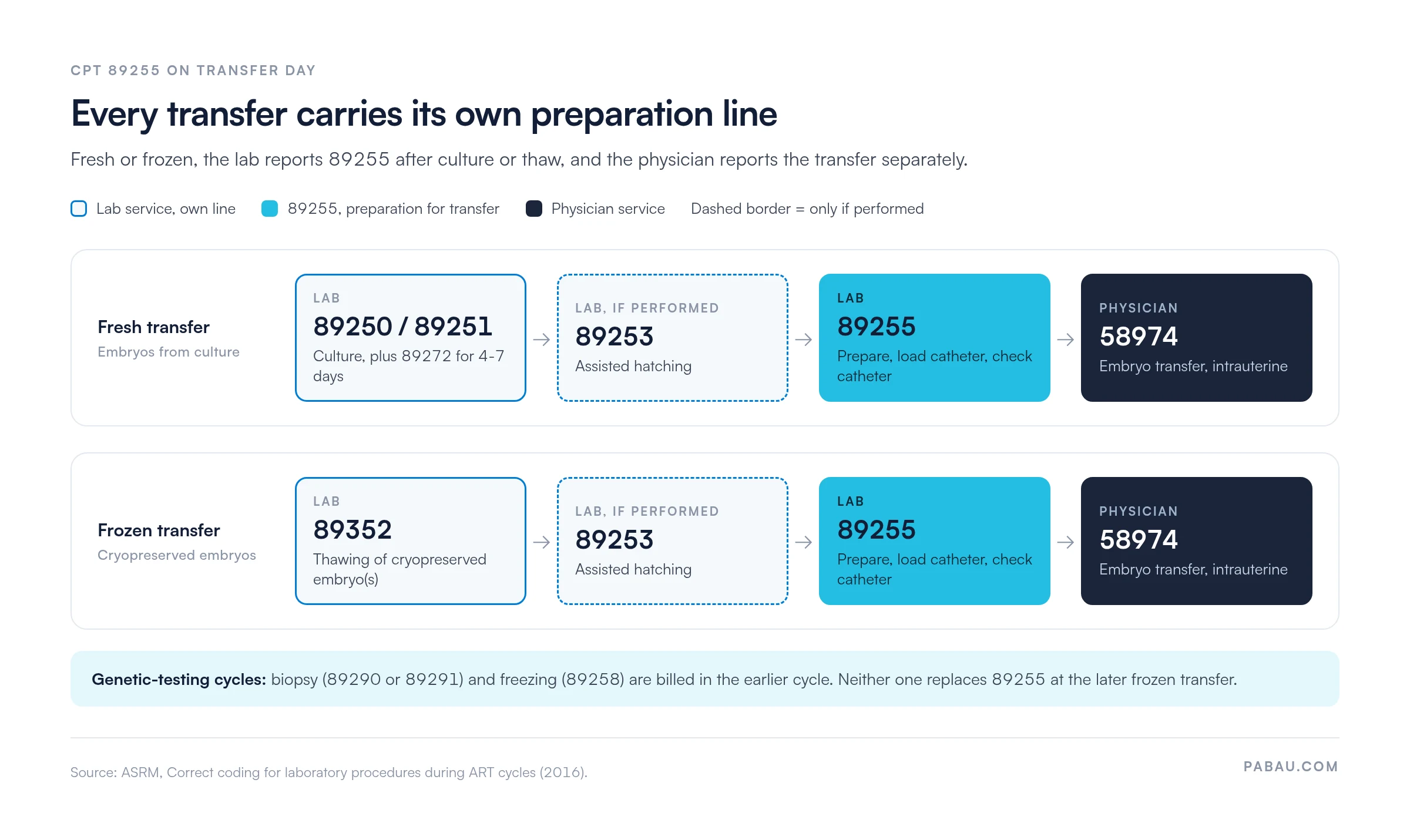
The frozen row is the easiest one to undercode. 89255 applies to a cryopreserved embryo, so a frozen transfer still carries the preparation line. The thaw sits on its own line with 89352, and assisted hatching takes 89253 when the lab performs it.
89255 includes only the preparation work listed above. ASRM names the services that sit outside it and are reported on their own lines:
ASRM also notes that 89258 may be reported for each day additional freezing work is required. Payer edits can still differ from ASRM guidance. Check the current National Correct Coding Initiative (NCCI) procedure-to-procedure edits and the payer’s ART policy before relying on this split.
Build transfer-day charge capture from the lab record, not from memory. List the thaw, any hatching and the preparation as separate lines before the claim leaves the practice. A frozen transfer that reaches the payer with 58974 alone has lost the lab work that went into it.
The embryology record has to show each step the code includes, on the date of the transfer. It also has to tie the preparation to the physician’s transfer note, so the two claim lines tell one story. Claims management software works best when these fields are complete before the claim is built.
A supportable 89255 claim rests on these record elements:
Assemble this set before submission, so the claim goes out clean the first time. An appeal for a missing lab record costs more staff time than the preparation line is worth.
Coverage for 89255 follows the patient’s fertility benefit, not the code itself. Plans that cover IVF usually authorize the cycle as a whole, so check that the approval lists both 89255 and 58974.
ASRM defines no units for 89255. Most practices report one unit per transfer, because ASRM describes the work as embryo(s). Confirm the payer’s ART policy before reporting more than one unit.
Reimbursement comes from each payer’s contract, and contracted rates for fertility lab codes are rarely published. Before quoting a Medicare figure, check the code’s status in the CMS Physician Fee Schedule Look-Up Tool for the year of service. Track what each payer pays per line, so an underpaid preparation charge shows up before the next cycle.
The six denial reasons below trace back to the benefit, the authorization or a code that does not match the lab record. Read the denial reason on the remittance before deciding how to respond.
A denial management workflow that groups denials by reason shows which of these keeps recurring. Fix the cause at the source, and the next cycle’s claims go out clean.
In many fertility practices, transfer-day charges are pieced together after the fact. The billing team reads the lab notes, the transfer note and the authorization, then decides which lines belong on the claim. Thaw and preparation lines are the ones that slip.
Pabau keeps the cycle’s forms, notes and charges on one patient record, with insurance billing built in. In the US, claims run through the Claim.MD integration, which adds eligibility checks before the cycle and electronic remittances after it. The billing team builds each transfer-day line from the same record the lab and the physician wrote.
The result is a transfer-day claim that matches the lab record line for line. Your team spends less time chasing missing preparation and thaw charges, and less time on appeals.

Pabau keeps fertility forms, clinical notes and insurance claims on one patient record. Eligibility checks, claim submission and remittances run in the same system, so 89255 and 58974 are billed from the same record.

CPT 89255 pays for lab work that is easy to overlook because it happens in the minutes before a transfer. Treat it as its own line on every transfer, fresh or frozen. Keep it apart from the biopsy codes, the thaw and the transfer itself.
The practices that get it right build the claim from the embryology record rather than from the transfer note alone. That habit protects the preparation line and keeps audits short.
Book a demo to see how Pabau links fertility lab records to claims, so every transfer-day line reaches the payer.

Need the full IVF billing picture? IVF CPT codes walks through the reproductive medicine codes billed across a standard IVF cycle.
Billing claims piling up without a system? Claims management software from Pabau handles electronic submission, eligibility checks and remittances in one place.
Want to understand the clearinghouse behind your claims? How a medical claims clearinghouse works explains the route a claim takes from practice to payer.
Storing embryos between cycles? CPT code 89342 covers the yearly storage charge, which ASRM keeps separate from freezing with 89258.
Tired of resubmitting claims? Clean claims explains what a payer needs to accept a claim on first submission.
CPT code 89255 covers preparation of embryo for transfer (any method). The lab removes the embryos from culture, prepares them and loads them into the transfer catheter. It carries the catheter to the transfer room and checks it afterward for retained embryos. The code applies to fresh and cryopreserved embryos.
No. Embryo biopsy for preimplantation genetic testing is reported with 89290 for 5 or fewer embryos, or 89291 for more than 5. 89255 is the preparation of an embryo for transfer. The biopsy codes cover the biopsy work alone and exclude 89255.
58974 is the intrauterine embryo transfer the physician performs. 89255 is the lab work that prepares the embryo and loads the catheter for that transfer. ASRM states that 89255 is not part of the transfer work, so both codes are reported on transfer day.
Yes. ASRM confirms 89255 applies to fresh and cryopreserved embryos. On a frozen transfer, report the thaw separately with 89352, plus 89253 if the lab performed assisted hatching.
No. 89258 stays separately billable from 89255. ASRM lists later preparation for transfer among the services 89258 does not include. It also notes 89258 may be reported for each day additional freezing work is required.
Most practices report one unit per transfer, because ASRM describes the work as embryo(s). ASRM defines no units for 89255, so confirm the payer’s ART policy before reporting more than one unit.
The embryology record should show the transfer date and cycle, whether the embryos were fresh or thawed, and which embryos were loaded. It should record the preparation steps, the embryologist and the post-transfer catheter check. Hatching and extended culture belong in their own entries.
The usual causes are a plan that excludes fertility treatment, or an authorization that left out the lab codes. Other causes are 89255 billed for a biopsy, a thaw folded into the line, or units over payer policy. Read the denial reason on the remittance first, because each cause needs a different fix.




