CPT Code 90961: ESRD monthly capitation billing guide
CPT Code 90961: Definition and official descriptor CPT Code 90961 is the monthly...

Last Updated: Oct 21, 2026
89290 is the CPT code for biopsy, oocyte polar body or embryo blastomere, microtechnique (for pre-implantation genetic diagnosis); less than or equal to 5 embryos. It is reported once per session when five or fewer embryos are biopsied. A session of more than five embryos bills 89291 instead, and the two codes are never billed together.
Three errors account for most denied 89290 claims. One is billing 89290 and 89291 for the same session. Another is reporting assisted hatching code 89253 without a distinct indication. The third is a biopsy note with no chain of custody to the genetics laboratory.
Let Pabau's smart automation suggest the right codes, reduce claim denials, and keep your practice compliant—effortlessly.
Automate repetitive tasks and focus on what matters most—your patients.
Reduce coding errors and ensure compliance with the latest regulations.
Clean claims, fewer denials, and faster reimbursements.
Powerful insights and reporting to help your practice thrive.
HIPAA compliant SOC 2 certified GDPR-compliant Trusted by 4,000+ clinics worldwide

CPT Code 89290 reports a biopsy session of five or fewer embryos for preimplantation genetic testing. A session of more than five embryos bills 89291 instead, and the two codes are never billed together.
The code does not include PGT genetic analysis, embryo culture, oocyte retrieval, or fertilization. Each of those is billed separately.
Most commercial payers require prior authorization and a supported ICD-10 diagnosis (e.g. Z31.83) before paying 89290. Traditional Medicare generally does not cover IVF-related procedures.
Pabau, the practice management platform we build, links the embryology record to charge capture, so coders bill from the lab’s own embryo count.
CPT Code 89290 describes “Biopsy, oocyte polar body or embryo blastomere, microtechnique (for pre-implantation genetic diagnosis); less than or equal to 5 embryos.” The American Medical Association (AMA) publishes and maintains the CPT code set.
It places 89290 in the reproductive medicine procedures subsection (89250-89398) of the Pathology and Laboratory section. It is a Category I code, meaning it describes a service with established clinical utility.
89290 has one sibling, 89291, and the two are alternatives. The total number of embryos biopsied in the session decides which one goes on the claim. The table below captures the facts a coder needs before building that claim.
A clinical embryologist performs embryo biopsy in the ART laboratory. It typically happens on day 5 or 6 of culture, once the embryo has reached the blastocyst stage. The embryologist removes 3 to 10 trophectoderm cells from the outer cell layer using a laser or mechanical technique.
The biopsy sample then goes to a genetics laboratory for PGT analysis. The biopsied embryo is vitrified (flash-frozen) while awaiting results. Thawing it later for a frozen transfer is a separate service, billed under 89352.
Earlier cleavage-stage biopsy (day 3, removing a single blastomere) is now less common because trophectoderm biopsy yields more DNA and causes less developmental disruption. Cleavage-stage and blastocyst-stage biopsies use the same pair of codes.
The total number of embryos biopsied in the session picks the code: 89290 for five or fewer, 89291 for more than five. The number of cells removed per embryo changes neither the code nor the single unit.
Knowing what falls inside and outside 89290 prevents the two most common charge-capture errors at fertility centers. One is unbundling services that are part of the biopsy. The other is failing to bill services that are genuinely distinct.
CPT 89290 and 89291 are alternative codes for the same biopsy service, and each claim carries only one of them per session. The total number of embryos biopsied in that session decides which.
A session of five or fewer embryos bills 89290, and a session of more than five bills 89291. Either code is reported as one unit, as the decision below shows.
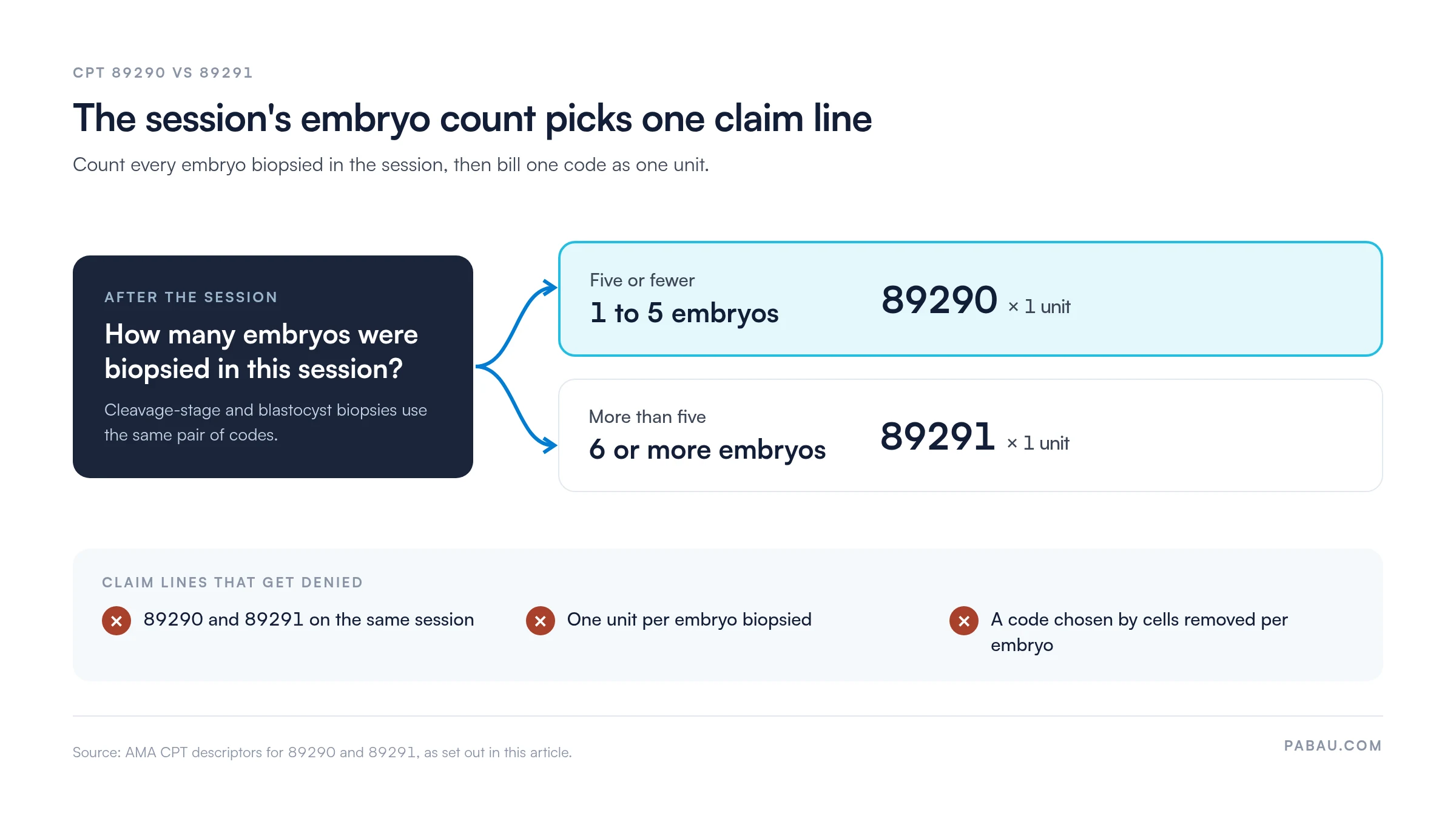
89291 is not an add-on code. It carries no “+” add-on marker in the CPT code set, and its descriptor has no “each additional embryo” wording. Billing 89290 and 89291 together for one session reports the same biopsy twice, which payers deny as a duplicate service.
Billing example: A session in which seven blastocysts are biopsied for PGT-A bills 89291 × 1 unit, and nothing else for the biopsy. It does not bill 89290 for embryos one to five plus 89291 for the other two. Count the embryos once the session is complete, then pick the code.
Our guide to IVF procedure codes covers the complete 89000-series. It also lists the clinical procedure codes that sit around the ART laboratory work.
Four codes appear alongside 89290 in ART coding discussions. Confusing them costs claims.
Yes, in specific circumstances, but only with careful documentation. Assisted hatching (CPT 89253) creates an opening in the zona pellucida with a laser or chemical technique. Its usual purpose is to help an embryo implant.
When a practice performs both assisted hatching and embryo biopsy for PGT on the same embryo in the same cycle, both codes may be reported. The American Society for Reproductive Medicine (ASRM) acknowledges that these are distinct procedures with different clinical purposes.
However, payers apply bundling edits under the National Correct Coding Initiative (NCCI). Some payers treat 89253 as part of the biopsy when it is performed immediately before trophectoderm biopsy. Their reasoning is that the zona pellucida must be opened to reach the trophectoderm cells. To override a bundling edit, the operative note must clearly document:
Without all four elements, expect a bundling denial. Verify current NCCI edits against the AAPC CPT code reference before assuming the edit does not apply to a specific payer contract.
Every 89290 claim needs a supporting ICD-10-CM diagnosis code that establishes the medical necessity of PGT. Payers cross-reference the diagnosis against the covered indication list in their benefit policy before adjudicating the claim. Using a vague or non-specific code is one of the fastest routes to denial.
Payer acceptance of these codes varies. Always verify the current covered-diagnosis list against the specific plan’s ART or fertility benefit policy before submitting. Z31.83 is the most consistently accepted code across commercial plans that offer IVF benefits, but it does not guarantee coverage on its own.
Traditional Medicare (Parts A and B) does not cover IVF or ART laboratory services, including CPT Code 89290. Medicare’s exclusion of IVF-related procedures is longstanding CMS policy.
Medicare Advantage (Part C) plans set their own benefit structures, and a small number offer limited fertility benefits. Check the individual plan’s evidence of coverage before concluding Medicare will not pay. Verify current Local Coverage Determinations (LCDs) through the CMS Medicare Coverage Database.
For commercial payers, coverage depends on whether the employer or health plan has purchased an infertility benefit rider. As of 2024, 21 US states had mandated some form of infertility coverage for large group plans.
The procedures covered and the cycle limits vary significantly by state and plan design. Prior authorization is required by most payers that do cover 89290. The authorization request typically needs to include:
Never assume a prior authorization for the IVF cycle covers 89290. Many payers issue separate authorizations for the clinical procedures (stimulation, retrieval, transfer) and the laboratory procedures (culture, biopsy, PGT).
Confirm the authorization names the biopsy code before the biopsy is performed. The embryo count can land on either side of five, so ask the payer to list 89290 and 89291 as alternatives.
The final embryo count is not known until biopsy day, so request authorization for 89290 and 89291 as alternatives on the same request. If you authorize only 89290 and the session produces six biopsied embryos, the 89291 claim will deny on first submission. Amending a PA after the fact delays payment by weeks.
Because traditional Medicare does not cover 89290, there is no widely published Medicare Physician Fee Schedule (MPFS) national allowable for this code.
For payers that do cover IVF laboratory services, reimbursement rates are set by contract and vary substantially by region and plan. Many ART laboratory fees are self-pay or run through specialty fertility benefit managers (e.g. Progyny, WINFertility) rather than standard insurance adjudication.
Where a payer does reimburse, the rate can run from several hundred to over a thousand dollars per session, set by each payer contract. 89291 carries its own contracted rate, paid as one unit for the whole session rather than per additional embryo.
No published benchmark replaces the contract, so check each payer’s fee schedule before quoting a patient. The CMS Physician Fee Schedule lookup tool shows whether a national rate exists for 89290 in a given year. It also lists the relative value units (RVUs) assigned to the code.
The embryology lab record is the primary documentation source for an 89290 claim. Payers that cover ART laboratory services conduct post-payment audits, and thin documentation is a frequent reason for recoupment demands. The record must support five elements.
A structured superbill documentation process captures all five elements at the point of service. That is far more reliable than retrospective chart review before claim submission.
Denial management for 89290 clusters around six root causes. Most are preventable at the point of charge capture rather than through appeals. The remittance names each denial with a reason code, and our guide to medical billing denial codes explains how to read them.
Practices with high denial volumes can build a structured denial management workflow to handle them. It routes 89290 denials to a dedicated ART coding specialist, not the general billing team. Each appeal then goes to someone who knows the code.
The chain-of-custody denial needs the embryology lab record as well as a claim correction. The billing team therefore needs a clear escalation path to the lab team.
Submitting a clean claim the first time requires all six elements to be in place before the claim leaves the practice. Retrospective corrections on ART claims are expensive. An appeal can take weeks to resolve, and the cycle revenue sits in accounts receivable meanwhile.
Most 89290 errors start at the handoff between the embryology lab and the billing team. In many fertility centers, the embryologist documents the biopsy in a lab-specific log.
Someone on the billing team then copies the embryo count and code onto the superbill by hand. Each handoff is a chance to miscount embryos, pick the wrong side of the five-embryo line, or miss the chain-of-custody note.
Connecting the clinical encounter directly to charge capture removes that handoff. Pabau, the practice management platform we build, keeps biopsy notes, cycle documentation and ICD-10 codes in the same patient record the coder bills from. The coder sees how many embryos were biopsied and which diagnosis the physician attached, so the right code goes on the claim without retyping.
Pabau’s medical billing software supports structured charge capture for the 89000-series codes, including 89290 and 89291. Completed claims then go out through the Claim.MD clearinghouse, Pabau’s US partner. Eligibility is checked in real time, and claims reach thousands of US payers electronically.

Pabau connects your embryology lab records to your billing workflow. Your coding team has the right embryo count, diagnosis codes, and cycle documentation before a claim is submitted.

CPT 89290 rarely fails on the code itself. It fails when the embryo count, the authorization and the chain-of-custody note live in three different places. Bring them together before the next cycle, and most 89290 denials stop before the claim is built.
Start with the authorization. Requesting 89290 and 89291 together costs one extra line on the form and removes the most avoidable denial on this code. Then make the lab’s embryo count the only number the coder bills from.
Pabau helps fertility centers build that handoff into the clinical workflow, so nobody retypes a count between the lab and the claim. Book a demo to see how charge capture and clearinghouse submission would fit your fertility center.

Building the authorization request? The prior authorization process walks through each step from request to approval, including what payers ask for.
Coding a PGT-M carrier indication? ICD-10 Code Z14.8 covers genetic carrier status for a disease without its own carrier code.
CPT Code 89290 covers the biopsy of embryos or oocyte polar bodies for preimplantation genetic testing (PGT). It applies when five or fewer are biopsied in one session. A session of more than five bills 89291 instead. The code includes the physical cell removal and documentation of the procedure. It does not include the genetic analysis performed by the genetics laboratory, embryo culture, oocyte retrieval, or embryo transfer.
CPT 89290 and 89291 are alternative codes chosen by the total number of embryos biopsied in a session. 89290 covers five or fewer embryos, and 89291 covers more than five. Each is reported as one unit, and only one of them is billed per session. 89291 is not an add-on code, so a seven-embryo session bills 89291 × 1 unit, not 89290 plus 89291. Billing both for the same session triggers a duplicate-service denial.
No, traditional Medicare (Parts A and B) does not cover CPT Code 89290 or any other IVF-related ART laboratory procedure under longstanding CMS policy. A small number of Medicare Advantage (Part C) plans include limited fertility benefits. If a patient holds one of those plans, verify that plan’s evidence of coverage.
Yes, but only when both procedures are performed for distinct clinical indications and the operative note documents each separately. Append Modifier 59 to CPT 89253 and document the specific reason assisted hatching was performed independently of the biopsy access. Without Modifier 59 and clear documentation, bundling edits will combine the two services and deny 89253.
Six reasons account for most denials. The first three are no ART benefit in the plan, a missing or expired prior authorization, and the wrong code for the embryo count. Billing 89290 and 89291 together for one session falls in that third group. The other three are a missing or unsupported ICD-10 code, 89253 billed without Modifier 59, and no chain-of-custody record for the sample.
Usually. Most commercial plans that cover IVF-related services require one. Requirements vary by payer but typically include a letter of medical necessity, the PGT indication, and an estimated embryo count. Because that count can land on either side of five, ask for 89290 and 89291 as alternatives on the authorization before the biopsy is performed.