CCSD code L5910: Femorofemoral bypass billing guide
CCSD code L5910: What the code covers CCSD code L5910 is the billing code for a ...

Last Updated: Nov 12, 2026
89253 is the CPT code for assisted embryo hatching, microtechnique(s) (any method). The embryology lab reports it when it thins or opens the zona pellucida, the shell around an embryo, before transfer.
The code sits in the Reproductive Medicine Procedures range (89250-89398) of CPT's Pathology and Laboratory chapter. Medicare does not cover it, and many plans that pay for IVF still exclude assisted hatching as a separate line. Verify the patient's benefits before each cycle.
Let Pabau's smart automation suggest the right codes, reduce claim denials, and keep your practice compliant—effortlessly.
Automate repetitive tasks and focus on what matters most—your patients.
Reduce coding errors and ensure compliance with the latest regulations.
Clean claims, fewer denials, and faster reimbursements.
Powerful insights and reporting to help your practice thrive.
HIPAA compliant SOC 2 certified GDPR-compliant Trusted by 4,000+ clinics worldwide

CPT Code 89253 reports assisted embryo hatching, a procedure the embryology lab bills rather than the supervising physician.
Medicare does not cover 89253, so the code carries zero RVUs on the Medicare Physician Fee Schedule.
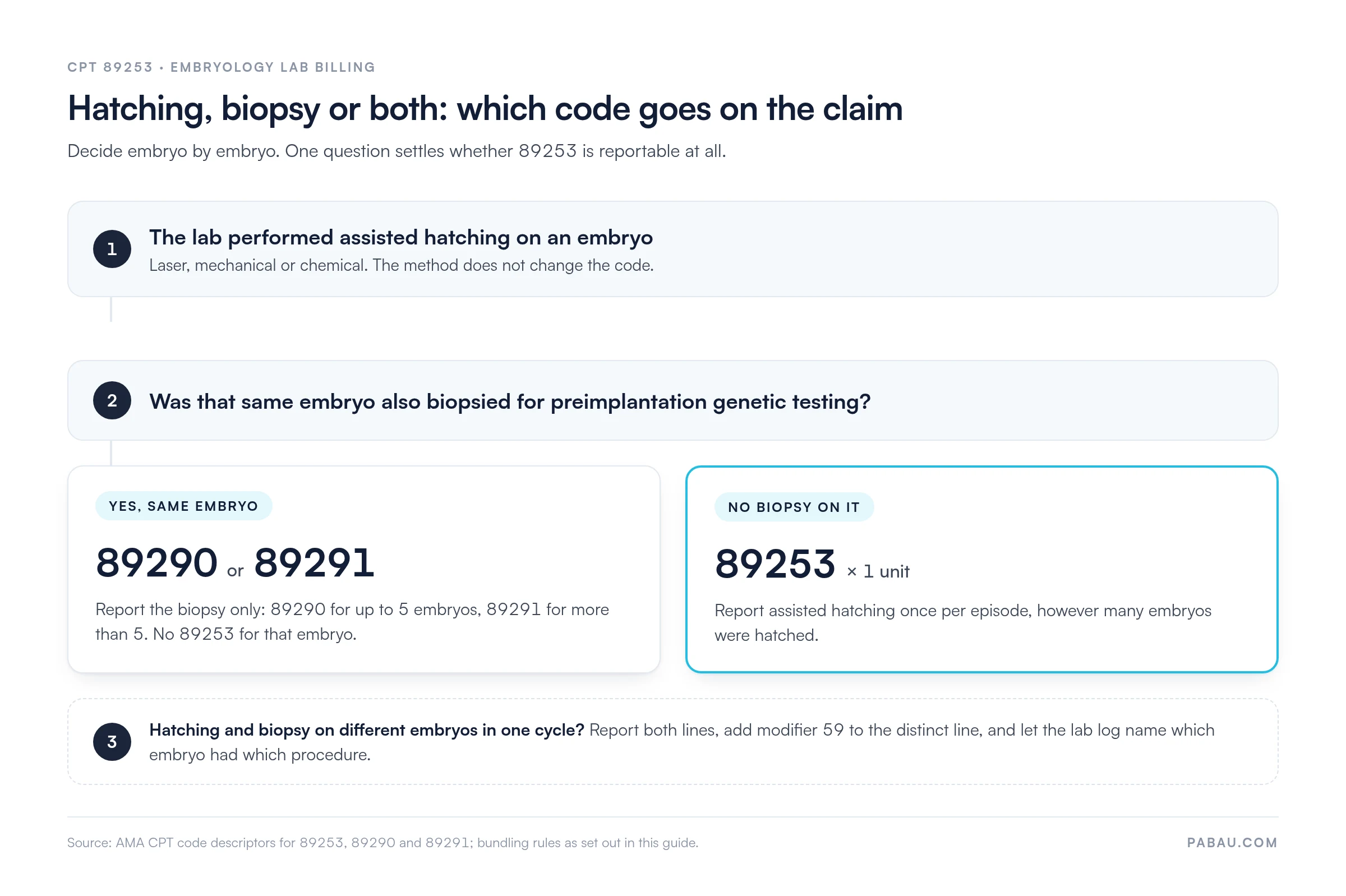
When the same embryo is hatched and biopsied for genetic testing, only 89290 or 89291 is reported for it, never 89253.
Missing medical necessity documentation is the leading denial trigger, so record the clinical indication before the cycle starts.
Pabau, the practice management platform we build, submits claims through Claim.MD and tracks each prior authorization on the patient’s case.
CPT Code 89253 reports assisted embryo hatching, the lab step that thins or opens the zona pellucida so the embryo can implant after transfer. It is a Category I code in the AMA’s CPT code set, in the Reproductive Medicine Procedures range (89250-89398). Medicare does not pay for it, so coverage depends on the patient’s commercial plan or self-pay agreement.
The table sums up the facts to confirm before a claim goes out. Our guide to IVF CPT codes covers the rest of the cycle.
Assisted hatching is a lab procedure on the zona pellucida, the protein shell around an embryo. The embryologist thins or breaches it before transfer into the uterus. The technique helps the embryo’s natural hatching, which must happen for implantation to succeed.
Three techniques fall under the single descriptor “any method” in 89253:
Clinical indications documented by ASRM guidelines include elevated zona thickness, advanced maternal age, prior failed IVF cycles and poor-prognosis embryos.
Frozen-thawed embryos qualify too, because the zona may harden during cryopreservation. These indications shape what payers accept as medical necessity documentation.
The AMA’s CPT code set classifies 89253 as a laboratory procedure. The embryology lab reports it, not the reproductive endocrinologist who oversees the cycle. Physician supervision is billed separately using the appropriate E/M or reproductive medicine code.
The bundling rules for 89253 are where the most costly claim errors happen. The descriptor “any method” bundles the zona manipulation, the microscopy and any chemical agent used in chemical hatching into one reportable unit.
Separately reportable on the same date:
Critical bundling error to avoid: 89253 and 89290/89291 must not be billed on the same embryo. If hatching was done to give access for a PGT biopsy, only 89290 or 89291 is reportable for that embryo.
Apply modifier 59 only where the hatching and biopsy were performed on distinct, separate embryos. The AAPC’s CPT code range lookup provides NCCI edit guidance for these code pairs. The chart below walks through the decision for each embryo.
89253 is a laboratory code, not a physician service code. Physician supervision, consultation or an E/M service on the same date is billed under the right physician code, with the supervising provider’s NPI.
The embryology section (89250-89398) contains several codes that billers confuse with 89253. The table below identifies the key distinctions.
Run an NCCI edit check on every embryology claim before submission. When 89253 and 89290 appear on the same claim, the clearinghouse flags a bundling conflict. It clears only when the record shows hatching and biopsy on distinct embryos and modifier 59 sits on the right line.
Payers are increasingly aligning their medical necessity criteria for 89253 with published clinical guidelines. Submitting a claim without all four documentation elements below is the fastest path to a denial.
When a payer publishes a medical policy for ART services, the clinical indication in the chart must map to one of its criteria. A generic “poor prognosis” note without measurements or cycle history does not satisfy most of these policies.
A clean claim submission for 89253 has all four elements attached before it leaves the system, or referenced in its attachment control number.
Coverage for CPT Code 89253 varies widely by payer type. Checking it before the cycle starts prevents surprise denials after the procedure is done.
As of 2024, about 15 states plus the District of Columbia had passed infertility insurance mandate laws, and their benefit requirements vary considerably.
Verify the current state count and mandate scope before advising patients. Confirming insurance eligibility for ART benefits specifically, not just general plan eligibility, is a required step in the fertility intake workflow.
Medicare does not cover assisted hatching, so CPT Code 89253 has no payable RVUs on the Medicare Physician Fee Schedule. Work, Practice Expense and Malpractice RVUs are all zero. There is no MPFS payment rate to reference for this code.
Commercial reimbursement is negotiated through two primary mechanisms:
Use the CMS Physician Fee Schedule search tool to confirm current RVU assignments annually. The FastRVU 2026 lookup tool gives free Work, PE and MP RVU values by code and region. Those values still help you benchmark commercial rate negotiations when Medicare does not apply.
Denials for CPT Code 89253 follow a predictable pattern. The table maps the most common denial reasons to fixes your billing team can make before the next submission.
A structured denial management workflow tags ART denials by claim adjustment reason code (CARC). That shows quickly whether a wave of denials comes from coverage or from documentation. Coverage problems need a front-end benefits check, and documentation problems need a change to the clinical workflow.
When a remittance arrives with an unfamiliar code, our denial code reference explains each CARC and remittance advice remark code (RARC).
Even when a patient’s plan covers IVF, assisted hatching may be excluded as a separate covered procedure. The benefits verification call must ask about 89253 specifically, not just ART in general.
Use this checklist during the benefits verification call before each cycle:
Document the verification outcome, the representative’s name, and the reference number in the patient’s record before the cycle begins. When a plan denies 89253 as non-covered, give the patient a written estimate of the out-of-pocket cost. Do it before they sign consent for the procedure.
A setup error for 89253 in a practice management or EHR system repeats on every cycle until someone corrects the template. These five configuration points matter most.
Set up a cycle code group template in your practice management system that includes 89253 alongside 58970, 58974 and 89258. When an embryologist marks a cycle as including assisted hatching, the template fills in the related codes for the billing team to review. That prevents the most common missed-code error in fertility billing.
Most fertility practices build an IVF claim from three places. The lab log says which embryos were hatched, the cycle notes hold the indication, and the billing system holds the codes. When one of them lags, 89253 goes out without its paperwork or not at all.
Pabau, the practice management platform we build, keeps the notes, the codes and the prior authorization on one patient record. For fertility practices billing US payers, its claims management tools submit claims through the Claim.MD clearinghouse. Eligibility checks and electronic remittances come back to the same record.
Prior authorization is tracked on the patient’s case, with the auth code, dates and sessions, and Pabau warns when one is missing. So a plan that never authorized assisted hatching shows up before transfer day, not on the remittance.

Pabau submits claims through the Claim.MD clearinghouse, checks eligibility, and tracks each prior authorization on the patient’s case. See how it keeps assisted hatching claims out of the denial queue.

Assisted hatching is a small line on a large claim, and it gets denied for reasons a billing team can see coming. The plan excludes it, the authorization doesn’t name it, or the chart doesn’t say why the embryo needed it. Each of those is settled before transfer day or not at all.
So treat 89253 as a pre-cycle task. Confirm the benefit and the authorization scope, record the indication, and ask whether any hatched embryo is also going to biopsy. If one is, 89290 or 89291 replaces 89253 for that embryo. Teams still building the wider process can start with our medical billing basics.
Get those steps into the intake workflow and 89253 stops being the line that holds up an IVF payment. Book a demo to see how Pabau carries an IVF cycle’s codes and authorizations from intake to payment posting.

Need a full list of IVF billing codes? IVF CPT codes covers every code in the ART cycle from oocyte retrieval through embryo transfer.
Unclear on what a clearinghouse does for lab claims? Claim.MD clearinghouse guide explains how electronic claim submission works for specialty labs and which rejections it catches before payer adjudication.
Freezing embryos in the same cycle? CPT code 89258 covers embryo cryopreservation, which is reported separately from hatching on the same date.
Storing embryos after the cycle? CPT code 89342 covers yearly embryo storage and how it is billed after the cycle ends.
CPT code 89253 covers assisted embryo hatching performed by an embryology lab. The lab may use any technique, whether laser, mechanical or chemical, to thin or breach the zona pellucida before embryo transfer. The code covers the manipulation itself, the microscopy and any chemical used. Physician supervision is not included and is billed separately.
No. Medicare does not cover CPT code 89253. There is no National Coverage Determination for assisted reproductive technology, so 89253 carries zero RVUs on the Medicare Physician Fee Schedule. If a Medicare patient requests an ART service, issue an Advance Beneficiary Notice (ABN) before the procedure.
Prior authorization requirements vary by commercial plan. A payer that authorized the IVF cycle may not have authorized assisted hatching as a separate line item. Ask the payer to confirm that 89253 is inside the ART authorization scope, or obtain a separate authorization for assisted hatching.
CPT 89253 covers zona pellucida manipulation (assisted hatching) only, while 89290 covers biopsy for preimplantation genetic testing on up to 5 embryos. The two codes cannot be billed for the same embryo. If hatching was done to give access for the biopsy, only 89290 is reportable for that embryo. Modifier 59 applies only where the procedures were performed on separate embryos in the same cycle.
CPT 89253 is billed as one unit per episode, meaning once per cycle event, however many embryos received assisted hatching. It is not billed per embryo. Billing several units for one cycle, or submitting 89253 on separate dates for the same cycle, triggers payer edits or denials.
The most common denials for CPT code 89253 are a non-covered service and a missing prior authorization. Others are medical necessity missing from the clinical notes and the wrong place of service (11 vs 81). Bundling conflicts with 89290 or 89291 follow when modifier 59 is applied incorrectly.