CPT Code 23076: Subfascial shoulder tumor excision
CPT code 23076: official descriptor and code structure CPT code 23076 describes ...

Last Updated: Oct 27, 2026
89342 is the CPT code for storage of embryo(s), reported per year of storage. It covers keeping cryopreserved embryos in the lab's storage tanks, not the freezing (89258) or the thaw (89352).
The code belongs to a four-code storage family split by what is stored. Embryos take 89342, sperm or semen 89343, reproductive tissue 89344, and oocytes 89346. CMS lists 89342 with no Medicare fee schedule payment, so commercial plans, state mandates, and self-pay decide reimbursement.
Let Pabau's smart automation suggest the right codes, reduce claim denials, and keep your practice compliant—effortlessly.
Automate repetitive tasks and focus on what matters most—your patients.
Reduce coding errors and ensure compliance with the latest regulations.
Clean claims, fewer denials, and faster reimbursements.
Powerful insights and reporting to help your practice thrive.
HIPAA compliant SOC 2 certified GDPR-compliant Trusted by 4,000+ clinics worldwide

CPT code 89342 reports storage of embryo(s) per year, so the lab bills one unit for each year the embryos stay in storage.
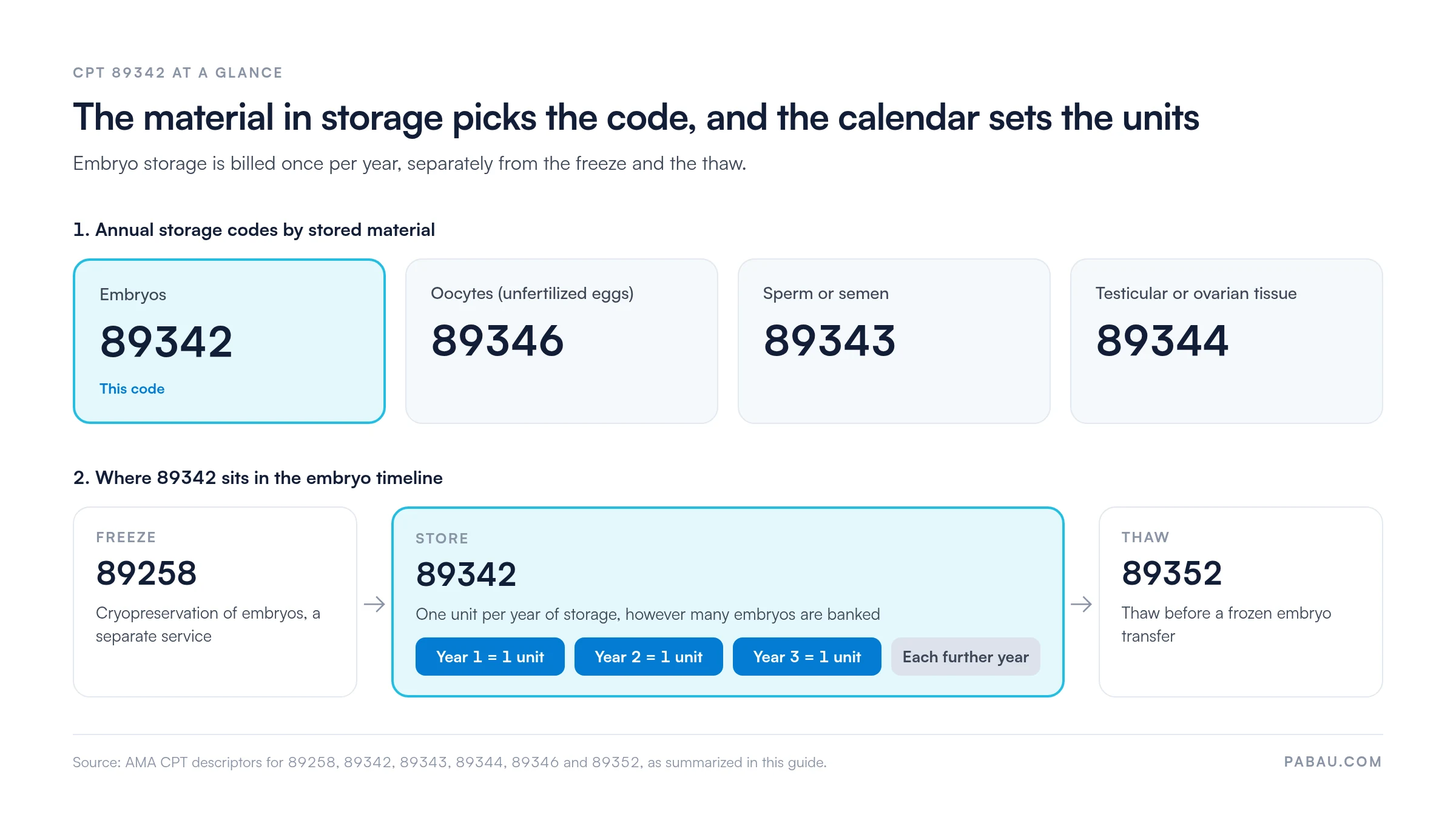
The annual storage codes split by what is stored: 89342 for embryos, 89343 for sperm or semen, 89344 for reproductive tissue, and 89346 for oocytes.
Freezing (89258) and thawing (89352) are separate services with their own codes, and 89342 covers neither of them.
CMS lists 89342 with status X and no payment amount, so coverage depends on commercial plans, state mandates, and oncofertility policies.
Pabau, the practice management platform we build, keeps consent forms, records, and claims in one patient file. Each storage claim has its documentation behind it.
CPT code 89342 describes storage of embryo(s), per year, in the American Medical Association’s CPT code set. The lab reports it for each year that cryopreserved embryos stay in storage, however many embryos the patient has banked.
The code sits in the Reproductive Medicine Procedures range (89250-89398) of the Pathology and Laboratory section. It covers only the storage service. Freezing is reported with 89258, the thaw with 89352, and the embryo transfer with its own code.
The AAPC’s CPT code lookup places 89342 in a group of four annual storage codes that differ only by what is stored. The American Society for Reproductive Medicine (ASRM) also publishes coding Q&As on storage billing, which billing teams can read alongside the AMA codebook. The map below shows the four storage codes side by side, and where storage falls between the freeze and the thaw.
Knowing what 89342 does not cover prevents the wrong-tissue and unbundling errors that fertility billing teams see most often.
The most common misuse of CPT code 89342 is reporting it for the wrong material. A patient who froze eggs and a patient who froze embryos both have specimens in storage, but only embryos take 89342. When freezing and the first storage year fall on the same date, 89258 and 89342 may both apply. Check the payer’s bundling edits before reporting both on one claim.
The annual storage codes share one descriptor stem, Storage (per year), and split by the material in the tank. The table below maps the codes billing teams confuse most often with CPT code 89342.
For practices managing IVF procedure code billing across several cycle stages, the tissue split matters most. When stored oocytes are later fertilized and the resulting embryos frozen, storage of those embryos moves from 89346 to 89342. A patient with both eggs and embryos in storage can have both codes on the same annual claim.
Payers expect a supporting diagnosis code on every CPT code 89342 claim. The ICD-10 code you select tells the payer the clinical context. In states with infertility or fertility preservation mandates, it can decide whether the claim is covered at all.
Selecting the most specific ICD-10 code available lowers the risk of a medical necessity denial. A claim with N97.9 draws more payer scrutiny than one with N97.1 when the record clearly documents tubal factor infertility. Payer policies vary, so check each plan’s accepted code list before submission.
Medicare’s physician fee schedule makes no payment for CPT code 89342. The CMS relative value file lists the code with status X, a statutory exclusion, with zero RVUs and no payment amount. Most embryo storage claims therefore go to commercial plans or are billed to the patient.
When a payer denies storage as an infertility exclusion, check whether the clinical indication qualifies for another coverage pathway. Oncofertility patients preserve fertility before chemotherapy or radiation, and their plan may cover storage under a fertility preservation benefit instead.
A defensible CPT code 89342 claim starts with the medical record. The documentation that supports each storage year must exist before the claim goes out, because records written after the fact rarely satisfy a payer audit.
Documentation is where many fertility practices lose money on storage claims. Keeping consent forms and lab records in the patient file, next to the claim, brings the two into line. Maintaining medical billing compliance standards across cycle documentation protects the practice at audit.
Pull 10 embryo storage claims each quarter and check each record for embryo count, storage period, signed storage agreement, and clinical indication. A field missing from several records points to a workflow problem upstream, so fix the process rather than patching single claims.
Getting the billing mechanics right for CPT code 89342 matters as much as the documentation. Errors in units, storage periods, or claim routing cause denials even when the record is clean.
The CY2026 CMS physician fee schedule relative value file lists 89342 with status X, zero RVUs, and no payment amount. The CMS Physician Fee Schedule lookup shows the same status, so Medicare offers no national rate to use as a benchmark.
Commercial rates for CPT code 89342 are set by contract and vary by payer and region. Fertility practices often negotiate storage within a broader ART contract, and many patients pay for storage directly. Put the self-pay storage fee in writing in the storage agreement.
CPT code 89342 denials cluster around a handful of root causes, and each is preventable with the right checks. Building denial management workflows into the billing cycle helps fertility practices spot patterns early instead of working rejections one by one.
Reviewing remittance denial codes by CPT code shows whether 89342 is building a specific denial pattern. A run of CO-97 denials points to a bundling edit. CO-96 (non-covered charge) or CO-50 (not medically necessary) points to benefit verification at scheduling.
Oncofertility billing follows different rules. When a patient stores embryos before chemotherapy, radiation, or surgery that can damage fertility, storage becomes part of cancer care. That shift can open coverage that a standard infertility exclusion would deny.
Oncofertility coverage changes more often than standard ART policy, so review payer oncofertility policies every year. Using claims management software that tracks denials by ICD-10 pairing shows which oncofertility code combinations payers accept and which trigger infertility exclusions.
Create a separate billing workflow for oncofertility patients. Flag them at scheduling and start prior authorization the day the oncology referral arrives. Record the cancer diagnosis on the embryology lab worksheet next to the standard storage fields. A ready-made oncofertility checklist shortens the time from authorization to storage.
Embryo storage billing runs on a yearly clock. A missed renewal leaves a storage year unbilled, and a wrong tissue code sends the claim back.
Pabau keeps consent forms, storage agreements, treatment notes, and invoices in each patient’s record. Your coders pick the storage code and period, and the claim carries the documentation behind it.
In the US, Pabau’s claims management sends claims through Claim.MD and tracks their status. Billing staff see rejections in the same system as the patient record. Pabau does not assign codes, so your team stays in control of 89342, 89346, and 89343.

Pabau keeps storage consent, treatment records, and claims in one patient file. Claims go to Claim.MD with the codes your team selects, and you track their status in one place.

CPT 89342 is simple once the clock and the material are clear. Each claim covers one year of embryo storage, and the code changes the moment the stored material is eggs, sperm, or tissue instead.
Most denials on this code come from coverage, and a benefit check before storage starts prevents them. Treat oncofertility patients as their own billing track, with the cancer diagnosis and fertility preservation code on every claim.
Book a demo to see how Pabau keeps storage records and claims together for fertility practices.

Need to understand how clearinghouses process ART claims? How the Claim.MD clearinghouse works covers how electronic claims are routed, checked, and tracked for US billing teams.
Managing denials across multiple CPT codes in your ART workflow? What is medical billing walks through the full revenue cycle from claim submission to payment posting.
Billing the thaw before a frozen embryo transfer? CPT code 89352 covers thawing cryopreserved embryos, the step that follows storage.
CPT code 89342 covers storage of embryo(s) for one year. Report one unit for each year that cryopreserved embryos stay in storage. It does not cover freezing (89258), thawing (89352), or storage of oocytes (89346) or sperm (89343).
The three codes report the same annual storage service for different material. 89342 is for embryos, 89346 for unfertilized oocytes, and 89343 for sperm or semen. Choose the code from what the embryology log shows is in storage.
Medicare’s physician fee schedule makes no payment for CPT code 89342. CMS lists it with status X, a statutory exclusion, with zero RVUs and no payment amount. Most embryo storage claims go to commercial plans or are billed to the patient.
They can appear on the same claim when embryos are frozen and the first storage year starts on the same date. 89258 reports the freezing, and 89342 reports the storage. Check the payer’s bundling edits before reporting both.
Z31.83 (encounter for assisted reproductive fertility procedure cycle) is common for standard IVF storage. Use the most specific N97 code when the record documents the cause of infertility. For oncofertility, report Z31.84 (encounter for fertility preservation procedure) with the cancer diagnosis code.
Coverage depends on the plan and the state. Many states now require some plans to cover fertility preservation before treatment that can cause infertility. Verify each patient’s plan before the cycle begins, and include the cancer diagnosis and treatment plan in any prior authorization request.