CCSD Code M6530: Endoscopic resection of prostate (TUR)
CCSD Code M6530: Definition and clinical scope CCSD Code M6530 is the UK private...

Last Updated: Nov 6, 2026
89258 is the CPT code for cryopreservation, embryo(s). Fertility practices report it once per session for freezing one or more embryos, whatever the number frozen.
The code covers the freeze alone. Embryo storage is billed under 89342, oocyte freezing under 89337, and thawing under 89352, each as a separate line on the claim.
Let Pabau's smart automation suggest the right codes, reduce claim denials, and keep your practice compliant—effortlessly.
Automate repetitive tasks and focus on what matters most—your patients.
Reduce coding errors and ensure compliance with the latest regulations.
Clean claims, fewer denials, and faster reimbursements.
Powerful insights and reporting to help your practice thrive.
HIPAA compliant SOC 2 certified GDPR-compliant Trusted by 4,000+ clinics worldwide

CPT code 89258 covers the freezing of embryos only, while storage, oocyte freezing and thawing are billed under separate codes.
Medicare does not cover embryo cryopreservation as a standard Part B benefit, and commercial coverage depends on state mandates and plan design.
The most common denial triggers are a non-covered benefit, missing embryo count or stage documentation, and an incorrect place-of-service code.
Pabau’s practice management software submits and tracks claims through Claim.MD, so your billing team can follow each 89258 claim to the payer’s response.
CPT code 89258 is published by the American Medical Association (AMA) with the official descriptor: Cryopreservation, embryo(s). It sits in the Reproductive Medicine Procedures subsection of the CPT code set. That subsection holds the assisted reproductive technology (ART) laboratory codes in the 89250-89398 range.
The code covers freezing one or more viable embryos after fertilization and culture in the laboratory. It is reported once per cryopreservation session, not per embryo.
Practices freeze embryos when a fresh transfer is not planned, or when the patient is at risk of ovarian hyperstimulation syndrome (OHSS). They also freeze surplus embryos left after a fresh transfer cycle.
The laboratory or fertility practice that performs the cryopreservation bills the code. The ordering physician bills separately for clinical management. Vitrification, the rapid-freeze technique now standard in most ART laboratories, and slow-freeze protocols both fall under 89258. The code does not distinguish between freezing methods.
The descriptor covers the freeze alone. Each step around it carries its own code, and billing them together is the most common unbundling error on these claims.
NCCI (National Correct Coding Initiative) edits govern bundling relationships between these codes. Check current CMS NCCI tables before combining 89258 with other ART laboratory codes on the same claim.
The reproductive medicine range holds several embryo and gamete codes that are easy to confuse. The side-by-side view below confirms which one you are billing. For the complete ART laboratory code set, see our guide to IVF CPT codes.
89258 and 89259 mirror each other for different material. Billing 89259 for an embryo freeze, or 89258 for a sperm freeze, is an easy keying error that triggers a claim rejection. 89352 pairs with 89258. You report 89258 when embryos are frozen and 89352 when they are thawed for a later FET cycle.
Payers reviewing 89258 claims focus on laboratory records. Weak documentation is one of the main denial drivers for this code, especially with commercial insurers under state fertility mandates. Submitting a clean claim for embryo cryopreservation requires the following elements to be present in the chart before billing.
Check that each element is in the lab record before the claim is built, not after a records request arrives. Medical billing compliance for ART procedures requires an audit trail connecting the clinical record to the submitted claim.
Prior authorization (PA) requirements for CPT code 89258 vary by payer and state. Insurers in fertility mandate states, including Connecticut, Illinois, Massachusetts, New Jersey and New York, are more likely to require PA before embryo cryopreservation. Check each payer’s portal for current requirements. Mandate scope and plan exemptions differ, so a state mandate alone does not confirm coverage.
A PA request should carry the cycle start date and the diagnosis codes, typically N97.x for female infertility or N46.x for male factor. Add the number of embryos expected and the clinical reason for freezing rather than a fresh transfer. Sending the full cycle protocol with the request cuts the back-and-forth with the insurer’s clinical reviewers.
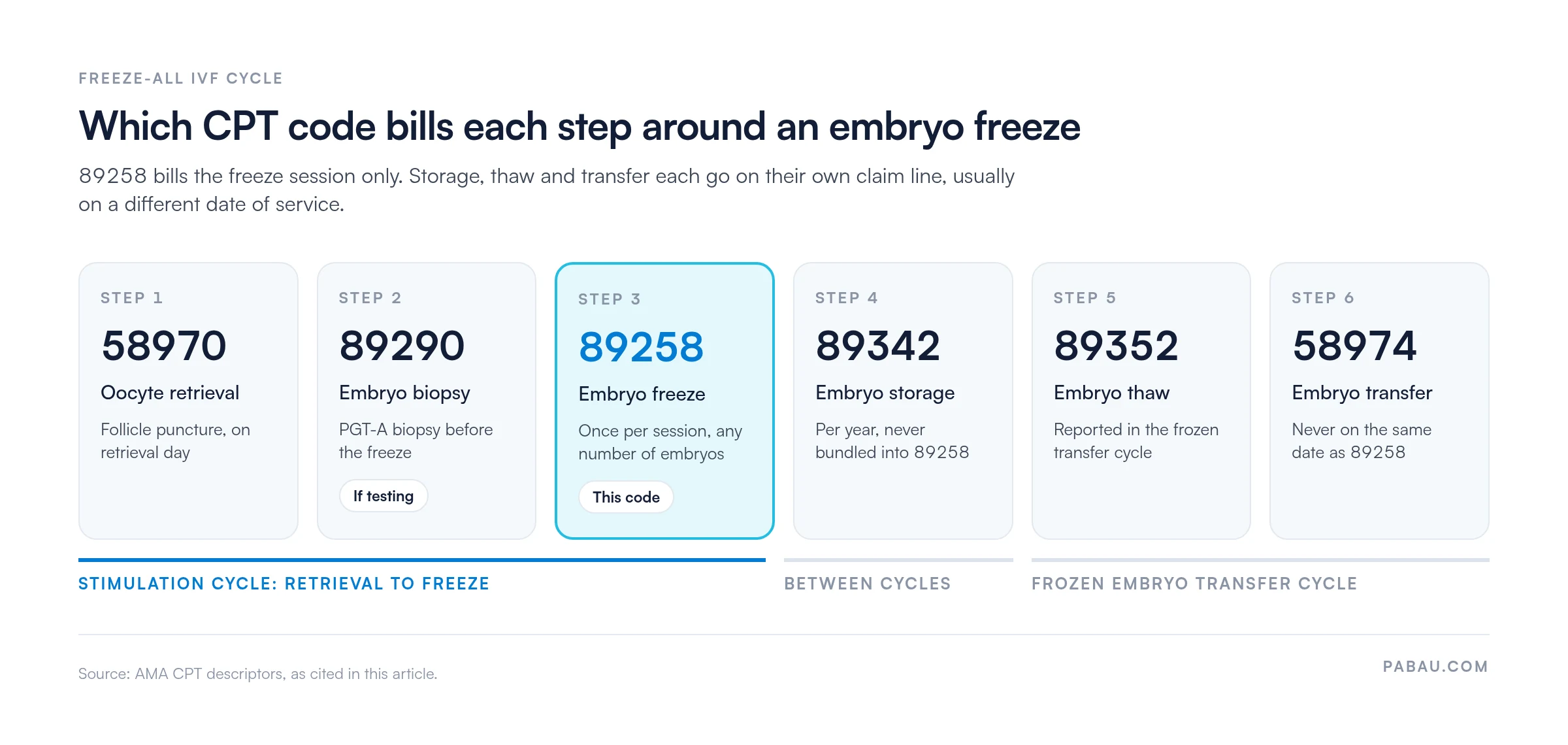
A full IVF freeze cycle generates several billable codes, often on different dates of service (DOS). Getting the sequence right prevents unbundling denials and makes sure each covered service is captured. When the cycle includes preimplantation genetic testing, the embryo is biopsied under 89290 before the freeze, so that biopsy carries its own DOS.
The most common sequencing error is billing 89258 and 58974 on the same DOS. In standard ART protocols, the freeze and the transfer never happen on the same day, as the cycle below shows. A same-DOS pairing of these two codes triggers automatic review at most payers.
CPT code 89258 reimbursement varies by payer type, state and plan design. The CMS Physician Fee Schedule (MPFS) lookup tool is the authoritative source for any Medicare facility or non-facility rate in a given year. Rates change with each annual MPFS update, so check the current year in the live tool.
Medicare does not cover IVF or embryo cryopreservation as a standard Part B benefit. The Medicare Benefit Policy Manual excludes IVF-related services, including embryo cryopreservation under CPT code 89258, from coverage. Submitting 89258 to Medicare as a primary payer for a non-oncofertility patient will result in a non-covered benefit denial.
Medicaid coverage varies by state. No federal mandate requires Medicaid programs to cover fertility treatments, so coverage depends on the individual state’s Medicaid plan. States with commercial insurance fertility mandates do not automatically extend that mandate to Medicaid enrollees.
Commercial payers set the 89258 rate in each contract, so your own fee schedule is the benchmark that matters. 89258 is a laboratory code with no physician work RVU, which means a work-RVU-times-conversion-factor calculation will not produce a usable rate.
Put the embryo count and developmental stage in Box 19 (Additional Claim Information) of the CMS-1500 form. Do it even when the payer does not require it. Reviewers pulling these claims for audit look for this detail first. Including it proactively shortens the review cycle and reduces the chance of a records request.
CPT code 89258 claims deny for a predictable set of reasons. Tracking patterns through structured denial management workflows lets fertility billing teams fix the root cause instead of appealing case by case.
Appeals for non-covered benefit denials in mandate states need the mandate statute, the patient’s Explanation of Benefits, and proof the plan is fully insured. Send all three with the first-level appeal.
The reason code on the remittance tells you which appeal path applies, and our guide to medical billing denial codes decodes the common ones.
The place-of-service (POS) code for CPT code 89258 depends on where the ART laboratory physically sits. The table below maps each setting to its POS code and the modifiers that may apply.
Modifier 90 applies when an outside reference lab performs the cryopreservation but the ordering fertility practice bills for it. Modifier 52 (reduced services) can apply when a session covered less than a full procedure would. It is uncommon for 89258, so document the reason in detail when you use it.
Check the current CMS NCCI edit tables for 89258 pairs before you bill any code combination for the first time. The tables update quarterly, so a pairing that passed last quarter may now need a modifier or a separate DOS. Recheck them each quarter and after every annual CPT update.
Many fertility billing teams key each 89258 claim into a separate clearinghouse portal. They then check payer websites one by one to see what happened to it. Every status check takes time away from appeals and prior authorization work.
Pabau’s claims management software submits claims electronically through Claim.MD. Your team sends the claim and follows its status without leaving Pabau. A denied freeze, storage or thaw line shows up while the appeal window is still open.
Our Claim.MD clearinghouse review explains how that route works. Your coders still choose the codes and your lab still owns the records. Pabau shortens the time between a finished claim and a paid one.

Pabau sends claims to payers through Claim.MD and tracks each one’s status from the same system. Your billing team spots a denied 89258 line without checking a separate portal.

CPT code 89258 bills one narrow step, the freeze itself. Once the code is right, most of the remaining risk sits in two places. Coverage gets checked too late, or the lab record is missing the embryo count and stage.
Verify fertility benefits at intake, and complete the freeze record before the claim is built. Bill storage, thaw and transfer on their own lines and dates. That is a little more front-end work per cycle, traded for far fewer appeals later.
Book a demo to see how Pabau submits and tracks your fertility practice’s claims through Claim.MD.

Need a reference for the broader IVF code set? IVF CPT codes covers the full cycle of ART billing codes from retrieval through transfer.
Want to understand how clearinghouse submission works? Medical claims clearinghouse guide explains how electronic claim routing reduces payer rejections.
Managing denials across multiple ART cycles? Electronic remittance advice walks through reading ERAs to identify and categorize denial patterns systematically.
CPT code 89258 covers cryopreservation of embryo(s), the laboratory procedure of freezing one or more viable embryos in a single session. It does not cover embryo storage (billed separately under 89342), oocyte freezing (89337), or thawing of cryopreserved embryos (89352). The code is reported once per cryopreservation session, regardless of how many embryos are frozen in that session.
No. Medicare does not cover IVF or embryo cryopreservation as a standard Part B benefit. The Medicare Benefit Policy Manual excludes IVF-related services. Submitting 89258 to Medicare as a primary payer for a non-oncofertility patient results in a non-covered benefit denial. State Medicaid coverage varies and is not mandated federally.
CPT 89258 covers cryopreservation of embryo(s); CPT 89259 covers cryopreservation of sperm. The codes differ by the material being frozen, an embryo or a sperm specimen. They are not interchangeable. Billing 89259 for an embryo freeze (or vice versa) causes an automatic claim rejection.
The laboratory record must include the embryo count, the stage at freeze (such as a Day 5 blastocyst), and the method used. It also needs a signed physician order and the clinical reason for freezing rather than a fresh transfer. Missing embryo count or stage is the documentation deficiency most commonly cited during payer audits of 89258 claims.