CCSD code F5010: Parotid duct transposition billing guide
CCSD code F5010 covers parotid duct transposition, one side or both CCSD code F5...

Last Updated: Oct 9, 2026
89352 is the CPT code for thawing of cryopreserved embryo(s). It covers the embryology lab's warming of frozen embryos and the post-thaw viability check, billed as one unit per thaw session.
Fertility billing teams often misapply it, confusing the thaw with the transfer (CPT 58974) or miscounting units when several embryos are warmed in one session.
Let Pabau's smart automation suggest the right codes, reduce claim denials, and keep your practice compliant—effortlessly.
Automate repetitive tasks and focus on what matters most—your patients.
Reduce coding errors and ensure compliance with the latest regulations.
Clean claims, fewer denials, and faster reimbursements.
Powerful insights and reporting to help your practice thrive.
HIPAA compliant SOC 2 certified GDPR-compliant Trusted by 4,000+ clinics worldwide

CPT code 89352 covers the laboratory thaw of a cryopreserved embryo, not the transfer procedure or any post-thaw culture steps.
The code is billed per thaw session, not per embryo thawed. Billing one unit per embryo in a multi-embryo session is a documented overbilling error.
Most commercial and government payers exclude ART procedures from standard coverage. Prior authorization and diagnosis code pairing directly affect reimbursement approval.
Pabau, the practice management platform we build, supports ART billing with eligibility checks and electronic claim submission for fertility practices.
CPT code 89352 is defined by the American Medical Association (AMA) as Thawing of cryopreserved; embryo(s). It sits in the Reproductive Medicine Procedures subsection of the CPT code set (89250-89398). That subsection covers laboratory-based ART services, separate from the physician-performed procedures in the 58xxx surgical range.
The code represents the embryology lab’s work of warming a cryopreserved embryo from storage temperature to physiological temperature. It also covers assessing viability after the thaw and documenting the outcome. One unit covers the thaw session, however many embryos are warmed during it (see the unit-billing note below).
Overbundling and underbundling are the two errors to watch for on ART thaw claims. Knowing precisely what 89352 covers prevents both.
Critical unit-billing note: Billing one unit of 89352 per embryo thawed in a multi-embryo session is incorrect under the AMA CPT descriptor. The code represents the thaw session, not each individual embryo. Submitting two units because two embryos were warmed on the same date of service is an overbilling error that payers flag in automated edits.
Four codes are often confused with CPT code 89352 or billed alongside it by mistake. The table below clarifies each one, including which combinations are permitted and which create bundling errors.
For a broader view of the code family, see the IVF CPT codes overview in Pabau’s procedure codes library.
Missing or incomplete lab documentation is a common reason payers recoup 89352 payments after an audit. The AAPC CPT code lookup and ASRM coding guidance both specify that the embryology record must fully support the claim before submission.
A clean claim submission for 89352 requires all of the following:
Pull the embryology record before claim creation, not after denial. Confirm the session date, unit count, and viability outcome are documented before the claim reaches the clearinghouse. Amending the record after a denial is costly, and auditors treat it as a red flag.
Medicare does not cover most ART procedures, including embryo thawing, under its standard benefit. Submitting CPT code 89352 to Medicare for most beneficiaries therefore ends in a payer-exclusion denial. The CMS Physician Fee Schedule still publishes RVU values for 89352, and commercial payers use them as a reference benchmark.
Send ART thaw claims through a clearinghouse that validates payer eligibility before submission, so exclusions surface before the claim is filed. In fertility billing claims management, that pre-submission check prevents the most common thaw-cycle denial.
For the current 2026 RVU values for CPT 89352, use the FastRVU 2026 RVU lookup tool. It draws directly from the CMS Physician Fee Schedule data file. Combine the work, PE, and MP RVUs with your practice’s geographic adjustment factor (GAF). The result is the locality-specific non-facility payment amount.
ART prior authorization requirements are among the most complex in outpatient billing. Fertility billing teams running high volumes of FET cycles need a structured pre-authorization workflow. It prevents the most expensive denial category, which is a post-service non-coverage determination.
Complete insurance eligibility verification at the plan level (not just the member level) before any ART cycle begins. Payer coverage policies for 89352 typically specify:
ART claims for CPT code 89352 are denied more often than average for structural reasons. Payer exclusions are common, unit-billing errors are frequent, and an incomplete embryology record often comes to light only after the claim is rejected. Systematic denial management workflows for fertility practices should address each of the following categories.
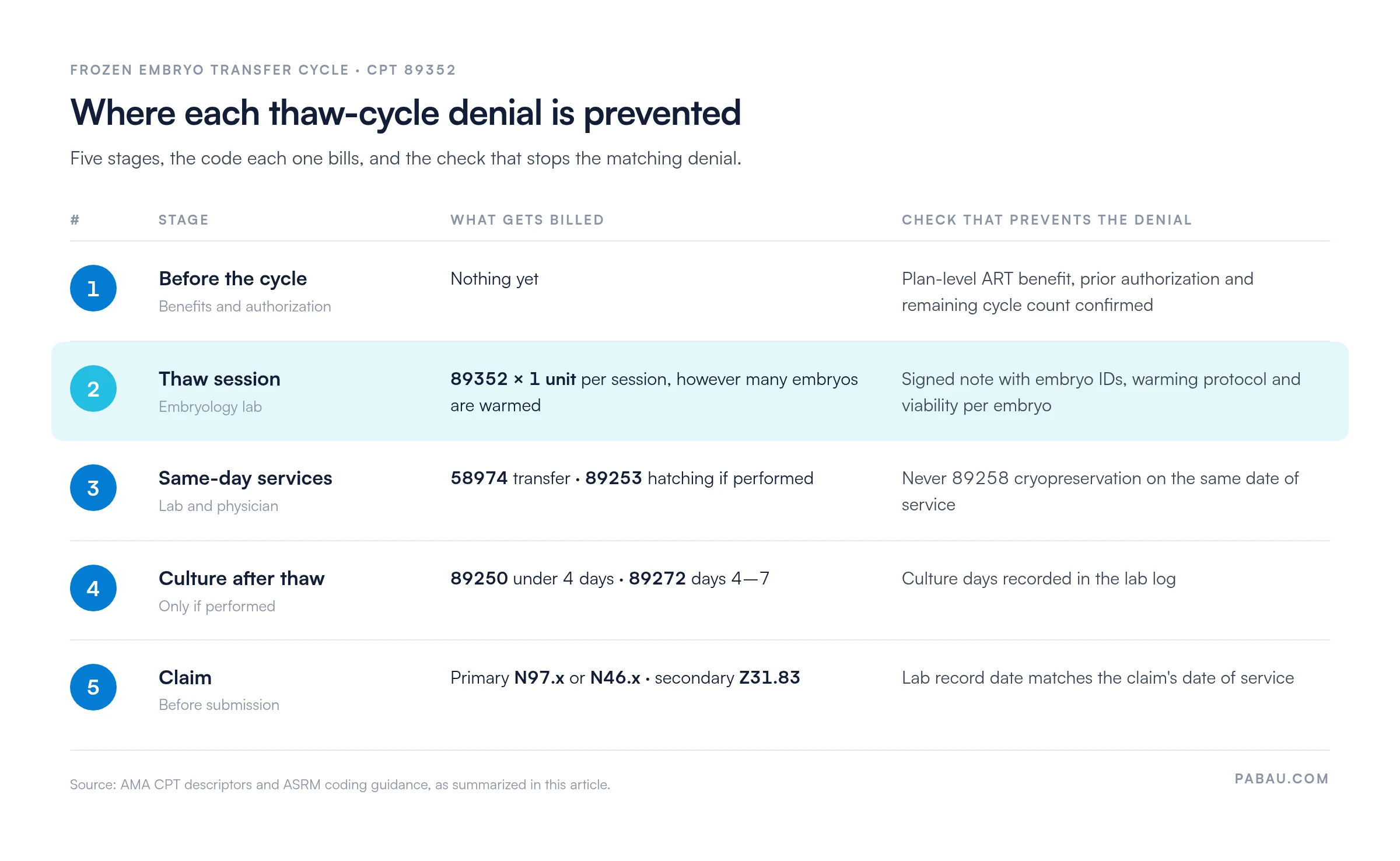
Each denial above traces back to one stage of the thaw cycle, as the timeline below shows.
Modifier use on ART laboratory codes is limited but specific. Applying the wrong modifier causes claims to fail, and so does omitting one the documentation supports.
Diagnosis code selection directly affects payer coverage decisions for 89352. Payers with limited ART benefits often approve claims only when specific ICD-10-CM diagnosis codes are present. The diagnosis code is the medical necessity gate for coverage, so choose it with the same care as the procedure code.
Check each payer’s local coverage determination (LCD) or coverage policy before selecting a diagnosis code for an ART claim. Some payers accept only specific N97.x subcategories as qualifying diagnoses for FET coverage. Pairing Z31.83 as a secondary code with the primary infertility diagnosis can improve acceptance on plans that do cover ART.
Most fertility billing teams build an 89352 claim from three places. The benefit check sits in a payer portal and the embryology note sits in the lab system. Then someone keys the claim into a clearinghouse by hand. Each handoff is a chance for a wrong unit count or a missing signature.
Pabau’s revenue cycle management tools keep eligibility verification, clinical documentation and electronic claim submission in one workflow. Claims go out through Pabau’s Claim.MD integration, which checks eligibility and retrieves ERAs across more than 4,000 US payers.
An ART exclusion shows up before the cycle starts, so your team can collect the patient’s share upfront instead of chasing a denial weeks later.

Pabau keeps eligibility checks, clinical documentation and electronic claim submission in one workflow, so fewer 89352 claims come back denied. See how it fits your fertility practice.

CPT 89352 is one of the simplest codes on an FET claim to describe and one of the easiest to get wrong. Two rules carry most of the risk. Bill one unit per thaw session, and keep the thaw separate from transfer code 58974.
If your team does one thing differently, make it the order of work. Confirm the plan-level ART benefit and pull the signed embryology note before the claim is built. A denied thaw claim costs more to appeal than it does to prevent.
Book a demo to see how Pabau handles ART billing from authorization through ERA posting.

Need to understand the full IVF code family? IVF CPT codes overview covers the complete set of ART procedure and laboratory codes used across fresh and frozen embryo cycles.
Managing a high volume of ART denials? Denial management in healthcare walks through the appeals workflow and root-cause analysis process for complex billing denials.
What does a clean ART claim look like? Clean claim submission guidelines outlines the pre-submission checks that eliminate the most common formatting and documentation errors before a claim leaves the practice.
CPT code 89352 covers the laboratory thawing of a cryopreserved embryo, including the warming process, post-thaw viability assessment, and laboratory monitoring during the session. It does not include embryo transfer, post-thaw culture, or assisted hatching, each of which is billed under a separate CPT code.
CPT 89352 is billed per thaw session, not per individual embryo. Submitting multiple units because two or three embryos were thawed on the same date of service is an overbilling error under the AMA CPT descriptor. One unit covers the complete thaw session regardless of embryo count.
CPT 89352 covers the thawing of a cryopreserved embryo. CPT 89253 covers assisted embryo hatching, microtechniques (any method). They are distinct laboratory procedures and can be billed together on the same date when both are documented and performed on the same embryo.
Coverage varies widely by payer. Medicare typically excludes ART procedures including embryo thawing from its standard benefit. As of 2026, 15 states mandate some level of ART coverage for commercial plans, but employer self-insured plans are not subject to state mandates. Always verify coverage and obtain prior authorization before the procedure.
Yes. CPT 89352 (lab thaw) and CPT 58974 (intrauterine embryo transfer) are distinct services performed by different providers. They can be billed together on the same date of service. The thaw is a laboratory procedure, while the transfer is a physician-performed surgical procedure. Both require their own documentation.
Modifier 52 applies when the thaw was performed but yielded a reduced service (fewer viable embryos than expected), documented by the embryologist. Modifier 53 applies when the procedure was discontinued before completion with documented clinical justification. Modifier 59 is used to bypass NCCI bundling edits when 89352 is billed with another ART lab code that would otherwise trigger an edit. Modifier 22 is generally not appropriate for laboratory codes.