CPT Code 31653: EBUS With 3+ Mediastinal Stations
CPT code 31653: Official descriptor and clinical scope CPT code 31653 is the pro...

Last Updated: Oct 20, 2026
88112 is the CPT code for cytopathology, selective cellular enhancement technique with interpretation, such as a liquid-based slide preparation. It applies to any specimen except cervical or vaginal. Labs report it when a non-gyn sample, like urine or bronchial washings, runs through a thin-layer system that concentrates and enriches the cells.
That enrichment step separates it from 88108, the cytospin code, and picking the wrong one invites a denial or a recoupment. Below, you'll find how 88112 compares with neighboring codes, which same-specimen pairs to avoid, and what to check before you submit.
Let Pabau's smart automation suggest the right codes, reduce claim denials, and keep your practice compliant—effortlessly.
Automate repetitive tasks and focus on what matters most—your patients.
Reduce coding errors and ensure compliance with the latest regulations.
Clean claims, fewer denials, and faster reimbursements.
Powerful insights and reporting to help your practice thrive.
HIPAA compliant SOC 2 certified GDPR-compliant Trusted by 4,000+ clinics worldwide

CPT code 88112 covers non-gyn cytology prepared with a selective cellular enhancement technique, such as a liquid-based thin-layer slide, with interpretation.
A plain cytospin preparation is 88108, and CPT guidance says not to report 88108 with 88112 for the same specimen.
Fine-needle aspirates go to 88173 whatever the preparation method, and cervical or vaginal specimens use the Pap codes instead.
The pathology report should name the liquid-based method, because that one line is what supports 88112 on audit.
Cytopathology codes split into professional (-26) and technical (TC) components, so check the MPFS indicators before you bill.
CPT code 88112 reports a non-gynecologic cytology specimen prepared with a selective cellular enhancement technique, then screened and interpreted.
The official descriptor reads: “Cytopathology, selective cellular enhancement technique with interpretation (eg, liquid-based slide preparation method), except cervical or vaginal.”
The code sits in the Cytopathology Procedures subsection (88104-88199) of the Pathology and Laboratory section. The American Medical Association maintains the CPT code set.
In practice, the lab places the sample in a preservative vial and runs it on a thin-layer processor. The processor concentrates the cells and cuts down blood, mucus and debris. What lands on the slide is an even layer of cells, and that enrichment is the “enhancement” in the descriptor.
Typical specimens include:
Here is the point that trips up coders. The preparation method picks the code, not the specimen source. The same urine sample could be 88104, 88108 or 88112, depending on how the lab processed it.
One unit of 88112 bundles the preparation, the screening and the interpretation for a specimen. Extra work on the same material is a separate service with its own code.
For cell block coding and documentation, see our guide to CPT code 88305.
All four codes cover non-gyn fluids, washings or brushings, and all four include interpretation. What separates them is how the lab prepared the slide.
88108 is the usual near-miss. Because both codes include interpretation, the pathologist’s signature won’t settle it. The question is whether the lab only spun the cells down or enriched them on a thin-layer system. Per CAP Today’s CPT guidance, a cytospin alone is 88108.
CPT guidance also says not to report 88112 with 88108 for the same specimen, since 88112 already includes the concentration step. That rule is specimen by specimen. Two separate specimens can each carry their own code.
Three other code families sit close to 88112. Three questions tell them apart.
Medicare screening Pap tests can also use HCPCS codes, such as HCPCS code G0145 for automated thin-layer screening.
Put those exclusions in order, and the prep method settles whatever is left.
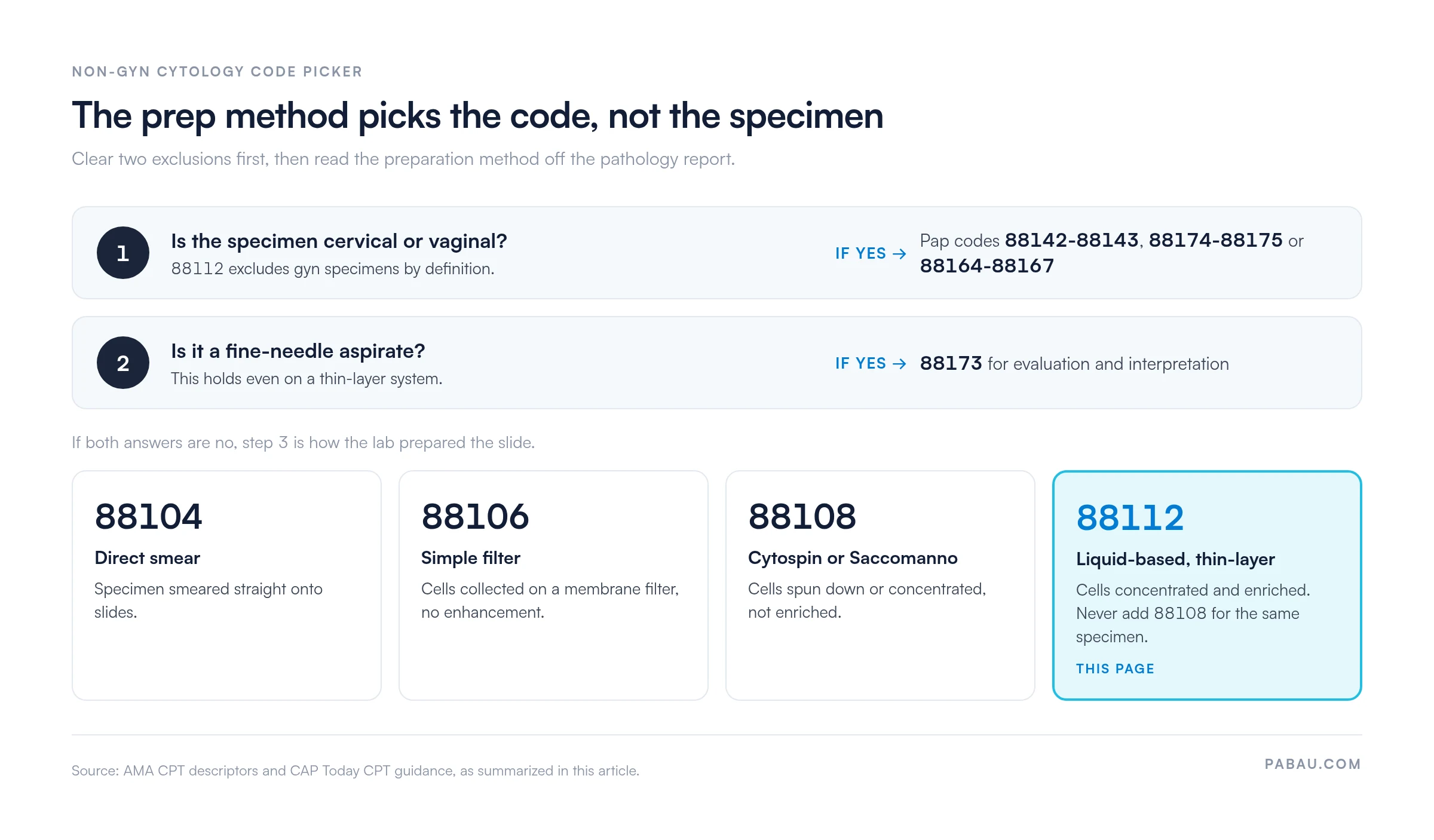
Two layers apply here. CPT guidance sets the coding rules. Meanwhile, the CMS procedure-to-procedure (PTP) edits decide what Medicare pays together on the same date.
PTP edits change every quarter, so treat any list of pairs as a prompt to check. Look up each same-day pathology pair in the CMS NCCI PTP edit files. Don’t lean on a modifier to push a same-specimen pair through.
Auditors read the report, not the claim, and cytopathology has its own must-haves. The report should show:
Pull ten recent 88112 claims and read the reports behind them. Any report that never names the preparation method is an audit risk. Fix it once in the report template, and every future claim carries the proof.
A worked example makes the flow clearer. A urologist sends voided urine from a patient with gross hematuria. The lab processes it on a thin-layer system, and a staff pathologist signs the report.
Where does this usually break? A report that says “cytospin”, a missing indication, or a stray 88108 line for the same vial.
Run through these seven checks before the claim leaves the building.
Most 88112 problems trace back to a handful of causes. Fixing them before submission beats managing denials afterward.
Look up any other code on the remittance in our guide to denial codes in medical billing. Getting a clean claim out on the first pass saves a full resubmission cycle.
Medicare pays 88112 under the Medicare Physician Fee Schedule (MPFS). Rates change every year and vary by locality. Look up your figure in the CMS MPFS Look-up Tool, and use the FastRVU lookup for the RVU split.
Like other cytopathology codes, 88112 carries a professional component (-26) and a technical component (TC). The PC/TC indicator in the MPFS file shows how each part is paid. So who bills what?
Medicare Administrative Contractors (MACs) set local coverage rules for cytopathology. As a result, a claim that passes in one jurisdiction may fail in another.
Many labs still re-key the diagnosis, units and modifiers from the requisition into a separate billing tool. Each hand-off is a chance to drop a field, and a dropped field is a CARC 16.
Pabau, the practice management and billing platform we build, keeps the order, the diagnosis code and the claim in one record. Its claims management software sends US claims electronically through Claim.MD. Remittances then come back as ERAs for posting.
Your coder still picks 88112 or 88108 from the report. What changes is that the details travel with the claim, so fewer come back for missing data.

Pabau keeps orders, diagnosis codes and claims in one record, submits US claims through Claim.MD and posts ERAs. See how it fits your billing workflow.

Code 88112 from the preparation method, not the specimen name. If the report says liquid-based or thin-layer, 88112 fits. If it says cytospin, it doesn’t.
Build that one line into your report template, and run the checklist above on every claim. The cost is a few extra words per report, which is cheap next to a recoupment. Book a demo to see how Pabau keeps lab orders, claims and remittances in one place.

Need to understand clearinghouse submission for lab claims? Medical claims clearinghouse guide covers how electronic claims move between labs, clearinghouses and payers.
Want a breakdown of the 837P file your lab submits? 837 file format explained details the EDI transaction behind every professional claim.
Billing a cell block alongside cytology? CPT code 88305 billing guide covers surgical pathology Level IV, including cell blocks.
Running immunostains on the same material? CPT code 88342 billing guide covers how the first antibody on a specimen is coded.
Bill one unit per specimen processed with an enhancement technique. Two separately labeled specimens, such as right and left ureteral washings, can support two units. Several slides from one specimen still count as one unit.
For Medicare, the date of service for a lab test is generally the specimen collection date. It is not the processing or sign-out date, though archived specimens have exceptions. Commercial payers may set their own rule.
Yes. Cytology is a high-complexity specialty under CLIA, so the lab needs a certificate that covers cytology. Workload limits for cytotechnologists also apply to the slides they screen.
No. CPT describes the method, not the product. Any liquid-based system that concentrates and enriches non-gyn cells supports 88112, as long as the report names the method used.