CCSD code F3070: Suture of palate billing guide
CCSD code F3070 covers stitching a wound in the palate CCSD code F3070 is the co...

Last Updated: Oct 12, 2026

CPT Code 88342 covers immunohistochemistry, or IHC, for the first antibody stain on a specimen in surgical pathology
Report 88342 once per specimen per date of service, then use add-on code 88341 for each additional antibody
The 2026 Medicare national payment is $110.22 for 88342 and $94.19 for 88341, in both facility and non-facility settings
Billing 88342 more than once for the same specimen is the most common denial reason on IHC claims
Pabau’s claims management software helps pathology billing teams track IHC units, attach documentation, and submit clean claims
CPT Code 88342 is the billable code for immunohistochemistry, or IHC, covering the first single antibody stain performed on a specimen. It sits in the surgical pathology family of the CPT code set, and it is payable once per specimen per date of service.
This guide covers the official descriptor, how 88342 works alongside 88341 on one specimen, and the 2026 Medicare payment amounts. It also sets out the documentation an audit expects, the ICD-10 codes that support medical necessity, and the errors behind most IHC denials.
CPT Code 88342 describes immunohistochemistry or immunocytochemistry, a tissue-based technique that uses antibody-antigen reactions to detect specific proteins in tissue or cell specimens.
The American Medical Association (AMA) maintains the CPT code set and classifies 88342 under Surgical Pathology, covering the first antibody per specimen.
Pathologists order IHC to characterize tumor type, assess prognostic markers, identify infectious organisms, or confirm lymphoma and leukemia subtypes. A single biopsy specimen may need several antibody panels.
CPT Code 88342 captures the first stain, and every subsequent antibody on that specimen is reported with add-on code 88341.
The first-versus-additional distinction is where most IHC billing errors start. Both codes describe the same technique on the same specimen. They differ only in sequence.
CPT Code 88342 is reported exactly once per specimen, however many antibodies are applied. It represents the first stain and is a standalone billable code. 88341 is an add-on code reported for each antibody beyond the first. It cannot be billed without 88342, or another qualifying parent IHC code, on the same claim.
Payer policies on unit maximums vary. Medicare imposes a one-unit-per-specimen limit on 88342. Some commercial payers apply their own caps per date of service, so check the payer’s Local Coverage Determination, or LCD, before submitting a multi-specimen claim.
Medicare limits CPT Code 88342 to one unit per specimen per date of service. The Local Coverage Determinations issued by Medicare Administrative Contractors, known as MACs, reinforce that limit. Billing more than one unit of 88342 for a single specimen on the same date is a compliance violation.
Pathology billing teams need to track three variables precisely on an IHC claim. Each one changes how many units of 88342 and 88341 are reportable:
Practice management software like Pabau validates the CPT catalog before a claim leaves the practice. A unit mismatch on 88342 then surfaces in-house instead of on a remittance advice.
Flag any order requesting more than one unit of 88342 on a single specimen before submission. Build a pre-bill audit step that cross-checks specimen count against reported 88342 units. A mismatch caught in-house costs minutes. A mismatch caught by the payer costs weeks of appeals work.
Medicare payment for CPT Code 88342 is built from the Resource-Based Relative Value Scale, or RBRVS, and adjusted by the Geographic Practice Cost Index (GPCI). Use the CMS Physician Fee Schedule lookup tool or FastRVU’s 2026 RVU lookup to confirm the amount for your locality.
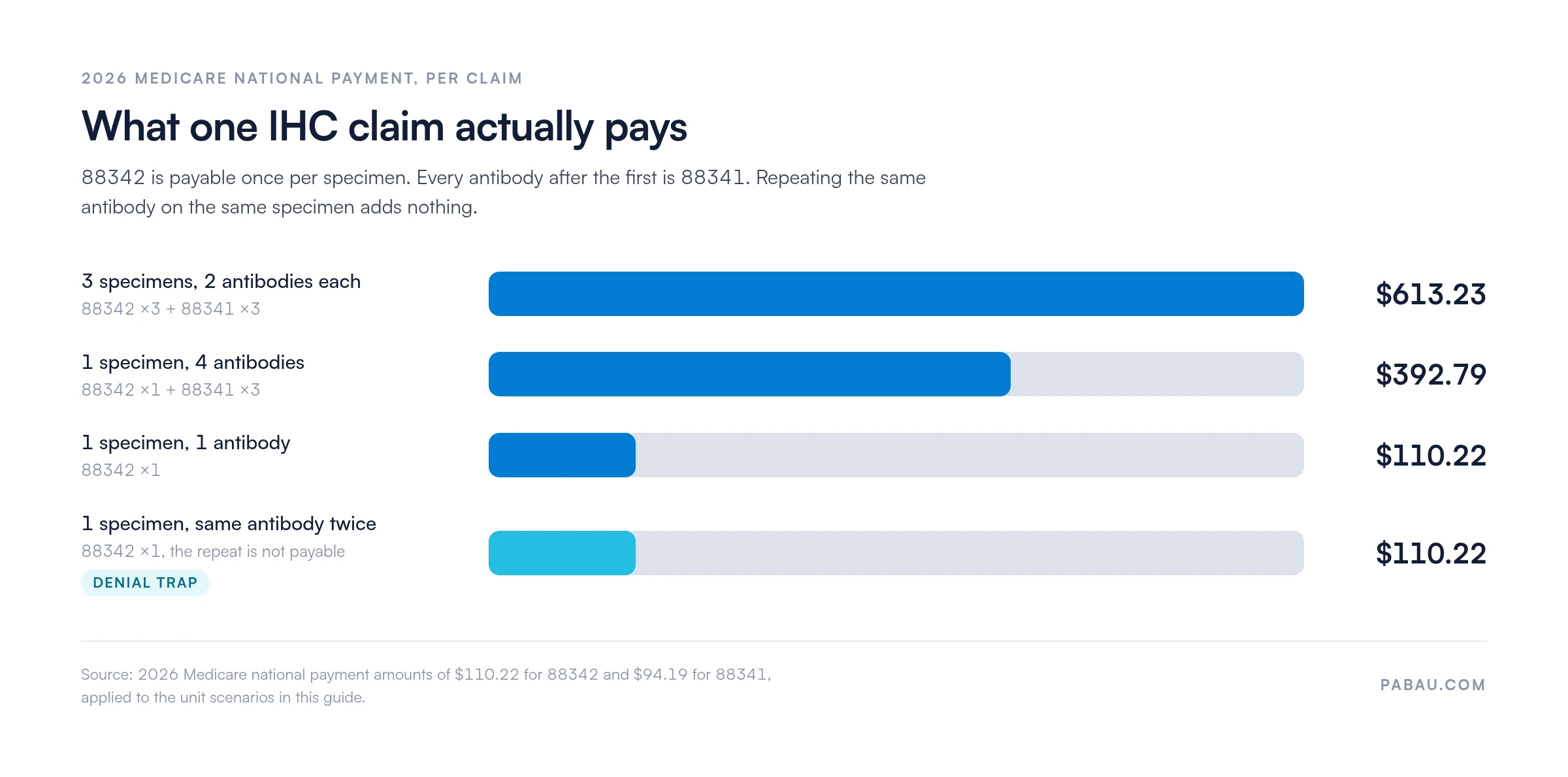
The 2026 national payment amount is $110.22 for 88342 and $94.19 for 88341. Both codes pay the same in a facility and a non-facility setting, so the place of service does not change the rate. Your locality’s GPCI still does. Applied to the unit scenarios above, those two amounts set what a whole IHC panel is worth.
The claim file sent to Medicare must carry the correct place-of-service code, 11 for office and 22 for outpatient hospital. A wrong code will not change the 88342 rate, but it can trigger a place-of-service edit and a denial. The remittance advice returned after adjudication confirms the amount paid and any line-item adjustment.
Documentation is the other main source of 88342 denials. CMS and most commercial payers require the medical record to establish medical necessity before the claim is approved.
The pathology report is the primary supporting document. It must carry the clinical indication, the specimen source and identifier, and each antibody applied with its clone, dilution and control tissue. It also needs the interpretation of the staining pattern and the pathologist’s conclusion.
Retention matters as much as content. For a laboratory accredited by the College of American Pathologists (CAP), the Anatomic Pathology Checklist sets the standard. It requires a 10-year minimum for surgical pathology reports, slides and blocks. Some MAC jurisdictions and state laws run longer, so hold to whichever period is longest.
Medicare covers immunohistochemistry when it is medically necessary for a diagnosis or a treatment decision. Medical necessity comes from the clinical context in the record rather than from the panel itself.
The codes below are categories that Medicare LCDs and major commercial policies commonly accept. Covered indications differ by contractor, so check the LCD active in your region before you submit.
Codes for neoplasms of uncertain behavior (D37-D48) matter most for IHC billing, because they describe the diagnostic uncertainty IHC is meant to resolve. Using a definitive malignancy code before the pathologist has confirmed malignancy is a compliance risk. The full ICD-10-CM code library carries the descriptors and coding notes for each family above.
Pathology billing rarely involves a single code. An IHC case usually carries several codes from the surgical pathology family, and knowing how they interact prevents both unbundling and over-reporting. The AAPC’s CPT code reference gives searchable detail on each one.
The two special stain rows cover histochemical methods, which detect their targets through a chemical reaction rather than antibody binding. A Group II stain such as trichrome or iron bills under 88313, with its own interpretation in the report.
One nuance catches billing teams out. CMS National Correct Coding Initiative (NCCI) procedure-to-procedure edits bundle 88342 and 88341 with 88360 and 88361. Reporting a quantitative Ki-67 analysis alongside standard IHC staining on the same specimen therefore needs modifier 59 or XU.
The record has to document a distinct antibody or a distinct method for the second service. Without that, the NCCI edit will deny the bundled line.
IHC rarely appears on a claim by itself. The specimen it runs on carries its own surgical pathology examination code, often 88305, so the two travel together on the same claim.
Cytology specimens work the same way. When the stain runs on a non-gynecologic liquid-based slide, the preparation is reported separately under 88112.
IHC claims generate a disproportionate share of pathology denials, because of the unit rules and the specificity payers expect in the record. Five error patterns account for most of them, and each one is catchable before the claim leaves the practice.
Patterns matter more than individual denials. A single denial may be a one-off. Repeated CO-4 or CO-11 denials on IHC claims point to a process problem that needs a root-cause fix. CO-4 flags an inconsistent modifier and CO-11 a diagnosis inconsistent with the procedure.
Run a quarterly audit on all 88342 claims submitted in the previous 90 days. Filter for any claim where 88342 appears more than once per date of service per patient. Cross-reference against the pathology report to confirm whether multiple specimens were documented. This single step catches the most expensive recurring error in IHC billing.
A pathology lab billing CPT Code 88342 has a tracking problem most general-purpose billing systems were not built for. It has to tie multi-specimen orders to individual claim lines, count antibodies per specimen, and hold an audit trail a MAC will accept. That is the work audit-ready claims management software is designed to absorb.
Pabau connects to a US clearinghouse for claim submission, real-time eligibility checks and remittance reconciliation in one workflow. Built-in CPT and ICD-10 catalogs flag a coding error at the point of entry. A unit mismatch on 88342 is caught before submission, not during a post-payment audit.
The payoff for a pathology billing team is fewer rework cycles. Denials that used to take weeks of appeals work get resolved in the minutes before a claim goes out.

Pabau’s claims management tools help pathology billing teams track specimen units, validate CPT codes, and submit clean claims through integrated clearinghouse workflows. See how it works for your practice.

The unit rule is the whole game with 88342. Get the specimen count and the antibody count right, and the code almost bills itself. Get them wrong and no amount of appeal work recovers the margin the rework consumed.
So the fix belongs upstream, in the pre-bill check rather than the appeals queue. A pathology lab that cross-checks specimen count against reported 88342 units every time will see its IHC denial rate fall without hiring anyone. Book a demo to see how Pabau catches unit and eligibility errors before an IHC claim reaches the payer.

Need to understand how clearinghouse submissions work? Claim.MD clearinghouse overview explains how electronic claims flow from practice to payer and where errors are caught.
Seeing repeated denial patterns across pathology claims? Denial codes in medical billing covers the most common CO and PR adjustment reason codes and what they mean for your revenue cycle.
Want to verify eligibility before IHC orders are processed? Insurance eligibility verification walks through how real-time eligibility checks reduce surprise denials on pathology claims.
Building a pre-bill audit step for your lab? Medical billing compliance sets out the record-keeping and review controls that hold up under a post-payment audit.
Need to know what the payer actually receives? The 837 claim file breaks down the electronic claim format, field by field, including where units and place of service sit.
CPT Code 88342 is immunohistochemistry (IHC) or immunocytochemistry performed per specimen for the initial single antibody stain procedure. It falls under the surgical pathology family in the AMA’s CPT code set. Pathologists use it to detect specific proteins or antigens in tissue through antibody-antigen reactions, most commonly for tumor typing.
CPT 88342 covers the first antibody stain applied to a specimen and is reported once per specimen per date of service. CPT 88341 is an add-on code reported for each additional antibody applied to the same specimen beyond the first. So a panel of four antibodies on one specimen would be billed as 88342 x1 plus 88341 x3. 88341 cannot be billed without a qualifying parent code like 88342 on the same claim.
Medicare limits CPT Code 88342 to one unit per specimen per date of service. Billing 88342 more than once for the same specimen on the same date is a compliance violation and a primary audit trigger. When multiple specimens are submitted on the same date, each one supports its own unit of 88342. The pathology documentation has to identify each specimen separately.
The 2026 Medicare national payment amount for CPT 88342 is $110.22 per specimen. The add-on code 88341 pays $94.19. Both amounts are the same in facility and non-facility settings, so place of service does not change the rate. Your locality’s GPCI adjustment does, so confirm the figure with the CMS Physician Fee Schedule lookup tool.
Yes. CPT 88342 and 88341 are routinely billed together when a single specimen receives multiple antibody stains. 88342 covers the first antibody, and 88341 covers each additional one. They must appear on the same claim, and the pathology report must document each antibody applied and the clinical basis for the panel.
The most frequent error is billing 88342 more than once per specimen. Two others are submitting 88341 without its parent 88342, and using 88342 for a multiplex assay when 88344 is correct. Two more are linking the claim to an ICD-10 code the applicable MAC LCD does not cover, and filing without a complete signed pathology report. Each error has a distinct fix and a distinct denial code pattern.