



HCPCS code E0198: Water pressure pad billing guide
HCPCS code E0198 is a water pad for a standard mattress HCPCS code E0198 is the ...

Last Updated: Oct 13, 2026

CPT code 88305 reports Level IV surgical pathology, which covers routine biopsies needing both a gross and a microscopic examination.
The 2026 Medicare non-facility allowable computes to roughly $70-$73 nationally, before your locality’s geographic adjustment.
Level misassignment is the top denial trigger, and neighboring specimens like incidental appendix and testis biopsy are where it happens.
Seven documentation elements have to sit in the record before the claim goes out, from the requisition to the pathologist’s attestation.
Practice management software like Pabau checks the code and the documentation before the claim leaves the practice.
CPT code 88305 is the surgical pathology code for gross and microscopic examination at Level IV, per the AMA CPT code set. A licensed pathologist has to perform and document both the gross evaluation and the microscopic one.
The code sits inside the surgical pathology hierarchy that runs from 88302 to 88309, where the level reflects specimen complexity rather than the diagnosis. Level IV is the most commonly billed rung in outpatient and practice-based settings. It covers routine biopsies that need full histologic examination but stop short of the Level V and Level VI thresholds.
The AMA parenthetical notes for 88305 define which specimen types qualify. Billing this code for a specimen that belongs to another level is upcoding or downcoding, and both carry compliance risk.
The same organ can appear on three different rungs of the ladder. What sets the level is the specimen submitted, not the anatomic site it came from.
A prostate TUR specimen bills under 88305, the same level as a prostate needle biopsy. A testis biopsy does not, because the AMA list puts it at Level V (88307).
Skin splits the same way, with a cyst, tag, or debridement at Level III (88304) and any other skin specimen at Level IV. Appendix runs lower still. An incidental appendix is Level II (88302), and only a non-incidental removal reaches 88304. The grid below sorts the specimens that land on the wrong rung most often.
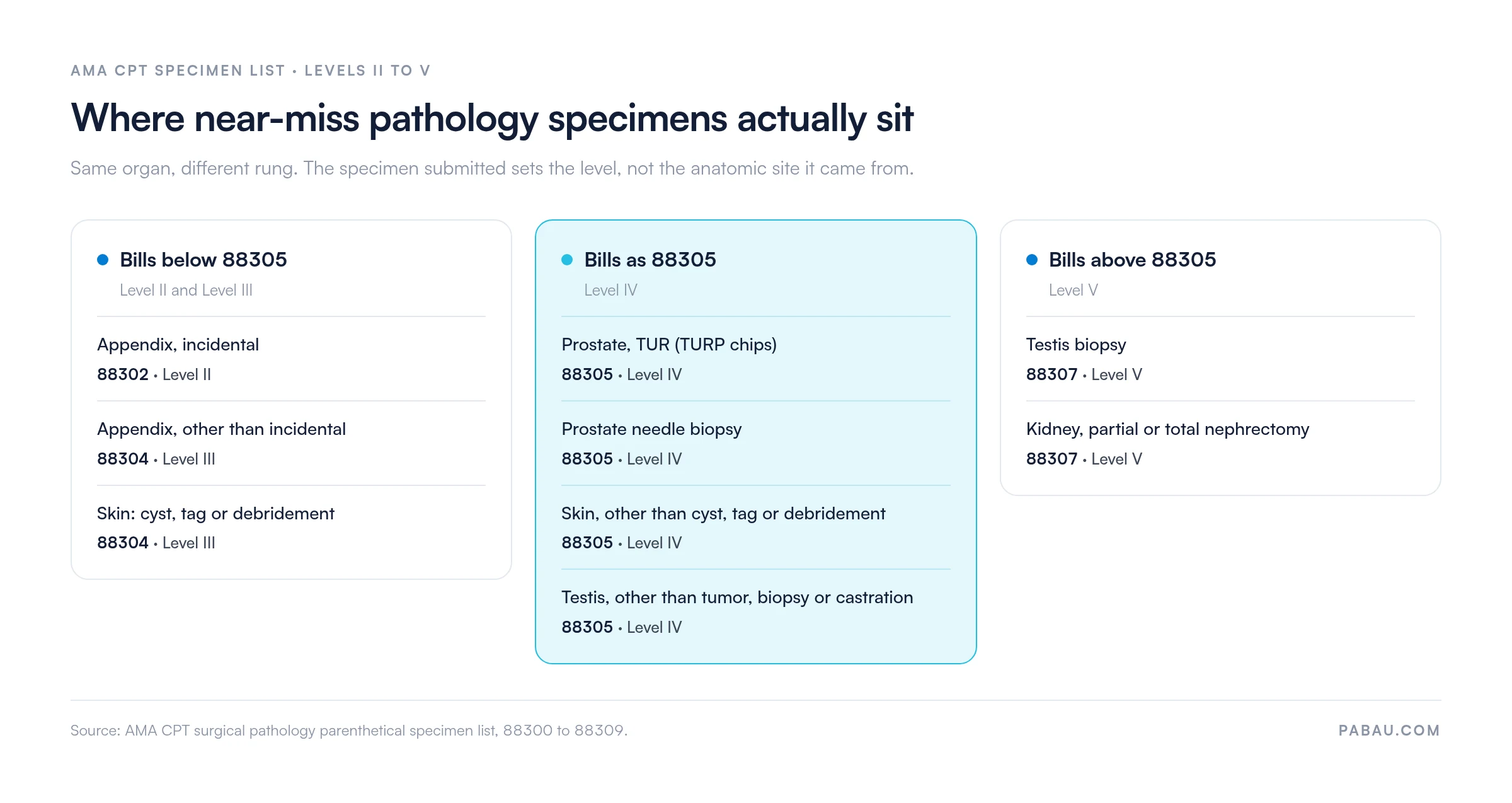
Specimens outside the 88305 parenthetical list belong to a different pathology level. Review AAPC’s CPT code reference alongside the AMA codebook when you classify a specimen across the hierarchy.
Medicare reimburses 88305 under the Physician Fee Schedule, at rates that vary by geographic locality and place of service. The 2026 non-facility national average works out to roughly $70-$73. That figure comes from the code’s 2.10 total RVUs multiplied by the CY2026 conversion factor of $33.4009.
Check your own MAC jurisdiction on the CMS Physician Fee Schedule lookup before you bill, because the rates change every January 1. For the underlying components, FastRVU’s 2026 RVU lookup shows work, practice expense, and malpractice RVUs with the geographic adjustment applied.
The non-facility rate consistently exceeds the facility rate, because independent labs carry the overhead a hospital absorbs. Commercial payer rates vary from Medicare, so verify the contracted rate with each one. Some payers pay a percentage of the Medicare allowable, and others use their own negotiated schedules. Medicaid rates, including Medi-Cal in California, usually sit below Medicare.
Four elements decide whether an 88305 claim pays cleanly. Work through them before you submit.
88305 is billed per specimen, not per slide, per container, or per tissue fragment. Billing multiple units for specimens from one anatomic site on the same date needs documentation that each was separately obtained, processed, and interpreted. Bundling edits may apply. Use modifier -59 with supporting documentation rather than stacking units without clinical justification.
Medical necessity for CPT code 88305 comes from the linked diagnosis code. It has to reflect the clinical reason for the biopsy, not the pathology finding that 88305 will establish.
When you look up ICD-10-CM codes for a pathology claim, work from the ordering clinician’s indication rather than the report’s conclusion. The pairings below are the highest-frequency ones across the primary specimen specialties.
Verify that the ordering clinician’s documentation supports the diagnosis code. A payer may deny 88305 if the linked ICD-10 code is absent from the Local Coverage Determination (LCD) for surgical pathology in your MAC jurisdiction.
Knowing where 88305 sits in the pathology hierarchy is what prevents level misassignment. The table below covers the full 88302 to 88309 spectrum plus the add-on codes that ride with it.
When 88341 or 88342 are billed with 88305, each immunohistochemistry stain needs its own documented medical necessity. The pathology report has to name the specific antibody used.
Histochemical special stains sit outside the IHC codes and are billed separately from 88305. Group II stains such as iron and trichrome are reported under 88313.
A cell block made from a non-gynecologic fluid is examined as its own specimen and reported with 88305. The liquid-based cytology prep on that same fluid stays separate, and the enhanced slide is reported under 88112.
Denials on 88305 cluster into five patterns. Each one is preventable at the point the claim is built.
Progressive Corrective Action (PCA) is the medical review framework CMS sets out in its Program Integrity Manual. Medicare Administrative Contractors run it, escalating from provider education to prepayment review as an error rate climbs. Surgical pathology draws that attention because of its improper billing rates, and 88305 is the highest-volume code inside it.
Strong medical billing compliance is the defense against PCA scrutiny. A lab under prepayment review waits for Medicare to approve its documentation before payment releases, which can add weeks to the revenue cycle.
The checklist below reflects CMS and MAC LCD requirements for 88305. Each element has to be present in the medical record to support the claim.
Audit preparedness means all seven elements sit in every 88305 pathology report before the claim is submitted. Documentation added after a denial or an audit is generally not accepted as supporting evidence.
Most practices only catch a level error when the denial arrives. The requisition, the pathology report, and the claim sit in three separate systems, so the mismatch stays invisible until the remittance comes back.
Pabau’s medical claims management works from a single client record instead. The clinical indication is captured on a digital requisition form. The service and its code go onto the invoice, and the claim is built from the same file. Nobody re-keys a specimen source between systems, which is where the detail usually goes missing.
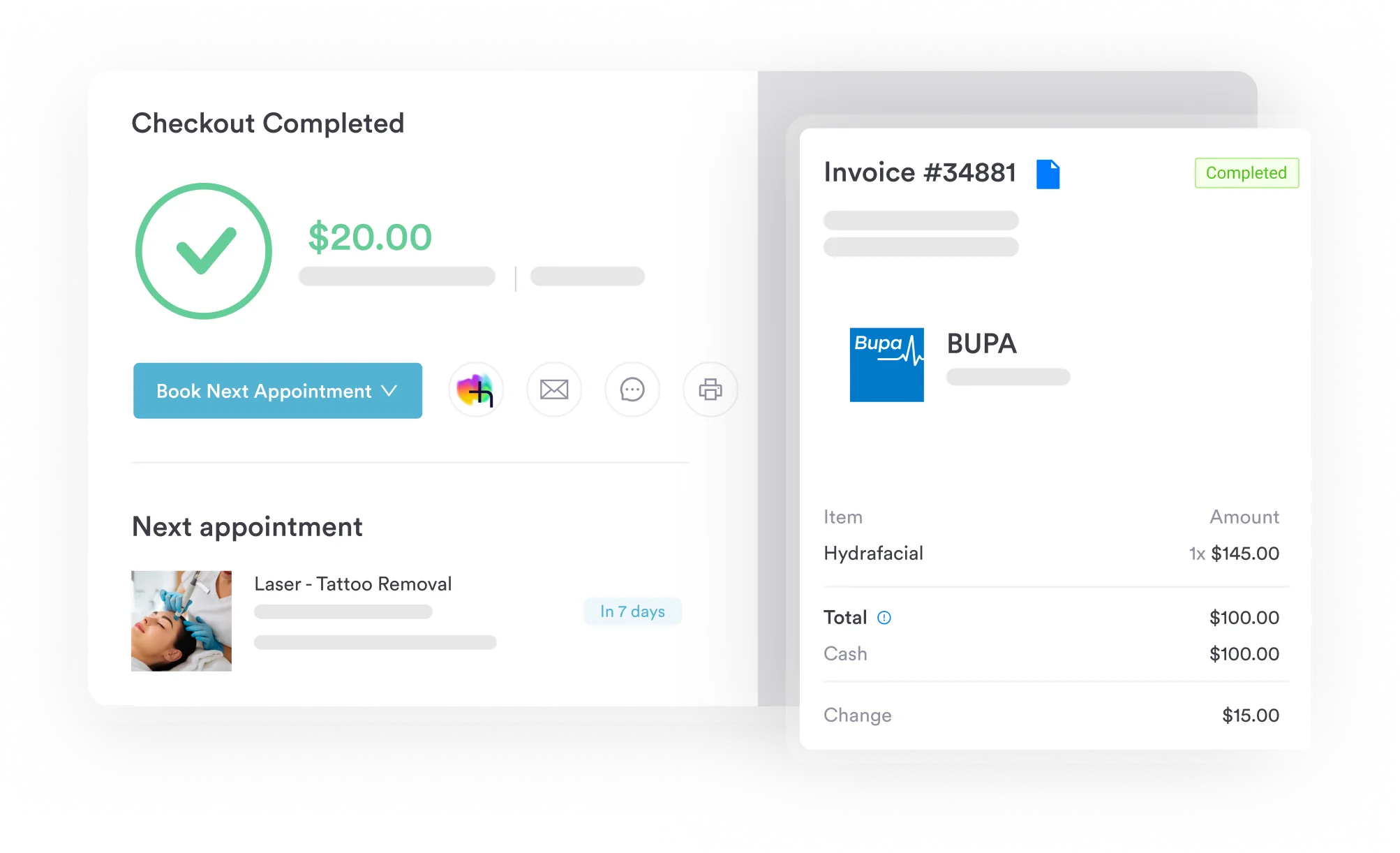
Routing the claim through a clearinghouse then adds a second check between the practice and the payer. Pabau connects to Claim.MD for that step, along with eligibility verification and electronic remittance advice. The scrub catches formatting errors, missing fields, and code combinations a payer will reject, before the claim reaches Medicare.

Pabau keeps the requisition, the pathology documentation, and the claim on one client record, then scrubs it through the clearinghouse before submission. That means fewer missing fields and fewer resubmissions.

Level assignment is where 88305 revenue is won or lost. Get the specimen-to-level match right and check the seven documentation elements, and most denial and PCA exposure disappears before a claim is ever sent.
The trade-off is that the checking has to happen at order entry rather than at submission. A pathologist cannot go back and add a clinical history the ordering clinician never wrote. Book a demo to see how Pabau puts the code check and the documentation check in front of the claim instead of behind the denial.

Need to understand how claims move through the system? Medical claims clearinghouse overview explains how electronic claims reach payers and where validation errors occur.
Billing denials eating into pathology revenue? Denial codes in medical billing covers the most common CARC reason codes and how to respond to each one.
Want to understand revenue cycle management for your lab? Revenue cycle management fundamentals walks through the end-to-end billing lifecycle from patient registration to payment posting.
CPT code 88305 is the AMA descriptor for surgical pathology, gross and microscopic examination at Level IV. It covers a defined list of biopsy and tissue specimens, including colon biopsy, cervix biopsy, prostate needle biopsy, endometrium curettings, skin biopsy, and bladder biopsy. A licensed pathologist has to perform and document both the gross and the microscopic evaluation.
The 2026 Medicare national average allowable for CPT 88305 is roughly $70-$73 at the non-facility rate. That comes from 2.10 total RVUs times the CY2026 conversion factor of $33.4009. Check your own MAC jurisdiction on the CMS Physician Fee Schedule lookup, because rates change every January 1.
CPT 88305 (Level IV) covers routine biopsies plus a few resection specimens, including prostate TUR chips. CPT 88307 (Level V) covers more complex specimens. Examples are a uterus with or without tubes, a thyroid resection, a testis biopsy, and a partial or total nephrectomy. The distinction is specimen complexity on the AMA list, not whether the specimen came from a biopsy or a resection.
The most common reasons are incorrect level assignment, missing clinical history from the ordering clinician, and an undocumented specimen source. A diagnosis code that is absent from the applicable MAC Local Coverage Determination for surgical pathology will also trigger a denial.
Progressive Corrective Action is the medical review framework CMS defines in its Program Integrity Manual, and Medicare Administrative Contractors run it. A lab flagged under it faces prepayment review, so Medicare holds payment until the documentation is reviewed. Corrective steps include tighter documentation protocols, pre-submission audits, and staff training on level assignment.
Seven elements are required. Those are a completed requisition with the clinical indication, a clinical history narrative, and the documented specimen source and collection method. The pathology report then needs the gross examination description, the microscopic findings, a final pathologic diagnosis, and the pathologist’s attestation. All seven have to be in place before submission, because documentation added after a denial is generally not accepted.



