CCSD code H4430: Examination of rectum under anaesthetic
CCSD code H4430 pays for the examination alone CCSD code H4430 is the UK private...

Last Updated: Oct 20, 2026
Billable Code
76098 is the CPT code for radiological examination, surgical specimen. It covers a radiograph of tissue taken after surgical excision, from any anatomical site.
Coders most often see 76098 in breast lumpectomy cases. The excised specimen is imaged during surgery so the team can confirm the target lesion was removed and the margins are clear.
Let Pabau's smart automation suggest the right codes, reduce claim denials, and keep your practice compliant—effortlessly.
Automate repetitive tasks and focus on what matters most—your patients.
Reduce coding errors and ensure compliance with the latest regulations.
Clean claims, fewer denials, and faster reimbursements.
Powerful insights and reporting to help your practice thrive.
HIPAA compliant SOC 2 certified GDPR-compliant Trusted by 4,000+ clinics worldwide

CPT code 76098 covers radiological examination of any surgical specimen, not only breast tissue, imaged during or immediately after excision.
Modifier 26 applies when the radiologist interprets but does not own or operate the imaging equipment. Bill globally only when the same provider supplies both components.
Every claim needs a written radiology interpretation signed by the interpreting provider. A missing report is the leading cause of 76098 denials.
Pabau’s claims management software routes 76098 claims through Claim.MD for real-time eligibility checks and automated ERA posting, reducing manual denial follow-up.
CPT code 76098 is defined by the American Medical Association as “Radiological examination, surgical specimen.” It sits within the Other Diagnostic Radiology subsection of the CPT code set (range 76000-76499). It covers any radiographic examination of surgically excised tissue, regardless of anatomical site.
In practice, the code is overwhelmingly ordered during breast-conserving surgery. The excised specimen is placed on a tray and imaged, typically by a portable radiographic unit in or next to the operating room. The surgeon then assesses margin status before closing.
The code is not breast-specific, though. It also applies to specimens from thyroid, parathyroid, or soft-tissue excisions where intraoperative radiographic guidance is clinically indicated.
Because the descriptor says “surgical specimen” and not “breast specimen,” the code applies well beyond oncology. It needs only two conditions. The tissue is a surgically excised specimen, and a radiographic examination is medically necessary.
Covered scenarios include any radiographic examination of excised tissue during or immediately after surgery. The imaging supports a clinical decision made before the patient leaves the operating room. The most common covered cases are:
Excluded scenarios are equally important to understand. The following are not billable under 76098:
The billing team’s most frequent documentation problem with 76098 is a missing written interpretation. CMS Claims Processing Manual Chapter 13 requires a separate written radiology report for every diagnostic radiology service. A note in the operative report that says “specimen sent for X-ray, margins appeared clear” does not satisfy this requirement.
The clinical workflow typically proceeds as follows:
A compliant 76098 claim needs these minimum documentation elements:
Reviewing superbill documentation practices helps ensure the radiology report is linked correctly to the claim before submission.
Build a short radiology report template specifically for specimen radiography. Include mandatory fields: Clinical indication, specimen site and orientation, imaging modality, margin findings, and provider signature. Practices that standardize this template see fewer 76098 denials tied to insufficient documentation.
Modifier selection is where the majority of CPT 76098 billing errors occur. The correct modifier depends on who owns the imaging equipment and who performs the interpretation.
In a hospital outpatient setting, the radiologist typically bills 76098-26 and the facility bills 76098-TC on separate claims.
Billing the global rate in a hospital setting, where the radiologist does not own the equipment, leads to overpayment recovery and potential audit exposure. Verify that the place-of-service code matches the setting. POS 22 (hospital outpatient) or POS 24 (ambulatory surgical center) triggers automatic TC/26 scrutiny by most payers.
The 2026 Medicare Physician Fee Schedule rates for 76098 reflect the code’s relatively low work RVU. Rates vary by geographic locality, so the figures below represent national non-facility rates as a reference baseline. Use the CMS Physician Fee Schedule lookup tool to retrieve locality-specific rates for your practice’s zip code.
Confirm current rates via the FastRVU 2026 RVU lookup tool, which mirrors official CMS data and shows work, practice expense, and malpractice RVU breakdowns.
Commercial payers typically contract at a percentage of the Medicare fee schedule, ranging from 100% to 140% depending on market and payer tier. Medicare Advantage plans use their own contracted rates, which may differ significantly from traditional Medicare.
The codes most often confused with 76098 describe related but distinct radiology services. Selecting the wrong code, or billing two overlapping codes on the same date, triggers NCCI edits or duplicate-service denials.
Whether 76098 and 77065 may be billed on the same date is a payer-specific question. Some payers allow both when the clinical record clearly separates the specimen radiograph from a post-procedure diagnostic mammogram. Others apply an NCCI edit that needs modifier 59 to override.
Always verify the current edit status in the CMS NCCI tables before billing both codes on the same claim. The AAPC Codify CPT lookup shows the current modifier-indicator status on paired codes.
Check the NCCI modifier indicator for any code pair involving 76098 before filing. A modifier indicator of 1 means modifier 59 can override the edit when the services are genuinely distinct and documented as such. A modifier indicator of 0 means the edit cannot be overridden under any circumstance.
Effective denial management in healthcare for specimen radiography claims starts with knowing which errors appear most frequently. The following patterns account for the majority of 76098 rejections.
Each of these denials traces back to one step of the workflow, so a five-point check before submission catches them in order.
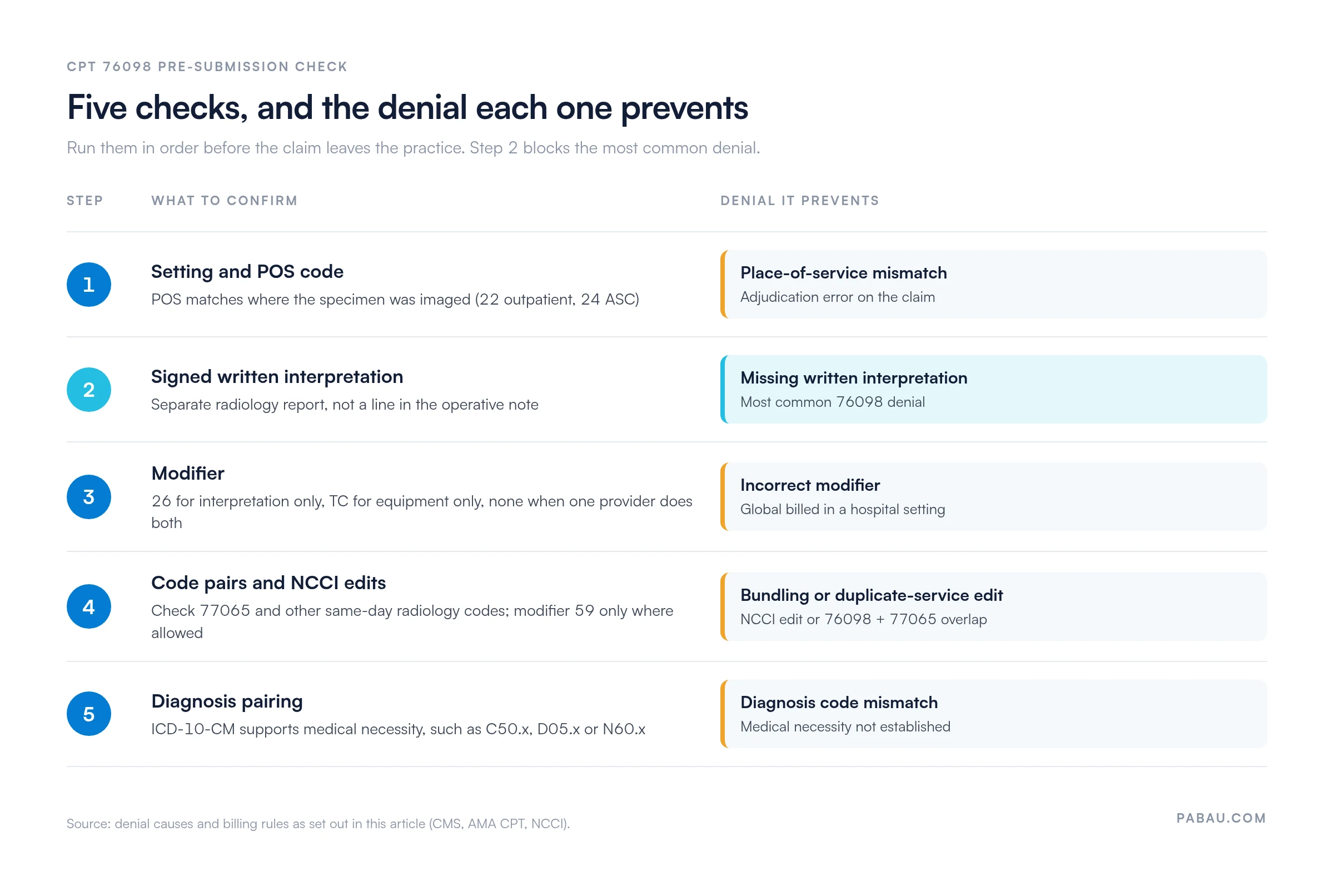
Payers require an ICD-10-CM diagnosis that supports the need for intraoperative specimen radiography. The most commonly paired diagnosis codes are:
Always verify that the selected ICD-10-CM code is covered under any applicable Local Coverage Determination. MAC-issued LCDs specify the diagnosis codes that support coverage for radiology services billed to Medicare.
Review medical billing compliance requirements for radiology codes before submitting claims to Medicare or Medicare Advantage plans. For information on common denial codes associated with these edits, see denial codes in medical billing.
Traditional Medicare does not generally require prior authorization for intraoperative specimen radiography. The decision to image is made during surgery, which typically bypasses standard authorization workflows.
Medicare Advantage plans and commercial payers vary considerably, however. Some require pre-authorization for any radiology service billed alongside a surgical procedure. Check each payer’s coverage policy and LCD before assuming no authorization is needed. Where authorization is required, the intraoperative nature of the service is strong supporting documentation.
The most common billing scenario pairs CPT code 76098 with a lumpectomy billed under CPT 19301. These two codes are not bundled under the CMS global surgical package. Specimen radiography is a separately identifiable radiology service outside the surgical global period. The radiologist who performs it may report it separately.
Key rules for billing 76098 alongside surgical codes:
Use the CMS list of CPT codes to verify current Medicare coverage status and cross-reference the surgical code pair. Practices that submit 76098 alongside 19301 regularly benefit from building a clean claim checklist specific to breast surgery cases. Review the components of building a clean claim to reduce first-pass denial rates on these paired submissions.
Billing teams often match the radiology report, the modifier, and the diagnosis for a 76098 claim by hand, across separate systems. A missing signature or a global claim from a hospital setting then surfaces weeks later as a denial.
Pabau, the practice management and billing platform we build, submits claims electronically through its Claim.MD clearinghouse integration. It supports CMS-1500 and 837P formats with real-time eligibility checks, ERA posting, and CARC denial reason tracking. Practices billing 76098 can spot payment shortfalls without manual reconciliation.
Pair it with Pabau’s claims management software to catch modifier mismatches before submission. That way a 76098-26 claim from a hospital outpatient case never goes out billed globally.
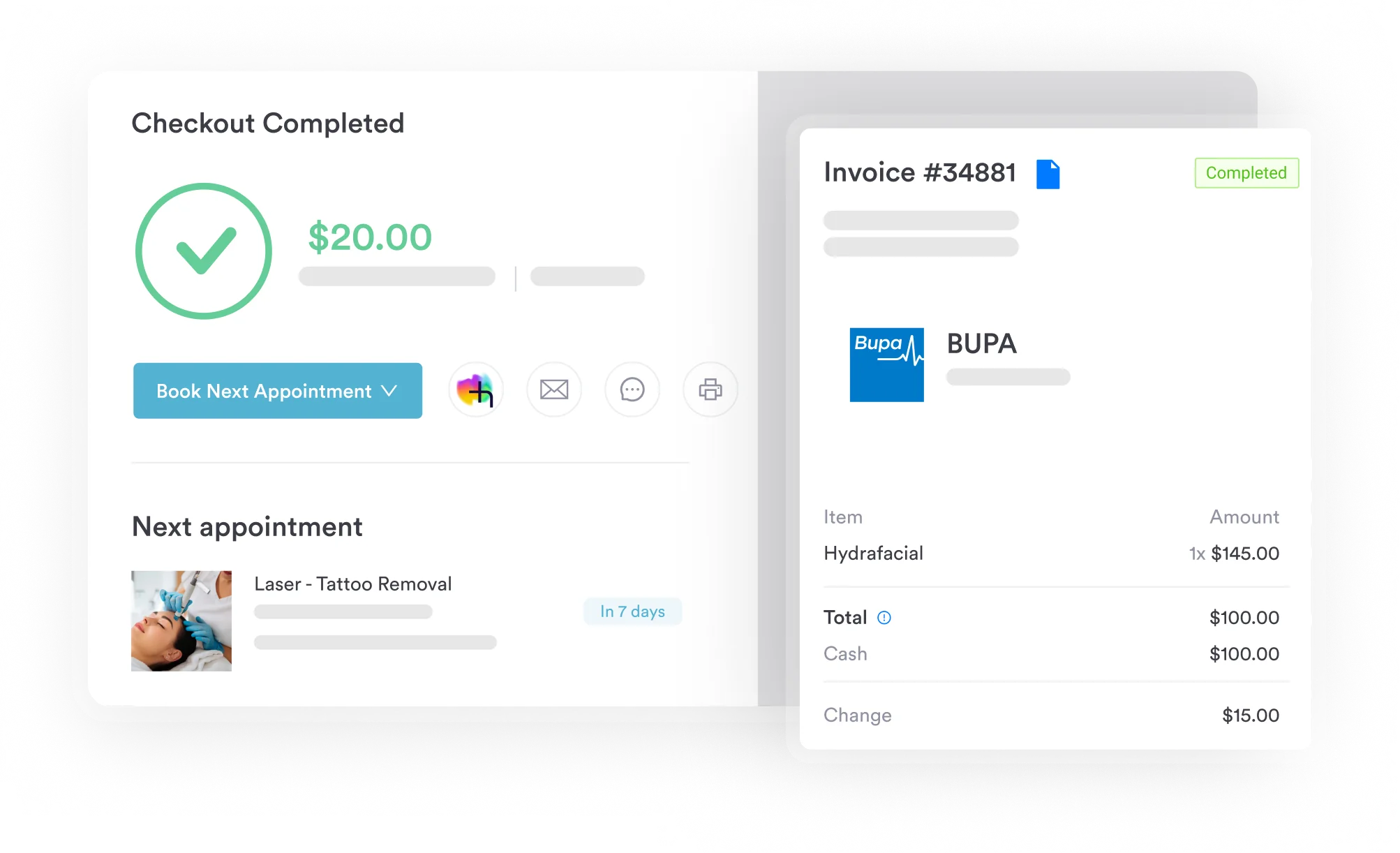

Pabau connects directly with Claim.MD to submit CPT claims electronically, run real-time eligibility checks, and auto-post ERAs. Billing teams spend less time chasing denials and more time on high-value coding work.

Treat the signed radiology report as the gate for every 76098 claim. Once the interpretation is written, signed, and filed before billing, the modifier and diagnosis checks become quick confirmations rather than appeal work.
For breast surgery practices billing 76098 alongside 19301 each week, a specimen report template and a short pre-submission checklist are worth building now. They add a few minutes per case up front, which costs far less than reworking a denied claim.
Book a demo to see how Pabau tracks radiology claims from submission to ERA posting, so denials surface while they are still quick to correct.

Billing the pathology read on the same specimen? CPT code 88305 billing guide covers surgical pathology Level IV coding for excised tissue.
Pairing 76098 with a breast cancer diagnosis? ICD-10 code C50.411 coding guide walks through site-specific C50 coding for a right breast malignancy.
Coding the ultrasound guidance before excision? CPT code 76942 guide explains how needle placement guidance is billed apart from specimen imaging.
Need to understand how clearinghouses process radiology claims? Medical claims clearinghouse guide explains how electronic claims are validated and routed to payers.
Tracing a 76098 underpayment back to its denial code? Electronic remittance advice (ERA) overview covers how to read 835 files and map CARC denial codes to specific claim errors.
CPT code 76098 covers radiological examination of a surgical specimen, meaning any radiograph taken of tissue after it has been surgically excised. It is most commonly ordered during breast lumpectomy to confirm margin status or localization device removal. It also applies to any site where intraoperative specimen imaging is medically necessary.
Modifier 26 applies when the radiologist performs and documents the interpretation but does not own or operate the imaging equipment. This is the standard arrangement in hospital outpatient and ASC settings. There, the facility owns the equipment and bills the technical component (modifier TC) separately.
CPT 76098 images the excised surgical specimen after it has been removed from the body. CPT 77065 is a diagnostic mammography code that images the intact breast while the patient is still on the table. The two codes are distinct services. Whether both may be billed on the same date depends on payer NCCI edit status, and modifier 59 is needed where allowed.
Yes. Specimen radiography is not included in the global surgical package for CPT 19301. The two codes are expected on the same date of service for breast-conserving surgery. Both are separately billable when performed and documented by the appropriate providers.
The most common cause is a missing or unsigned written radiology interpretation. Incorrect modifiers in hospital outpatient settings, NCCI bundling edits with the parent surgical code, and diagnoses that do not support medical necessity follow. Each has a specific corrective action in the denial section above.
Traditional Medicare does not generally require prior authorization for intraoperative specimen radiography. Medicare Advantage and commercial payers vary by plan. Because the service is performed during surgery, prior authorization workflows may not be practical. Verify payer-specific policies before assuming authorization is not needed.