

CPT Code 98981: RTM Treatment Management Billing Guide
CPT code 98981: Definition and official descriptor CPT code 98981 is an add-on c...

Last Updated: Nov 9, 2026
78800 is the CPT code for radiopharmaceutical localization of tumor, inflammatory process or distribution of radiopharmaceutical agent(s), planar, single area, single day imaging. Vascular flow and blood pool imaging are included when performed.
The code turns on area and day count. One area imaged on one day is 78800. Two or more areas, or one area over two or more days, is 78801, while whole-body and SPECT studies have codes of their own.
Let Pabau's smart automation suggest the right codes, reduce claim denials, and keep your practice compliant—effortlessly.
Automate repetitive tasks and focus on what matters most—your patients.
Reduce coding errors and ensure compliance with the latest regulations.
Clean claims, fewer denials, and faster reimbursements.
Powerful insights and reporting to help your practice thrive.
HIPAA compliant SOC 2 certified GDPR-compliant Trusted by 4,000+ clinics worldwide

CPT code 78800 covers planar radiopharmaceutical imaging of one body area on one day, for a tumor, an inflammatory process or tracer distribution.
The radiotracer is billed on its own line with a HCPCS A-code, such as A9541 for Tc-99m sulfur colloid.
Use 78801 for two or more areas, or one area over two or more days. Whole-body planar imaging is 78802 for one day and 78804 for two or more.
SPECT of a single area on a single day is 78803, and an organ-specific nuclear medicine code takes priority over 78800 where one exists.
Pabau pre-fills claims from the patient record, checks required fields like authorization codes and sends US claims through Claim.MD.
CPT code 78800 reports planar radiopharmaceutical imaging of a single body area, finished on a single day, to localize a tumor or an inflammatory process. It also covers mapping where a radiopharmaceutical agent has spread. The American Medical Association descriptor has three parts.
It opens with “Radiopharmaceutical localization of tumor, inflammatory process or distribution of radiopharmaceutical agent(s).” It then adds “(includes vascular flow and blood pool imaging, when performed).” It closes with “planar, single area, single day imaging.”
Each phrase in that descriptor decides whether 78800 fits the study in front of you.
78800 sits in the diagnostic nuclear medicine section of CPT, 78000 to 78999. Within it, 78800 to 78804 form the subsection for tumor and inflammatory process localization.
Under the CMS Physician Fee Schedule, the code has a technical component (TC) and a professional component (modifier 26). That split matters whenever a hospital and a radiologist bill the same scan.
Five codes share the same clinical purpose and split on three facts from the study. Those facts are how many areas were imaged, over how many days, and with which camera.
The ladder below runs those checks in the order a coder should, starting with the camera.
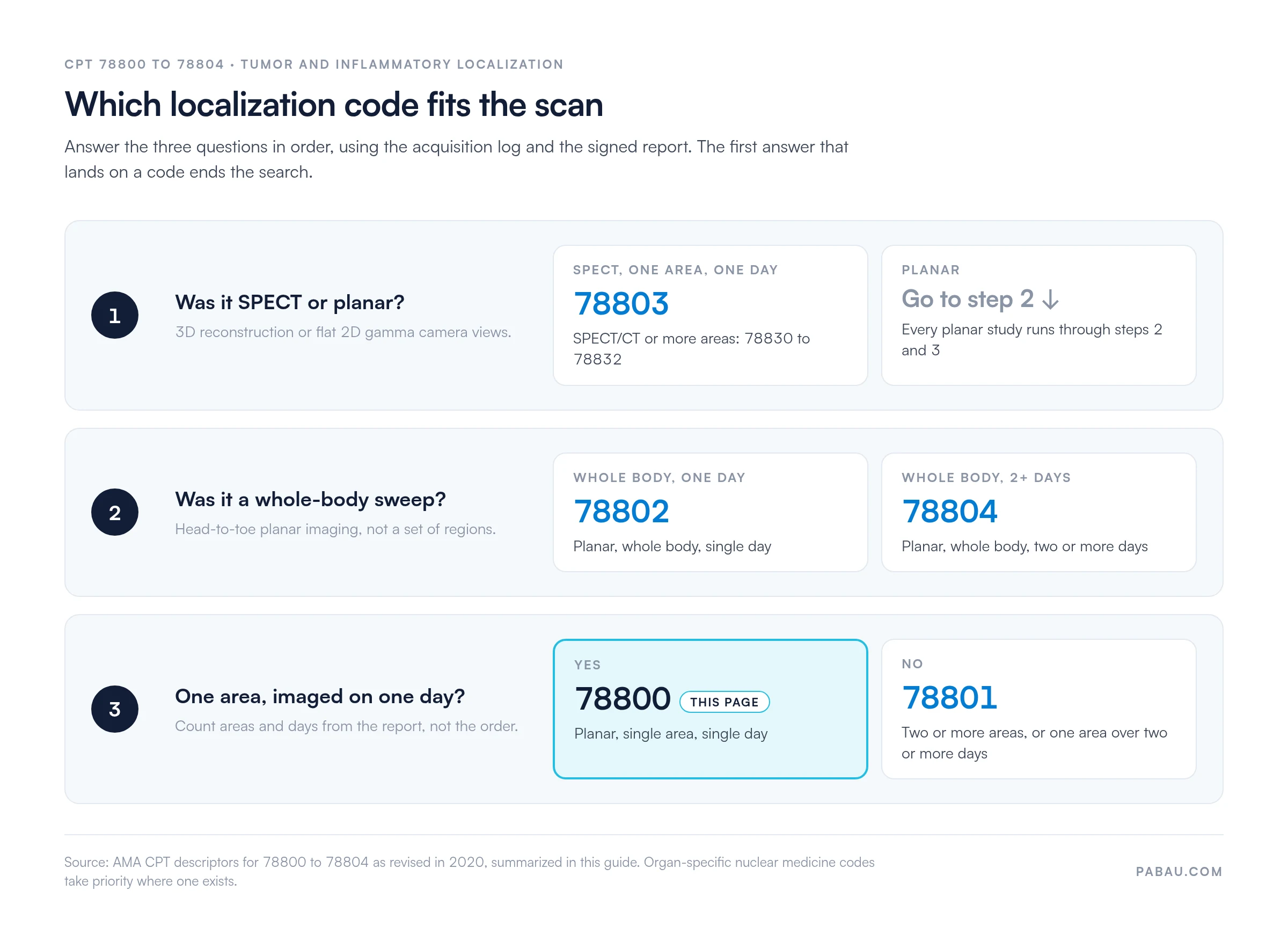
Here’s how the mix-up usually happens. A technologist images the pelvis, then extends to the lumbar spine for clinical reasons. The report reads “pelvis and lumbar spine.”
That is two areas, so 78801 is correct, not CPT code 78800. Billing 78800 against that report invites a medical-necessity denial, because the documented scope contradicts the single-area descriptor.
Before you select 78800, read the acquisition log and the signed report side by side. If the report names two body regions, even as a comparison or survey, code 78801. The payer audits the report, not the coder’s intent.
Every step between the order and the claim produces a document the payer may ask for on audit. Here’s the sequence and what each step has to capture.
The radiopharmaceutical is not bundled into CPT code 78800. The scan is 78800, and the tracer is a separate line on the same claim, reported with a HCPCS Level II A-code.
When no agent-specific code fits, report the tracer with A4641. Some commercial payers then ask for the invoice showing what the practice paid for the dose.
Request that invoice from the radiopharmacy when the dose is given, not when the claim is built. Chasing it weeks later delays payment and can push the claim past the payer’s timely filing limit.
The modifier depends on who owns the camera, who reads the images and where the scan happens. A wrong or missing one produces a denial you can prevent with a quick check, for example in the PGM Billing CPT lookup.
Hospital outpatient departments paid under the Outpatient Prospective Payment System (OPPS) don’t split TC and 26 on the facility claim. The hospital bills its facility fee, and the interpreting physician bills 78800-26 on a CMS-1500.
Medicare reimbursement for CPT code 78800 comes from Relative Value Units (RVUs) set each year in the Medicare Physician Fee Schedule (MPFS). The global rate covers both components, and split billing pays each side its share.
Check current rates with the FastRVU 2026 RVU lookup or the CMS MPFS Look-Up Tool. Dollar amounts change every January 1 and vary by locality.
Three billing facts shape what a 78800 claim pays, beyond the fee schedule figure.
Payers check medical necessity by matching the ICD-10-CM code against their coverage policy. A diagnosis the policy doesn’t support returns a CO-50 denial, however well the CPT code was chosen.
Code to the highest specificity the record supports. A documented primary site should be coded over C80.1, the unspecified malignant neoplasm code.
Check your MAC’s local coverage determinations (LCDs) and billing articles before you submit. Noridian, CGS, Palmetto and WPS each publish their own policies, and their covered diagnosis lists differ.
Most commercial payers require prior authorization for nuclear medicine imaging, including CPT code 78800. Traditional Medicare generally doesn’t require it under fee-for-service. Medicare Advantage plans often do, and each plan sets its own rules.
Radiology benefit managers such as eviCore and Carelon (formerly AIM Specialty Health) handle prior authorization for many commercial payers. A request for 78800 typically needs the documents below.
Every authorization carries an expiry date, and the window varies by payer. A scan performed after it lapses is denied, and recovering the claim takes a timely appeal with the service date and authorization number.
Nuclear medicine denials tend to trace back to a handful of avoidable errors. Reading the denial codes for billers on each remittance shows which step broke down.
Tracking denial management by CPT code shows whether a pattern is systemic or a one-off. A wrong code family is systemic, while a missing signature is usually a one-off. The two need different fixes, so sorting them first saves appeal time.
Run a weekly denial report filtered to CPT 78800 and sort it by reason code. If CO-50 leads, fix the ICD-10 mapping rather than code selection. If CO-15 leads, your pre-service authorization check needs work.
A clean claim for 78800 clears six checks before it leaves the queue. Run them at charge capture, not after a denial comes back.
Most of these come from coding off the order instead of the signed report. Others come from the wrong code family, such as SPECT studies, which belong to 78803, and whole-body bone scans, which are 78306.
A 78800 claim draws on the order, the dose record, the signed report and the authorization. Pulled together by hand at billing time, one of them is easy to miss.
Pabau, the practice management platform we build, pre-fills each claim from the patient record. It won’t send until required fields, such as the authorization code, are complete. Authorization codes, dates and sessions sit on the patient’s case, with a warning when one is missing.
Pabau’s claims software for practices sends US claims through Claim.MD, with eligibility checks, claim-status tracking and ERA remittance posting. Your billing team spends its time on coding questions instead of chasing paperwork.


Pabau pre-fills claims from the patient record, checks required fields before sending and runs US claims through Claim.MD with eligibility checks and ERA posting.

Treat 78800 as the narrowest code in its family. If the signed report shows one area, one day and planar views, bill it with confidence. If any of those three facts changes, the code changes with it.
The habit worth building is simple. Read the report before you pick the code, then add the tracer line before the claim leaves. Those two steps head off most of the denials covered here.
Book a demo to see how Pabau keeps 78800 claims, tracer lines and authorizations together from order to payment.

Coding a SPECT study instead of planar views? CPT code 78803 billing guide covers single-area SPECT localization and how it differs from 78800.
Sending nuclear medicine claims through a clearinghouse? How Claim.MD clearinghouse works with Pabau explains how claims, eligibility checks and remittances move through Claim.MD.
Confused about remittance advice remark codes on denied nuclear medicine claims? Electronic remittance advice explained breaks down ERA file structure and CARC/RARC code interpretation for billing staff.
Building a denial prevention workflow for your nuclear medicine department? Medical billing compliance best practices covers the documentation controls and audit trail requirements that keep nuclear medicine claims defensible.
No. Two areas imaged on one day are reported once with 78801, not as two units of 78800. Planar views taken within a whole-body study aren’t billed separately either.
Yes. Planar Tc-99m pyrophosphate imaging of the chest can be reported with 78800, and SPECT of the same area with 78803. The tracer goes on its own line as A9538.
Only where an NCCI edit exists between 78800 and another same-day code, and documentation supports a distinct service. Without both, leave it off.
They were deleted in 2020. Inflammatory process localization is now reported with 78800 to 78804, which were revised to include it, or with the SPECT/CT codes 78830 to 78832.
It depends on the agent. Tc-99m sulfur colloid is A9541 and Tc-99m medronate is A9503. A diagnostic agent with no specific code is reported with A4641.
Yes, when the diagnosis supports medical necessity under your MAC’s coverage policy. Traditional Medicare generally doesn’t require prior authorization for 78800, but many Medicare Advantage plans do.




