CPT code 85651: Erythrocyte sedimentation rate, non-automated
CPT code 85651: Definition, descriptor, and code summary CPT code 85651 is the p...

Last Updated: Nov 24, 2026
78811 is the CPT code for positron emission tomography (PET) imaging; limited area (eg, chest, head/neck), performed without CT attenuation correction.
It sits in a family of six PET codes, 78811 through 78816. 78811 differs from 78812 and 78813 by scan scope only, and from 78814 by the absence of CT. Wrong code selection within the family is a common cause of denials.
Let Pabau's smart automation suggest the right codes, reduce claim denials, and keep your practice compliant—effortlessly.
Automate repetitive tasks and focus on what matters most—your patients.
Reduce coding errors and ensure compliance with the latest regulations.
Clean claims, fewer denials, and faster reimbursements.
Powerful insights and reporting to help your practice thrive.
HIPAA compliant SOC 2 certified GDPR-compliant Trusted by 4,000+ clinics worldwide

CPT Code 78811 covers a limited-area PET scan, such as the chest or head and neck, without CT attenuation correction. The CT-corrected equivalent is 78814.
Medicare covers 78811 for oncology under NCD 220.6.17, with one scan for the initial treatment strategy and three for the subsequent strategy.
Wrong code selection within the six-code family, 78811 to 78816, is a common denial driver, so document the scan field and attenuation method first.
Medicare FDG PET oncology claims need modifier PI or PS, plus KX on a fourth or later subsequent-strategy scan.
Pabau, a practice management platform, supports US insurance billing through Claim.MD and tracks prior authorization on each case.
CPT Code 78811 describes positron emission tomography (PET) imaging of a limited area, such as the chest or head and neck, without CT attenuation correction.
The American Medical Association’s CPT code set formally titles it: Positron emission tomography (PET) imaging; limited area (eg, chest, head/neck).
The “limited area” designation separates 78811 from the skull-base-to-mid-thigh code 78812 and the whole-body code 78813. It signals that imaging was confined to one defined anatomical region. When the documented field is larger, a different code in the family applies.
A limited area PET scan uses an intravenous dose of fluorodeoxyglucose (F-18 FDG) to measure metabolic activity within the defined region. Imaging typically starts after an FDG uptake period of about 60 minutes. Oncology drives most orders. Common indications are initial staging, restaging after treatment, and treatment-response monitoring for solid tumors or lymphoma in the head, neck, or chest.
Documentation must exist in the medical record before the claim is submitted. Missing documentation is, alongside wrong code selection, a common reason CPT Code 78811 claims are denied.
CPT 78811 belongs to a family of six PET codes, 78811 through 78816, that differ on two axes. One is anatomical scope, and the other is whether CT was used for attenuation correction. Wrong code selection is a common denial driver for PET scan claims, and the grid below maps each combination to its code.
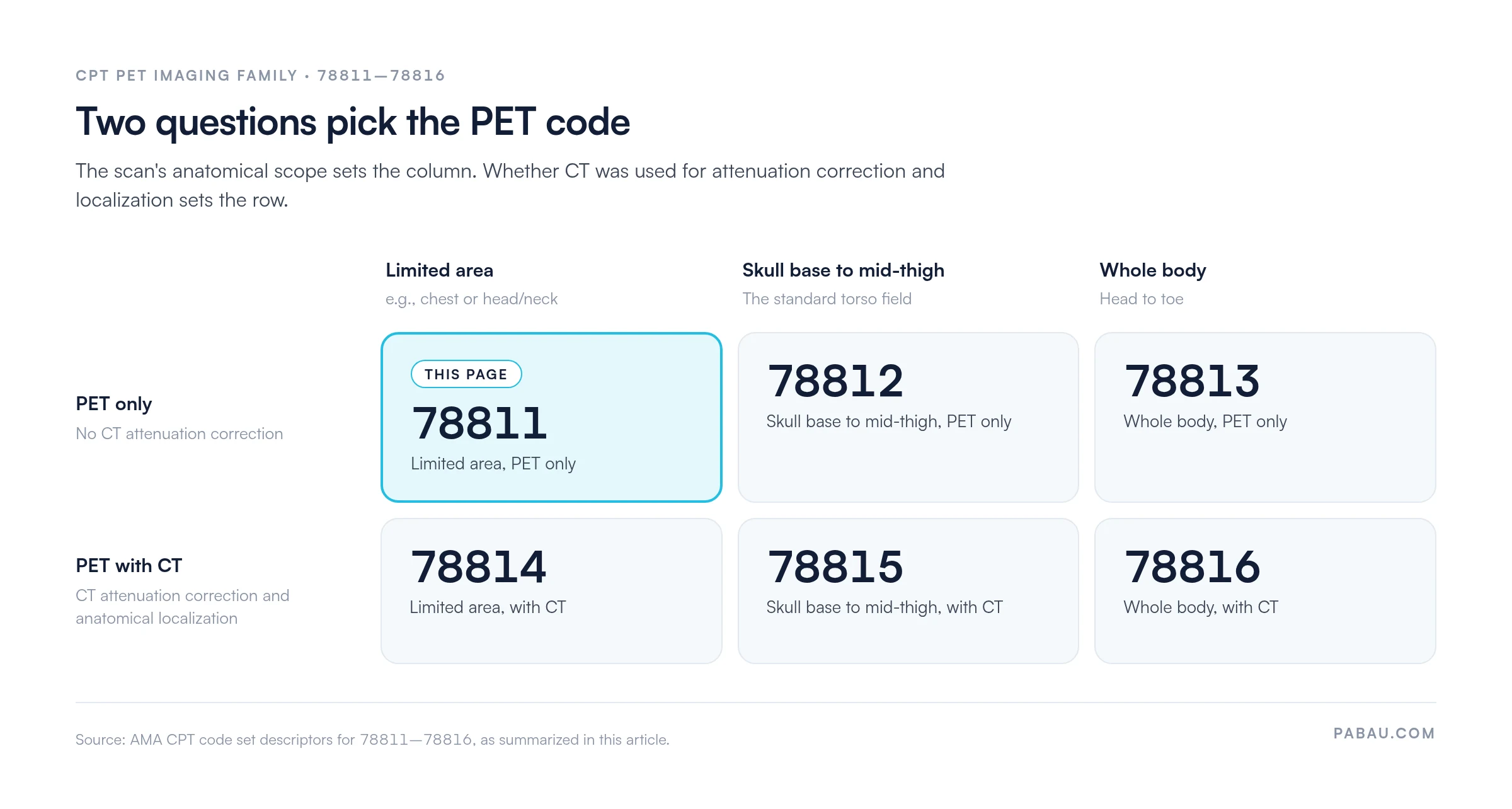
78811 differs from 78812 and 78813 by scope only, because all three are PET without CT. It differs from 78814 by CT use only, because both cover a limited area. On a PET/CT system, 78814 is the code to rule out first.
Critical distinction: Many PET scanners in service are combined PET/CT systems, which usually apply CT attenuation correction. If your facility applies CT correction to a limited area study, the correct code is 78814, not 78811. Submitting 78811 when CT correction was performed misstates the service and can be flagged as a documentation mismatch during audit.
CMS National Coverage Determination 220.6.17 is the Medicare policy for FDG PET in oncology, including CPT Code 78811. It sits under NCD 220.6, the parent PET policy.
Under the NCD 220.6.17 coverage criteria, Medicare covers one FDG PET scan for the initial anti-tumor treatment strategy of biopsy-proven or strongly suspected cancer. It covers three scans for the subsequent treatment strategy, and the MAC decides on coverage beyond three.
The diagnosis code paired with CPT Code 78811 must reflect an NCD 220.6.17 covered indication. An unsupported ICD-10-CM code is a common reason PET scan claims are denied.
Non-covered indications: NCD 220.6.17 lists a few initial-strategy uses as nationally non-covered. They include the initial diagnosis of breast cancer, initial staging of its axillary lymph nodes, and evaluation of regional lymph nodes in melanoma. FDG PET for the initial treatment strategy of prostate adenocarcinoma is non-covered too.
Cardiac and neurological PET fall under other coverage provisions and use separate codes.
Your Medicare Administrative Contractor (MAC) may also publish local coverage articles with billing and documentation instructions for PET. MACs also decide coverage beyond the third subsequent-strategy scan. Check your MAC’s guidance before submitting claims to avoid a coverage-based denial.
Original Medicare does not require prior authorization for 78811. Medicare Advantage plans and commercial payers often do. Verify requirements with the specific payer before scheduling the study.
When prior authorization is required, submit the following clinical package:
When prior authorization is denied, many payers offer a peer-to-peer review. Check the payer’s appeal window in the denial notice. Document the peer-to-peer outcome and keep the denial letter for the appeal file. Where authorization is required, never perform the scan first and bill later, because that denial is hard to overturn on clinical grounds alone.
Before scheduling any PET scan, run an eligibility and prior authorization check in your billing system. Document the authorization number, approval date, and expiration date in the patient record and on the claim. Missing or expired authorization is one of the easiest CPT Code 78811 denials to prevent.
Accurate claim submission for CPT Code 78811 turns on three decisions. You choose how to split the technical and professional components, how to bill the radiopharmaceutical, and which modifiers apply. Getting any one wrong delays or denies payment. Submitting a clean claim for nuclear medicine imaging depends on resolving all three before the claim leaves the practice.
When the same entity owns both the scanner and employs the interpreting physician, bill CPT Code 78811 globally (no modifier). When separate entities provide the technical and professional components, split billing applies. The facility or imaging center appends modifier TC to bill the scan itself. The nuclear medicine physician or radiologist appends modifier 26 to bill the interpretation.
Under the Outpatient Prospective Payment System (OPPS), hospital outpatient departments bill 78811 on a UB-04 and are reimbursed under the applicable APC rate. The professional interpretation is billed separately on a CMS-1500 by the interpreting physician’s group. Submit electronic claims through the Claim.MD clearinghouse, which supports CMS-1500/837P claims.
HCPCS code A9552 (fluorodeoxyglucose F-18, diagnostic, per study dose) is reported with CPT Code 78811 on the same claim and date of service. The technical component entity, the facility or imaging center, typically reports it. The interpreting physician does not rebill it.
Under Medicare OPPS, A9552 is packaged into the APC payment for the scan. It must still be on the claim, but it is not paid separately. Confirm how other payers handle it, and document the dose in the administration log.
Medicare FDG PET oncology claims need modifier PI or PS to show the treatment strategy. Add KX to a fourth or later subsequent-strategy scan where your MAC covers it.
Medicare reimbursement for CPT Code 78811 follows the Medicare Physician Fee Schedule (MPFS) formula. The sum of the work, practice expense and malpractice RVUs is multiplied by the Geographic Practice Cost Index (GPCI), then by the conversion factor. The conversion factor changes annually with the MPFS Final Rule.
Use the CMS Physician Fee Schedule lookup tool to retrieve the current-year national payment rates and FastRVU’s 2026 RVU lookup for locality-adjusted estimates.
RVU values change every year with the MPFS Final Rule. Under OPPS, hospital outpatient departments are paid the Ambulatory Payment Classification (APC) rate, which CMS sets separately from the physician fee schedule. Claims software for practices such as Pabau supports insurance billing via Claim.MD, including ERA remittances.
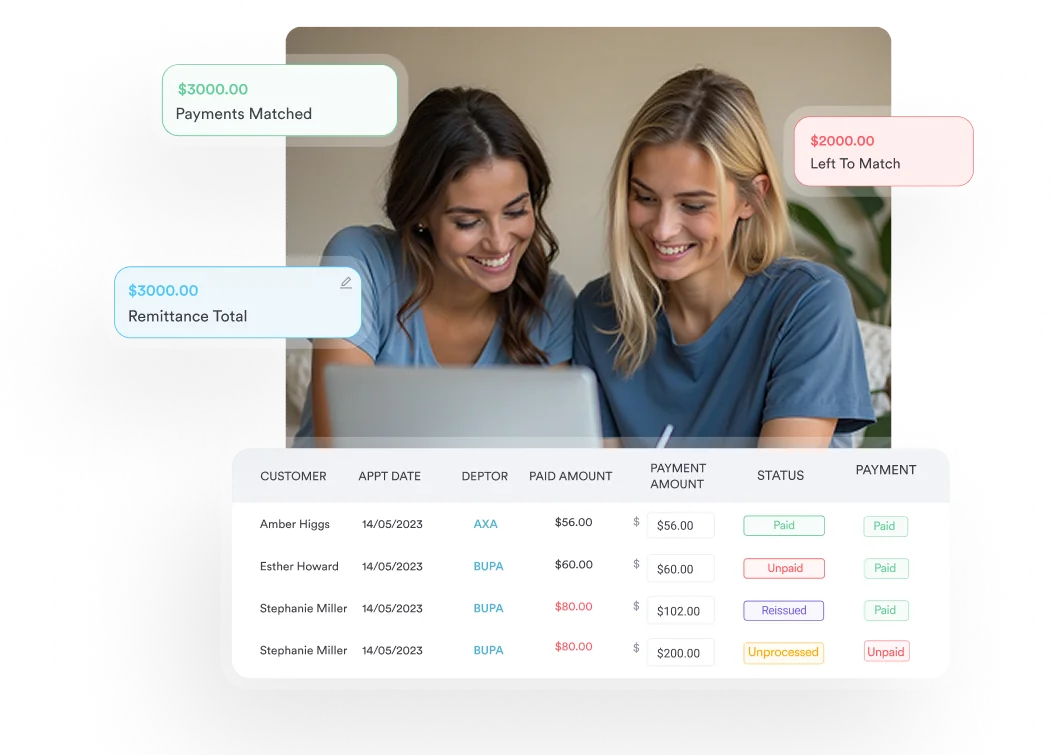
A denial management workflow for 78811 starts by sorting each denial by root cause, since the corrective action differs for each.
Review denial codes in medical billing alongside your Remittance Advice Remark Codes (RARCs) to sort denials quickly and route each to the right fix. Tracking denial categories monthly shows which documentation steps keep failing before the losses add up.
CMS publishes National Correct Coding Initiative (NCCI) Procedure-to-Procedure (PTP) edits quarterly. For CPT Code 78811, the most relevant edit pairs involve same-day billing with related nuclear medicine imaging codes in the 78xxx range. Certain diagnostic radiology services with clinical overlap are paired as well.
Every NCCI pair carries a modifier indicator. An indicator of 1 lets modifier 59 (or XE, XP, XS, XU) bypass the edit when the services are distinct. An indicator of 0 means no modifier can bypass it.
Check the indicator in the current quarterly PTP table before appending 59. A modifier on a 0-indicator pair changes nothing and may draw an audit.
Run your 78811 claims through a clearinghouse edits check before submission. NCCI PTP tables update quarterly, so an edit that did not apply last quarter may apply this quarter. Catching a bundling conflict before submission saves a denial and a resubmission cycle.
Use this checklist before every 78811 claim submission. Each item maps to a denial reason in the table above. Sound medical billing compliance for nuclear medicine imaging depends on capturing each of these in the patient record before the claim leaves the practice.
A structured revenue cycle workflow for PET imaging captures each element at scheduling, confirms it at check-in, and validates it at billing. An element missed at any of those stages becomes a denial risk.
Imaging practices often track PET authorizations in one system, build claims in another and match remittances by hand. A lapsed approval or a 78811 billed for a CT-corrected study then only surfaces when the denial arrives.
Pabau supports US insurance billing through Claim.MD, with CMS-1500/837P claims, eligibility checks and ERA remittances. The prior authorization code, dates and sessions are tracked on the patient’s case, with a warning when one is missing.
Your team sees the authorization before the scan is scheduled, so an expired approval is caught while it can still be renewed.

Pabau supports US insurance billing through Claim.MD, with CMS-1500/837P claims, eligibility checks and ERA remittances. Prior authorization is tracked on each case, with a warning when one is missing.

Two documented facts decide CPT Code 78811: a limited field and no CT attenuation correction. Get either one wrong and the claim belongs to another code in the six-code family. On Medicare claims, pair the code with an NCD 220.6.17 indication and the PI or PS modifier.
Pabau supports US insurance billing through Claim.MD (CMS-1500/837P claims, eligibility checks and ERA remittances) and tracks prior authorization on the case. Book a demo to see how it keeps your PET claims and authorizations in one workflow.

Need to understand how clearinghouse edits affect your PET scan claims? Claim.MD clearinghouse guide explains how real-time edits catch billing errors before they reach the payer.
Confused about when a denial can be successfully appealed? Electronic remittance advice covers how to read ERA denial codes and prioritize your appeal queue.
Looking for guidance on insurance credentialing for nuclear medicine? Getting credentialed with insurance companies walks through the enrollment steps that unlock clean claims submission.
Billing a PET scan without CT across the whole body? CPT code 78813 covers the whole-body PET-only code and how it differs from 78811.
Is the study a whole-body PET/CT? CPT code 78816 explains the whole-body code with CT attenuation correction.
CPT Code 78811 is the nuclear medicine code for PET imaging of a limited anatomical area, such as the chest or head and neck. The scan is acquired without CT attenuation correction. It falls within the 78xxx nuclear medicine diagnostic imaging range. It is used mainly for oncology indications covered under CMS NCD 220.6.17.
CPT 78811 covers a limited area PET scan without CT attenuation correction. CPT 78815 covers a skull-base-to-mid-thigh PET/CT scan with CT attenuation correction applied. The two differ in anatomical scope (limited region vs. full torso) and in imaging technology (PET only vs. PET/CT). Many staging studies use 78815 because PET/CT systems usually apply CT correction across the standard torso field.
Yes. Medicare covers CPT Code 78811 for oncology indications under CMS NCD 220.6.17. That means one FDG PET scan for the initial anti-tumor treatment strategy and three for the subsequent strategy, with more at MAC discretion. Coverage requires a supported ICD-10-CM diagnosis code, documented medical necessity, and the PI or PS modifier. Non-oncology indications need a separate NCD or MAC policy.
Original Medicare does not require prior authorization for 78811. Medicare Advantage plans and commercial payers often do, so verify requirements with the specific payer before scheduling the study.
No. 78811 and 78815 describe overlapping PET acquisitions at different anatomical scopes, so bill only the one code that matches the study performed. Billing both for the same patient on the same date can trigger an NCCI edit or a payer denial. Modifier 59 does not fix it.
The Medicare reimbursement rate for CPT Code 78811 changes annually with the MPFS Final Rule and varies by geographic locality via the GPCI adjustment. Use the CMS Physician Fee Schedule lookup tool or FastRVU to retrieve current-year rates for your specific MAC locality. The professional component (modifier 26) rate is substantially lower than the non-facility global rate because it covers only the interpretation.