HCPCS Code Q4175: Billing, coverage, and documentation guide
HCPCS code Q4175: Code description and product identity HCPCS Code Q4175 is the ...

Last Updated: Nov 20, 2026
79445 is the CPT code for radiopharmaceutical therapy by intra-arterial particulate administration. In practice, it reports the delivery of yttrium-90 (Y-90) microspheres into the hepatic artery to treat liver tumors.
The code belongs to the authorized user who manages the radiation dose, and it is billed together with 37243 for the embolization. Catheter placement, mapping angiography, and dosimetry planning are each reported with their own codes.
Let Pabau's smart automation suggest the right codes, reduce claim denials, and keep your practice compliant—effortlessly.
Automate repetitive tasks and focus on what matters most—your patients.
Reduce coding errors and ensure compliance with the latest regulations.
Clean claims, fewer denials, and faster reimbursements.
Powerful insights and reporting to help your practice thrive.
HIPAA compliant SOC 2 certified GDPR-compliant Trusted by 4,000+ clinics worldwide

CPT code 79445 reports the radiopharmaceutical part of Y-90 radioembolization, the intra-arterial delivery of the microspheres. It belongs to the authorized user who manages the radiation dose.
CPT 37243 is the main embolization code for Y-90 and is reported together with 79445, usually once per operative field. The NCCI practitioner tables carry no edit between the two codes.
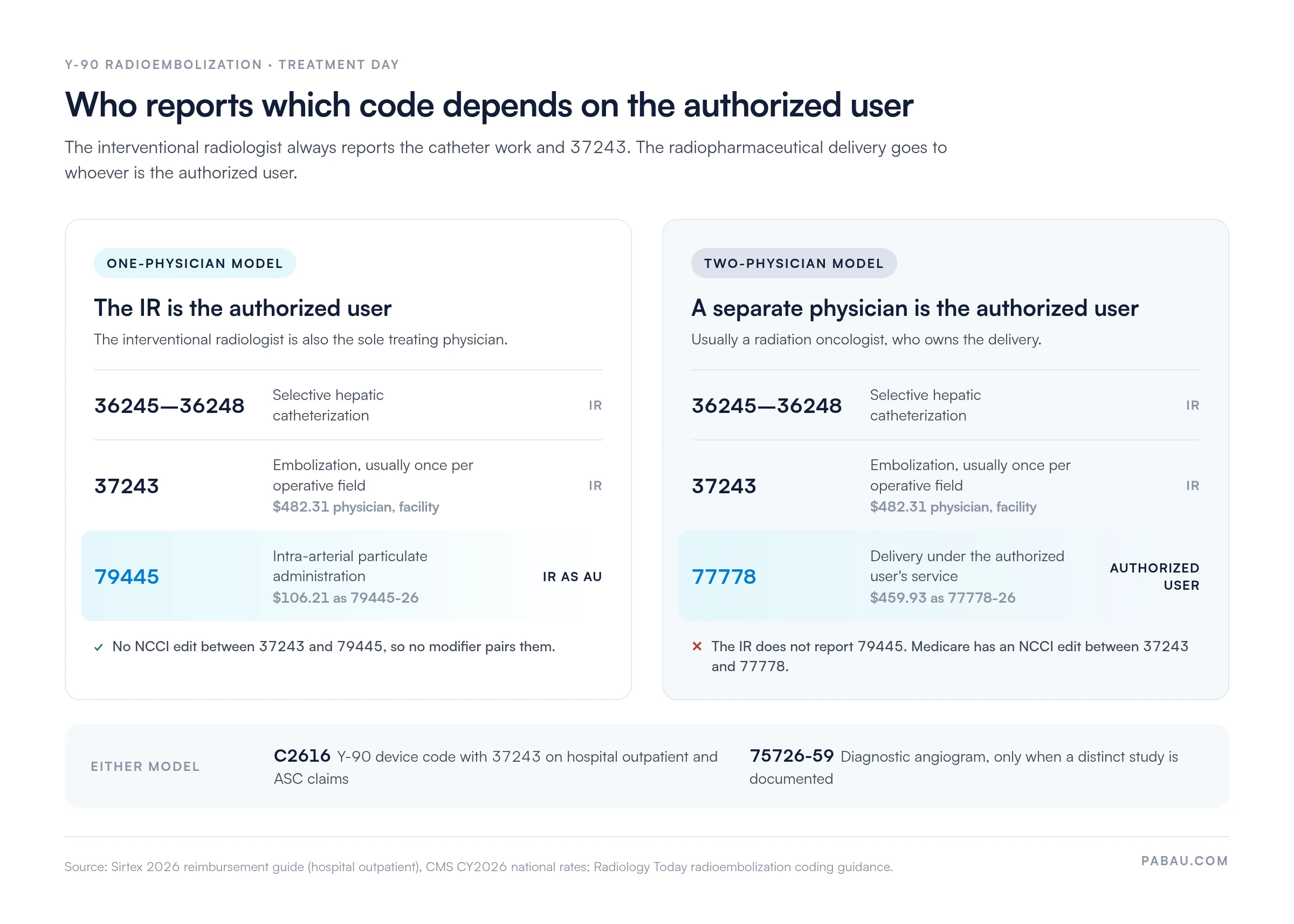
An interventional radiologist reports 79445 only as the authorized user and sole treating physician. In a two-physician model, the delivery belongs to the authorized user’s service, and Sirtex lists 77778 for that model.
Selective catheterization (36245 to 36248) and a diagnostic hepatic angiogram (75726) are coded separately. Neither belongs inside 37243 or 79445.
Missing prior authorization, thin operative notes, a missing device code, and the wrong physician reporting 79445 drive most denials on Y-90 claims.
CPT code 79445 reports radiopharmaceutical therapy by intra-arterial particulate administration, which in practice means delivering yttrium-90 (Y-90) microspheres into the hepatic artery. It is reported alongside CPT 37243, the embolization code, by the physician who is the authorized user for the radioactive material. That split is spelled out in Radiology Today’s coding guidance for radioembolization.
The microspheres are either SIR-Spheres (resin, Sirtex Medical) or TheraSphere (glass, Boston Scientific). Both treat primary or metastatic liver tumors. The radioactive material must be handled by an authorized user under Nuclear Regulatory Commission rules. That rule decides who may report 79445 on the claim.
Y-90 radioembolization usually runs over two sessions. The first is a mapping angiogram, and the second is the treatment day. Each code on the treatment-day claim needs its own support in the operative note.
Payers return Y-90 claims most often when the note skips the access route, the target artery, the agent and dose, or confirmation of delivery. Each of those details supports a different code on the claim. A note that names every hepatic branch reached supports 36247, plus 36248 for each additional branch in the same vascular family.
CPT code 79445 covers the radiopharmaceutical administration only. Catheterization, the embolization itself, diagnostic angiography, and the microsphere device are reported with their own codes. Building a clean claim for a Y-90 treatment day means listing each of them correctly.
Sirtex adds one rule that catches coders out. A precautionary coil in the gastroduodenal or gastric artery on the treatment day is not billed as 37242. Only 37243 is reported.
CPT 79445 and CPT 37243 are reported together for Y-90 radioembolization, because they describe two different parts of the same treatment. Code 37243 is the embolization, and 79445 is the radiopharmaceutical delivery by the authorized user.
Key rule: Report 37243 for the embolization on every Y-90 treatment, and add 79445 when the same physician is the authorized user. The CMS NCCI procedure-to-procedure tables for practitioners carry no edit between 37243 and 79445 in either direction. Pairing them is not a bundling error.
Two units of 37243 apply when separate operative fields are treated in one session, such as tumors in both liver lobes. Medicare does not accept modifier 50 on 37243, so the second unit takes XS, 76, or 59, as the payer instructs.
The Society of Interventional Radiology assigns 79445 to the authorized user. An interventional radiologist reports it only when they are the authorized user and the sole treating physician.
When a radiation oncologist is the authorized user, the delivery falls under that physician’s service and stays off the interventional radiologist’s claim. The Sirtex 2026 reimbursement guide lists 77778 for this two-physician model. Sirtex also flags a Medicare NCCI edit between 37243 and 77778, so check it before one provider reports both.
The diagram below maps each treatment-day code to the physician who reports it under both models.
A Y-90 claim needs a liver malignancy diagnosis that matches the payer’s coverage policy. The codes below appear in Sirtex’s list of potential diagnoses for radioembolization. CrossCoder’s procedure-to-diagnosis crosswalk tool helps confirm the pairing before you submit.
Use the most specific code the record supports. An unspecified liver code such as C22.9 invites a medical necessity denial when the pathology names the tumor type.
The note for a Y-90 treatment day must support every code on the claim, not only 79445. Payer auditors look for seven elements.
A diagnostic angiogram billed on the treatment day needs its own description of a diagnostic study. A note that only gives the catheter position will not support 75726. Check the Local Coverage Determination (LCD) for your MAC jurisdiction before billing.
Medicare covers CPT code 79445 when the documentation supports an approved indication under the applicable LCD. Coverage is not nationally uniform, because each Medicare Administrative Contractor (MAC) maintains its own LCD.
Running insurance eligibility verification before the treatment session confirms active coverage. It also shows whether the plan adds its own criteria for Y-90.
Most commercial payers and Medicare Advantage plans require prior authorization before the treatment session. Send these documents with the request:
Turnaround usually runs 5 to 14 business days, and urgent requests may be expedited. A pending or denied authorization on the treatment date is hard to fix after the service. Request it well ahead of the scheduled date.
Routing claims through a clearinghouse such as the Claim.MD clearinghouse adds payer edit feedback before submission. A missing authorization number then comes back as an edit your team can fix before the payer sees the claim.
Medicare pays CPT code 79445 differently by setting and by who bills. The figures below are CMS 2026 national rates before geographic adjustment, as Sirtex lists them. Physician and hospital outpatient rows come from the Sirtex 2026 hospital outpatient guide. Office-based lab rows come from the Sirtex 2026 office-based lab guide.
Confirm your local rate in the CMS Physician Fee Schedule lookup tool or the FastRVU RVU lookup.
Important: The microsphere device is not paid inside 79445. On Medicare hospital outpatient and ASC claims, report it with HCPCS C2616. Sirtex notes that 37243 is device-intensive in the facility setting and is denied without the device code.
In a hospital outpatient setting, the hospital reports 79445 under OPPS and the physician reports 79445-26. Confirm which entity bills which line before the claim goes out. A global 79445 from the physician while the hospital also reports it invites an overpayment demand.
Modifiers on a Y-90 claim decide which entity is paid for which part of the service. They also show when a second embolization or a diagnostic angiogram is distinct. Check current edit guidance in the AAPC Codify CPT lookup.
CPT code 79445 denials cluster around a handful of root causes. The CARC code on the remittance shows which one applies. A systematic denial management workflow turns each failure into a process fix. The CARC denial codes tell you why the payer rejected the claim.
Run a quarterly denial analysis on 79445 claims and sort by CARC code. If CARC 50 (medical necessity) accounts for more than 20% of denials, the problem sits in documentation or diagnosis specificity. Fix the clinical note template before fixing the claim form.
A Y-90 claim has more moving parts than most code families. Check these five points before the claim leaves the practice:
On a Y-90 case, the billing team often rebuilds the claim from the operative note days later. A missing authorization number or patient detail only surfaces when the payer rejects the claim.
Pabau, a practice management platform, gives your team claims software for coders that checks each claim for missing or invalid details before it is sent. It tracks prior authorizations against the encounter and submits claims electronically through the Claim.MD clearinghouse.
The result is fewer returned claims on a high-value procedure, where a single denial can mean significant delayed revenue. Your coders still choose the codes, and Pabau flags missing or invalid details before the payer does.

Pabau checks claims for missing or invalid details, tracks prior authorizations, and sends claims electronically through the Claim.MD clearinghouse. Your team spends less time reworking radioembolization denials.

Treat a Y-90 treatment day as one claim with two physician roles. Report 37243 for the embolization every time. Add 79445 only on the authorized user’s claim, and code the catheter work and any diagnostic angiogram separately.
Coders who drop 37243, or hold it back for a missing modifier, leave the main embolization payment unbilled. Fix the role assignment and the documentation once, and the rest of the claim follows. Book a demo to see how Pabau validates and submits radioembolization claims for your practice.

Need a framework for managing clearinghouse claim edits? Understanding how a medical billing clearinghouse works explains how payer edits, eligibility checks, and ERA routing reduce denials before they reach your AR queue.
Struggling with claim denial patterns across your code set? Revenue cycle management fundamentals covers how to build a denial prevention loop from charge capture through posting.
Want to understand what a superbill needs to include for IR procedures? Building a compliant medical superbill walks through the fields a compliant superbill carries.
Planning authorization before a Y-90 treatment date? The prior authorization process sets out each step from request to approval, so the treatment date is not left waiting on a payer.
CPT code 79445 covers radiopharmaceutical therapy by intra-arterial particulate administration, such as Y-90 microsphere delivery to liver tumors. The authorized user reports it. The embolization (37243), catheter placement (36245 to 36248), and the microsphere device are reported with their own codes.
CPT 37243 reports the embolization of the tumor’s blood supply, and 79445 reports the radiopharmaceutical delivery by the authorized user. For Y-90 radioembolization, the two are reported together. No NCCI edit pairs them, so no modifier is needed to bill both on the same date.
The authorized user reports CPT 79445. An interventional radiologist reports it only when they are the authorized user and the sole treating physician. When a radiation oncologist is the authorized user, the delivery falls under that physician’s service, and Sirtex lists 77778 for this two-physician model.
Yes, Medicare covers CPT code 79445 for approved indications under the patient’s MAC Local Coverage Determination. The most common are hepatocellular carcinoma (C22.0) and colorectal liver metastases (C78.7). Criteria vary by MAC jurisdiction, so confirm the applicable LCD before billing.
Prior authorization is required by most commercial payers and Medicare Advantage plans, but generally not by traditional Medicare fee-for-service. Send imaging, oncology notes, dosimetry, and performance status with the request. Allow 5 to 14 business days, and request it well before the treatment date.
The note needs the access site and each vessel catheterized, the artery treated, the agent and dose, and the embolization of each operative field. It also needs confirmation of delivery, the ICD-10-CM diagnosis, a dosimetry reference, and the authorized user’s attestation. Missing any one invites a documentation denial.
The most common are a missing prior authorization, a diagnosis outside the payer’s policy, and a thin operative note. Others include 79445 billed by a physician who is not the authorized user, a missing device code, and the wrong component for the setting. The CARC code on the remittance shows which applies.