HCPCS Code G0163: Skilled nursing observation and assessment
What is HCPCS Code G0163? HCPCS Code G0163 is a deleted Level II code for skille...

Last Updated: Oct 15, 2026
CPT Code 78306 is the billable code for bone and/or joint imaging, whole body. It is a nuclear medicine scan of the entire skeleton using a technetium-99m tracer. Medicare pays a national average of $259.19 for the global service in 2026, built from 7.76 total RVUs.
The code covers one delayed whole-body pass and nothing narrower. A three-phase study of a single site is 78315, and one anatomical region is 78300. Below you will find the descriptor, the indications payers accept, the 2026 payment math, modifiers, ICD-10 pairings, companion HCPCS codes, and prior authorization rules.

CPT Code 78306 describes bone and/or joint imaging, whole body, a nuclear medicine procedure that images the entire skeleton with a technetium-99m tracer.
Three-phase bone scans use CPT 78315, not 78306. Confusing the two is the single most common billing error on nuclear medicine claims.
Spot images taken during a whole-body scan are included in 78306 and must not be billed separately. Per SNMMI coding guidance, doing so counts as improper unbundling.
Practice expense carries 6.84 of the 7.76 total RVUs, so the technical component decides most of the payment on a split claim.
Your billing staff choose the codes and modifiers. Practice management software like Pabau then holds that data on the patient record and submits the claim through its Claim.MD clearinghouse integration.
CPT Code 78306 is published by the American Medical Association (AMA) under the Nuclear Medicine section of the CPT code set. The official long descriptor reads: Bone and/or joint imaging; whole body. It sits in the 78xxx nuclear medicine family and covers skeletal scintigraphy performed across the entire skeleton with a radionuclide tracer.
The procedure requires an intravenous injection of technetium-99m methylene diphosphonate (Tc-99m MDP). The whole-body scan follows two to four hours later, once the tracer has been taken up by bone. The radiopharmaceutical supply is billed separately under HCPCS A9503 for Tc-99m medronate (MDP) or A9561 for Tc-99m oxidronate (HDP).
Payers require a supported ICD-10 diagnosis code to establish medical necessity for any bone scan claim. These are the indications that most often justify a whole body scan.
Each indication must be supported by the ordering physician’s clinical documentation. An entry as vague as “bone pain” is a common trigger for medical necessity denials. Record the clinical rationale explicitly in the chart before the scan date.
Payment comes from the Medicare Physician Fee Schedule (MPFS), which the Centers for Medicare and Medicaid Services (CMS) updates every January. The 2026 national average for the global service is $259.19. Rates move with locality, so confirm yours with the CMS Physician Fee Schedule lookup tool before billing.
One line in that table drives the rest. Practice expense accounts for 6.84 of the 7.76 total RVUs, so the equipment and the technologist carry almost the whole payment.
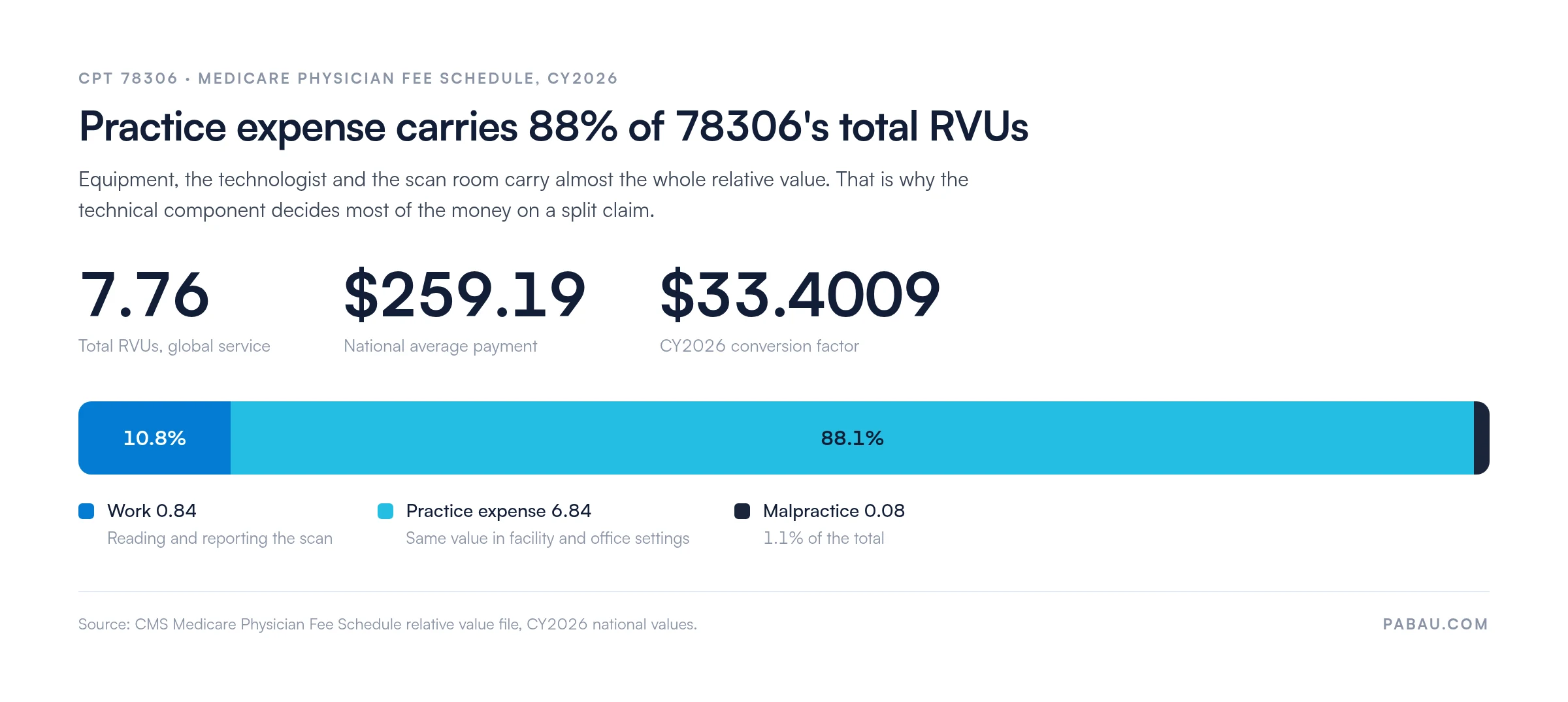
CMS publishes separate professional-component and technical-component lines for 78306 in the relative value file, and the two add back up to the global rate. Look both up for your locality rather than splitting the global figure yourself.
Geographic practice cost indices (GPCI) then adjust the result. Facilities in high-cost metropolitan areas are paid well above the national average, and rural localities often sit below it. Run the code through the CMS tool once for every jurisdiction you bill.
Never publish a flat dollar rate for 78306 in an internal billing guide without naming the year and the locality. The conversion factor changes every January, and geographic adjustment moves a site’s payment well above or below the national average. Point your team at the CMS fee schedule lookup tool instead.
Modifier selection depends on the billing entity and the service setting. The common scenario is the TC and 26 split. An imaging center performs the scan, and an outside radiologist or nuclear medicine physician reads and reports it.
One rule overrides the rest: a single entity cannot bill modifier TC and modifier 26 for the same service date. The global service, with no modifier, is billed only when one entity owns the equipment and employs the interpreting physician.
This distinction is the most expensive one in nuclear medicine billing. A three-phase scan billed as 78306 is underpaid or denied once the payer sees a three-phase protocol on the order. Read the AAPC CPT code reference alongside the procedure note before you assign a code.
The three-phase scan is not a subset of the whole-body scan. It images a limited area across three physiologic phases, so “three phase” describes the protocol rather than the anatomical coverage. Per SNMMI coding guidance, submitting a three-phase study under 78306 is a coding error. Spot images taken during a whole-body scan are bundled into 78306 and must not be billed separately.
Every 78306 claim needs at least one ICD-10 diagnosis code establishing medical necessity. The table below lists the diagnoses most often paired with the code, drawn from CMS claims data patterns and published coding guidance.
Use the most specific code the documentation supports. C79.51 will support a 78306 claim far more reliably than a generic pain code. The M84.3 stress fracture codes all need a seventh character, so M84.30 on its own is not billable.
Osteomyelitis is the most common non-oncology reason for a whole body scan, and M86.9 is the diagnosis most often paired with 78306 in that workup. Capture the referring physician’s diagnosis before the scan date, since that record is what answers a medical necessity review.
The radiopharmaceutical is billed separately from the procedure. Picking the wrong HCPCS supply code creates a payment discrepancy and, on audit, an exposure the practice has to explain.
Never bill SPECT without confirming that the scanner performed a distinct SPECT acquisition. A reformat of the planar data does not qualify. CMS and most commercial payers treat the two as inclusive unless the protocol documents a separate acquisition.
Bone scan claims produce a predictable set of denials, and most of them are preventable at submission rather than on appeal. These six account for the bulk of them.
Run every remittance cycle against these six patterns. Anything that shows up more than twice a month is a process problem rather than a one-off appeal.
Prior authorization rules for nuclear medicine bone scans vary by payer type, MAC jurisdiction, and plan design. Checking them after the scan is how a whole service ends up written off with no appeal route left.
One point is widely misreported. CMS retired National Coverage Determination (NCD) 220.8, Nuclear Radiology Procedure, effective December 18, 2014, so it no longer governs coverage of bone scans. Coverage now sits with each MAC’s Local Coverage Determination (LCD) and its billing and coding article. Read the LCD for your jurisdiction and match its covered indications to the order.
Medicare fee-for-service does not routinely require pre-authorization for 78306. Medicare Advantage plans follow their own benefit designs, and most of them do require it. Verify coverage and authorization status when the scan is scheduled, not on the day of service.
Documentation that consistently supports medical necessity for 78306 includes the following elements.
Keep every pre-authorization confirmation number in the patient record before the service date, then attach it to the claim at submission. Most MACs will not accept retroactive authorization as grounds for appeal.
A clean 78306 claim needs three fields to agree: the procedure code, the modifier, and the diagnosis codes that support medical necessity. Your billing staff choose all three. What software can do is keep those choices attached to the encounter they came from.
Practice management software like Pabau holds the coded charge, the modifier, and the linked ICD-10 codes on the patient record. From there it submits the claim through its Claim.MD clearinghouse integration in the US. That route covers more than 4,000 payers and supports CMS-1500 and 837P formats. Pabau’s claims management software submits and tracks what your team recorded, so nothing is re-keyed into a separate billing tool.
When a 78306 claim comes back denied, the electronic remittance advice posts against that same record. Your team reads the reason code, corrects the modifier or the diagnosis link, and resubmits without switching systems. Repeat denial codes then surface as a pattern you can fix at the source.
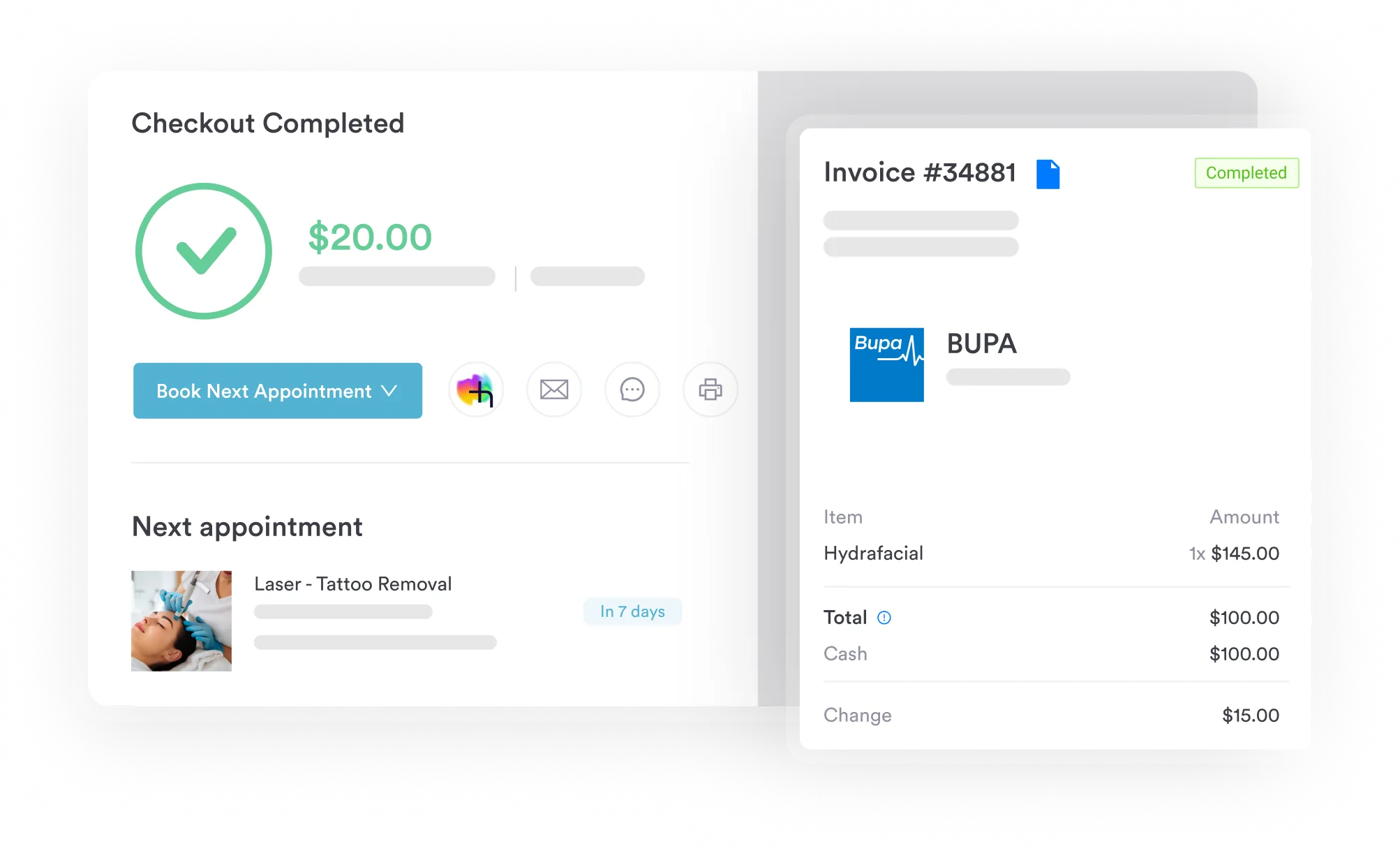

Your billers choose the code, the modifier, and the diagnosis links. Pabau keeps all three on the patient record and submits the claim through its Claim.MD clearinghouse integration. Denials get caught and corrected in one place.

The money on a 78306 claim sits in the technical component, and the denials sit in the code choice. Read the procedure order before the report, confirm a single whole-body pass was performed, and the two costliest errors on this code stop happening.
Check the authorization rule for each payer before the scan date rather than after it. Retroactive authorization is rarely accepted as grounds for appeal, so one missed check writes off the full $259 service.
Want the modifier, the diagnosis links, and the remittance data on one patient record instead of three systems? Book a demo to see how Pabau handles nuclear medicine billing end to end.

Need a framework for managing claim denials across your nuclear medicine department? Denial management in healthcare covers how to track, appeal, and prevent recurring claim errors.
Want to know what happens after a claim is submitted? Electronic remittance advice explains how ERA files work and where the denial reason codes sit.
Looking for a complete overview of the US billing workflow? What is medical billing? walks through the process from charge capture to payment posting.
Checking eligibility before an expensive scan? Insurance eligibility verification sets out what to confirm before the appointment is booked.
Documenting to survive an audit? Medical billing compliance covers the records a payer expects to see behind a paid claim.
CPT Code 78306 is bone and/or joint imaging, whole body. It is a nuclear medicine procedure that uses a technetium-99m (Tc-99m MDP) tracer. One delayed-phase scan images the entire skeleton from skull to feet. It is used for metastatic workup, Paget’s disease assessment, osteomyelitis evaluation, and other conditions needing a full skeletal survey.
No. Per SNMMI coding guidance, spot images taken during a whole-body bone scan are included in CPT 78306. They must not be billed as a separate code. Adding 78300 or a second 78306 for spot views taken in the same session is improper unbundling and will be denied on audit.
The most commonly applied modifiers are 26 and TC. The interpreting physician bills 26 for the professional component, and the facility bills TC for the technical component. Modifier 52 applies when the scan was not fully completed. Modifier 59 applies when 78306 is billed alongside another nuclear medicine code that triggers a bundling edit. A single entity cannot bill both 26 and TC on the same claim.
HCPCS A9503, technetium Tc-99m medronate (MDP), is the standard radiopharmaceutical supply code billed with 78306. If the preparation administered was Tc-99m oxidronate (HDP), use A9561 instead. A9552 is fluorodeoxyglucose F-18 FDG, a PET tracer, so it never belongs on a bone scan claim. Always check the agent administered against the nuclear pharmacy invoice.