



CCSD code G5100: Bypass of duodenum billing guide
CCSD code G5100 bills a bypass that leaves the duodenum in place CCSD code G5100...

Last Updated: Oct 16, 2026

CPT Code 78803 describes tomographic (SPECT) nuclear medicine imaging of a single area, acquired on a single day. The code has no whole-body option.
Whole-body scope belongs to the planar codes 78802 and 78804. SPECT covering two or more areas, or one area over two or more days, is 78831.
No current LCD or NCD in the Medicare Coverage Database governs CPT 78803. Coverage sits with your MAC under the general reasonable-and-necessary standard.
The 2026 Medicare non-facility rate for the global service is about $336, before geographic adjustment. A hospital outpatient department bills the technical side under OPPS at $554.73.
Modifier -26 (professional component) and modifier TC (technical component) apply when the reading physician and the imaging facility bill separately. Confirm the PC/TC indicator before submitting.
Pabau’s claims management software supports nuclear medicine billing workflows, including CPT 78803 claim submission via the Claim.MD clearinghouse integration.
CPT Code 78803 bills tomographic (SPECT) nuclear medicine imaging of a single area, acquired on a single day. Most of its volume comes from the Tc-99m pyrophosphate (PYP) cardiac scan that diagnoses ATTR amyloidosis. Medicare currently pays roughly $336 for the global service in a physician office.
This guide covers fee schedule, RVU values, modifiers, ICD-10 pairings, and documentation requirements. It also corrects two claims that circulate widely in other billing resources. The first is that 78803 has a whole-body variant. The second is that LCD L33560 governs its coverage. Neither is true.
The American Medical Association (AMA) maintains and updates the CPT code set every year. Confirm the descriptor against the current codebook before you rely on it.
CPT Code 78803 sits within the Tomographic (SPECT) subsection of Nuclear Medicine Diagnostic Procedures in the AMA CPT codebook. It describes SPECT imaging of one anatomical area, acquired on one day. The official descriptor comes in two clauses.
Read that second clause closely, because it sets two hard limits. The scan covers a single area, and it happens on a single day. No CPT edition has ever given 78803 a whole-body option, and multi-area SPECT is a different code entirely.
The procedure acquires cross-sectional images of radionuclide distribution in tissue using single photon emission computed tomography. The camera rotates around the patient, capturing multiple projection images that are reconstructed into three-dimensional slices.
This differs fundamentally from planar scintigraphy, which uses 78800 to 78802 and 78804. It also differs from PET imaging, which has its own codes in the 78xxx range.
The CMS Physician Fee Schedule lookup tool is the definitive source for current payment rates. The figures below come from the 2026 Medicare Physician Fee Schedule (MPFS).
All payments are adjusted geographically through the Geographic Practice Cost Index (GPCI). Reimbursement in high-cost localities such as Manhattan and San Francisco runs higher, while rural areas run lower.
The professional and technical components add up to the global total, so nothing is lost by splitting the claim between two billing entities. Payment equals total RVUs multiplied by the national conversion factor, then adjusted by GPCI. Confirm the exact figures in the MPFS lookup tool before you submit.
Where CPT 78803 is performed determines which rate applies. In a physician office with practice-owned imaging equipment, Medicare pays the non-facility rate. That is because the practice bears the cost of equipment, supplies, and technologist time.
When the scan happens in a hospital outpatient department, the hospital bills the technical side through OPPS. The reading physician then bills only the professional component with modifier -26.
The two payment systems are set separately, so the numbers do not line up the way many billers expect. The hospital’s OPPS technical payment exceeds the entire office global rate for the same scan. Place of service is therefore a revenue decision as much as a clinical one.
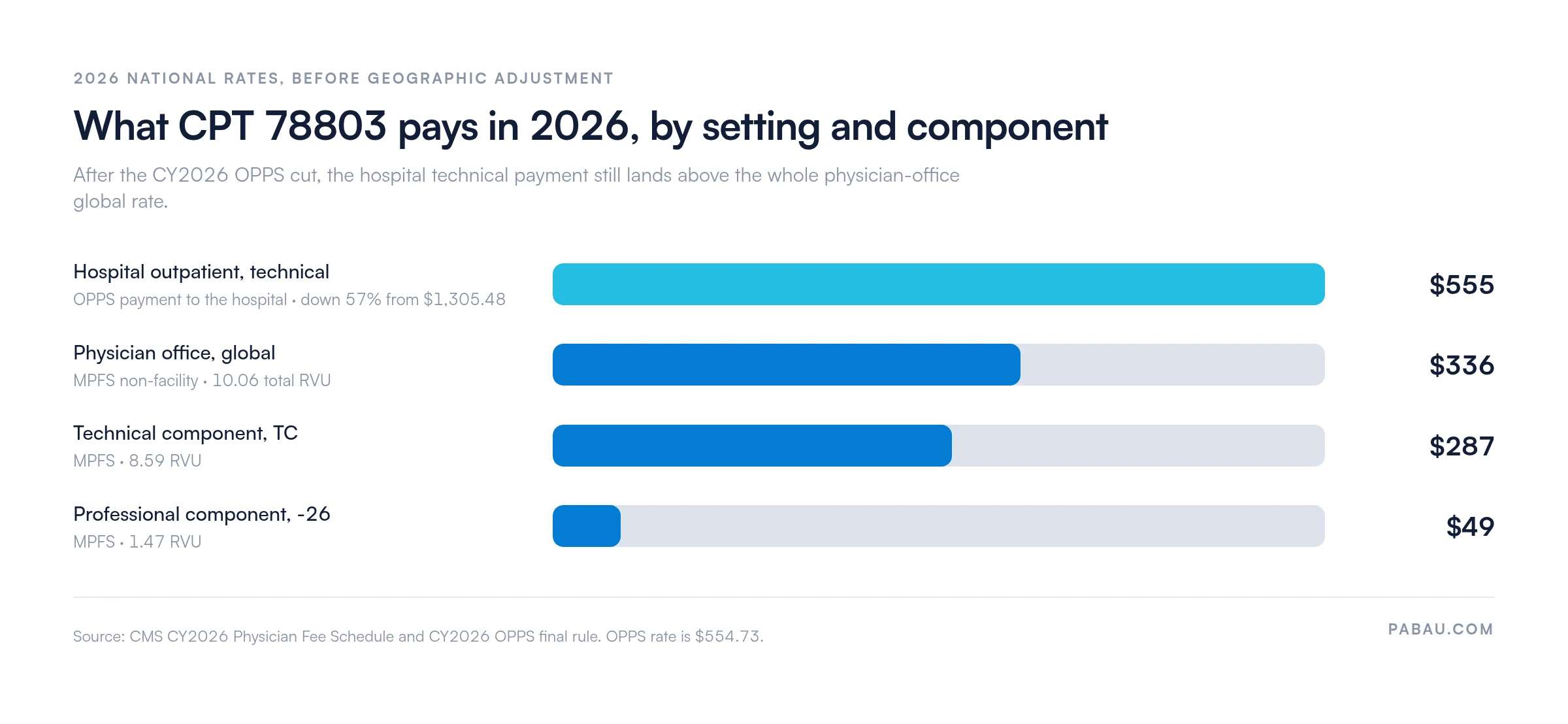
CMS finalized a large payment cut for PYP and amyloid imaging in the CY2026 hospital outpatient prospective payment final rule, effective January 1, 2026. The hospital rate for these scans fell roughly 57%, from $1,305.48 to $554.73. The American Society of Nuclear Cardiology (ASNC) opposed the reduction while it was still a proposal.
Practices that moved amyloid imaging into a hospital outpatient department on the old rate should rebuild their volume assumptions around the new one. Track the paid amounts on your remittances through the first quarter, because contractor implementation can lag a final rule by several weeks.
The ICD-10 code you pair with 78803 carries the medical necessity argument on its own. No coverage determination publishes code-specific criteria for 78803, so the diagnosis link does that work unaided.
A mismatch between the clinical indication and the paired diagnosis is a leading denial reason for nuclear medicine claims. Check every candidate against the current ICD-10-CM code set before you build it into an order template.
E85.81, E85.82 and E85.89 took effect on October 1, 2017, at the start of FY2018. They replaced the deleted code E85.8, which had grouped every other amyloidosis under one entry. Reach for I43 only when the record names the underlying systemic disease. Confirm each code against the CDC/NCHS ICD-10-CM web tool.
CPT 78803 carries a PC/TC indicator of 1, so it can be split-billed between the reading physician and the facility. Modifier applicability is payer-specific. The table below summarizes the modifiers that commonly apply, but confirm each one against the payer’s own billing manual before you submit.
CPT 78803 belongs to the radiopharmaceutical localization family that CPT restructured in 2020. Choosing between codes in this family is where upcoding and downcoding errors most commonly occur. Three variables separate them.
SPECT vs PET: PET imaging uses entirely separate CPT codes, such as 78816 for whole-body PET. PET detects positron-emitting radionuclides, while SPECT detects single-photon gamma rays from tracers like Tc-99m. Never bill 78803 for a PET acquisition.
Parathyroid studies have their own codes as well. A sestamibi scan that localizes a parathyroid adenoma reports 78070 for planar images, and 78071 once SPECT is acquired. Those dedicated codes take precedence, so a parathyroid SPECT never bills as 78803.
The dominant clinical use driving 78803 volume in cardiology departments is the Tc-99m pyrophosphate (PYP) cardiac SPECT scan. It diagnoses transthyretin amyloid cardiomyopathy (ATTR-CM).
This non-invasive scan has become the preferred diagnostic tool for ATTR-CM, because in the right clinical context it confirms the diagnosis without endomyocardial biopsy.
The chest is one area imaged on one day, so a standard PYP protocol sits squarely inside the 78803 descriptor. Billing this indication correctly requires attention to four points.
Because no coverage determination sets criteria for 78803, your documentation is the entire medical necessity argument. Have the ordering physician record the clinical suspicion of ATTR-CM before the scan is performed, not after. Retroactive documentation is a standard audit finding and will not support the claim.
No Local Coverage Determination and no National Coverage Determination currently governs CPT 78803. That holds for the PYP cardiac scan and for every other indication the code covers. A search of the full CMS Medicare Coverage Database returns no active LCD, billing and coding article, or NCD that addresses the code.
Billing resources routinely name LCD L33560, Cardiovascular Nuclear Medicine, as the governing policy. It is not. Neither L33560 nor its companion billing and coding article A56743 mentions 78803, pyrophosphate, or amyloid anywhere in its text.
The code list in those two documents is confined to perfusion, cardiac function, blood pool, and infarct-avidity studies. It runs 78451, 78452, 78453, 78454, 78466, 78468, 78469, 78472, 78473, 78481, 78483, 78494, and 78496. A PYP amyloid study is none of those.
With no code-specific policy in force, coverage falls to your MAC under the general reasonable-and-necessary standard in Section 1862(a)(1)(A) of the Social Security Act. That changes how a billing team should work the claim.
Tie your compliance checklist to your MAC’s stated expectations rather than to a policy number. Re-check the Medicare Coverage Database each quarter, because a new LCD covering amyloid imaging would change this position overnight.
A clean 78803 claim starts with complete documentation before the scan is performed. Incomplete records are the second most common reason, after ICD-10 mismatch, for post-payment audits and recoupment demands on nuclear medicine claims. The record behind the claim must capture every element listed below.
Build this checklist into the ordering workflow rather than the billing queue. Missing elements then get flagged before the scan, rather than after the claim comes back denied.
Most 78803 denials are preventable. The errors below recur in nuclear medicine billing departments, and each has a specific fix.
For practices managing high volumes of nuclear medicine claims, front-end edits at the clearinghouse catch many of these errors before the claim reaches the payer. Documentation checkpoints built into the ordering workflow catch most of the rest.
Run a quarterly audit of your 78803 claims. Pull every claim submitted in the last 90 days and flag any where the POS code does not match the imaging facility’s enrollment type. POS mismatches consistently generate payment recoupments on nuclear medicine audits.
Nuclear medicine billing teams lose most of their time to the handoff between the order, the imaging report, and the claim. The clinical indication sits in one system, the dose record in another, and the biller reassembles both after the fact.
Practice management software like Pabau keeps the order, the clinical note, and the claim on a single patient record. Pabau’s claims management software connects to the Claim.MD clearinghouse, so eligibility checks, 837 submission, and ERA posting happen without rekeying anything.
That matters more for a code with no published coverage criteria. Your medical necessity documentation stays attached to the claim it supports. A denial then comes back to a team that can see the original order and report in seconds. That shortens the wait between service and payment.

Pabau integrates with the Claim.MD clearinghouse to support CPT claim submission, eligibility checks, and ERA processing for nuclear medicine practices. See how it works for your billing team.

CPT Code 78803 demands precision at every step. Confirm that the report documents a SPECT acquisition of one area on one day. Then split the professional and technical components correctly, and pair an ICD-10 code that supports the indication.
Then remember what is not there. No LCD or NCD sets coverage criteria for this code. The documentation you assemble before the scan is the whole medical necessity case, and your MAC decides on that alone.
Pabau’s nuclear medicine claims workflows, backed by a Claim.MD connection to thousands of payers, help billing teams submit cleaner 78803 claims and work denials faster. To see how Pabau handles nuclear medicine billing for your practice, book a demo.

Need to understand how clean claims are built? Submitting clean claims in medical billing covers the elements that prevent front-end rejections across all CPT codes.
Want to streamline ERA processing after CPT 78803 submissions? Electronic remittance advice explained walks through how ERAs map payer decisions back to individual claim lines.
Looking for context on how clearinghouses process nuclear medicine claims? How a medical claims clearinghouse works explains the validation layer between your practice and the payer.
CPT Code 78803 bills tomographic (SPECT) nuclear medicine imaging of a single area, acquired on a single day. Its most common clinical application is the Tc-99m pyrophosphate (PYP) cardiac SPECT scan for diagnosing ATTR cardiomyopathy. It also covers other single-area SPECT localization studies for tumor or inflammatory process.
No. CPT 78803 is single area, single day only, and no CPT edition has given it a whole-body option. Whole-body scope belongs to the planar codes 78802 (single day) and 78804 (two or more days). SPECT covering two or more areas, or one area over multiple days, is 78831.
No. No current Local Coverage Determination or National Coverage Determination in the Medicare Coverage Database addresses CPT 78803. LCD L33560 (Cardiovascular Nuclear Medicine) is often cited in error, but neither it nor article A56743 mentions 78803, pyrophosphate, or amyloid. Your MAC decides coverage under the general reasonable-and-necessary standard.
The 2026 national Medicare non-facility rate for the global service is about $336, before GPCI adjustment. Split billing pays roughly $49 for the professional component and $287 for the technical component. When the scan is performed in a hospital outpatient department, the hospital bills the technical side under OPPS at $554.73 for CY2026.
Modifier -26 (Professional Component) applies when the reading physician bills separately from the facility. Modifier TC applies when the facility bills for the technical component. Modifier -59 may be used when 78803 is billed alongside another procedure that would otherwise be bundled per NCCI edits. Modifier applicability is payer-specific, so verify against the payer’s billing manual before submitting.
Yes. CPT 78803 is the correct code for the SPECT component of the Tc-99m pyrophosphate (PYP) cardiac scan used to diagnose ATTR cardiomyopathy. The chest is one area imaged on one day, which fits the descriptor. The radiopharmaceutical is reported separately under HCPCS A9538, subject to current NCCI bundling edits. Do not use CPT 78452 (myocardial perfusion SPECT) for a PYP scan.
CPT 78803 covers single-area, single-day SPECT localization imaging, including PYP scans for cardiac amyloidosis. CPT 78452 is specific to myocardial perfusion imaging using SPECT, usually with stress and rest phases for coronary artery disease evaluation. These are distinct procedures, and using 78452 for a PYP amyloid scan is incorrect.
A clean 78803 claim needs the ordering physician’s documented clinical indication and the correct place-of-service code. It also needs the single area imaged, the date of acquisition, and the radiopharmaceutical name, dose and administration time. The interpreting physician must sign the imaging report. No coverage determination sets criteria for this code, so the medical record alone has to support medical necessity for your MAC.



