HCPCS Code L0472: Hyperextension TLSO billing guide
HCPCS code L0472: Official descriptor and device definition HCPCS code L0472 des...

Last Updated: Nov 5, 2026
70481 is the CPT code for computed tomography of the orbit, sella, or posterior fossa or outer, middle, or inner ear, with contrast material(s). It covers a single post-contrast CT series of these head structures, including the temporal bone.
The code turns on what the radiology report documents. A post-contrast series alone is 70481, a study without contrast is 70480, and a pre-contrast series followed by a post-contrast series is 70482.
Let Pabau's smart automation suggest the right codes, reduce claim denials, and keep your practice compliant—effortlessly.
Automate repetitive tasks and focus on what matters most—your patients.
Reduce coding errors and ensure compliance with the latest regulations.
Clean claims, fewer denials, and faster reimbursements.
Powerful insights and reporting to help your practice thrive.
HIPAA compliant SOC 2 certified GDPR-compliant Trusted by 4,000+ clinics worldwide

CPT code 70481 covers CT of the orbit, sella, posterior fossa, or outer, middle, or inner ear with contrast only. Use 70480 for a study without contrast and 70482 for both phases.
The radiology report must document the contrast agent administered, the anatomical structures imaged, and the clinical indication to support medical necessity.
Medicare’s 2026 national payment for 70481 is about $180 (5.38 total RVUs), the same in facility and non-facility settings. Check your locality rate in the CMS fee schedule each year.
Pabau, our practice management and billing platform, checks eligibility and claim details before submission. Radiology billing teams fix errors before a payer denies the claim.
CPT code 70481 describes “Computed tomography, orbit, sella, or posterior fossa or outer, middle, or inner ear; with contrast material(s).” The code is maintained by the American Medical Association (AMA) CPT codebook and sits in the 70450-70498 head and neck CT range of diagnostic radiology. The medical billing process for this study begins with confirming which contrast variant the radiologist performed.
Three elements define 70481. First, the modality is computed tomography, not MRI or plain film. Second, the scan targets one or more of four areas: The orbit, the sella turcica, the posterior fossa, or the outer, middle, or inner ear. Third, contrast material was administered, typically intravenous iodinated contrast.
Understanding which anatomical structures fall under CPT code 70481 helps coders confirm that the radiology report supports the chosen code before the claim is filed.
Medical necessity documentation must tie the study to a supported diagnosis from the ICD-10-CM code set. Commonly paired codes include H05.20 (unspecified exophthalmos), D35.2 (benign neoplasm of pituitary gland), and C71.6 (malignant neoplasm of cerebellum). For an acoustic neuroma workup, D33.3 (benign neoplasm of cranial nerves) applies.
The ordering physician’s record must state the clinical indication. The diagnosis code alone does not satisfy medical necessity review.
Verify the ICD-10-CM code against the payer’s Local Coverage Determination (LCD) for CT head imaging before submitting. MAC jurisdictions publish different covered diagnoses for orbit and posterior fossa CT studies. An unrecognized diagnosis is a leading cause of medical necessity denials for CPT code 70481.
The three codes in the 70480-70482 family differ by contrast use alone. Misreading the contrast phase is a common coding error on this study, and it drives contrast-variant denials.
The key verification step is reading the radiology report’s technique section. Suppose it reads “post-contrast images were obtained following IV injection of [contrast agent].” With no pre-contrast series mentioned, CPT code 70481 is correct. If the report documents a pre-contrast series followed by a post-contrast series, use 70482. The two questions below settle every study in this family.
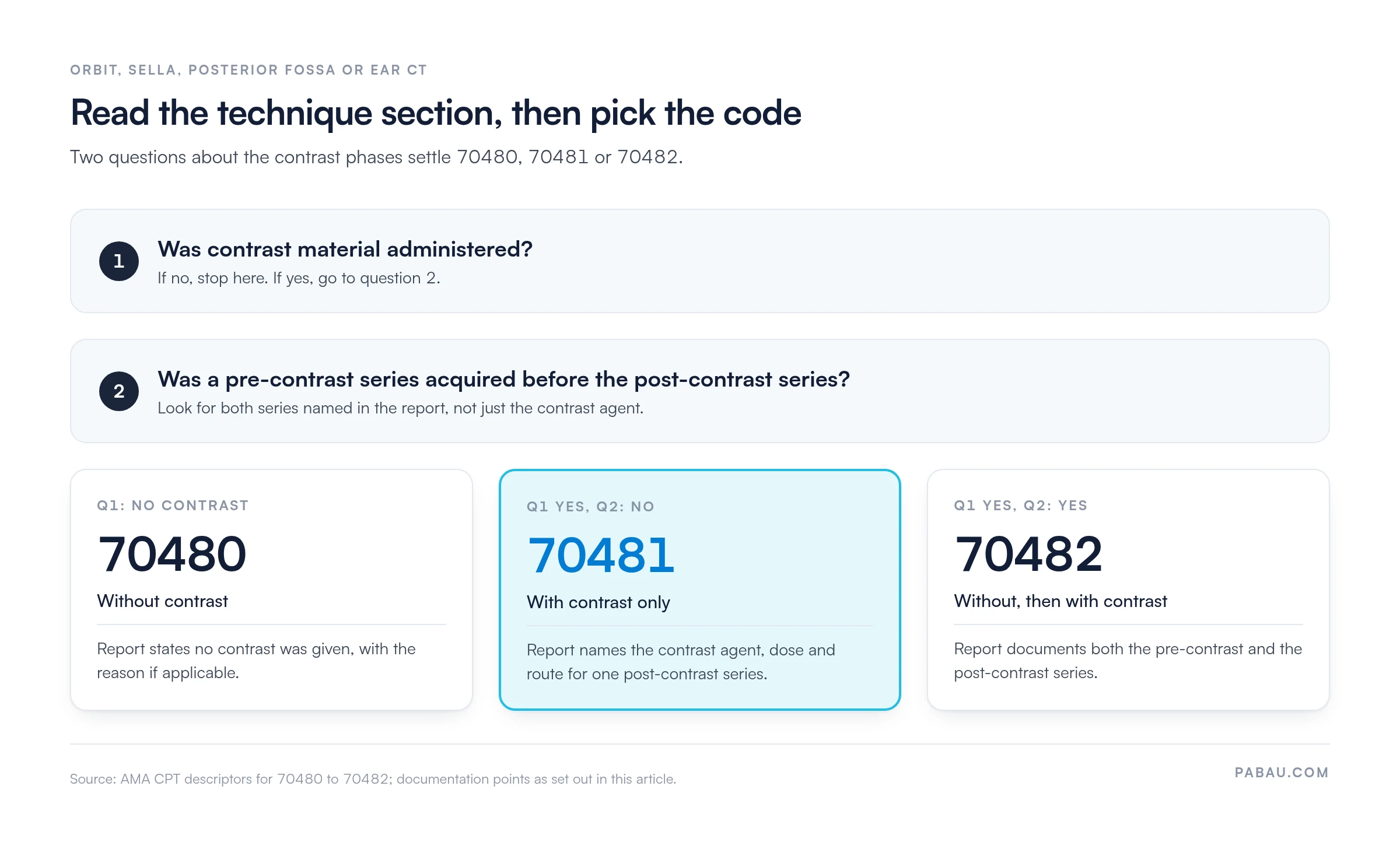
CPT code 70481 belongs to the 70450-70498 head and neck CT range. Understanding how adjacent codes relate prevents unbundling errors and wrong-family submissions.
A frequent wrong-family error is billing the maxillofacial CT code, 70486, when the ordering physician notes sinuses. If the primary clinical question involves the orbit, sella, posterior fossa, or ear, the 70480-70482 family applies regardless of whether sinuses are incidentally visualized.
Complete documentation protects the claim from medical necessity and contrast-variant denials. Both the radiology report and the ordering physician’s record contribute required elements. Submitting a clean claim for CPT code 70481 depends on capturing all of these before the claim is queued.
Medicare pays for CPT code 70481 under the Medicare Physician Fee Schedule (MPFS). For this code, CMS lists the same total RVU in facility and non-facility settings, so one global figure applies to both.
Rates are updated annually on January 1 and vary by locality through the Geographic Practice Cost Index (GPCI). The figures below use the 2026 fee schedule and its national conversion factor of $33.4009. Verify your locality rate in the CMS MPFS lookup tool before submitting claims.
Use the FastRVU RVU lookup tool to pull current work, practice expense, and malpractice RVUs for CPT code 70481 by locality. When radiologists and facilities bill separately, modifier 26 (professional component) applies to the interpreting physician’s claim. Modifier TC (technical component) applies to the facility’s claim. Billing both on the same claim without splitting the components is a global billing scenario and requires confirmation with the specific payer’s policy.
Traditional Medicare does not require prior authorization for CPT code 70481, while many Medicare Advantage, commercial, and managed Medicaid plans do. Running insurance eligibility verification before scheduling the study confirms both coverage and whether the specific plan requires pre-authorization.
Before an authorized claim passes through a clearinghouse like Claim.MD, confirm that the authorization number sits in item 23 of the CMS-1500 form. A missing or mismatched authorization number on an authorized service is a preventable denial.
Most denials on CPT code 70481 fall into five categories, and each has its own corrective path. Effective denial management workflows track these by denial reason code to surface patterns across payers.
Three modifiers apply most commonly to CPT code 70481 claims. Modifier 50 is generally not reported on this code, because one study already covers both orbits and CMS applies no bilateral payment adjustment to it.
Modifier 59 carries audit risk when used without clear supporting documentation. Confirm the National Correct Coding Initiative (NCCI) edits for CPT code 70481 in an authoritative CPT coding reference before appending modifier 59. Repeated, unsupported use is a pattern that triggers payer review.
When billing CPT code 70481 alongside a head CT code on the same date, check the CMS NCCI procedure-to-procedure edits before submitting. Many pairings between the orbit/sella family and the head CT family (70450/70460) are bundled edits. Modifier 59 requires documented evidence that the two studies addressed entirely separate clinical questions. That separation must be apparent in the radiology reports, not only implied.
Radiology billing teams handling a high volume of 70480-70482 claims need a workflow that flags contrast-variant mismatches before submission. Claims management software with built-in CPT and ICD-10 catalogs lets coders check the code, modifier, and diagnosis combination. That check runs against payer edits before the 837P file is transmitted.

Pabau integrates with Claim.MD, its US clearinghouse partner, for 837P claim submission, real-time eligibility verification, ERA/835 reconciliation, and secondary claim handling. For practices billing CPT code 70481 under several payer contracts, a missing prior authorization number or mismatched modifier gets caught before transmission.
Fixing the claim at that stage takes minutes. Working the same error after adjudication means an appeal, a resubmission, and a longer wait for payment.

Pabau’s claims management tools help billing teams submit accurate CPT codes, verify eligibility before appointments, and manage denials with built-in workflow automation. See how it works for your practice.

Code 70481 only when the technique section shows a single post-contrast series of the orbit, sella, posterior fossa, or ear. If the report is vague about contrast, query the radiologist before the claim goes out rather than appealing a downcode afterward.
That check adds a minute to each study and removes the denials that cost the most to work, from contrast variants to missing authorization numbers. To see how Pabau runs it inside your claims workflow, book a demo.

Need to understand how clearinghouse submissions work? 837 file format guide walks through the electronic claim transaction structure used for CPT code 70481 submissions.
Looking for denial reason code definitions? Denial codes in medical billing covers the CARC and RARC codes most frequently returned on imaging claim denials.
Comparing against a whole-head study? CPT code 70460 explains how to code CT of the head or brain with contrast.
Want to review revenue cycle fundamentals? Revenue cycle management overview explains how imaging billing fits into the end-to-end payment collection workflow.
CPT code 70481 is a computed tomography scan of the orbit, sella, posterior fossa, or outer, middle, or inner ear performed with contrast material. It covers acquiring and interpreting a post-contrast CT study of these regions. It does not cover a study without contrast or a two-phase study, which fall under 70480 and 70482 respectively.
The three codes differ by contrast phase only. Code 70480 covers CT of the orbit, sella, posterior fossa, or ear without contrast. Code 70481 covers the study with contrast only, as a single post-contrast series. Code 70482 covers a pre-contrast series followed by a post-contrast series. The technique section of the radiology report determines which code applies.
Traditional Medicare fee-for-service does not require prior authorization for CPT 70481. Medicare Advantage plans and many commercial payers do, often through radiology benefit managers such as eviCore or Carelon Medical Benefits Management. Always verify with the specific payer and plan before scheduling the study.
Under the 2026 Medicare Physician Fee Schedule, the national payment for CPT 70481 is about $180. That is 5.38 total RVUs multiplied by the $33.4009 conversion factor, or $179.70. The same global figure applies in facility and non-facility settings. Use the CMS MPFS lookup tool to pull the rate for your locality, since GPCI adjustments move it above or below the national figure.
Billing CPT 70481 and CPT 70486 on the same date is permissible when the two studies addressed separate, documented clinical questions. The pair is subject to NCCI bundling edits, so modifier 59 may be required. The radiology reports for both studies must independently document distinct anatomical targets and clinical indications. A claim submitted without checking the NCCI edit status first is likely to deny.
The most common reasons are a radiology report that does not document contrast, which triggers a downcode to 70480, and a missing prior authorization number. Others include an ICD-10-CM diagnosis not covered under the payer’s LCD and modifier errors when professional and technical components are split. Matching the Explanation of Benefits denial reason code to these categories identifies the corrective action.