CCSD code F3070: Suture of palate billing guide
CCSD code F3070 covers stitching a wound in the palate CCSD code F3070 is the co...

Last Updated: Oct 12, 2026
70460 is the CPT code for computed tomography, head or brain; with contrast material(s). It reports a head CT acquired only after intravenous contrast, with no pre-contrast series in the same session.
Coders who confuse it with 70450 (no contrast) and 70470 (without and with contrast) risk avoidable denials. The 2026 Medicare national rate for the global service is about $148.
Let Pabau's smart automation suggest the right codes, reduce claim denials, and keep your practice compliant—effortlessly.
Automate repetitive tasks and focus on what matters most—your patients.
Reduce coding errors and ensure compliance with the latest regulations.
Clean claims, fewer denials, and faster reimbursements.
Powerful insights and reporting to help your practice thrive.
HIPAA compliant SOC 2 certified GDPR-compliant Trusted by 4,000+ clinics worldwide

CPT code 70460 covers a head CT acquired with IV contrast only, while 70450 has no contrast and 70470 captures both phases in one session.
Modifier 26 reports the professional component and TC the technical component, and LT/RT modifiers never apply to head CT codes.
The 2026 Medicare national rate is about $148 for the global service, split into about $52 for modifier 26 and $96 for TC.
Missing prior authorization is one of the most preventable 70460 denials, so run the check at scheduling for Medicare Advantage, commercial and Medicaid plans.
Pabau’s claims management software connects to the Claim.MD clearinghouse, so your team can run eligibility checks, submit 70460 claims and post remittances in one system.
CPT code 70460 is the billable AMA procedure code for “Computed tomography, head or brain; with contrast material(s).” The code covers a single contrast-enhanced acquisition of the cranial vault and its contents, from skull base to vertex. It sits in the diagnostic radiology section of the CPT code set and applies in both inpatient and outpatient settings.
Contrast administration for CPT code 70460 means intravenous iodinated contrast is injected before or during acquisition. The resulting images show vascular enhancement, blood-brain barrier breakdown, and lesions that a non-contrast scan can miss. Accurate medical billing for this study starts with the phases the technologist acquired. That one detail decides whether 70450, 70460, or 70470 is correct.
The global service bundled into CPT code 70460 covers contrast administration supervision, image acquisition, and the radiologist’s interpretation and report. Charging separately for contrast supervision is unbundling, and CMS Correct Coding Initiative (CCI) edits will catch it.
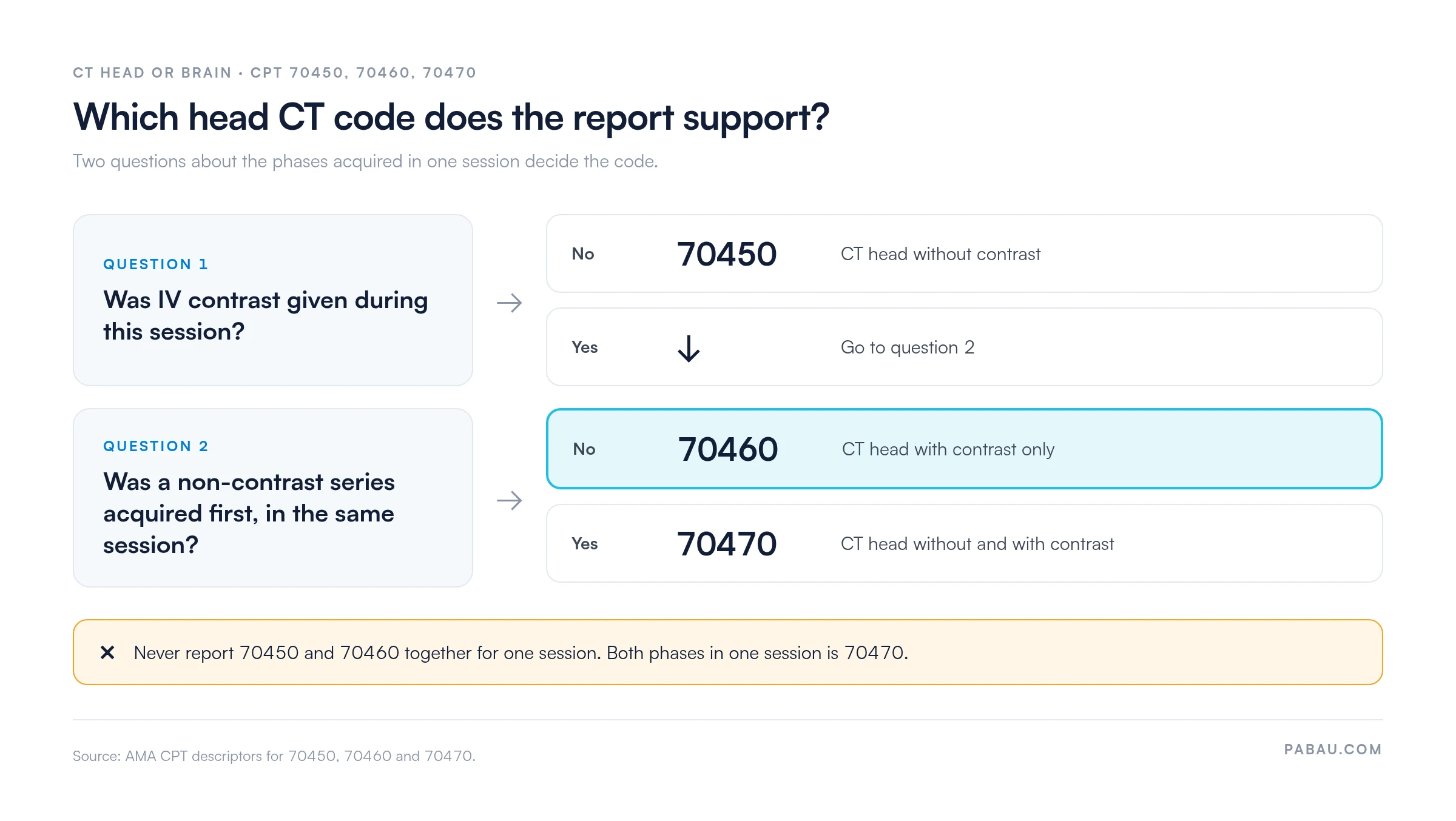
The three CT head codes share an identical body region but differ by contrast phase. Picking the wrong one of 70450, CPT code 70460, and 70470 is a frequent cause of downcoded or denied radiology claims. Bill only the phases the radiology report documents.
Key decision rule: If only a contrast-enhanced series was acquired, with no pre-contrast baseline, bill 70460. If a non-contrast run came first in the same session, followed by a contrast run, bill 70470. Never bill 70450 and 70460 for the same session, because payers treat that as duplicate billing. The diagram below walks through the two questions that settle it.
A clean claim for CPT code 70460 depends on documentation that mirrors the clinical workflow. MAC Local Coverage Determinations require the radiologist report to contain specific elements before the professional component is payable.
A pre-submission clean claim checklist flags a missing contrast dose or an unsigned report before the claim reaches the clearinghouse.
Payers evaluate medical necessity for CPT code 70460 by matching the billed ICD-10-CM diagnosis against their LCD or coverage policy. A mismatch, or a non-specific code when a more precise one exists, is among the most common denial triggers. The table below lists frequently accepted ICD-10-CM codes, sourced via the CrossCoder CPT-to-diagnosis crosswalk.
Important caveat: Facial pain or sinusitis (J32.x) does not support medical necessity for CPT code 70460. The correct code for sinus imaging is 70486 (CT maxillofacial without contrast) or 70487. Billing 70460 for a sinusitis indication will trigger a medical necessity denial. ICD-10-CM specificity matters: use the most precise code available rather than an unspecified catch-all wherever documentation supports it.
Before submitting a 70460 claim, pull your MAC’s LCD for CT of the head, if one applies in your jurisdiction. Cross-reference your ICD-10-CM code against its covered diagnosis list. A code missing from that list will trigger a medical necessity denial, however well the radiologist report is written.
Medicare payment for CPT code 70460 is set each year in the Medicare Physician Fee Schedule (MPFS). Rates vary by locality, setting, and whether the claim is global, professional component only (modifier 26), or technical component only (modifier TC). The figures below are 2026 national unadjusted rates from the CMS PFS relative value file. Your MAC applies a locality adjustment, so check your own rate before contracting or forecasting revenue.
2026 is the first year with two conversion factors. Most clinicians are paid at $33.4009 per RVU, while qualifying APM participants (QPs) get $33.5675. Comparing these rates against what payers deposit is part of any working revenue cycle management process.
In a hospital, only the professional component is paid under the MPFS. The hospital bills the technical side under its own facility payment system, so the global and TC rates above apply to freestanding and office settings.
For the full RVU breakdown, download the current CMS PFS relative value files. Medicaid rates vary by state, and so does the prior authorization route. Alabama Medicaid, for example, routes prior authorization for this code through eviCore Healthcare. Contact your state Medicaid program for current fee schedule figures, because rates change at least annually.
Pabau, the practice management and billing platform we build, lets your team run real-time eligibility checks through its Claim.MD integration. Coverage is confirmed before the scan instead of after a denial.
Prior authorization is not universally required for CPT code 70460. The risk of a missing-PA denial is highest when the payer uses a radiology benefits manager (RBM). Requirements vary by plan and can change without notice, so verify with each payer before scheduling.
Maintaining medical billing compliance for imaging codes means building a PA verification step into the scheduling workflow, not the billing workflow. By the time a claim is denied for missing PA, the imaging has already been performed and the appeal window is the only recovery path.
CPT code 70460 has a predictable denial profile. Most denials fall into six categories, each with a clear prevention step and an effective denial management strategy.
Each month, sort your 70460 denials by payer and CARC denial codes. A cluster of CO-197 denials (missing prior authorization) points to the scheduling workflow. A cluster of CO-50 (not medically necessary) or CO-11 (diagnosis inconsistent with procedure) denials signals an ICD-10 documentation problem.
Modifier selection for CPT code 70460 determines who gets paid and for what. Getting it wrong is a common billing error in freestanding imaging centers and hospital-based radiology departments alike.
Global billing: When a freestanding imaging center employs its own radiologists and owns its equipment, it bills both components. Submit CPT code 70460 without any component modifier, and the payer pays the global rate. Pabau’s claims management software, with its Claim.MD integration, submits and tracks each 70460 claim with the modifiers your team enters.
Run a quarterly audit of your 70460 claims split by modifier. If your professional-component payments consistently fall short of the expected modifier 26 rate, check how modifier 26 is appended. It belongs on every encounter where the radiologist does not own the equipment. A missing modifier 26 means the radiologist’s interpretation is being billed globally and the reimbursement is allocated to the wrong entity.
Several codes neighbor CPT code 70460 in the diagnostic radiology section. Coders frequently encounter them in the same imaging order or on the same date of service and need to distinguish them cleanly. The AAPC Codify CPT lookup is a useful reference for checking descriptors and bundling edits across this code family.
Many imaging practices check eligibility on a payer portal, build the claim in a separate billing system, and match remittances by hand. Each handoff is another chance to lose an authorization number or a modifier 26.
In Pabau, eligibility checks, 837P claim submission, and electronic remittance advice (ERA) posting run through the Claim.MD clearinghouse integration. Your team enters the CPT code, modifiers, and ICD-10-CM diagnoses from the signed report. Pabau then submits and tracks the claim with those values.
Claim status and remittances come back through the same integration. Your billers can see which 70460 claims were paid, denied, or rejected without logging in to each payer portal.

Pabau’s claims management software connects to the Claim.MD clearinghouse, so your team can check eligibility, submit 837P claims, and post remittances in one system. Less time chasing denials leaves more time for patient care.

Code 70460 from the signed report, not the order. If the technologist acquired only post-contrast images, the claim is 70460. If a non-contrast series came first in the same session, it is 70470, whatever the order said.
Most of the revenue risk sits upstream of coding. Check prior authorization at scheduling and match the diagnosis to your MAC’s coverage policy before submission, and the common 70460 denials stop at the source.
Pabau’s Claim.MD clearinghouse integration supports eligibility checks, 837P submission, and ERA posting for 70460 and related imaging codes. Book a demo to see how it fits your radiology billing workflow.

Need guidance on clean claim submission? Clean claim best practices covers the pre-submission checks that prevent the most common radiology billing rejections.
Tracking denial patterns across your imaging codes? Denial management in healthcare walks through CARC-level analysis and appeal workflows for high-volume procedure codes.
Choosing a clearinghouse for imaging claims? Claim.MD clearinghouse explains how the clearinghouse handles eligibility, claim submission, and remittance for US payers.
Checking coverage before a contrast CT? Insurance eligibility verification shows what to confirm with the payer before the patient arrives.
Reconciling payments on 26 and TC claims? Electronic remittance advice explains how to read an ERA and post each adjustment code.
CPT code 70460 covers a CT scan of the head or brain performed with intravenous contrast material. When billed globally, it includes contrast supervision, image acquisition, and the radiologist’s interpretation. It does not cover a pre-contrast series, since that combination is billed as 70470.
Prior authorization depends on the payer. Traditional Medicare fee-for-service does not routinely require PA for 70460. Many Medicare Advantage plans, commercial payers using eviCore, and managed Medicaid plans do, so verify with each payer before scheduling the exam.
No. CPT code 70460 (contrast only) and 70470 (without and with contrast) cannot be billed together for the same head CT encounter. If both pre-contrast and post-contrast images were acquired in the same session, bill only 70470. Billing both codes for the same service is an unbundling error subject to CCI edits.
The most common denial reasons for CPT code 70460 are missing prior authorization and an ICD-10-CM code that does not support medical necessity. Duplicate billing with 70450 or 70470 and missing contrast documentation also recur. Missing PA is among the easiest to prevent, because the check happens at scheduling.