

CPT Code 98981: RTM Treatment Management Billing Guide
CPT code 98981: Definition and official descriptor CPT code 98981 is an add-on c...

Last Updated: Nov 9, 2026
69110 is the CPT code for excision external ear; partial, simple repair. It covers removal of a diseased or abnormal portion of the auricle, closed with a simple repair. The rest of the ear's cartilage and skin framework stays in place.
When the whole external ear is removed, CPT 69120 applies instead. Payers review 69110 claims for medical necessity, so the record has to show the lesion was symptomatic, obstructing, or malignant.
Let Pabau's smart automation suggest the right codes, reduce claim denials, and keep your practice compliant—effortlessly.
Automate repetitive tasks and focus on what matters most—your patients.
Reduce coding errors and ensure compliance with the latest regulations.
Clean claims, fewer denials, and faster reimbursements.
Powerful insights and reporting to help your practice thrive.
HIPAA compliant SOC 2 certified GDPR-compliant Trusted by 4,000+ clinics worldwide

CPT code 69110 covers partial excision of the external ear with simple repair. Complete removal of the ear is coded 69120.
The code carries a 90-day global period, so related post-operative visits are bundled into the surgical package.
Append RT or LT to every 69110 claim, because a missing laterality modifier is one of the most frequent denial triggers.
The operative note must record lesion size, margins, closure technique, and laterality to pass medical necessity review.
Pabau, the practice management platform we build, scrubs each claim for missing or invalid details before it goes out through the Claim.MD clearinghouse.
CPT code 69110 describes “Excision external ear; partial, simple repair.” The defining word is partial. The surgeon removes a diseased or abnormal portion of the auricle and preserves the remaining cartilage and skin framework. That separates it from CPT 69120, which covers complete amputation of the external ear.
The code sits within the 69000-69399 range, which the American Medical Association designates as Surgical Procedures on the External Ear. ENT (otolaryngology) practices and plastic surgeons bill it most often. Dermatologists excising malignant or pre-malignant lesions of the pinna also bill it regularly.
The “simple repair” language in the descriptor matters for coding, because 69110 includes a primary closure only. When the defect is closed with an adjacent tissue transfer, the transfer code includes the excision. On the ear that is usually 14060, reported in place of 69110 rather than alongside it.
A skin graft or a complex layered closure is coded separately, so record the repair type explicitly in the operative note.
The table below summarizes the billing parameters coders need before submitting a 69110 claim.
Use the CMS Physician Fee Schedule lookup tool to retrieve the current-year facility and non-facility payment rates for 69110 by locality. Rates change each January 1 and vary by geographic pricing area, so bookmark the lookup rather than relying on a cached figure.
CPT 69110 covers partial removal of any part of the external ear. That includes the auricle (the visible cartilaginous structure), the pinna, and the periauricular skin attached to it. Lesion types within scope include:
The key exclusion is complete removal. If the surgeon removes the entire external ear, 69120 applies. The operative note must state that the ear architecture was preserved and the resection was partial.
Knowing the operative sequence helps coders confirm that the procedure maps to 69110 and that the note contains the elements payers audit.
The pathologist reports the specimen exam on their own claim, often with 88305 for a skin or soft tissue specimen. That exam sits outside the 69110 global package.
The operative note is the payer’s primary audit document. Three omissions most often trigger a medical necessity review or a downcode request. They are missing lesion dimensions, absent laterality, and a vague closure description.
One clinical fact decides between 69110 and 69120, and that is how much of the ear was removed. The table below maps the distinction and covers other codes coders sometimes pull instead of 69110.
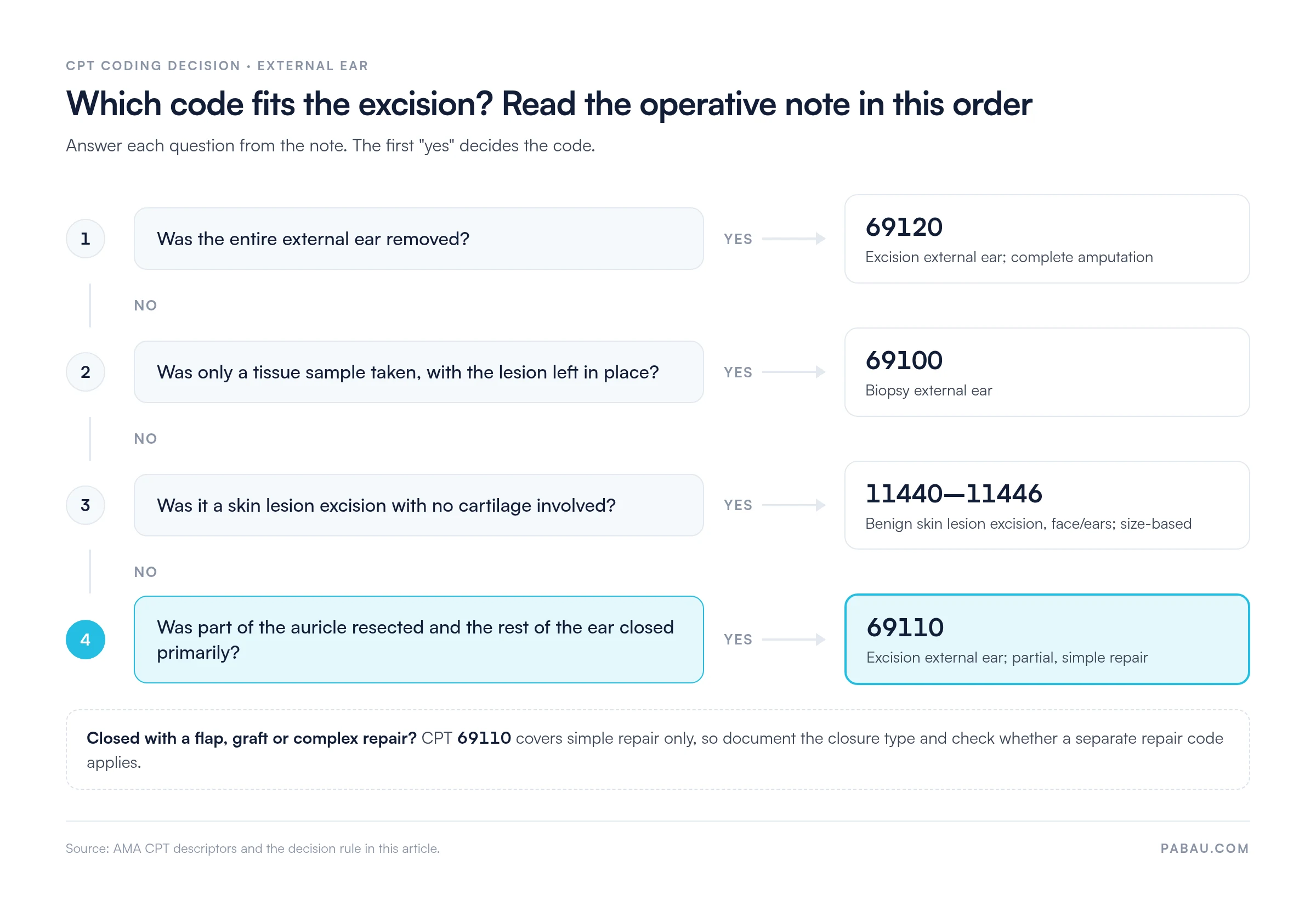
Decision rule: If the operative note states the auricle or pinna was partially resected and the remaining ear was repaired primarily, 69110 is correct. If the note states total removal of the ear, use 69120. When only a tissue sample was taken, 69100 applies instead.
A skin lesion excision with no cartilage involved usually belongs in the 11440 to 11446 range, so check with the surgeon before coding. A benign lesion with a 1.1 to 2.0 cm excised diameter on the ear, for example, is 11442. The chart below runs these questions in the order a coder should ask them.
Every 69110 claim requires a supporting ICD-10-CM diagnosis code that establishes medical necessity. The table below lists the codes payers most commonly accept with 69110, drawn from the CDC/NCHS ICD-10-CM web tool. For a diagnosis outside this list, our ICD-10-CM code library covers the full tabular list.
Caution: Codes in the Q17 and Q18 congenital range often attract cosmetic-exclusion reviews. Document any functional impairment, recurrent infection, or pain associated with the lesion to establish medical necessity beyond the diagnosis code alone.
Before submitting a 69110 claim with a congenital ear code (Q17.x, Q18.1), attach a clinical note on the patient’s symptoms. Recurrent infections, pain, or functional obstruction all count. A bare congenital diagnosis code without symptom documentation is the fastest route to a cosmetic-exclusion denial.
Medicare reimbursement for CPT code 69110 is set each year in the Medicare Physician Fee Schedule (MPFS). The Centers for Medicare and Medicaid Services (CMS) administers it. Payment rates differ based on place of service and geographic pricing locality.
Use the FastRVU lookup tool to retrieve current work, practice expense, and malpractice RVU values for 69110 without buying the full AMA data file.
For locality-adjusted dollar amounts, the CMS MPFS search tool is the authoritative source. The 90-day global also shapes the follow-up schedule, because related post-operative visits in that window are not billed separately.
After incomplete documentation, modifier selection is where 69110 claims fail most often. Each modifier below triggers a specific reimbursement or processing rule.
Each denial below traces back to the record or the claim form, which is where it gets fixed for good. These are the most frequent triggers, based on coding guidance from the AAPC and common payer audit patterns.
A denial is cheapest to prevent while the note is still being written. The checklist below maps to the elements payer reviewers check against Local Coverage Determinations (LCDs) on 69110 claims.
When billing runs in a tool kept apart from the chart, a coder reads the operative note and retypes the code. The modifier gets picked by hand. Each handoff is a chance to drop the RT or LT, or to send a congenital diagnosis with no symptom note.
In Pabau, the operative note and the claim sit on the same patient record. Pabau’s claims management software scrubs every claim for missing or invalid details before it leaves, and flags any that need action. Claims then go out through the Claim.MD clearinghouse to thousands of US payers.
Eligibility checks run before the procedure date, so a coverage problem surfaces while it can still be fixed. Claim status updates and electronic remittance advice (ERA) come back against the same record. For the habits that get a claim paid first time, see our guide to the clean claim.

Pabau scrubs each claim for missing or invalid details, checks eligibility before the visit, and posts ERA payments against the patient record. See how it handles surgical claims like 69110.

A clean 69110 claim is decided in the operative note, well before anyone opens the claim form. The note has to say how much of the ear came off, which side, and how the wound was closed. The code and the modifier follow from those three lines.
The 90-day global is the detail to carry forward from this page. Plan post-operative visits as part of the package. Use modifier 57 when the decision to operate is made that day or the day before, and keep 58, 78 and 79 for what follows.
Pabau sends each claim through the Claim.MD clearinghouse to thousands of US payers, scrubbed before it leaves. Book a demo to see how Pabau keeps ear surgery claims moving from note to payment.

Need to understand how claims reach payers electronically? 837 file format guide explains how electronic claim files are structured and transmitted.
Seeing repeated denials on surgical claims? Denial management in healthcare covers how to build a systematic denial reduction workflow.
Want to verify patient coverage before the procedure date? Insurance eligibility verification explains the real-time check process that prevents post-service cosmetic-exclusion surprises.
CPT code 69110 covers partial excision of the external ear (auricle or pinna) with simple repair. Surgeons use it when they remove a diseased or abnormal portion of the ear and preserve the rest of its structure. It covers benign lesions, malignant lesions, preauricular cysts, and ear tags. Complete removal of the ear is coded 69120 instead.
CPT 69110 covers partial excision of the external ear, and CPT 69120 covers complete amputation of the external ear. The clinical record must state whether the ear architecture was preserved (69110) or the entire ear was removed (69120). Miscoding between these two codes is a common audit trigger.
The most commonly accepted ICD-10-CM codes include H61.11x (acquired deformity of pinna) and C44.21x (basal cell carcinoma of ear skin). Others are D22.21 (melanocytic nevi of the right ear), Q18.1 (preauricular sinus and cyst), Q17.0 (accessory auricle), and L91.0 (hypertrophic scar or keloid). Congenital codes (Q17.x, Q18.x) need symptom documentation to avoid cosmetic-exclusion denials.
Medicare reimbursement for 69110 varies by geographic pricing locality and changes each January 1. Use the CMS Physician Fee Schedule lookup tool to retrieve current facility and non-facility rates for your specific locality. The non-facility (office) rate is higher than the facility rate because the facility overhead is billed separately by the hospital or ASC.
Yes, with the right modifier. Because 69110 carries a 90-day global period, the E/M visit that leads to the decision to operate takes modifier 57. That applies on the day of surgery or the day before. A significant, separately identifiable E/M service on the same day takes modifier 25. Without a modifier, the payer bundles the visit into the surgical package.
Yes. Preauricular cysts and sinuses (ICD-10 Q18.1) are among the most frequently billed indications for 69110. When the cyst has been recurrently infected or is symptomatic, medical necessity is straightforward to establish. Document the infection history, symptom duration, and any prior conservative management attempts to support the claim and reduce cosmetic-exclusion review risk.
The leading denial reasons start with a missing laterality modifier, since Medicare expects RT or LT. Cosmetic exclusions on congenital lesions without symptom documentation come next, followed by wrong code selection (69110 vs 69120). A same-day E/M billed without modifier 57 or 25, and operative notes that omit lesion size, margins, or closure type, round out the list. Each has a documentation fix that prevents it recurring.




