

CCSD code G5100: Bypass of duodenum billing guide
CCSD code G5100 bills a bypass that leaves the duodenum in place CCSD code G5100...

Last Updated: Oct 16, 2026
Billable Code
69100 is the CPT code for biopsy of external ear. It reports a diagnostic tissue sample taken from the auricle (pinna) and sent to pathology. Biopsies inside the ear canal are reported with 69105 instead.
Common denial triggers include missing laterality, a non-specific ICD-10 code, and an operative note that names the anatomic site too vaguely. Documenting the side, the exact site, the biopsy technique, and the pathology send-out keeps the claim payable.
Let Pabau's smart automation suggest the right codes, reduce claim denials, and keep your practice compliant—effortlessly.
Automate repetitive tasks and focus on what matters most—your patients.
Reduce coding errors and ensure compliance with the latest regulations.
Clean claims, fewer denials, and faster reimbursements.
Powerful insights and reporting to help your practice thrive.
HIPAA compliant SOC 2 certified GDPR-compliant Trusted by 4,000+ clinics worldwide

CPT code 69100 reports a diagnostic biopsy of the external ear, meaning the auricle or pinna. Canal biopsies are reported with 69105, and cerumen removal and full excision have their own codes.
The code sits in the Excision Procedures on the External Ear range (69100-69155). The operative note must document the site, laterality, and biopsy technique.
Billing a broad ICD-10 code when the pathology report supports a precise one is a common denial trigger. Precise options include C44.212, C44.219 (BCC) and D23.21, D23.22 (benign neoplasm).
Pabau’s claims management software connects to the Claim.MD clearinghouse for real-time eligibility checks, CMS-1500 claim submission, electronic remittance advice, and claim tracking.
In 2026, 69100 carries 2.77 total RVUs in the office and 1.12 in a facility, so the office setting pays roughly 2.5 times more.
CPT code 69100 is “Biopsy of external ear,” the procedure code for removing tissue from the auricle (pinna) for pathological analysis. Biopsies inside the external auditory canal are reported with 69105 instead. The code belongs to the Excision Procedures on the External Ear subsection of CPT, which covers 69100 through 69155. That code set is maintained by the American Medical Association.
The code covers any technique that obtains a diagnostic tissue specimen from the external ear. Punch, shave, incisional, and excisional biopsies all qualify, provided the intent is diagnostic rather than therapeutic removal. If the surgeon removes the entire lesion for curative intent, a different code in the 69100-69155 range typically applies.
The clinical steps of an external ear biopsy follow a standard surgical biopsy sequence. Coders who handle skin biopsies will recognize the pattern, but the anatomic site is what drives code selection.
The operative note language matters directly for coding. Payers expect the note to specify “right auricle,” “left helix,” or equivalent anatomic precision. A note that states only “ear lesion biopsy” lacks the laterality and site detail required for clean claim submission.
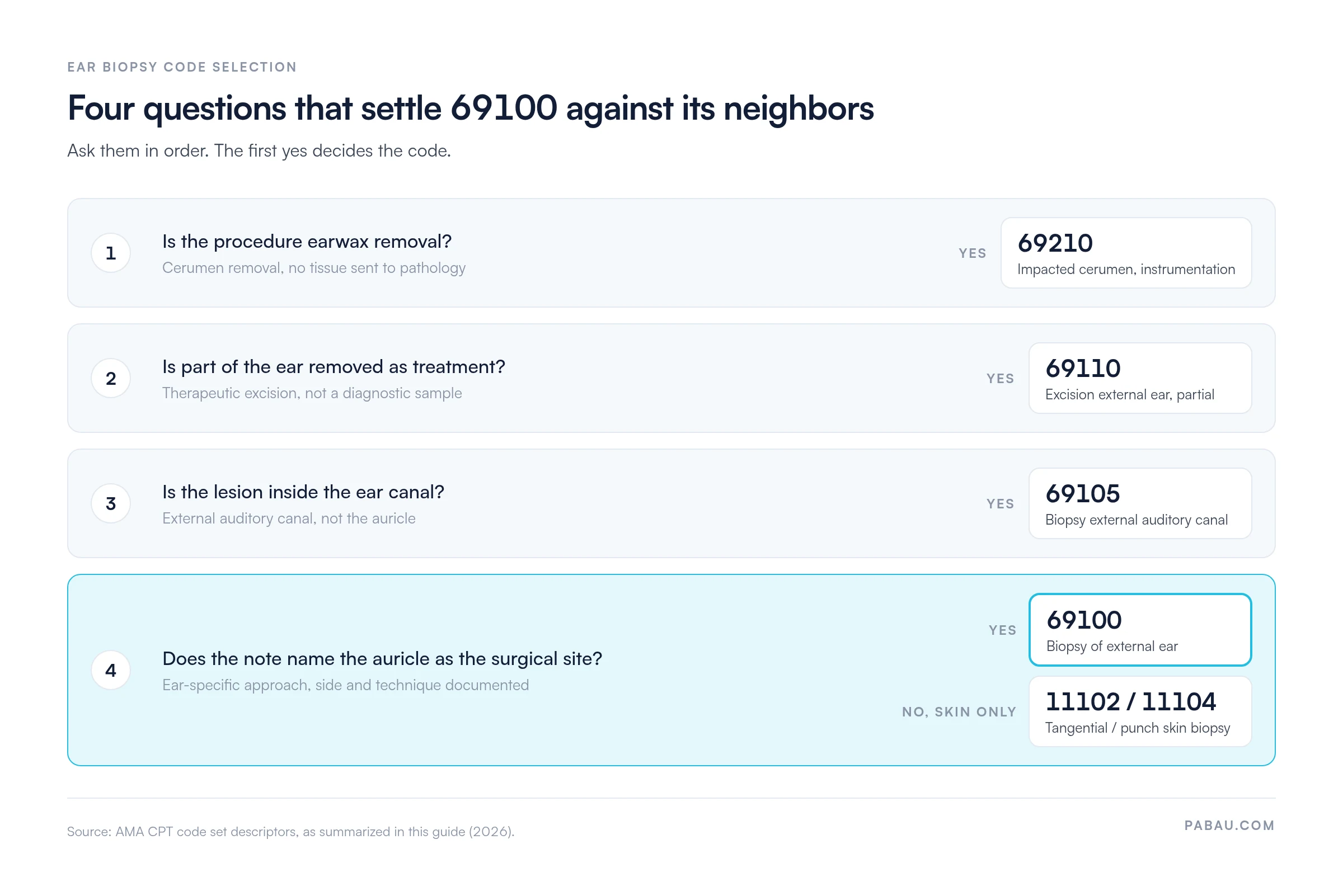
The external ear code range shares neighbors that coders frequently misapply. CPT 69100 reports a diagnostic biopsy only, so more extensive removal or a different procedure needs a different code. Earwax removal, for example, is reported with 69210, never with a biopsy code.
Auditors in ENT practices often flag the choice between 69100 and 11102. Use 69100 when the operative report names the external ear as the surgical site and describes an ear-specific approach. Use 11102 when the provider takes a standard tangential skin biopsy from the ear surface with no ear-specific surgical detail.
Those rules settle into four questions, asked in the order below. The first one that gets a yes decides the code.
Payers reviewing CPT 69100 claims look for six elements in the operative note. A clean claim submission requires all six to be present before the claim is sent, not added retrospectively during an audit.
Before submitting a CPT 69100 claim, run a quick documentation check. Confirm the note contains ‘right’ or ‘left’, the exact anatomic site, the word ‘biopsy’, and the pathology send-out. If any of the four is missing, flag the encounter for a provider addendum before billing.
Selecting the most specific ICD-10-CM code available is essential. Payers deny CPT 69100 claims when the diagnosis code is too broad to establish medical necessity for a surgical biopsy. Where a more specific code is available from the clinical presentation or pathology report, use it.
When the biopsy is performed for a suspected malignancy, code the presenting sign or symptom rather than the malignancy. The exception is a pathology report that confirms malignancy before the claim is submitted. Verify current payer-specific local coverage determinations (LCDs) via the CMS Physician Fee Schedule lookup for medical necessity linkage requirements.
The pathology read on a 69100 specimen is billed separately as CPT 88305. That code covers the Level IV gross and microscopic examination, and nearly every ear biopsy specimen goes to pathology for one.
Medicare reimbursement for CPT 69100 comes from the Medicare Physician Fee Schedule (MPFS). Total relative value units (RVUs) are multiplied by the annual conversion factor, then adjusted for geographic location (GPCI). Practices should verify current rates using the FastRVU 2026 RVU lookup, since rates change annually and vary by MAC jurisdiction.
At the 2026 conversion factor of about $33.40, those totals come to roughly $92.50 in the office and $37.40 in a facility. GPCI adjustment comes on top. Practice expense drives almost all of that difference, because the office pays for the supplies and staff time.
Important caveat: The RVU values above come from the 2026 MPFS and should be checked against the current calendar-year file. GPCI adjustments apply, so reimbursement in high-cost areas such as San Francisco runs above the national average. Commercial payer rates vary independently of Medicare and are not governed by the MPFS.
Common denial triggers for CPT 69100 are listed below, and each one can be caught with a documentation check before the claim goes out. When one slips through, the remittance explains it with one of the standard denial codes.
Modifier selection for CPT 69100 follows standard ENT surgical billing rules. Payer-specific policies vary, so confirm requirements with individual payers before applying, particularly for modifier 50 bilateral billing. Insurance eligibility verification prior to the procedure can also confirm whether prior authorization is required.
Check whether your MAC jurisdiction requires modifier 50 or separate line items (LT + RT) for bilateral ear biopsies before submitting. Medicare Administrative Contractors differ on this, and using the wrong bilateral billing method is a common reason bilateral claims are reprocessed at a reduced rate.
In many ENT and dermatology practices, the biopsy note, the codes, and the claim sit in separate systems. The biller rebuilds the picture after the visit, and that is where a missing side or a vague site slips through.
Pabau, the practice management platform we build, keeps the procedure note, the codes, and the claim on one patient record. Its claims management software connects to the Claim.MD clearinghouse, which handles four jobs:
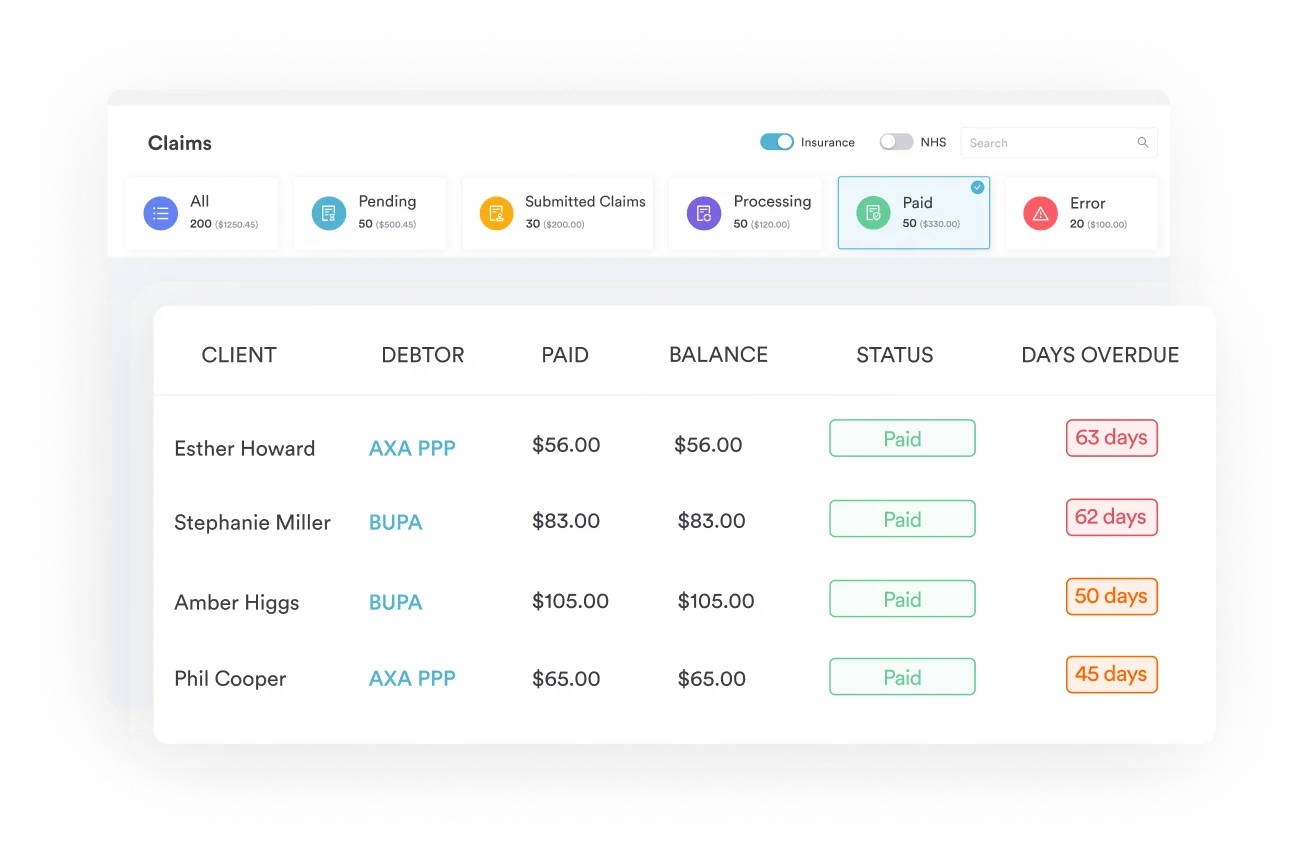
With ERA posted to each line, your billing team can compare what the payer paid against the MPFS rate above and chase short payments early. You can also generate a superbill with the CPT and ICD-10 codes already filled in, which cuts transcription errors.

Pabau’s claims management software connects to Claim.MD for real-time eligibility checks, CMS-1500 claim submission, ERA posting, and claim tracking. Your team can follow every biopsy claim from visit to payment.

CPT 69100 is a narrow code, and that is its strength. It pays for a diagnostic sample from the auricle, provided the note proves the side, the site, the technique, and the pathology send-out.
The practical move is a short pre-billing check on every ear biopsy note. Look for a returned pathology report before you settle the diagnosis code. Record the place of service carefully too, since the office rate is about 2.5 times the facility rate.
Pabau keeps that note, the codes, and the claim on the same patient record, from eligibility check to remittance. Book a demo to see how Pabau handles ENT biopsy claims from the first check to the final payment.

Need a framework for reducing claim denials across your practice? Denial codes in medical billing covers the most common CARC codes and how to address each one systematically.
Billing a punch biopsy of ear skin rather than an ear-specific procedure? CPT code 11104 explains when the punch skin biopsy code applies and what the note must show.
Want to understand how clearinghouse submission works? Medical claims clearinghouse explains how clearinghouses validate, translate, and route claims to payers.
Reconciling biopsy payments against the fee schedule? Electronic remittance advice walks through how ERA files map payment decisions back to individual claim lines.
Coding biopsies at other head and neck sites? CPT code 40490 covers lip biopsy billing, with the same site and laterality documentation questions.
CPT code 69100 is “Biopsy of external ear,” the procedure code for removing diagnostic tissue from the auricle (pinna) for pathological analysis. Biopsies inside the external auditory canal are reported with 69105. The code belongs to the Excision Procedures on the External Ear subsection (69100-69155) of the AMA CPT code set. It is distinct from excision codes in the same range that describe therapeutic removal.
CPT 69105 is the code for a biopsy of the external auditory canal. CPT 69100 covers the external ear itself, meaning the auricle or pinna. When the procedure is performed inside the canal, 69105 is the correct selection. Confirm the site in the operative note and the payer LCD before choosing between the two codes.
Yes, when they are billed by separate providers. The surgeon bills CPT 69100 for the procedure. The pathologist or pathology group independently bills CPT 88305 for the gross and microscopic examination of the specimen. NCCI bundling edits generally do not apply when the two codes appear on different claims from different providers. If the same provider bills both, verify current NCCI edits before submitting.
Medicare national payment for CPT 69100 is based on 2.77 total RVUs in a non-facility setting and 1.12 in a facility setting. Those totals are multiplied by the conversion factor, about $33.40 (2026 conversion factor), and adjusted for geographic GPCI. Local payment varies by MAC jurisdiction and year. Use the CMS Physician Fee Schedule lookup tool to confirm current rates for your location.
CPT 69100 is an ear-specific biopsy code, while CPT 11102 is a general tangential skin biopsy code for any body site. Use 69100 when the operative note documents an ear-specific surgical approach and anatomic site. Use 11102 for a standard tangential skin biopsy without ear-specific surgical documentation, or 11104 for a punch skin biopsy. Auditors compare the operative report language to the code selected, so documentation drives the choice.
Common denial triggers for CPT 69100 include missing laterality (no modifier LT or RT) and non-specific ICD-10 codes. R23.8 is a typical example when a precise neoplasm code is available. Same-day E&M billed without modifier 25 and a thin operative note cause denials too. A pre-submission documentation check for laterality, anatomic site, technique, and medical necessity linkage catches each of them.



