CPT code 62230 – CSF shunt replacement or revision
Code Definition
62230 is the CPT code for replacement or revision of cerebrospinal fluid shunt, obstructed valve, or distal catheter in shunt system. It applies when a neurosurgeon repairs part of a shunt that is already in place.
Two sets of codes sit close to it. 62258 covers removing the complete shunt system and placing a new one at the same operation. 62220 and 62223 cover creating a new shunt, chosen by where the distal catheter ends. A 62230 claim needs a documented pre-existing shunt and a named failed component.
Related Information
Section
10004-69990 Surgery
Subsection
61000-64999 Nervous system
Code range
61000-62258 Skull, meninges, and brain
Billable
No
Code also known as
VP shunt revision, ventriculoperitoneal shunt replacement, shunt revision surgery
Save time. Improve accuracy. Get paid faster.
Automate coding with Pabau
Let Pabau's smart automation suggest the right codes, reduce claim denials, and keep your practice compliant—effortlessly.
Automate repetitive tasks and focus on what matters most—your patients.
Improve accuracy
Reduce coding errors and ensure compliance with the latest regulations.
Get paid faster
Clean claims, fewer denials, and faster reimbursements.
Grow with confidence
Powerful insights and reporting to help your practice thrive.
HIPAA compliant•SOC 2 certified•GDPR-compliant•Trusted by 4,000+ clinics worldwide
Key takeaways
CPT code 62230 covers replacement or revision of a CSF shunt, obstructed valve, or distal catheter in an existing shunt system.
Creating a new shunt is 62220 or 62223, chosen by where the distal catheter ends, so 62230 needs a documented pre-existing shunt.
Removing the complete shunt system and placing a new one at the same operation is 62258, not 62230.
The most common denial triggers are missing ICD-10 linkage, absent prior authorization, and a creation code billed for a revision.
Claims software such as Pabau checks eligibility before submission, tracks claim status, and flags denied 62230 claims for rework.
CPT code 62230: official descriptor and procedure overview
CPT code 62230 describes replacement or revision of cerebrospinal fluid shunt, obstructed valve, or distal catheter in shunt system. The American Medical Association (AMA) publishes it in the annual CPT code set. It sits in the Nervous System surgery section (61000-64999), under Skull, Meninges, and Brain (61000-62258).
Field
Detail
Code number
62230
Code set
CPT (Current Procedural Terminology)
Section
Surgery / Nervous System
Global period
90 days (major surgery)
Primary performer
Neurosurgeon
Facility vs. non-facility
Facility rate applies (hospital inpatient or outpatient)
The procedure involves surgically accessing the existing shunt system, identifying the malfunctioning component, and replacing or revising it. The code covers replacement or revision of the shunt, an obstructed valve, or the distal catheter. The whole system does not have to come out.
What CPT 62230 covers: procedure components and clinical indications
CPT code 62230 applies when a neurosurgeon revises an existing CSF shunt rather than placing an entirely new one. The descriptor names the valve and the distal catheter, which ends in the peritoneum, atrium, or pleura. Replacing or irrigating the ventricular (proximal) catheter alone has its own code, 62225.
Common clinical indications that support medical necessity include:
Shunt obstruction or occlusion causing recurrent hydrocephalus symptoms
Valve malfunction (pressure mismatch, siphoning, or mechanical failure)
Shunt infection requiring component removal and replacement
Catheter migration or positional failure
Overdrainage or underdrainage confirmed on imaging
Pseudocyst formation around the peritoneal catheter tip
Payers expect the operative report to name the specific indication and the intraoperative finding that confirmed it. A chart note that only says “shunt not working,” with no imaging evidence or ICP monitoring data, is likely to be denied.
Pabau closes the visit and records the invoice against the payer, so the shunt revision claim starts from one complete patient record.
CPT 62230 vs. 62220 and 62223: revision vs. creation
Creating a new shunt is reported with 62220 or 62223, depending on where the distal catheter ends. 62220 covers a ventriculo-atrial, -jugular, or -auricular shunt. 62223 covers a ventriculo-peritoneal, -pleural, or other-terminus shunt, which is the common VP shunt. 62230 is for revising a shunt that already exists, so a prior shunt must be documented in the patient record.
Feature
CPT 62220 / 62223
CPT 62230
Procedure
New shunt creation: 62220 for an atrial, jugular, or auricular terminus; 62223 for a peritoneal, pleural, or other terminus
Replacement of existing shunt or component
Requires prior shunt?
No
Yes (mandatory)
Typical patient
New hydrocephalus diagnosis, no prior shunt
Known shunt patient with revision indication
ICD-10 companion
G91.x (active hydrocephalus)
T85 shunt complication code (for example, T85.09XA) + G91.x
Can they bill together?
No. They are mutually exclusive, so report whichever matches the procedure performed.
When a neurosurgeon moves the distal catheter of a failing VP shunt to the atrium and keeps the rest of the system, 62230 still applies. The shunt system was already in place. A brand-new shunt is 62220 or 62223, chosen by terminus.
CPT 62230 vs. CPT 62258: partial vs. complete system removal
62258 covers removal of the complete shunt system with replacement at the same operation. 62230 covers replacement or revision without removing every component.
Feature
CPT 62230
CPT 62258
Scope
Replacement of shunt, valve, or distal catheter
Removal of complete shunt system with replacement
All components removed?
Not necessarily
Yes
Typical trigger
Valve failure, catheter obstruction, migration
Shunt infection requiring full system explant
Reimbursement (typical)
Lower – partial revision
Higher – greater operative complexity
The operative note is the deciding document. If the surgeon documents that all components were explanted and a new system placed, 62258 is the correct code. If one or two components were retained and only the malfunctioning element was swapped, CPT code 62230 applies.
Related CSF shunt CPT codes: complete reference
The CSF shunt code range covers creation, revision, irrigation, removal, and spinal variants. Knowing the full family prevents miscoding and supports accurate crosswalk lookups via the AAPC Codify CPT lookup.
Code
Short descriptor
Use case
62220
Creation of shunt; ventriculo-atrial, -jugular, -auricular
New shunt ending in the atrium, jugular vein, or auricle
62223
Creation of shunt; ventriculo-peritoneal, -pleural, other terminus
New VP shunt, or a pleural or other terminus
62225
Replacement/irrigation of ventricular catheter
Proximal catheter only, no valve change
62230
Replacement or revision of CSF shunt, obstructed valve, or distal catheter
Partial revision of existing shunt system
62252
Reprogramming of programmable CSF shunt
Non-surgical valve reprogramming
62256
Removal of CSF shunt system, without replacement
Explant only, no same-session replacement
62258
Removal and replacement of complete shunt system
Full explant with new system placed same session
63740
Creation of spinal CSF shunt
Lumbar or spinal (not intracranial)
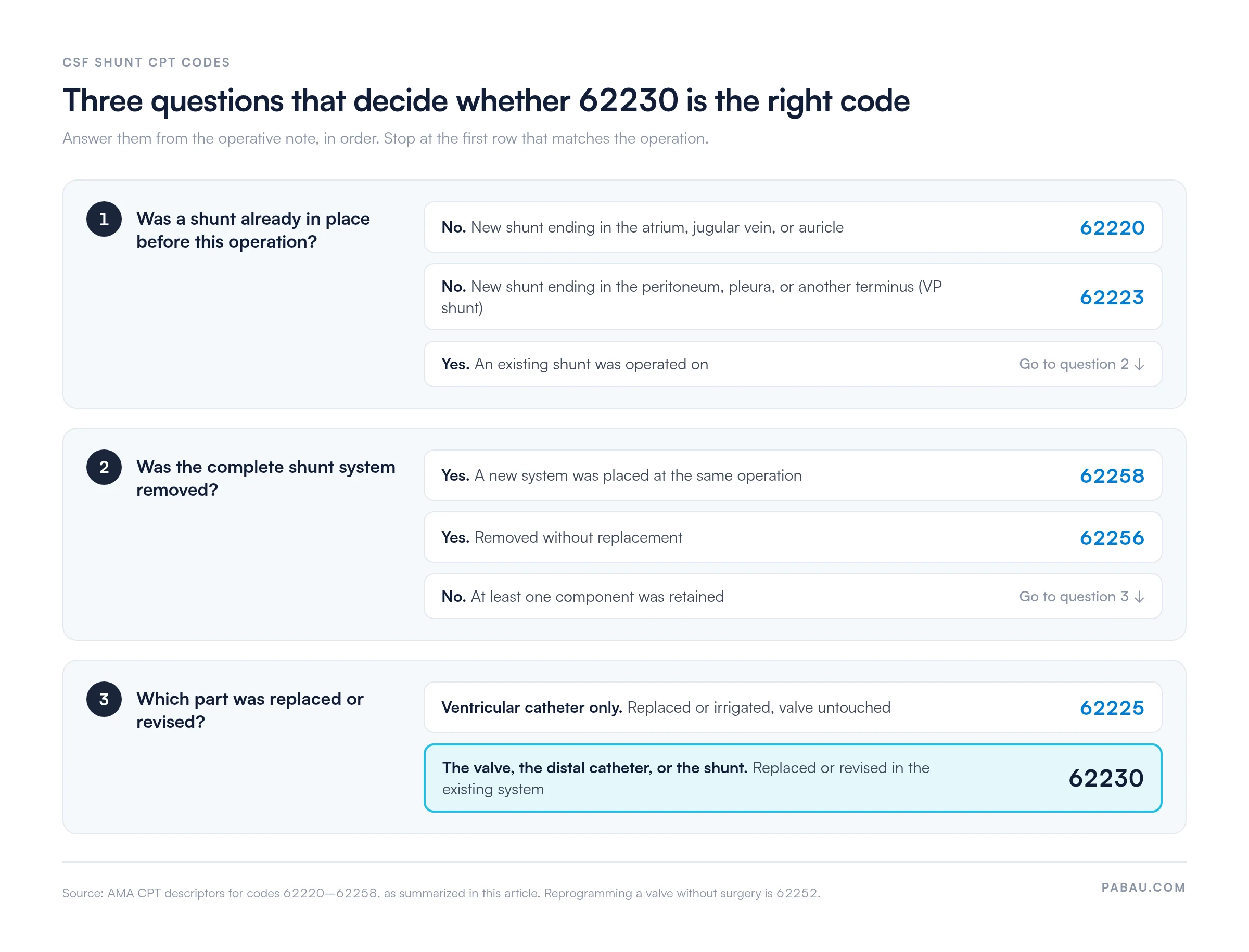
Read the operative note against three questions, in order, and the code falls out of the answers.
62230 is the code only after the note confirms a prior shunt, retained components, and a failed valve or distal catheter. Based on AMA CPT descriptors.
Pro Tip
Check the surgeon’s operative note for the phrase ‘retained components.’ If any shunt component was left in place during a revision, CPT code 62230 is almost always the right call over 62258. Document this distinction explicitly in the operative note to preempt payer audit requests.
ICD-10 diagnosis codes paired with CPT 62230
Every 62230 claim must carry at least one ICD-10-CM code that establishes medical necessity. Payers use the diagnosis-to-procedure linkage to validate that the revision was clinically justified.
ICD-10-CM Code
Description
When to use
T85.09XA
Other mechanical complication of ventricular intracranial (communicating) shunt, initial encounter
Active treatment of a malfunction, including the surgical revision. Use T85.01XA (breakdown), T85.02XA (displacement), or T85.03XA (leakage) when the note specifies one.
T85.09XD
Other mechanical complication of ventricular intracranial (communicating) shunt, subsequent encounter
Routine care during healing or recovery after active treatment ends, not the revision itself
T85.730A
Infection of CSF shunt, initial encounter
Revision triggered by shunt infection
G91.0
Communicating hydrocephalus
Underlying condition driving shunt requirement
G91.1
Obstructive hydrocephalus
Non-communicating/obstructive type
G91.2
Normal pressure hydrocephalus
NPH patients with existing programmable shunt
Z98.2
Presence of CSF drainage device
Shunt status only. Leave it off when a T85 shunt complication code is reported.
Z98.2 is not required on 62230 claims. ICD-10-CM guidelines say a status code should not be reported when another code already carries that information. A T85 shunt complication code already tells the payer a shunt was in place, so Z98.2 would be redundant beside it.
Modifiers for CPT code 62230
Modifier selection depends on the operative scenario. The table below covers the most commonly applicable modifiers for CPT code 62230 claims.
Modifier
When to use with 62230
-22 (Increased complexity)
Unusually complex revision: severe scarring, multiple prior revisions, difficult anatomy. Requires an operative note that explicitly documents why the case exceeded normal complexity.
-51 (Multiple procedures)
62230 performed in the same session as a distinct secondary procedure. Apply to the lower-valued procedure, not to 62230 if it is the primary code.
-59 (Distinct procedural service)
Second procedure performed during the same encounter that would otherwise be bundled by NCCI edits. Use only when a modifier is necessary to override an edit with clinical justification.
-78 (Unplanned return to OR)
Return to operating room during the global period of the original shunt procedure for a related complication. Prevents denial of 62230 as a duplicate when it occurs within the global period of a prior code.
-79 (Unrelated procedure during global period)
62230 performed during the global period of a prior surgery but for an unrelated reason. Rare for shunt revisions; document the unrelated indication clearly.
Modifier -22 is frequently misused. Payers require a written explanation and often a cover letter detailing why the case was exceptional. Submit supporting documentation proactively rather than waiting for a request.
Documentation requirements for CPT code 62230
Claim approvals and audit survivability both depend on the operative note. The following elements must appear in the record before CPT code 62230 is submitted. Maintaining medical billing compliance at the documentation level is the most reliable denial prevention strategy available.
Confirmation of pre-existing shunt: Date of original placement and operative reports or imaging confirming the shunt was in situ before this procedure.
Indication for revision: Clinical symptoms such as headache, vomiting, or altered mental status. Add at least one objective finding: CT/MRI showing ventricular enlargement, a shunt series showing a break or disconnection, or intracranial pressure monitoring data.
Specific components replaced: The operative note must name which component(s) were replaced (valve only, proximal catheter, distal catheter, or a combination). Vague language (“shunt was revised”) does not satisfy payer requirements.
Surgical approach and intraoperative findings: Confirm whether a craniotomy or burr hole was used, and the access site. Record the findings on inspection, such as a catheter tip encased in choroid plexus, a fractured valve, or a calcified catheter.
Any add-on procedures performed: If CPT 69990 (operating microscope) was used, document the microsurgical technique specifically. If fluoroscopy was used for catheter placement, note it.
Auditors reviewing CPT code 62230 claims specifically look for imaging evidence tying the pre-operative clinical picture to the intraoperative findings. Missing that link is the most common documentation deficiency identified on post-payment review.
Medicare reimbursement and RVU data for CPT 62230
CPT code 62230 carries a 90-day global surgery period under the Medicare Physician Fee Schedule (MPFS), classifying it as a major surgery. The RVU components determine the physician payment rate, which varies by geographic location via the Geographic Practice Cost Index (GPCI). Verify the current year’s figures directly using the CMS Physician Fee Schedule lookup tool or the FastRVU 2026 RVU lookup, as values update each January.
RVU Component
Description
Source
Work RVU (wRVU)
Reflects physician time, intensity, and skill
CMS MPFS annual file
Practice expense RVU
Overhead costs allocated to the procedure
CMS MPFS annual file
Malpractice RVU
Professional liability cost component
CMS MPFS annual file
Total RVU x conversion factor
Physician payment = total RVU x CF x GPCI
CMS MPFS – varies by locality and year
Facility vs. non-facility
62230 is performed in hospital; facility rate applies
CMS site-of-service rules
Because 62230 reimbursement figures change annually and vary by MAC jurisdiction, publishing a single national dollar figure risks being outdated within months. Use the CMS lookup tool or FastRVU for current locality-adjusted rates. Practices using revenue cycle management workflows can automate fee schedule refresh alerts to flag when annual MPFS updates affect high-value neurosurgery codes.
Global surgery period, NCCI edits, and bundling rules
CPT code 62230 carries a 90-day global surgery period. The single code payment includes the surgeon’s pre-operative visit on the day before surgery and all intraoperative services. It also covers all related post-operative care for 90 days.
What can still be billed during the global period:
E/M visits for new, unrelated problems (append modifier -24)
Complications requiring a return to the operating room (append modifier -78 or -79 as appropriate)
Services by a different surgeon for unrelated conditions
Key NCCI bundling notes for CPT code 62230:
CPT 62225 (replacement or irrigation of the ventricular catheter) may pair with 62230 on the same date. Check the NCCI PTP edit table before reporting both.
Imaging guidance (fluoroscopy, ultrasound) used to confirm catheter placement is generally bundled. It is not separately billable unless a code with explicit “with imaging” language applies.
CPT 69990 (operating microscope add-on) may be separately reportable when microsurgical technique is documented in the operative note. Check the current NCCI Policy Manual and PTP edit tables for the date of service before reporting 69990.
Check the MUE (Medically Unlikely Edit) table for the number of 62230 units allowed per date of service. Units above the MUE value are denied unless documentation supports them.
Common claim denial reasons for CPT 62230 and how to fix them
CPT code 62230 denials cluster around a predictable set of root causes. Identifying them before submission is faster and cheaper than working the appeals queue. Each denial arrives with a reason code, and this guide to common denial codes explains them.
Wrong code: a creation code (62220 or 62223) submitted instead of 62230
Coder missed the “pre-existing shunt” criterion
Void and resubmit with 62230; attach prior operative report as evidence
Missing ICD-10 linkage to the procedure
No T85 shunt complication code (such as T85.09XA) linked to the procedure line
Link the T85 code as primary and the G91.x hydrocephalus code as secondary, then resubmit
Prior authorization not obtained
Payer requires pre-auth; procedure scheduled without it
For emergent cases, submit retro-auth with clinical urgency documentation; for non-urgent, appeal with auth obtained late
Incomplete operative note
Component replaced not named; no imaging evidence cited
Obtain addendum from surgeon naming specific component; attach pre-op imaging report to appeal
NCCI bundling edit triggered
62225 or imaging guidance billed alongside 62230
Remove the bundled code; if distinct procedure, add modifier -59 with documentation
Global period conflict
62230 billed within 90 days of a prior shunt code without modifier
Append modifier -78 (return to OR for complication) or -79 (unrelated); include clinical documentation
How to submit a clean CPT 62230 claim: step-by-step
A clean CPT code 62230 claim follows a consistent pre-billing workflow. Run a real-time eligibility check through your clearinghouse first, then work through the eight steps below.
Confirm the pre-existing shunt in the chart. Pull the original operative report or imaging confirming shunt placement date. For transferred patients, obtain outside records before coding.
Select CPT code 62230 over the neighboring codes. Was the entire system removed and replaced (62258)? Was only the proximal catheter irrigated or replaced (62225)? If the valve, distal catheter, or shunt was replaced or revised, 62230 is correct.
Assign the primary ICD-10 code. Use T85.09XA for other mechanical complication, or T85.01XA-T85.03XA when the note names breakdown, displacement, or leakage. Use T85.730A for infection. Add G91.x for the hydrocephalus type.
Attach applicable modifiers. Review the operative note for complexity flags (-22), same-session secondary procedures (-51), global period conflicts (-78/-79), or NCCI override needs (-59).
Verify prior authorization status. Commercial and Medicare Advantage plans commonly require pre-auth for 62230. Confirm the auth number is on the claim before submission. For emergent cases, document urgency and request retro-authorization afterward.
Attach or link the operative report. Many payers request the operative report on first submission for high-value neurosurgery codes. Attach it proactively to reduce information requests. Use the superbill or CMS-1500 as the submission vehicle, with the operative note attached at the claim level.
Run an NCCI edit check before submission. Verify no bundled codes are billed alongside 62230. A clean claim leaves the practice with no edits left to resolve. Check the current CMS NCCI edit tables for the date of service.
Monitor for remittance and track denial patterns. Log every 62230 denial by reason code. A pattern of the same denial reason across multiple cases signals a workflow problem rather than a one-off coding error.
Pro Tip
Run a quarterly audit of all CPT code 62230 claims submitted in the prior 90 days. Compare original code submitted against any denial reason codes received. Three or more denials for the same reason point to a documentation or coding habit. Fix that habit in the workflow instead of correcting each claim by hand.
How Pabau keeps 62230 claims moving after submission
Most neurosurgery billing teams check eligibility by phone and chase claim status payer by payer. A 62230 denial often surfaces weeks later, after the appeal window has started to close.
Pabau, the practice management platform we build, connects to the Claim.MD clearinghouse for US practices. Its claims software for surgical practices runs real-time eligibility checks, converts the claim to an electronic CMS-1500, and tracks its status. Remittances are matched to the claim, and denials are flagged for rework.
Coding decisions stay with your coders and the operative note. What changes is visibility: a rejected shunt revision claim shows up in the queue the day the payer responds.
Fewer stalled shunt revision claims
Pabau checks patient eligibility before submission, tracks every 62230 claim through to payment, and flags denials for rework. Your billing team sees a stalled claim while it can still be fixed.
Treat the operative note as the claim. If it confirms a prior shunt, names the failed valve or distal catheter, and states which components stayed in place, 62230 holds up. If it cannot, query the surgeon before coding rather than after a denial.
The trade-off is a slower first pass on each revision case in exchange for fewer reworked claims later. Book a demo to see how Pabau tracks shunt revision claims from eligibility check to payment.
Continue your research
Need a step-by-step guide to medical billing fundamentals?Medical billing explained covers the end-to-end revenue cycle from charge capture through payment posting.
Want to reduce claim rejection rates across your practice?Denial management in healthcare outlines a systematic approach to tracking, appealing, and preventing claim denials.
Looking for guidance on clean claim standards?What is a clean claim defines every field requirement that determines whether a claim passes or fails the clearinghouse edit check.
Frequently asked questions
What does CPT code 62230 cover?
CPT code 62230 covers replacement or revision of cerebrospinal fluid shunt, obstructed valve, or distal catheter in shunt system. It applies when a pre-existing shunt is documented and part of it is replaced or revised. It is a major neurosurgery procedure with a 90-day global period.
What is the difference between CPT 62230 and CPT 62258?
CPT 62230 applies when one or more shunt components are replaced but not all of them are removed. CPT 62258 applies when the entire shunt system is explanted and a new system is placed at the same operation. If the surgeon documents retained components, 62230 applies. If all components were removed, use 62258.
What modifiers are used with CPT code 62230?
The most common modifiers are -22 for increased procedural complexity, which requires documentation, and -51 for multiple procedures in the same session. Use -59 for a distinct procedural service that overrides an NCCI edit. Use -78 for an unplanned return to the operating room during the global period, and -79 for an unrelated procedure in that period.
Does CPT 62230 require prior authorization?
Prior authorization for CPT 62230 varies by payer. Most commercial and Medicare Advantage plans require it for this high-value inpatient neurosurgery code, while traditional fee-for-service Medicare generally does not. For emergent revisions, submit retro-authorization immediately after the procedure, with clinical urgency documentation.