HCPCS Code G0163: Skilled nursing observation and assessment
What is HCPCS Code G0163? HCPCS Code G0163 is a deleted Level II code for skille...

Last Updated: Oct 15, 2026

CPT Code 52332 describes cystourethroscopy with insertion of an indwelling ureteral stent, such as a Gibbons or double-J type.
The 2026 Medicare facility rate is about $139.62 and the non-facility rate about $372.75. The POS code on the claim decides which one applies.
Under current NCCI edits, CPT 52332 bundles into only two ureteroscopy codes, 52353 and 52356. It is separately reportable with 52351, 52352, 52354, and 52355, and no modifier is needed.
Practice management software like Pabau tracks CPT coding, applies modifier rules, and routes urology claims through a clearinghouse.
CPT Code 52332 is cystourethroscopy with insertion of an indwelling ureteral stent, such as a Gibbons or double-J type. It sits in the Ureter and Pelvis Transurethral Surgical Procedures section of the CPT code set. Ureteral stent placement is one of the highest-volume urology procedures billed in the United States.
This reference covers the official descriptor and the 2026 Medicare reimbursement rates. It also sets out the ICD-10 codes most often paired with CPT 52332, the live NCCI edit pairs, modifier guidance, and documentation requirements. The final sections cover the denial patterns that leak the most revenue in urology billing.
The full descriptor reads cystourethroscopy with insertion of indwelling ureteral stent (eg, Gibbons or double-J type). The American Medical Association maintains the AMA CPT code set and updates it annually.
The procedure uses a cystoscope passed through the urethra and bladder to access the ureteral orifice. A guidewire is advanced into the ureter under fluoroscopic or endoscopic guidance. The stent, typically a double-J (JJ) or Gibbons design, is then deployed. One coil sits in the renal pelvis and the other in the bladder, maintaining ureteral patency.
CPT 52332 covers stent insertion performed for any of these presentations:
The code applies regardless of stent type, laterality, or the approach used for guidewire placement. That covers double-J, Gibbons, or equivalent designs, on the left side, the right side, or both. The one condition is that the procedure is performed cystourethroscopically.
Medicare reimbursement for CPT Code 52332 varies by site of service. The CMS Physician Fee Schedule (Centers for Medicare and Medicaid Services) sets the national rates annually. Medicare Administrative Contractors (MACs) then apply locality adjustments. Verify current figures for your MAC region before billing.
Use the FastRVU 2026 RVU lookup to verify locality-adjusted payment amounts for your MAC jurisdiction. The rates above are approximate national averages, so actual payments will differ by geography. Confirm against the current year’s MPFS final rule before submitting claims.
The non-facility rate for CPT 52332 runs more than two and a half times the facility rate. That difference exists because Medicare pays the hospital or ASC separately for overhead under the facility rate.
In an office setting the physician absorbs those costs, so the higher non-facility payment compensates for them. Practice expense is the component that moves.
Billing the facility rate for a procedure performed in an office is one of the most auditable errors in urology. The reverse mistake is just as easy to make.
The place-of-service (POS) code on the claim drives which rate Medicare applies. POS 11 (office) triggers the non-facility rate. POS 22 (hospital outpatient) and POS 24 (ASC) trigger the facility rate, and the chart below shows what that one field is worth.
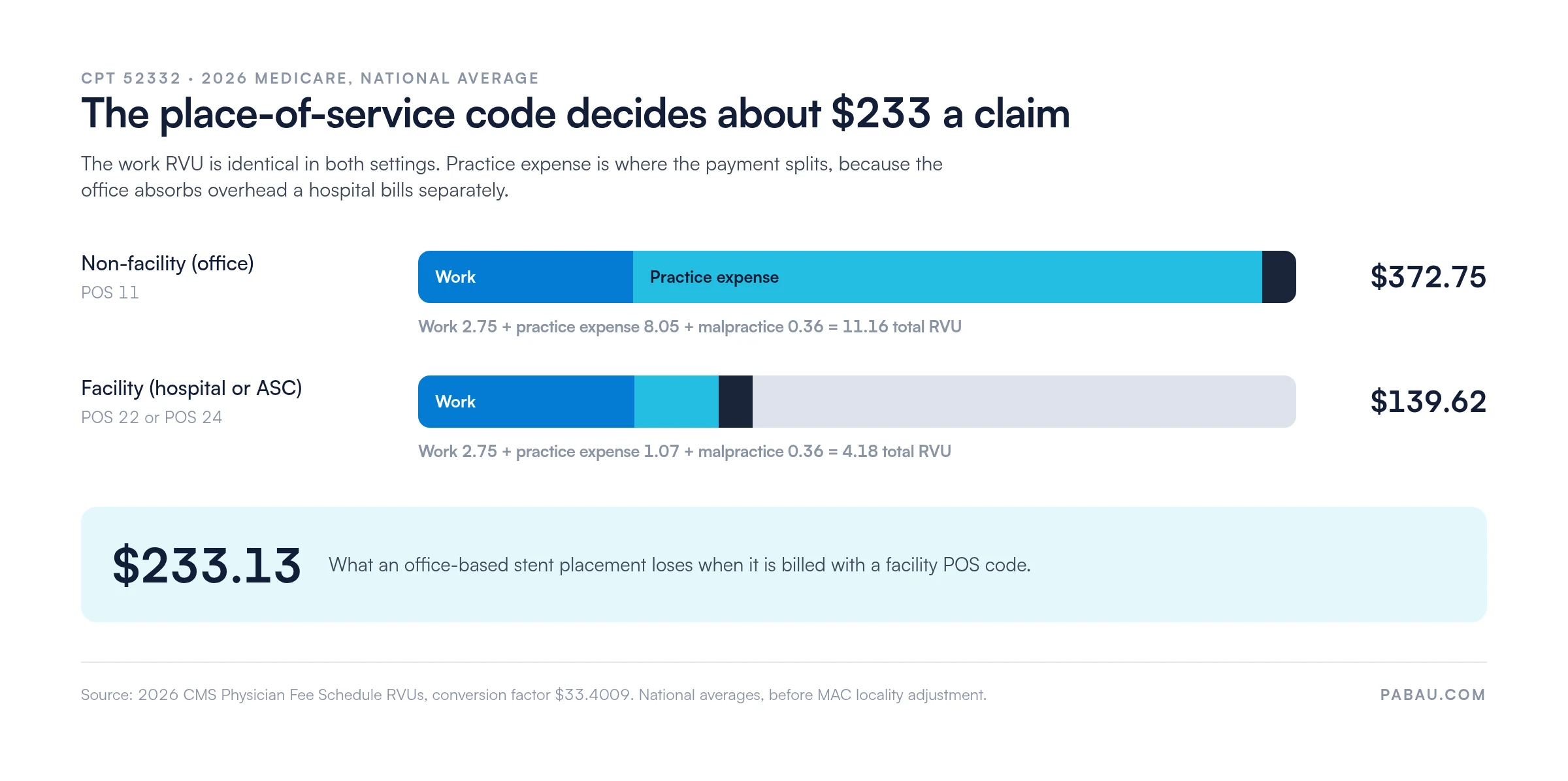
Audit your POS codes quarterly against your procedure log. A single incorrect POS 22 on an office-based stent placement costs roughly $233 per claim in lost reimbursement at national average rates. Run a 90-day retrospective before each MPFS update to catch systematic errors before they compound.
CPT Code 52332 requires a supporting ICD-10-CM diagnosis code that establishes medical necessity. Payers match the procedure code against the diagnosis to confirm the stent was clinically indicated. Mismatched or vague diagnosis codes are a primary denial trigger.
When multiple diagnoses apply (eg, ureteral calculus causing hydronephrosis), sequence the code that drove the decision to place the stent as the principal diagnosis. Individual payer local coverage determinations (LCDs) may restrict covered diagnoses. Confirm with each payer before assuming coverage based on ICD-10 pairing alone.
When the operative note names a cause outside this list, do not default to an unspecified code. Work from the wider ICD-10-CM set to find the right ICD-10 code.
Under the current National Correct Coding Initiative (NCCI) edits, CPT 52332 is bundled into only two ureteroscopy codes, 52353 and 52356. Against 52351, 52352, 52354, and 52355 it is separately reportable, and no modifier is needed.
That runs against guidance still circulating in coding forums and vendor cheat sheets. CMS did once bundle 52332 into most of the ureteroscopy range. Those edits carry a deletion date of December 31, 2006, applied retroactively in the NCCI 13.1 update. CMS has never reinstated them.
In an NCCI procedure-to-procedure pair, 52332 is the column 2 code and the ureteroscopy code is the column 1 driver. Only two of those pairs are live today. Knowing which two prevents both denials and unnecessary modifiers.
52353, ureteroscopy with lithotripsy, has bundled 52332 since January 1, 2015. The rationale on file is a CPT or CMS manual coding instruction, which covers a stent placed on the same side as the lithotripsy. The edit carries modifier indicator 1, so modifier 59 or XS can bypass it.
52356, ureteroscopy with lithotripsy and indwelling stent, has bundled 52332 since January 1, 2014. The stent is written into the descriptor of 52356, so a same-side stent carries no separately reportable value.
Edit status above was checked against the 2026 CMS NCCI procedure-to-procedure tables for the third quarter, practitioner file ccipra-v322r0 and hospital file ccioph-v322r0. Re-check each quarter, because CMS adds and retires pairs on that cycle.
Modifier 59, or its preferred subset XS, applies in one scenario. That is 52332 billed with 52353, where the stent went into the ureter the lithotripsy did not treat. The AAPC and CMS both require the operative report to state that separation outright.
The same documentation test applies to bladder stone work. A stent placed during litholapaxy under CPT 52317 is separately reportable only when the note documents it as a distinct service.
Documentation that supports the modifier looks like this:
A same-side stent after 52353 lithotripsy does not qualify. Neither does a stent placed during 52356, because that descriptor already pays for it.
The opposite error is now the more likely one. Adding modifier 59 to a 52332 line billed with 52351, 52352, 52354, or 52355 is unnecessary. A pattern of unsupported 59 use also draws audit attention.
If a payer denies one of those four pairs as bundled, that is a payer-side edit rather than an NCCI one. Cite the December 31, 2006 deletion date in the appeal.
Applying the correct modifier to CPT Code 52332 decides whether the claim processes cleanly or triggers a denial. Confirm payer-specific modifier policies before submitting, because commercial payer rules may differ from Medicare guidelines.
When stents are placed in both the left and right ureters during a single session, bill CPT 52332 with modifier 50. Medicare’s bilateral payment policy applies a 150% adjustment. The physician receives 100% for the first side and 50% for the second. That nets roughly 150% of the single-procedure rate.
Some commercial payers do not accept modifier 50. They require two line items instead, 52332-LT on one and 52332-RT on the other. Verify each payer’s bilateral billing preference before submission. Applying modifier 50 where the payer expects LT/RT generates systematic underpayment or denials.
Strong operative documentation is the most effective denial prevention tool for CPT Code 52332. A complete operative report supports the medical necessity determination and audit-readiness under MAC and RAC review. Compliance starts with the procedure note, not the claim form.
The operative report for a CPT 52332 claim should include each of the following elements. Missing any one of them creates an audit vulnerability.
A clean claim submission for CPT 52332 depends on four records agreeing with each other. The operative note, ICD-10 code, modifier, and POS code must tell one consistent clinical story before the claim reaches the clearinghouse.
CPT Code 52332 sits within a family of ureteroscopy and cystourethroscopy codes. Understanding the descriptor differences between these codes prevents selection errors and CCI bundling conflicts.
The line between 52332 and 52356 is the most common code-selection error in this family. When a ureteroscopy with lithotripsy ends with a stent placed in the same session, 52356 is the correct code. CPT 52332 is not additionally billable, because the stent is already bundled into 52356’s descriptor.
What the physician does in the session decides the code, and other code families apply the same test. A screening colonoscopy billed under HCPCS code G0105 becomes a therapeutic CPT code after a polypectomy, with modifier PT recording the screening start.
Denials for CPT Code 52332 cluster around five root causes. Addressing them in the billing workflow before submission costs far less than appealing afterward. The denial codes that attach to 52332 most often relate to medical necessity, documentation, and modifier errors.
Track denial metrics at the code level, not just across the practice as a whole. Denial rate by CPT, days in AR by code, and denial reason distribution are the ones that matter here. Those numbers let urology billing teams spot systematic errors before they compound across hundreds of claims.
Urology practices billing CPT Code 52332 juggle CCI edit checks, bilateral modifier decisions, and site-of-service tracking. Practice management software like Pabau brings those steps together through cleaner claims management, so the coding decision and the claim stay in one place.
Claims built in Pabau route through the Claim.MD integration, which validates CPT and ICD-10 combinations before transmission. The built-in CPT catalog supports modifier selection at the line item level. Superbill tools produce CMS-1500-ready documents directly from appointment records. The platform also generates 837P claim files and returns 835 remittance files for automated posting.
For practices that need audit-readiness, Pabau’s digital documentation tools capture operative reports and procedure notes at the point of care. Each one links directly to the claim record, so the clinical and billing paper trail stays in one place.
Check your ERA (835) files after each claims batch for CARC codes on 52332 lines. A CARC 97 on a 52332 paired with 52353 or 52356 is a legitimate NCCI bundle, so read the operative note before appealing. A CARC 97 on a 52332 paired with 52351, 52352, 52354, or 52355 is a payer-side edit. Appeal that one, citing the 2007 NCCI deletion date. Pabau’s Claim.MD integration surfaces these codes in the platform, so your team can sort the two apart without a separate portal login.

Pabau helps urology practices track CPT codes, apply modifiers, and submit clean claims through the Claim.MD clearinghouse. Errors get caught before they reach the payer.

The pressure points on CPT Code 52332 are narrower than the coding folklore suggests. Only two NCCI pairs bundle it, so the routine work is documenting laterality and getting the POS code right. Treat those two as a monthly audit rather than a per-claim judgment call, and the denial rate on this code falls on its own.
The trade-off worth remembering is that modifier 59 cuts both ways. Using it where no edit exists draws audit attention. Skipping it on a documented contralateral stent leaves that line unpaid.
Pabau gives urology billing teams one place to code, submit, and reconcile a 52332 claim. Book a demo to see how the platform keeps operative notes and claim lines in step.

Need guidance on medical billing compliance for procedural codes? Medical billing compliance fundamentals covers the documentation and audit standards that protect urology practices from RAC reviews.
Want to understand how clearinghouse submissions work? Medical claims clearinghouse overview explains how claims move from practice management software to payers and what edits are applied.
Working through a stack of 52332 denials? Denial management in healthcare sets out how to triage, appeal, and track denials by code rather than by batch.
Building the paperwork behind a 52332 claim? What a superbill includes walks through the fields a payer expects and where practices leave them blank.
Looking to reduce urology billing denials systematically? Best medical billing software for US practices compares platforms by claims accuracy features, clearinghouse integrations, and denial tracking dashboards.
CPT Code 52332 is cystourethroscopy with insertion of an indwelling ureteral stent (eg, Gibbons or double-J type). It covers the scope-guided placement of a stent to relieve ureteral obstruction. The AMA CPT manual classifies it under Ureter and Pelvis Transurethral Surgical Procedures. The code applies regardless of stent type or laterality, provided the approach is cystourethroscopic.
The approximate 2026 national Medicare facility rate for CPT 52332 is $139.62, and the non-facility rate is $372.75. Those figures come from a total facility RVU of 4.18 and a non-facility RVU of 11.16, at the 2026 conversion factor of $33.4009. Actual payments vary by MAC locality. Verify current rates with the CMS Physician Fee Schedule lookup tool for your jurisdiction.
Yes, in most cases. Under current NCCI edits, CPT 52332 is separately reportable alongside 52351, 52352, 52354, and 52355, with no modifier required. The edits that once bundled those pairs were deleted effective January 1, 2007. Two pairs remain active. CPT 52353 bundles a same-side stent, which modifier 59 or XS can unbundle when the stent goes into the opposite ureter. CPT 52356 already includes the stent in its descriptor, so separate billing of 52332 is not appropriate.
Modifier 59, or its preferred subset XS, applies to CPT 52332 in one scenario. That is 52332 billed with 52353, where the stent was placed in the ureter the lithotripsy did not treat. The operative report must state that separation outright. No modifier is needed with 52351, 52352, 52354, or 52355, because no NCCI edit pairs 52332 with those codes. Using modifier 59 without adequate documentation is a compliance risk, since CMS treats improper 59 use as unbundling.
The 2026 work RVU for CPT 52332 is 2.75. Total RVUs are 4.18 in a facility setting and 11.16 in a non-facility setting, reflecting the different practice expense components. Use the FastRVU lookup tool or the CMS MPFS search to verify current values and locality-adjusted payment amounts.
The most common causes are insufficient medical necessity from a vague ICD-10 code, incomplete operative reports, and bilateral modifier errors. Bundling denials also occur, but only on the two active NCCI pairs. Those are 52332 with a same-side 52353, and 52332 with 52356. Site-of-service mismatches from a wrong POS code cause systematic underpayment rather than outright denials, so a denial-only audit will not surface them.
CPT 52332 covers stent insertion performed via cystoscopy without a ureteroscopy component. CPT 52356 covers ureteroscopy with lithotripsy plus stent placement, and the stent is explicitly included in 52356’s descriptor. When a ureteroscopy with lithotripsy and stent placement happens in one session, 52356 is the correct code. Billing 52332 in addition is almost always incorrect, and it will be denied as an NCCI bundle.