HCPCS Code Q4135: Billing Guide for Biovance Amniotic Membrane
HCPCS Code Q4135: Official Descriptor and Product Details HCPCS Code Q4135 is a ...

Last Updated: Nov 16, 2026
52318 is the CPT code for litholapaxy of a bladder stone that is complicated or large (greater than 2.5 cm). Its descriptor covers crushing or fragmentation of calculus by any means in bladder and removal of fragments.
The work is done cystoscopically, through the urethra. 52318 is often coded as 52317 when the operative report documents a large or complicated stone. 52318 pays more than 52317, so the note needs the stone's measured size or the factor that made the case complicated.
Let Pabau's smart automation suggest the right codes, reduce claim denials, and keep your practice compliant—effortlessly.
Automate repetitive tasks and focus on what matters most—your patients.
Reduce coding errors and ensure compliance with the latest regulations.
Clean claims, fewer denials, and faster reimbursements.
Powerful insights and reporting to help your practice thrive.
HIPAA compliant SOC 2 certified GDPR-compliant Trusted by 4,000+ clinics worldwide

CPT code 52318 covers cystoscopic litholapaxy for a bladder stone greater than 2.5 cm, or for a case the operative note documents as complicated.
Without a measured stone size or a named complicating factor, payers downcode the claim to 52317 or deny it.
NCCI edits bundle diagnostic cystoscopy and cystoscopic foreign-body removal into 52318, so billing them separately gets those lines denied.
In 2026, 52318 carries 12.40 total RVUs and a 000-day global period, paying about $414 nationally before locality adjustment.
Pabau’s claims management software pre-fills the claim from the patient record, validates required claim fields and submits electronically via Claim.MD.
CPT code 52318 reports litholapaxy for a bladder stone greater than 2.5 cm, or for a smaller stone the surgeon documents as complicated. The code sits in the Surgery section of the AMA’s CPT code set, under the urinary system.
The AMA publishes the official descriptor in these words.
Litholapaxy: Crushing or fragmentation of calculus by any means in bladder and removal of fragments; complicated or large (greater than 2.5 cm).
It sits in the 5231x family alongside 52317 (simple litholapaxy) and 52310/52315 (cystoscopic removal of foreign body or calculus). The phrase “by any means” covers mechanical crushing, electrohydraulic fragmentation and laser lithotripsy through a cystoscope. The technique never decides the code. The stone’s size, or the complexity of the case, does.
Litholapaxy is performed entirely through the urethra, with no incision. The urologist passes a cystoscope into the bladder and visualizes the calculus. The stone is then crushed or fragmented, and the pieces are irrigated out. That separates it from open cystolithotomy (CPT 51050) and from percutaneous approaches.
When coders read the operative note, they look for four steps:
Step 4 is where 52318 claims usually fall apart. A coder can’t assign 52318 if the note doesn’t say what made the case large or complicated. The fragmentation method matters less, though the note should still name it:
Operative reports that say ‘holmium laser lithotripsy’ without a stone size are a common cause of downcoding on 52318 claims. Ask urologists to dictate the measured size in centimeters and say whether the case was complicated. A one-line addendum such as ‘2.8 cm calculus confirmed on cystoscopy’ protects the full 52318 payment.
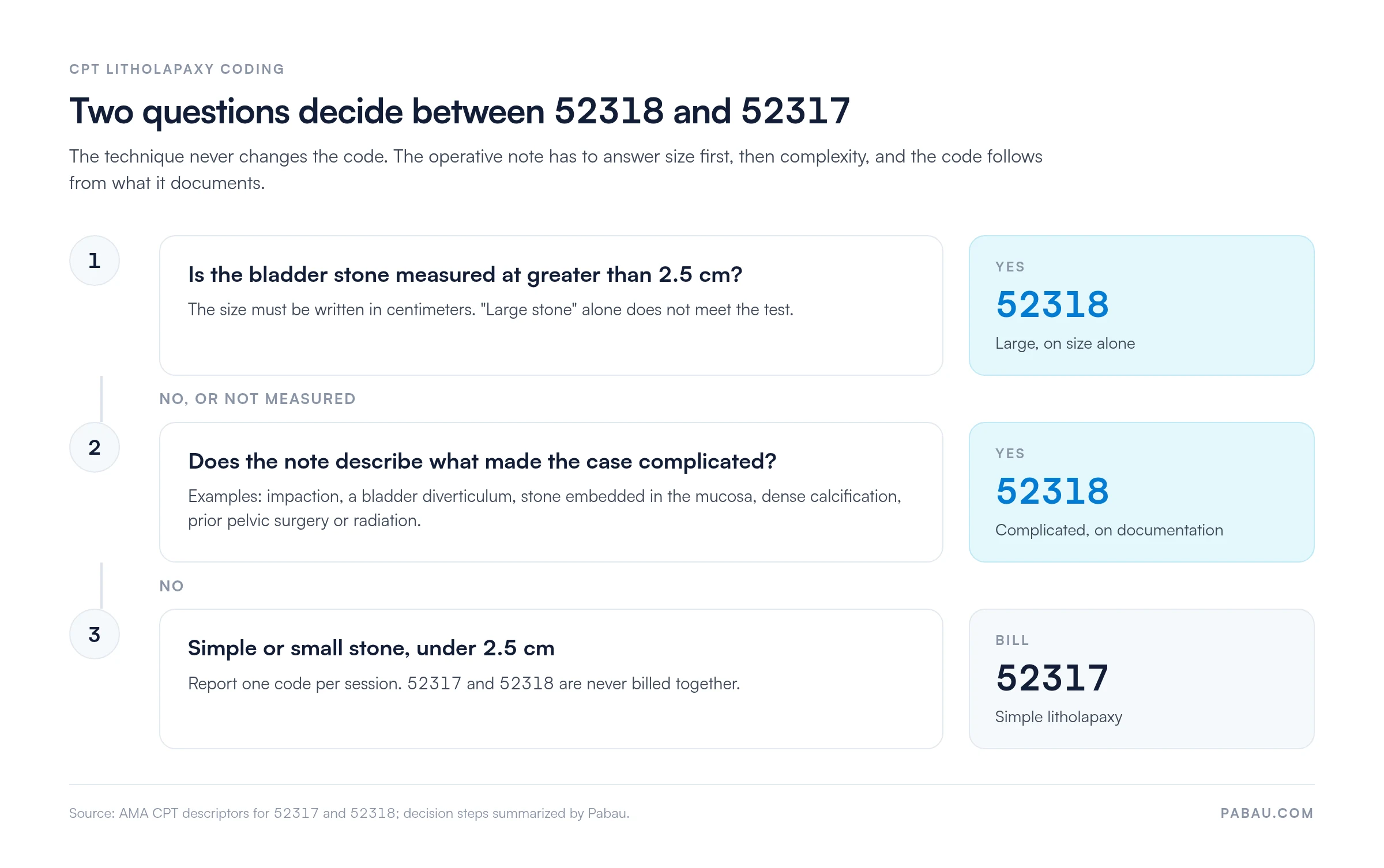
Two criteria separate the codes, stone size and case complexity. If either one is met and documented, 52318 applies. If neither is, the case belongs under 52317.
“Complicated” in the descriptor reaches beyond size. A calculus under 2.5 cm can still qualify. It might be impacted in a bladder diverticulum, embedded in the mucosa, or found in a patient with prior pelvic radiation. The note has to name that factor clearly. The flow below shows the order to read a note in.
The National Correct Coding Initiative (NCCI) bundles several procedure codes into 52318. Report a bundled code with 52318 on the same date of service, and the bundled line is denied. NCCI edits update quarterly, so check the current table before you submit.
Staged cases are where the cystoscopy bundle bites. If the surgeon scopes first and then decides to treat, only 52318 goes on the claim, with no separate line for 52000. Our CPT code library lists the neighboring urology codes, each with its own billing guide.
Payers auditing 52318 claims look for five specific elements in the operative report. Missing any one invites a denial or a downcode to 52317. A clean claim submission starts in the operating room, well before the billing desk.
A clean 52318 claim passes through five hands, and each one can break it:
Most 52318 problems start at step 1 and only surface at step 5. That’s why the checks below happen before the claim leaves the practice.
Medicare pays CPT code 52318 under the Medicare Physician Fee Schedule (MPFS), and its RVUs update each January. The table shows the 2026 national figures. Check the CMS Physician Fee Schedule lookup tool for your payment locality, because the Geographic Practice Cost Index (GPCI) shifts payment by region. FastRVU’s 2026 RVU lookup gives a quick locality-specific figure.
Facility and non-facility totals match for 52318 in 2026, so the professional payment doesn’t change with the setting. The setting still matters on the facility side. A hospital outpatient department bills its facility fee under the Outpatient Prospective Payment System (OPPS), and an ASC bills under the ASC payment system.
The 000-day global period covers the day of the procedure only. Follow-up visits on later days are billed separately.
52318 denials follow a predictable set of documentation and coding errors. Strong denial management workflows catch them before submission rather than on appeal.
Each quarter, audit the 52317 and 52318 claims from the prior 90 days. Compare the code billed with the stone size in the operative note. Any 52317 claim whose note documents a stone over 2.5 cm is a missed 52318. You can correct and resubmit it within the timely filing window.
Prior authorization for CPT code 52318 varies by payer and plan year. Medicare fee-for-service doesn’t require it. Medicare Advantage plans often do, so check the plan’s authorization list before scheduling, since it changes annually.
Commercial payers and state Medicaid plans differ. Some need only medical necessity documentation. Others want imaging of the calculus (ultrasound or CT KUB), notes on failed conservative management and the planned approach. Sending those together, backed by sound medical billing compliance habits, cuts the back-and-forth that delays cases.
These elements typically support approval with commercial payers:
The ICD-10-CM codes below are the most common primary diagnoses paired with CPT code 52318. ICD-10-CM updates every October 1, so check them against the current tabular list before you submit.
Pick the most specific code the operative and diagnostic workup supports. N21.0 fits the vast majority of 52318 claims. Add secondary codes for documented comorbidities that support medical necessity, such as recurrent UTI (N39.0), gross hematuria (R31.0) or urinary obstruction (N13.9).
In many urology practices, the coder rekeys the procedure, diagnosis and patient details from the operative note into a separate billing tool. Each rekeyed field is another chance for a rejection.
Pabau, the practice management and billing platform we build, cuts out that rekeying. Its streamlined claims management software pre-fills the claim from the patient record, so the 52318 charge and its diagnosis land on the form. It also checks that required claim fields are complete before you send.
US practices submit 52318 claims electronically through Claim.MD, with real-time eligibility checks before the date of service. Remittances come back into Pabau, so your team sees what was paid and what needs follow-up.

Pabau’s claims management software pre-fills claims from the record and validates required fields before you send. It submits clean claims electronically via Claim.MD, so your urology billing team spends less time on rework and more on patient care.

For 52318, the operative note does the coding. When the urologist dictates a measured size, or names what made the case complicated, the claim holds up on review. When the note stays vague, the payer treats it as 52317, and the difference is hard to recover once the filing window closes.
So start with the dictation template, not the billing desk. Add a size prompt and a complexity prompt, then audit last quarter’s 52317 claims for missed 52318s.
Pabau’s claims management platform pre-fills claims from the record, validates required fields and submits to payers through Claim.MD with eligibility checks. If your urology billing team is losing reimbursement on stone management claims, book a demo to see how Pabau handles the claim lifecycle.

Coding a smaller, uncomplicated stone? CPT code 52317 covers simple litholapaxy under 2.5 cm, with its own documentation rules.
Stone sitting in the ureter instead? CPT code 52353 covers cystourethroscopy with ureteroscopic lithotripsy.
New to the billing workflow behind these codes? Medical billing fundamentals covers the end-to-end workflow, from charge capture to payment posting.
Submitting urology claims through Claim.MD? How Claim.MD clearinghouse works explains real-time eligibility checks and electronic remittance advice for US practices.
Building the superbill for a stone procedure? Superbill guide for medical practices walks through what must appear on a claim so it processes without manual review.
Medicare’s 2026 national rate for CPT 52318 is about $414, the same in facility and non-facility settings. That figure is 12.40 total RVUs times the $33.4009 conversion factor, before GPCI. Your locality adjustment moves the final payment up or down.
Yes, a 000-day global period. Work on the day of the procedure is included in the code. Visits on later days are billed separately, and a significant, separately identifiable E/M on the same day needs modifier 25.
Not on size alone. The descriptor says greater than 2.5 cm, so a stone measured at exactly 2.5 cm misses the size test. 52318 then depends on a documented complicating factor. Without one, query the surgeon, because 52317 reads less than 2.5 cm.
One. 52318 describes the whole litholapaxy session, so report it once however many stones are fragmented. A heavy stone burden belongs in the operative note as a complicating factor, not as extra units.
No. 52318 covers litholapaxy “by any means,” including holmium laser, electrohydraulic and mechanical fragmentation. Stone size or complexity decides between 52317 and 52318. A laser case with a 3 cm stone bills as 52318.