



CCSD code G5100: Bypass of duodenum billing guide
CCSD code G5100 bills a bypass that leaves the duodenum in place CCSD code G5100...

Last Updated: Oct 16, 2026

CPT code 52000 covers a diagnostic cystourethroscopy of the bladder and urethra, performed as a standalone procedure.
Under the 2025 fee schedule, Medicare paid roughly $209 for 52000 in an office and $69 in a facility.
The 0-day global period bundles no post-operative care, so follow-up visits on later dates bill separately.
NCCI edits bundle 52000 into any higher-complexity cystoscopy code billed on the same date. The separate procedure designation does not override an active edit.
Practice management software like Pabau ties the operative note to claim submission, so a missing modifier surfaces before the claim goes out.
The official AMA CPT descriptor for CPT code 52000 reads: Cystourethroscopy (separate procedure). The code covers a diagnostic endoscopic examination of the bladder and urethra using a rigid or flexible cystoscope. No additional intervention – biopsy, stent placement, or stone removal – is included.
The “(separate procedure)” parenthetical is a specific AMA designation, not generic billing language. It means CPT code 52000 is integral to more comprehensive cystoscopy procedures. Report a higher-complexity cystoscopy code on the same date, say CPT 52204 for a biopsy, and 52000 is bundled into it. The code bills independently only when it is the sole cystoscopic service.
Cystourethroscopy is a direct visual examination of the urethra and bladder using a cystoscope passed transurethrally. A urologist or qualified physician advances the scope under direct vision, irrigating the bladder for visibility. From there they inspect the mucosa, trigone, ureteral orifices, and bladder neck.
Common indications include hematuria, whether gross or microscopic, and recurrent urinary tract infections. Lower urinary tract symptoms, incontinence evaluation, a suspected foreign body, and surveillance after bladder cancer resection also prompt it. The examination takes 5 to 20 minutes depending on findings.
CMS applies split facility and non-facility rates to CPT code 52000 because physician work and practice expense differ by setting. The rates below reflect the 2025 CMS Physician Fee Schedule national average. Geographic adjusters (GAFs) vary these figures by locality. Always confirm your specific payment amount using the CMS Physician Fee Schedule lookup tool.
Those figures come from the code’s published RVUs and the 2025 conversion factor of $32.3465. Non-facility total RVUs of 6.46 work out to about $209. Facility RVUs of 2.13 work out to about $69. Verify the exact amount for your MAC jurisdiction using the fee schedule lookup. Commercial payers negotiate their own rates and often pay above Medicare.
Modifier selection for 52000 turns on one question: Was another procedure performed on the same date? The code carries a CMS professional/technical component indicator of 9, so the component split does not apply to it. Applying the wrong modifier, or skipping a required one, is the fastest path to a denial.
Modifier 51 needs care. Some payers auto-apply a 50% reduction when it appears on 52000 as the secondary code, so confirm the reduction policy before submission. Medicare’s modifier rules also differ from commercial payer rules, so review each contract individually.
Medical necessity requires a supporting ICD-10-CM diagnosis code that justifies the cystoscopy. Payers cross-reference the submitted diagnosis against their LCD (Local Coverage Determination) for cystoscopy. Using a diagnosis code outside the covered list – even a clinically reasonable one – triggers a medical necessity denial. Below are the most commonly paired codes.
Submitting a covered diagnosis code does not guarantee payment. The clinical record still has to document the reasoning that links the diagnosis to the cystoscopy. Verifying eligibility before the procedure date confirms whether the plan covers cystoscopy for the planned indication.
Urine cytology ordered alongside a hematuria workup is billed by the laboratory on its own claim. Liquid-based preparation of that specimen is reported as 88112, not under the cystoscopy code.
Run a payer-specific LCD check before scheduling diagnostic cystoscopy for microscopic hematuria. Several MACs have updated their LCDs to require risk stratification (age, smoking history, degree of hematuria) before approving 52000 under R31.21. Documenting this stratification in the pre-procedure note prevents post-service denials.
The National Correct Coding Initiative (NCCI) is a CMS program that prevents unbundling. Unbundling means billing component procedures separately when they are integral to a more comprehensive service. CPT code 52000 is the base cystoscopy code of the 52000 series. Every higher-complexity procedure in that series bundles it when both fall on the same date of service.
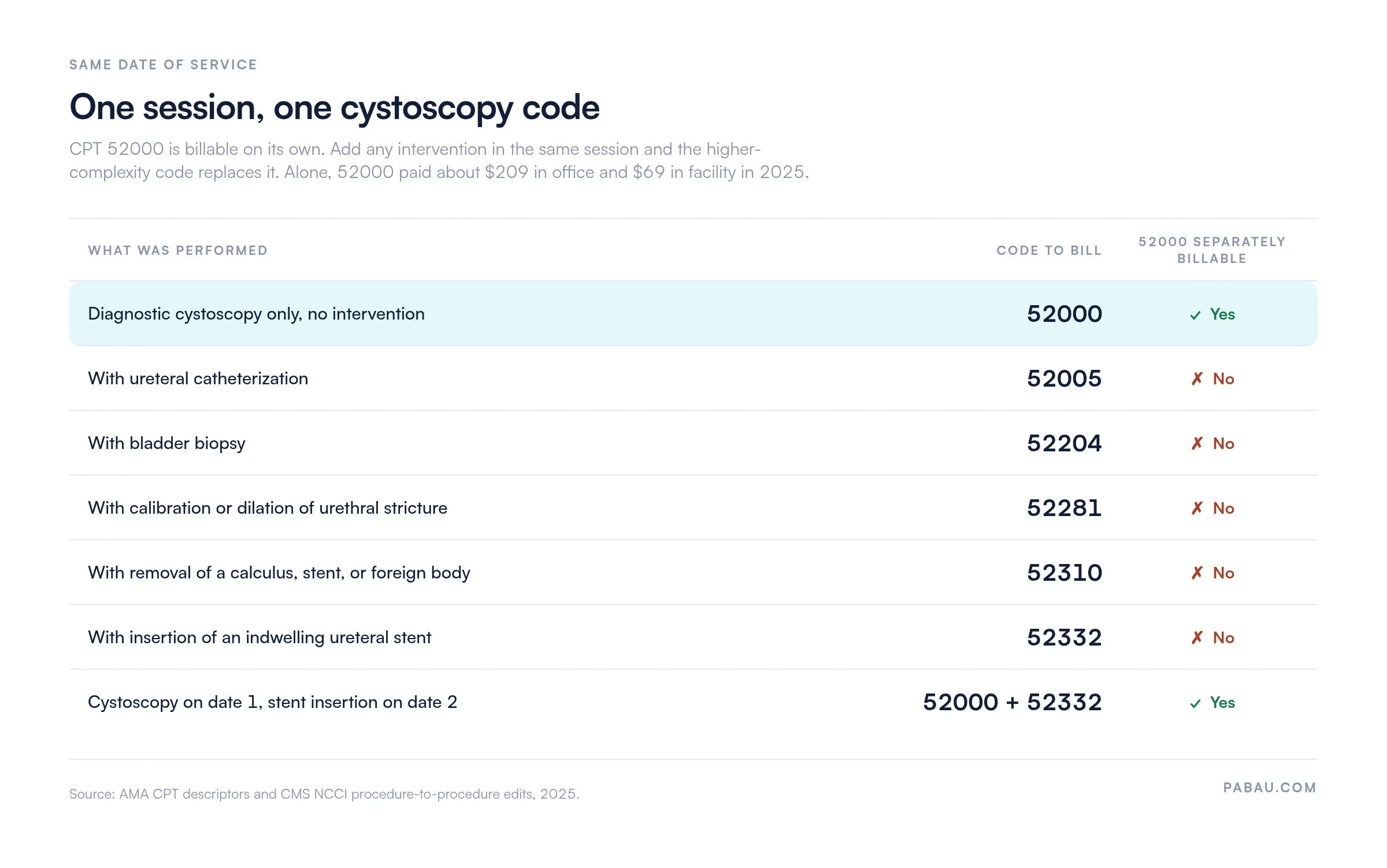
The practical rule is short. If you bill CPT 52204, 52281, 52310, or 52332 on the same claim, do not also bill 52000. The more complex code already includes the diagnostic visualization that 52000 represents.
Two common conversions sit outside that short list. Fulguration of a minor bladder lesion found during the scope is reported as CPT 52224, and crushing a small bladder stone is CPT 52317. Either one already includes the diagnostic cystoscopy, so leave 52000 off the claim.
Submit both and the NCCI pair edit fires, so 52000 gets denied. Check the edit table every quarter, because CMS updates it four times a year. The matrix below is the whole rule on one screen.
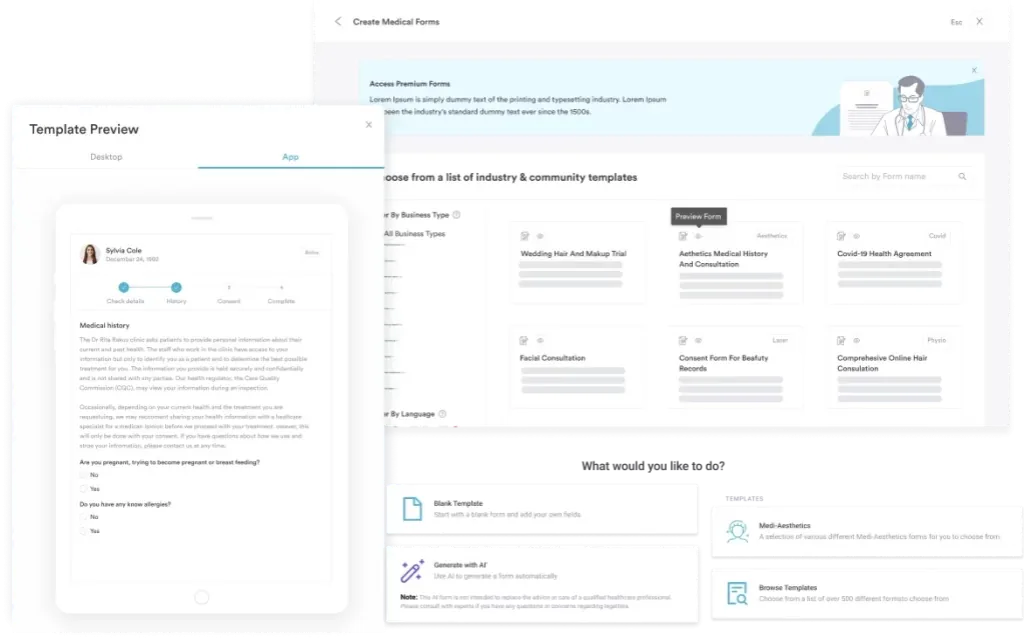
Insufficient documentation is the second-most-common reason 52000 claims are denied on audit, after incorrect code selection. The operative note has to support every element of the code descriptor and show medical necessity. Clean claim submission depends on the chart carrying each of the elements below.
A structured operative note template does most of that work. It prompts the physician to record the indication, the instrument, and the findings while the scope is still in hand. Billing is then not chasing detail a week later.
These are the four situations where 52000 coding decisions diverge most often in urology practices. Each row gives the clinical situation, the code to submit, and the reason behind it.
CPT code 52000 carries a 0-day global period under the CMS Physician Fee Schedule. This means the global surgical package includes only the procedure itself – no pre-operative day and no post-operative follow-up care is bundled into the reimbursement.
Follow-up visits after a diagnostic cystoscopy bill as separate E/M services on later dates. There is no restricted post-operative period during which the physician has to see the patient for free.
An E/M service on the same day as the cystoscopy is a different case. Append modifier 25 to the E/M so the payer reads it as a separate, significant service rather than pre-procedure counseling. A billing workflow that captures those visits keeps them from being written off.
Claims for 52000 are denied for predictable reasons. Find which error recurs most often in your own claim data, then fix the coding template or the payer rule that lets it through.
Tracking denials by reason code across your cystoscopy claims shows which of these errors drives the most write-offs. The breakdown of common claim denial codes explains each remittance adjustment reason code and what it signals about the claim.
CPT code 52000 is the diagnostic foundation of the cystoscopy family. Knowing when a related code replaces it prevents both undercoding and the overbilling that triggers NCCI edits.
CPT 52005 describes cystourethroscopy with ureteral catheterization, with or without irrigation, instillation, or ureteropyelography. It is used when the urologist places a catheter into the ureter – for example, to collect a retrograde urine specimen or inject contrast. When 52005 is performed, bill it instead of 52000. The two codes are not additive.
CPT 52310 covers removal of a foreign body, calculus, or ureteral stent via cystoscopy. CPT 52332 covers insertion of an indwelling ureteral stent. Both are therapeutic services that subsume the diagnostic visualization of 52000.
When either one is performed, 52000 is bundled and should not appear on the claim. The code for a cystoscopy with stent placement is 52332, not 52000 with a modifier appended.
Stones broken up with lithotripsy rather than retrieved whole fall to a different code. Ureteroscopy with lithotripsy, 52353, already includes the cystourethroscopy, so report it on its own and leave 52000 off the claim.
Plenty of urology practices still run cystoscopy coding by hand. Paper charge tickets, verbal handoffs from the OR, and coders picking modifiers from memory all cause the same avoidable denials on 52000. That is a workflow problem before it is a coding one.
Practice management software like Pabau closes the distance between the chart and the claim. When the cystoscopy note is completed in the system, the billing team sees the procedure, the diagnosis, and the modifier applied. That happens before the claim goes out, not after a denial comes back.
Pabau’s claims management for urology connects documentation to submission and flags the missing fields that would otherwise cause a denial downstream.
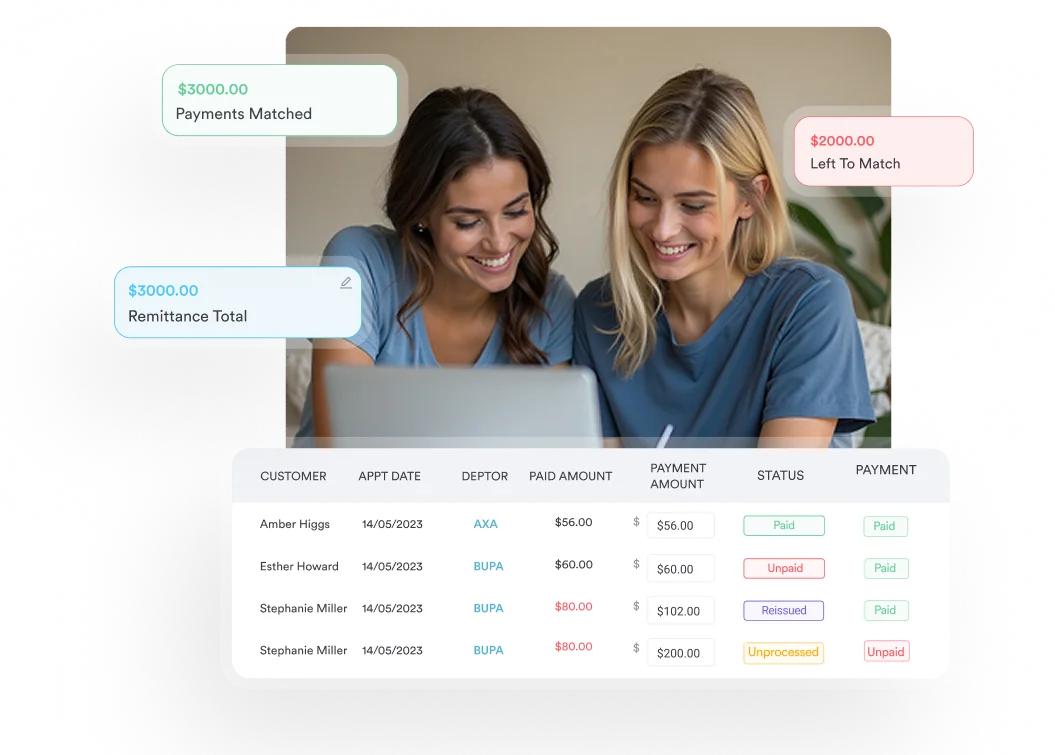
Cystoscopy claims submitted through Pabau route to more than 4,000 US payers via its Claim.MD clearinghouse integration. Built-in CPT and ICD-10 code catalogs validate the code pair at submission, so a bundled 52000 is caught before the payer sees it.
The charge also captures the procedure code and the supporting diagnosis before the patient leaves. Nobody is reconciling missing codes at closing.

Pabau connects your clinical documentation to claim submission – with built-in modifier support, NCCI edit flags, and electronic claims via Claim.MD across 4,000+ US payers. See how it works for urology practices.

CPT code 52000 is simple to bill when it is the only cystoscopic service of the day. The difficulty is always the second procedure. Once a higher-complexity code enters the same session, 52000 stops being a billable line and becomes part of that code.
So the decision worth building into your workflow comes before the modifier question: Does 52000 belong on this claim at all? Answer that from the operative note rather than from the charge ticket, and most of the denials in this article stop happening.
Book a demo to see how Pabau catches a bundled 52000 and a missing modifier before your urology claim is submitted.

Need to track denial patterns across your cystoscopy claims? Denial management in healthcare covers systematic approaches to identifying, tracking, and resolving claim denials by reason code.
Want to understand how clearinghouse submissions work? Medical claims clearinghouse guide explains how electronic claims move from your practice management system to the payer.
Looking for the right billing software for your US practice? Best medical billing software for US practices compares platforms by claim submission capability, specialty fit, and RCM features.
CPT code 52000 is the AMA procedure code for cystourethroscopy performed as a separate, standalone procedure. It covers a diagnostic endoscopic examination of the bladder and urethra without any additional intervention such as biopsy, dilation, or stent insertion. The “(separate procedure)” designation in the code descriptor means it should not be billed alongside higher-complexity cystoscopy codes performed in the same session.
Under the 2025 fee schedule, the national average for CPT 52000 is about $209 in an office setting. In a facility such as an outpatient hospital or ASC, it is about $69. Those figures come from total RVUs of 6.46 and 2.13 against the 2025 conversion factor of $32.3465. Exact rates vary by MAC jurisdiction and geographic adjustment factor.
Modifier 51 applies when 52000 is a second procedure on the same date. Modifier 59 applies when it is a distinct procedural service that overrides an NCCI edit. Modifier 25 goes on an associated E/M billed the same day. Modifiers 26 and TC do not apply, because 52000 carries a CMS professional/technical component indicator of 9. Verify each payer’s policy, since Medicare’s rules differ from commercial rules.
Yes, CPT 52000 carries the AMA “(separate procedure)” designation. This means the diagnostic cystoscopy is integral to, and bundled into, more comprehensive cystoscopy procedures. It can only be billed independently when it is the only cystoscopic service performed on that date. Billing it alongside CPT 52204, 52281, 52310, or 52332 on the same claim will trigger an NCCI bundling edit and denial of 52000.
CPT 52000 describes diagnostic cystourethroscopy as a separate procedure with no intervention. CPT 52001 covers cystourethroscopy with irrigation and evacuation of multiple obstructing clots. It is a therapeutic code, used when the bladder holds blood clots that need evacuating. The two codes serve different clinical purposes and are not interchangeable. Bill 52001 only when clot evacuation is the primary purpose of the procedure, not when visualization alone was performed.
The operative note for CPT 52000 must include the clinical indication, the instrument type, and the irrigation method. It also needs a complete description of findings, even a normal exam, plus the anesthesia used and the patient’s tolerance. If another procedure was billed alongside it, the note must show the cystoscopy was a distinct service at a separate site or session.



