CCSD code F5010: Parotid duct transposition billing guide
CCSD code F5010 covers parotid duct transposition, one side or both CCSD code F5...

Last Updated: Oct 9, 2026
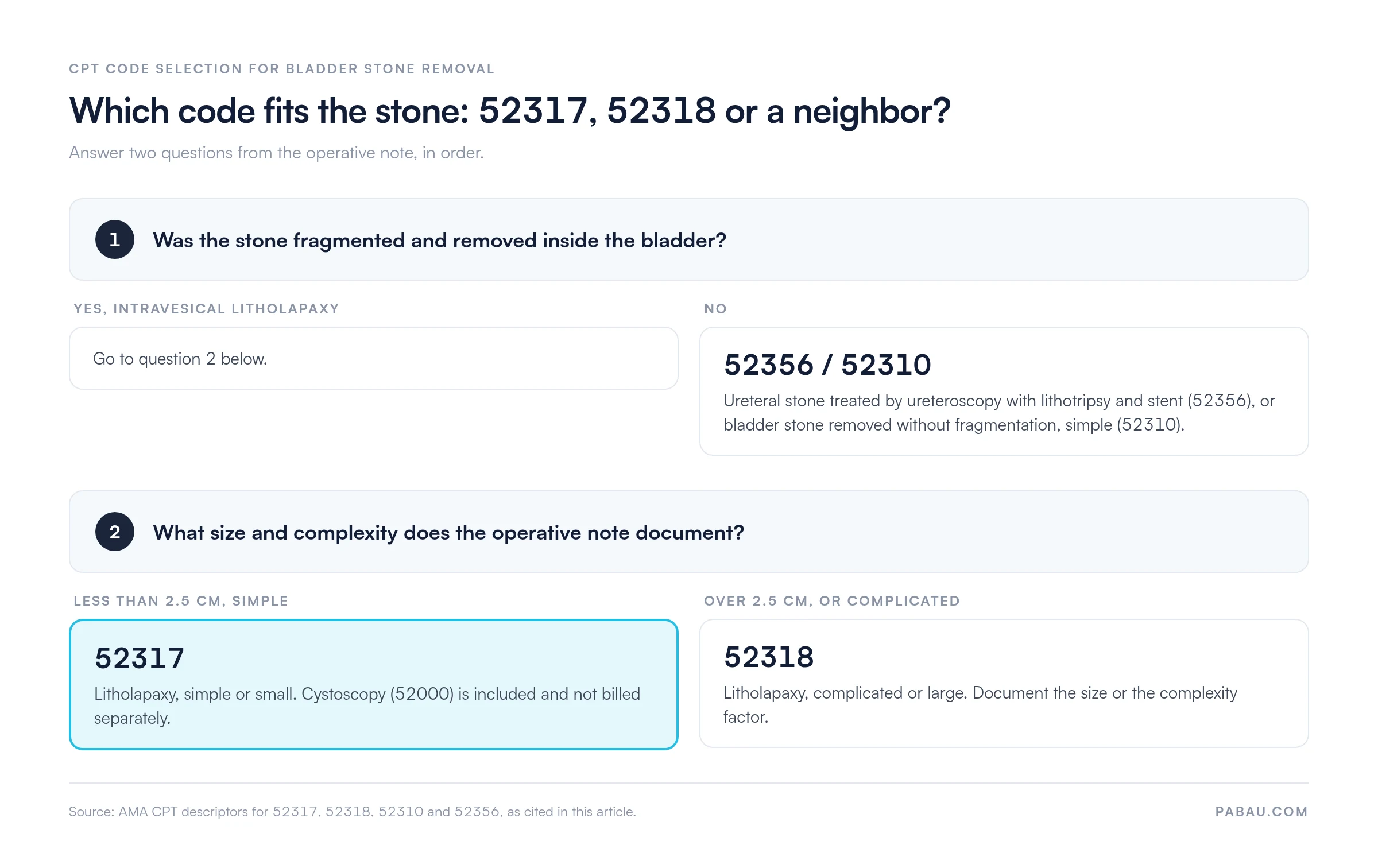
52317 is the CPT code for litholapaxy of a bladder stone that is simple or small, less than 2.5 cm. It covers crushing or fragmenting the calculus by any means inside the bladder and removing the fragments through a cystoscope.
Complicated or large stones, over 2.5 cm, take CPT 52318 instead. Confusing the two is a frequent reason bladder stone claims are denied or downcoded. The operative note must document the stone size rather than leave it assumed.
Let Pabau's smart automation suggest the right codes, reduce claim denials, and keep your practice compliant—effortlessly.
Automate repetitive tasks and focus on what matters most—your patients.
Reduce coding errors and ensure compliance with the latest regulations.
Clean claims, fewer denials, and faster reimbursements.
Powerful insights and reporting to help your practice thrive.
HIPAA compliant SOC 2 certified GDPR-compliant Trusted by 4,000+ clinics worldwide

CPT code 52317 covers cystoscopic litholapaxy for simple or small bladder calculi under 2.5 cm, performed via transurethral approach.
The operative note must state the stone size against the 2.5 cm threshold, because a missing measurement is a frequent cause of claim denial.
Use CPT 52318 when the calculus is complicated or large (over 2.5 cm). The two codes are mutually exclusive for the same stone in one session.
Pabau, the practice management and billing platform we build, flags missing required fields before a 52317 claim is submitted.
CPT code 52317 is defined by the American Medical Association in the CPT code set. The descriptor reads “Litholapaxy: crushing or fragmentation of calculus by any means in bladder and removal of fragments; simple or small (less than 2.5 cm).” The code sits within the Urethra and Bladder Transurethral Surgery subsection of the CPT code set.
Litholapaxy refers specifically to the intravesical fragmentation of a calculus. The stone is broken apart inside the bladder and the fragments are evacuated through the cystoscope, rather than extracted intact. The phrase “by any means” is deliberate: It encompasses mechanical, ultrasonic, electrohydraulic, and laser fragmentation. The one condition is that the entire procedure occurs within the bladder rather than the ureter.
Understanding the procedure steps helps coders confirm that the operative note supports CPT code 52317 before submitting the claim.
When the stone extends into the ureteral orifice or needs a ureteroscopic approach, the appropriate code shifts to CPT 52356. Its descriptor reads “cystourethroscopy, with ureteroscopy and/or pyeloscopy; with lithotripsy including insertion of indwelling ureteral stent.” CPT 52317 is reserved for calculi treated entirely within the bladder lumen.
A frequent coding error in bladder stone procedures is billing CPT 52318 when 52317 is correct, or the reverse. Stone size is the primary differentiator, but complexity factors also apply.
When stone size is not documented in the operative note, payers default to the lower-complexity code or deny the claim outright. The safe coding practice is to query the physician before submission rather than assume size from pre-operative imaging.
The choice runs in two steps, stone location first and documented size second, as the diagram below lays out.
Medical necessity for CPT code 52317 must be supported by an ICD-10-CM diagnosis code that identifies the bladder or urinary tract calculus. Payers review the diagnosis-procedure pairing at adjudication. A mismatched or incomplete diagnosis code is a common denial trigger.
N21.0 (Calculus in bladder) is the usual primary pairing for CPT 52317. N21.9 (unspecified) invites payer scrutiny, so code to the documented site whenever the operative note identifies where the stone sat.
Incomplete operative notes sit behind many CPT 52317 denials. The note must contain each of the following elements to support clean claim submission for this procedure.
A note that says only “cystoscopy with lithotripsy performed” without size, approach, or method is not sufficient. Payers applying LCD (Local Coverage Determination) criteria will request records or deny outright.
Ask the urologist to dictate stone size and fragmentation method as two discrete sentences in the procedure body. Keep them out of the catch-all impression paragraph. Coders reviewing notes for compliance can locate the required elements in seconds when they are structured this way, and so can payer auditors.
Medicare reimburses CPT code 52317 under the Medicare Physician Fee Schedule (MPFS), administered by CMS. Rates vary by setting (non-facility vs. facility) and by geographic location, with the conversion factor and relative value units (RVUs) updated annually. For current national and locality-adjusted rates, use the CMS Physician Fee Schedule lookup tool and select the appropriate year, MAC locality, and place of service.
Practices billing CPT 52317 at an ambulatory surgery center (ASC) should verify the ASC payment indicator for the current fiscal year. ASC rates are set separately from the physician fee schedule. Non-facility rates apply when the procedure is performed in an office setting.
Verify current figures at FastRVU’s 2026 RVU lookup for a quick national estimate before checking your MAC locality.
Modifier use for CPT code 52317 is payer-specific. Applying a modifier without a documented clinical rationale is as problematic as omitting one when it is required. Billing staff should confirm each modifier’s applicability against the individual payer’s policy before submission, in line with billing compliance requirements.
Several urology procedure codes are frequently performed in the same operative session as CPT code 52317. Understanding which codes may be billed together and which are bundled by NCCI edits is essential for accurate urology billing.
NCCI edits are updated quarterly by CMS. Verify current bundling status against the live NCCI table before assuming a code pair is billable. When the surgeon removes a simple stone intact, without fragmenting it, review CPT 52310 instead. See the AAPC CPT lookup for quick code descriptor reference alongside crosswalk information.
Prior authorization requirements for CPT code 52317 vary by payer and plan year. Medicare does not require prior authorization for most litholapaxy procedures, but commercial payers and Medicaid managed care organizations frequently do.
The CPT 52317 denial patterns below are preventable, and each fits the denial management workflows that revenue cycle teams use to reduce write-offs. A reference table of medical billing denial codes helps decode remittance advice messages.
Without a structured note, a missing stone size usually surfaces only when the remittance comes back denied. The biller then queries the urologist, corrects the code, and resubmits weeks after the procedure.
In Pabau’s billing software, teams use the urology claims management tools to attach structured operative notes to claims before submission. Missing required fields are flagged at that point. Corrected claims can be routed again after a denial, which cuts the manual work of a urology denial queue.
Pabau also integrates with Claim.MD’s clearinghouse to route urology claims electronically to thousands of US payers. Eligibility is verified in real time before the procedure date, so the practice confirms coverage for CPT 52317 without calling the payer.
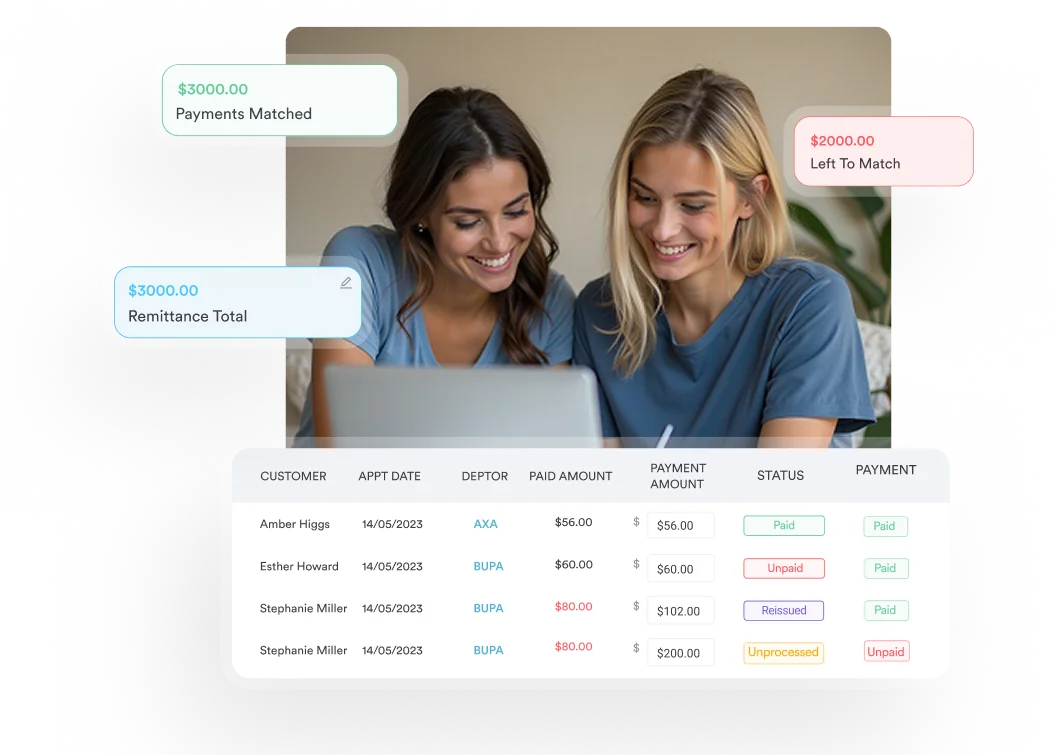

Pabau’s claims management tools support structured operative documentation, electronic claim submission, and real-time eligibility checks. That means fewer denials on CPT 52317 and other urology procedure codes.

The most preventable CPT 52317 denials trace back to one root cause: An operative note that does not state the stone size. Without that number, coders guess, auditors deny, and billers appeal.
The fix belongs in the operative note template, not in the billing office. A required size field costs the surgeon a few seconds per case. It turns the 52317 versus 52318 choice into a lookup rather than a physician query.
Pabau’s structured billing workflows catch a missing size or a bundled cystoscopy code before the claim leaves the practice. Book a demo to see how Pabau handles urology procedure billing end to end.

Need a framework for reducing claim denials across your practice? Denial management in healthcare covers the systematic workflows revenue cycle teams use to prevent, appeal, and track denied claims.
Submitting claims electronically and unsure about clearinghouse options? How Claim.MD clearinghouse works explains the submission, eligibility, and ERA process for US payers.
Want to understand how clean claims are built from the start? What makes a clean claim outlines every field and documentation element required for first-pass acceptance.
Placing a ureteral stent in the same session? CPT code 52332 explains stent insertion coding and when it bills separately.
CPT code 52317 covers cystoscopic litholapaxy, the crushing or fragmentation of a bladder calculus by any means and removal of the fragments. It applies to simple or small calculi, less than 2.5 cm, treated transurethrally within the bladder.
CPT 52317 applies to simple or small bladder calculi under 2.5 cm. CPT 52318 applies to complicated or large calculi over 2.5 cm. The two codes are mutually exclusive for the same stone. Code selection must rest on the intraoperative stone size documented by the physician, not pre-operative imaging alone.
The threshold is 2.5 cm: Below 2.5 cm maps to CPT 52317 (simple or small). Over 2.5 cm maps to CPT 52318 (complicated or large). The physician’s intraoperative measurement governs the selection, so the operative note must state the size explicitly.
No. CPT 52000 (cystourethroscopy) is bundled into CPT 52317 by NCCI edits and cannot be billed separately for the same session. Billing both codes together without a valid modifier and distinct documentation will trigger a bundling denial. Always check the current CMS NCCI table before adding any concurrent cystoscopy code.
The primary pairing is N21.0 (Calculus in bladder). N21.1 (Calculus in urethra), N21.8 (Other lower urinary tract calculus), and N21.9 (Calculus of lower urinary tract, unspecified) may apply in specific circumstances. N21.0 is the preferred code when the operative note confirms the stone is intravesical.
Medicare rates for CPT 52317 vary by locality and setting (facility vs. non-facility) and are updated annually. Use the CMS Physician Fee Schedule lookup tool at cms.gov to obtain the current national and locality-adjusted rates. Facility rates apply at ASCs and hospital outpatient departments; non-facility rates apply in office settings.