CCSD code H4180: Full or partial thickness rectal biopsy
CCSD code H4180: definition and procedure scope CCSD code H4180 is listed in the...

Last Updated: Oct 22, 2026

CPT code 52310 covers cystourethroscopy with simple removal of a foreign body, calculus, or ureteral stent from the urethra or bladder.
Bill 52310 for a routine stent extraction, and move to 52315 only when the note documents a complication.
52310 is a separate procedure, so it bundles into a more comprehensive cystourethroscopy unless modifier 59 is justified.
The scope reaches the urethra and bladder only, so a stone still sitting in the ureter needs a ureteroscopy code.
Practice management software like Pabau pre-fills the claim from the record, offers CPT and ICD-10 lookup, and checks required fields.
CPT code 52310 covers cystourethroscopy with simple removal of a foreign body, calculus, or ureteral stent from the urethra or bladder. The procedure itself is routine. The claim often is not.
One word in the descriptor does most of the work. That word is simple. It earns 52310, and reaching past it for 52315 without a documented complication is what draws an audit. Payers watch that pair closely, so the choice moves both your revenue and your risk.
We start with the descriptor, then work through the 52315 decision, Medicare rates, modifiers, and ICD-10 pairings. Documentation and the denial patterns close it out.
The official descriptor reads cystourethroscopy, with removal of foreign body, calculus, or ureteral stent from urethra or bladder; simple. It sits in the Urethra and Bladder subsection of the Surgery chapter, under transurethral procedures in the 52000 to 52400 range.
The code also carries a separate procedure designation. In practice, that means it folds into a more comprehensive cystourethroscopy when both happen in one session. Report it on its own only when the retrieval was the substantive work of that encounter.
The American Medical Association (AMA) maintains the CPT codebook and publishes the official descriptor each year. Check the current edition before you submit, because descriptor language does shift in annual updates.
Cystourethroscopy, also called cystoscopy, passes a rigid or flexible scope through the urethra into the bladder under direct vision. For 52310, the clinician then retrieves a foreign body, a calculus, or an indwelling ureteral stent.
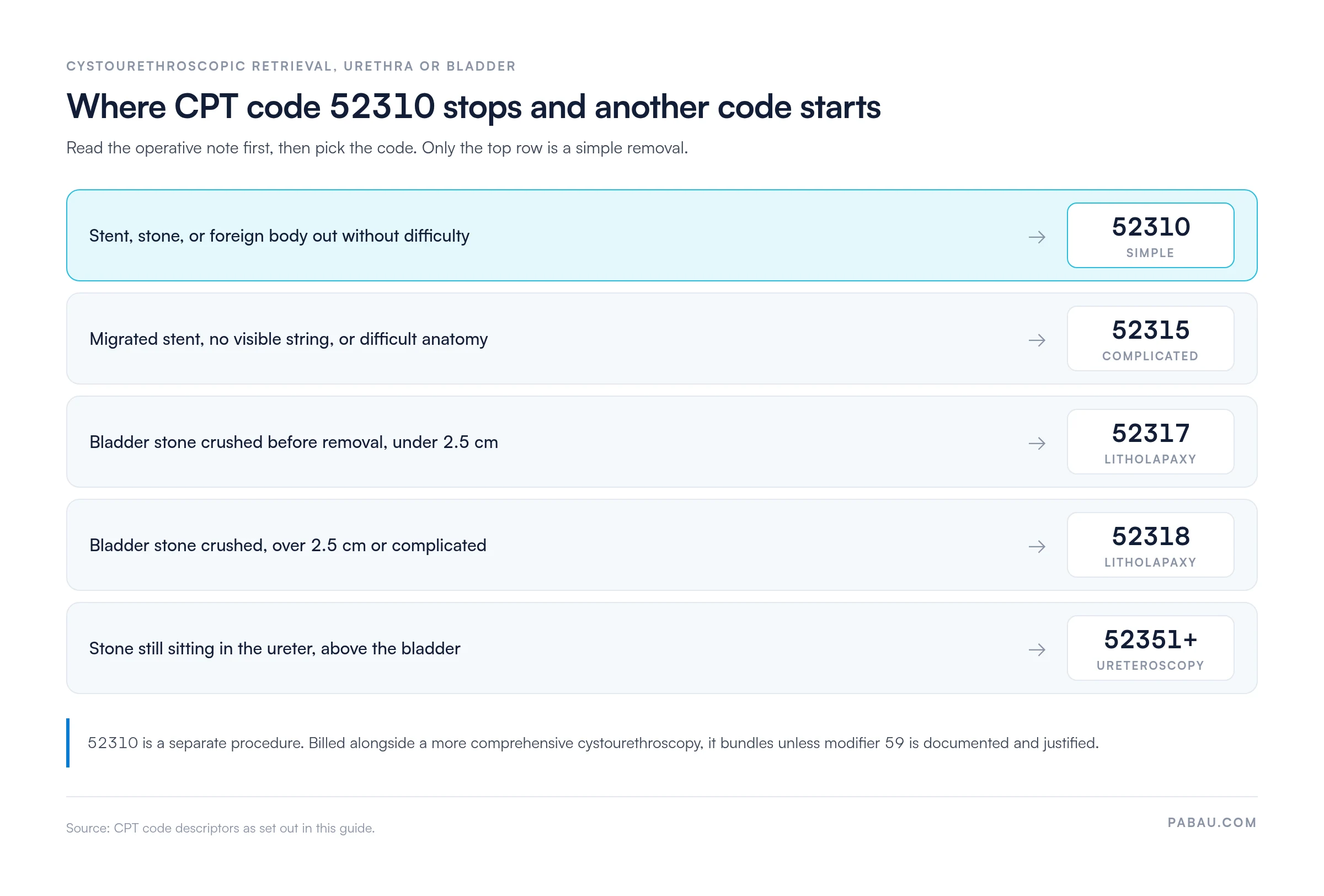
If the surgeon crushes the bladder stone instead of removing it intact, the service becomes litholapaxy. CPT code 52317 covers an uncomplicated stone under 2.5 cm, and 52318 takes the rest.
The word simple is the part that decides the code. It means the removal ran without significant complication, awkward anatomy, or difficulty beyond what you would expect. On a stent, the string is usually visible or easy to catch with standard graspers.
Any step can turn the encounter into a different code. Serious resistance, a migrated stent with no visible string, or a stone that needs fragmenting first all take the removal past simple. That is where 52315 comes in.
The note decides. If it describes a routine extraction, the code is 52310, and reporting 52315 instead is the most common upcoding error in urology endoscopy.
Both codes cover cystourethroscopic removal from the urethra or bladder. Only the complexity language separates them.
The same decision has three more exits, and the chart below maps all of them in one place.
Take a common case. A patient comes back two weeks after ureteroscopy for a stent pull. The string is visible, the scope goes in, and the stent is out inside a minute.
The note reads “stent removed without difficulty,” so the code is 52310. The original stone case may have been complex, but the code follows this encounter, not the one before it.
Payers audit 52315 more heavily than 52310. Billing it without documented complicating factors is a familiar trigger for post-payment review. When the note is ambiguous, 52310 is the defensible choice.
Urology applies the same either-or test in the lab, where a screening PSA and a diagnostic PSA use an identical assay. The reason for the order picks the code, so preventive intent gives G0103 and a documented urinary symptom gives CPT 84153.
Medicare prices this code from relative value units, not from a flat fee. Work, practice expense, and malpractice RVUs are added under the Resource-Based Relative Value Scale.
The total is then adjusted for your locality with the Geographic Practice Cost Index (GPCI). So the same removal pays differently in two settings and two zip codes.
Check the current figure in the CMS Physician Fee Schedule lookup tool before you submit or quote a patient. Rates reset every January 1.
Commercial payers usually price off Medicare, often somewhere between 110% and 130% of the Medicare rate. Contracts vary widely, so read the multiplier your own agreement applies to urology endoscopy codes.
Pull the facility and non-facility rates for 52310 before you schedule stent removals in a new setting. The office rate carries the full practice expense RVUs, so it sits above the facility rate. That difference moves your revenue and the patient’s coinsurance at the same time.
Most 52310 claims need one modifier at most, and laterality is the usual one. Modifier choice is still a frequent denial trigger, so four of them deserve a second look before the claim goes out.
Bilateral removal is the one to settle before you bill. Medicare and the National Correct Coding Initiative (NCCI) both set rules for bilateral cystourethroscopy, and payers apply them differently.
Some accept one unit with modifier 50. Others want two units on separate claim lines. Confirm against the current NCCI Policy Manual first.
Medical necessity for 52310 rests on the diagnosis code sitting beside it. A Local Coverage Determination (LCD) can limit coverage to a named list, so check the pairing against the payer’s LCD before you send it.
The codes below are the ones reported most often.
The encounter character matters on the T-codes. Use A for the first encounter that addresses the complication, and D for follow-up visits dealing with the same problem. Sequence the primary diagnosis first, then list the rest by clinical relevance.
One pairing gets practices in trouble. N20.1, calculus of ureter, does not support 52310, because the scope only reaches the urethra and bladder.
A stone still sitting in the ureter calls for a ureteroscopic code such as 52356. If that session fragments the stone but leaves no stent behind, 52353 is the code instead. Once the stone has dropped into the bladder and comes out through the scope, N21.0 is the pairing you want.
A clean note is the best defense against a 52310 denial. Vague documentation is why straightforward stent pulls get downcoded, and it is the easiest of these problems to fix.
Each element below should appear in the report by name, not by implication:
Keep the note in the patient record for at least seven years, in line with CMS record retention guidance. Your state may ask for longer, so check the stricter of the two.
Five questions catch most 52310 rejections before a payer ever sees the claim. Run them at charge entry, while the note is still open on the screen.
Denials on this code cluster around five mistakes, and they repeat from practice to practice. Working the pattern beats working each denial one at a time, so it helps to know the claim denial codes your payers keep sending back.
Coders reach for these six most often when 52310 is on the table. Knowing where each one starts is what prevents the crossover errors that turn up in urology audits.
When insertion and removal fall in the same session, read the NCCI edits before you bill 52332 and 52310 together. Each procedure has to be clinically distinct and independently indicated in the note.
Most urology billing teams retype. A coder reads the operative note, finds the code, opens the billing system, and enters it again by hand. Every hop is a chance to drop a modifier or mistype a diagnosis. Nobody spots it until the remittance comes back short.
Practice management software like Pabau closes that loop with claims management built in. The CPT code attached to the service lands on the charge line by itself.
The ICD-10 slots are seeded from the patient’s recorded problem list. Searchable CPT and ICD-10 libraries sit behind the form too, so a coder can look up 52310 and 52315 without leaving the claim.
The form also holds itself back. Pabau checks that the claim’s required fields are complete, and the send button stays locked until they are. Remittance data then posts against the submitted claim, so you can see which lines paid and which came back.
For US Medicare and commercial work, Pabau submits 837 claim files through Claim.MD, our US clearinghouse partner. Claim.MD publishes no total payer count, but describes reach into thousands of US payers, with real-time eligibility checks at over 400 of them.
Remittance advice returns to the same system, so the trail from a 52310 note to confirmed payment holds together.

Pabau pulls the CPT and ICD-10 codes already on the record onto the claim form, and gives your coders searchable code libraries. The send button stays locked until the required fields are complete. That means fewer retypes and fewer resubmissions.

Denials on 52310 come down to three habits. Write the note so the complexity is unmistakable, match the modifier to the laterality you documented, and stop upgrading to 52315 on instinct. Practices that hold those three steady rarely argue about this code.
The bigger win is shortening the distance between the note and the claim. When the code travels from the record to the charge line without a retype, fewer errors get in. Add a form that will not go out with a field missing, and the arithmetic of denials changes.
Book a demo to see how Pabau moves a urology claim from operative note to posted payment.

Coding a cystoscopy with a biopsy rather than a retrieval? CPT code 52204 sets out the descriptor, the documentation, and the pairing rules for cystourethroscopy with biopsy.
Want more claims to pay on the first pass? What is a clean claim in medical billing? walks through the fields and checks a payer expects before it will pay.
Denials piling up faster than you can appeal them? Denial management in healthcare covers the causes, the workflow, and the prevention steps that cut rework.
Not sure how a claim actually reaches the payer? What is a medical claims clearinghouse? explains how 837 submissions, eligibility checks, and remittance advice connect.
Comparing US clearinghouse options for your practice? Claim.MD clearinghouse review covers real-time edits, denial reasons, and how resubmissions get routed.
Only when the visit addresses a separate, documented problem. A minor procedure already includes the usual pre-procedure evaluation, so a same-day E/M for the stent removal itself is not separately payable. When the patient raises an unrelated issue, append modifier 25 to the E/M code and keep the two notes distinct.
No. The diagnostic cystourethroscopy is included in 52310, so 52000 gets denied when the two are reported together. Bill 52000 on its own only when the scope was diagnostic and nothing was retrieved.
There is no procedure to report, so 52310 does not apply. Some stents are placed with an external string for exactly that reason. Log the phone or portal contact in the record, and bill only the visit that follows, if there is one.
Yes. The code describes the removal, not who placed the stent. Record why the stent went in, the date it was placed if you have it, and the indication for taking it out.
It depends on the plan. Traditional Medicare rarely requires prior authorization for a physician service like this, while Medicare Advantage and commercial plans often do. Check the surgical policy before you schedule, and put the authorization number on the claim.