

CPT Code 30801: Superficial turbinate ablation billing guide
CPT Code 30801: Official descriptor and procedure overview The American Medical ...

Last Updated: Nov 27, 2026
49020 is the CPT code for drainage of peritoneal abscess or localized peritonitis, exclusive of appendiceal abscess; open. It covers drainage of an infected collection inside the peritoneal cavity through a laparotomy or a focused abdominal incision. The code carries a 90-day global period.
The approach decides the code. Percutaneous image-guided catheter drainage of the same collection is reported with 49406, since 49021 was deleted in 2014. Retroperitoneal, subdiaphragmatic and appendiceal abscesses each have their own open code.
Let Pabau's smart automation suggest the right codes, reduce claim denials, and keep your practice compliant—effortlessly.
Automate repetitive tasks and focus on what matters most—your patients.
Reduce coding errors and ensure compliance with the latest regulations.
Clean claims, fewer denials, and faster reimbursements.
Powerful insights and reporting to help your practice thrive.
HIPAA compliant SOC 2 certified GDPR-compliant Trusted by 4,000+ clinics worldwide

CPT code 49020 reports open drainage of a peritoneal abscess or localized peritonitis, excluding an appendiceal abscess.
The code sits in the 49000-49084 incision procedures range for the abdomen, peritoneum, and omentum, and it carries a 90-day global period.
Percutaneous image-guided catheter drainage of the same collection is reported with 49406, because 49021 was deleted on January 1, 2014.
K65.1 (peritoneal abscess) is the usual diagnosis pairing, while a retroperitoneal abscess belongs with 49060 instead.
Pabau sends 49020 claims through the Claim.MD clearinghouse, checks eligibility before surgery, and posts remittances against the original claim.
CPT Code 49020 is the procedure code for open surgical drainage of a peritoneal abscess or localized peritonitis, exclusive of an appendiceal abscess.
The official AMA CPT descriptor reads: Drainage of peritoneal abscess or localized peritonitis, exclusive of appendiceal abscess; open. AAPC’s Codify entry for 49020 places it under Incision Procedures on the Abdomen, Peritoneum, and Omentum, the 49000-49084 range of the CPT manual.
The procedure treats collections of pus or infected fluid within the peritoneum that conservative management or image-guided drainage cannot safely resolve. Clinically, it applies to localized peritonitis where a walled-off abscess can be reached through a focused abdominal incision or a standard laparotomy.
49020 covers only open drainage within the peritoneal cavity. Several adjacent codes handle anatomically or technically distinct situations that coders frequently confuse with 49020.
The operative report is the billing anchor for 49020. Payers will not pay on the code alone. They reimburse the procedure the note documents. An operative note that lacks the approach, the anatomical findings, and the drainage volume is the fastest path to a medical necessity denial.
The standard open procedure follows this sequence, and each step should appear in the operative note to support the claim via your superbill documentation:
The operative report must also say why percutaneous drainage was not performed or did not work. A patient with a failed catheter drainage, or with anatomy that blocked image-guided access, needs that reasoning stated in the note. Without it, a reviewer has no record of why the case needed an open operation.
Flag the approach decision early in the operative note. Reviewers scan the first paragraph for the surgical method. Open with a line such as ‘Exploration revealed a 4 cm loculated peritoneal abscess not amenable to percutaneous drainage due to overlying bowel.’ Then add ‘Open drainage performed.’ Together they give an auditor the approach and the reason up front.
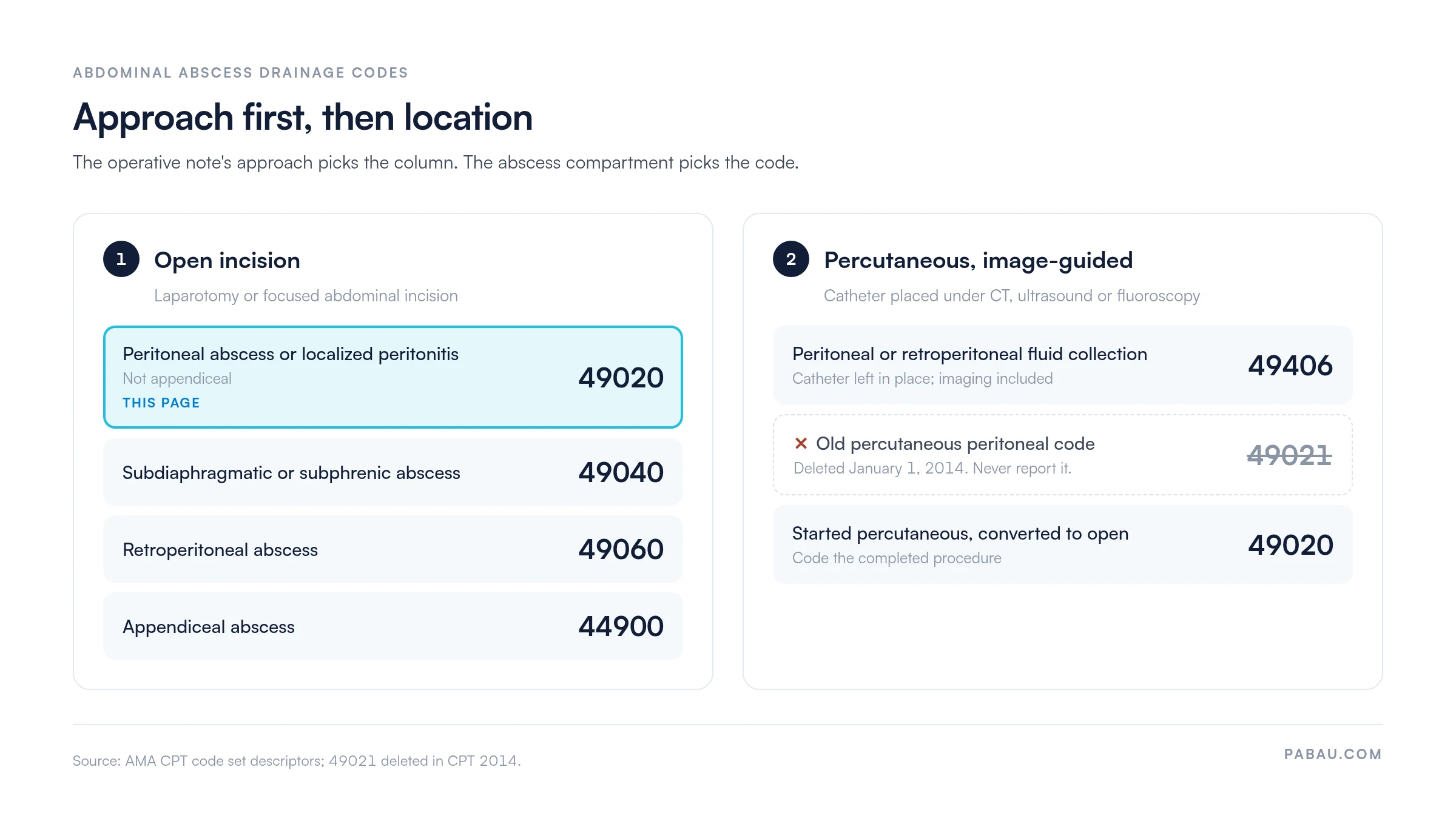
49020 covers open surgery. When the same peritoneal collection is drained by a catheter placed under imaging guidance, the code is 49406, which includes the imaging guidance.
Older references still cite 49021 for this work, but the AMA deleted 49021 on January 1, 2014. The approach at the time of service determines the code, regardless of what was planned.
When a planned percutaneous drainage converts to open surgery intraoperatively, 49020 is the correct code for the completed procedure. The operative note must document the conversion and the reason for it. Billing 49406 for a procedure that ended open misstates the service, and it exposes the claim to denial on review and to audit recovery later.
49060 is the code for open drainage of a retroperitoneal abscess. The boundary between the peritoneal and retroperitoneal spaces matters clinically, so the operative note must state it explicitly. Coders cannot determine the correct code from a discharge summary alone.
The operative note must state the anatomical location of the abscess clearly enough that a coder can tell peritoneal from retroperitoneal without calling the surgeon. If the report says “intraabdominal abscess” without naming the compartment, the coder must query before assigning a code. Read together, the two questions are approach first and location second, as the chart below sets out.
Modifiers attached to CPT Code 49020 affect payment directly. Using the wrong modifier or omitting one that the payer requires results in either underpayment or denial.
Modifier 22 is often appended to CPT Code 49020 after prior abdominal surgery or radiation. It also fits when several separate abscesses each need drainage in one operation. The documentation must show why the work was substantially greater than a typical 49020. Work that was merely different does not qualify.
49020 carries a 90-day global surgery period under CMS rules. Routine evaluation and management visits, wound checks, and uncomplicated drain management during those 90 days are bundled into the procedure payment. These services may be billed separately within the global period:
Modifier 79 covers an unrelated procedure during the global period. Modifier 58 covers a staged or related procedure planned at the time of the original service. Neither circumvents the global package for routine follow-up care.
Diagnosis-to-procedure code linkage is a clean claim requirement. The ICD-10-CM code must medically justify the CPT procedure being billed. Payers cross-reference the diagnosis against the procedure at the claim edit level. An incorrect or non-specific diagnosis code therefore triggers an automatic edit before human review begins.
K65.1 is the primary match for the vast majority of 49020 claims. Coders who default to K65.0 for every peritonitis case are over-coding the severity (generalized vs localized) and may trigger a medical necessity query. The clinical documentation should specify whether the infection is localized or diffuse.
CPT Code 49020 reimbursement under Medicare is calculated with the Relative Value Unit (RVU) system. The total combines a work RVU for surgeon time and skill, a practice expense RVU for overhead, and a malpractice RVU. That total is multiplied by the Medicare Conversion Factor to produce the payment amount.
For current 2026 figures, check the CMS Physician Fee Schedule lookup tool directly. Rates vary by location through the Geographic Practice Cost Index (GPCI). The FastRVU 2026 RVU lookup gives a quick national average estimate.
Commercial payers negotiate rates separately from Medicare. Many base contracted rates on a percentage of the Medicare Physician Fee Schedule, commonly 110-140% for surgical procedures. Verify those figures against the specific payer contract, and never assume commercial reimbursement equals Medicare rates.
49020 is an open surgical procedure, and many commercial payers require prior authorization before they will pay for elective or semi-elective abdominal surgery. Emergency presentations typically bypass prior auth, but the record must document the clinical urgency.
A planned procedure performed without required authorization cannot be appealed on the grounds that the surgery was clinically appropriate. The payer’s contract terms govern.
Medical necessity for CPT Code 49020 rests on three clinical pillars, each of which must appear in the pre-operative or operative documentation:
Understanding medical billing fundamentals at the practice level helps staff identify which payers require prior auth for 49020 before the surgery is scheduled. Build payer-specific authorization requirements into the scheduling workflow, not the billing workflow.
49020 denials cluster around four failure modes. Each has a predictable cause and a preventable fix.
An effective denial management workflow maps each denial code (CARC) back to the documentation or process failure behind it. Re-submitting without correcting the root cause brings the same denial back.
Track 49020 denials by payer, because edit logic varies from payer to payer. The payers that flag this code most often show where pre-submission QA should focus.
Our denial codes and fixes guide pairs each code with its corrective action. For clean claim submission, every 49020 claim should clear these pre-submission checks:
Run a quarterly audit of your CPT Code 49020 claims against the approach documented in operative notes. Open-versus-percutaneous errors tend to repeat, because one surgeon’s dictation habit affects every case they perform. Catching the pattern early prevents an OIG audit from catching it for you.
On a 49020 claim, the approach sits in the operative note, the authorization number in a payer portal, and the diagnosis in the chart. Re-keying all three into a separate clearinghouse form is how a catheter drainage gets billed as open surgery, or how K65.1 turns into K68.11.
Pabau, a practice management platform with insurance billing built in, keeps the patient record and the claim in one place. Its streamlined claims management sends CMS-1500/837P claims through the Claim.MD clearinghouse and checks eligibility before the date of surgery. The prior authorization code, its dates and its sessions sit on the patient’s case, with a warning when one is missing.
When the payer responds, the electronic remittance advice posts against the original claim. Your billing team sees the allowed amount and any adjustment on 49020 without reconciling it by hand. A denial then surfaces while the operative note is still fresh enough to correct.

Pabau sends surgical claims through the Claim.MD clearinghouse, checks eligibility before the date of surgery, and tracks prior authorizations on the patient’s case. See how it carries a 49020 claim from operative note to posted remittance.

The coding decision on 49020 gets made in the operating room, when the surgeon dictates the approach and the abscess compartment. A note that states both in plain words lets the coder assign the code without a query. A note that leaves either one vague hands the decision to a coder who was not there.
The change worth making first is a dictation template with the approach, the compartment, the volume drained and any conversion reason as required fields. It costs the surgeon a minute per case. In return, the wrong-code and wrong-compartment denials stop at the source, and so do claims that still carry the deleted 49021.
Pair that template with an authorization check at scheduling, and most of the remaining 49020 denials become administrative rather than clinical. Book a demo to see how Pabau carries that note through to a clean claim and a posted remittance.

Need a refresher on how clearinghouses process surgical claims? Medical claims clearinghouse guide explains how 837P electronic claims reach payers and what happens during the scrubbing process.
Confused about why your 835 remittance shows a different paid amount than the allowed amount? Claim.MD clearinghouse overview breaks down how remittance advice flows back from payer to practice.
Want to understand the full revenue cycle behind a surgical procedure claim? Revenue cycle management guide covers the end-to-end process from eligibility through final payment posting.
CPT Code 49020 describes open drainage of a peritoneal abscess or localized peritonitis, performed through a direct surgical incision rather than a percutaneous imaging-guided approach. The code sits in the “Incision Procedures on the Abdomen, Peritoneum, and Omentum” section of the AMA CPT Manual.
CPT 49020 is open surgical drainage of a peritoneal abscess. CPT 49406 is percutaneous image-guided catheter drainage of a peritoneal or retroperitoneal collection, and it replaced 49021 when that code was deleted in 2014. The approach used at the time of service determines the code. 49020 carries a 90-day global period, while 49406 carries a 0-day global period.
K65.1 (Peritoneal abscess) is the primary ICD-10-CM pairing for CPT 49020. K65.0 (Generalized acute peritonitis) applies when the infection is diffuse rather than localized. K68.11 (Postprocedural retroperitoneal abscess) should not be paired with 49020, because a retroperitoneal location maps to CPT 49060.
Modifier 22 applies when the procedure is substantially more complex than typical, such as with dense adhesions, multiple loculations, or a failed percutaneous drainage. Modifier 51 applies when 49020 is performed alongside another major same-day procedure. Modifier 59 applies when 49020 is distinct from a same-day service that would otherwise be bundled under NCCI edits.
The most common reason is wrong code selection: billing 49020 for a percutaneous catheter drainage that should have been 49406. Missing prior authorization for semi-elective cases and thin operative documentation follow. The fourth is an ICD-10 linkage mismatch, most often K68.11 (retroperitoneal) used instead of K65.1 (peritoneal).
Yes, CPT 49020 is a Medicare-covered surgical procedure when medical necessity is documented. Reimbursement is calculated using the Physician Fee Schedule RVU system, with rates varying by geographic location. Verify current 2026 rates directly via the CMS Physician Fee Schedule Look-Up Tool, as the Medicare Conversion Factor is updated annually.




